Questioner: Hi Tom, can you please explain verse 32 of Ulladu Narpadu (40 verses on Reality, a text written by Sri Ramana Maharshi)?
When the Vedas have declared, ‘Thou art That’ – not to seek and find the nature of the Self and abide in It, but to think ‘I am That, not This’ is want of strength. Because, That abides forever as the Self.
Sri Ramana Maharshi, Ulladu Narpadu, Verse 32
Tom: The idea is that we should turn within and discover what we truly are by inwardly and intuitively going towards the sense of ‘I’. When we go within in this way (this is also called self-enquiry) our mind becomes increasingly withdrawn and we start to discover, and eventually do discover, what we actually are: the formless, eternal, birthless, deathless Spirit that is devoid of objectivity, multiplicity, ego and suffering.
If instead of discovering what we truly are, we remain extroverted, sensing and perceiving objects and multiplicity, and merely repeat or think to ourselves ‘I am that’ or ‘all is already one’ or something like this, then we are fooling and deceiving ourselves, and we are weak and uncourageous, for we are not applying ourselves and developing true bravery or strength, which is turning within, away from the world, to discover our actual nature.
Tom: as usual my explanatory comments are inserted in italiscised red
Questioner: How long did it take Maharshi to realise the Self?
Bhagavan Sri Ramana Maharshi: This question is asked because the name and form are perceived. These are the perceptions consequent on the identification of the ego with the gross body.
Tom’s comments: Bhagavan Sri Ramana is stating that perception of name and form only occur after ignorance, ignorance being the notion that I am the body (or body-mind). This is consistent with his writing in ‘Who Am I?‘:
When the mind comes out (rises) from Self, the world appears. Therefore, when the world appears, Self will not appear; and when Self appears (shines), the world will not appear
Therefore, Sri Ramana is stating this question only is asked due to ignorance of taking Sri Ramana to be a person (ie. a body-mind entity) who at one time attained realisation, when in fact Sri Ramana is just the ever-realised Self, which is the only existent reality. That said, the fact that Sri Ramana gave out this teaching to this devotee in itself meant that the devotee was spiritually developed enough to receive this higher teaching.
If the ego identifies itself with the subtle mind, as in dream, the perceptions are subtle also. But in sleep there are no perceptions. Was there not the ego still? Unless it was, there cannot be the memory of having slept. Who was it that slept? You did not say in your sleep that you slept. You say it now in your wakeful state. The ego therefore is the same in wakefulness, dream and sleep.
Tom’s comments: Sri Ramana is stating that objects are seen in dream but not seen in deep sleep. In this instance he states that the ego is present in all 3 states of waking/dream/deep sleep and next he will say we are to find the reality that underlies these 3 states. When that is found, the 3 states are no longer present, he will say:
Find out the underlying Reality behind these states. That is the Reality underlying these.
In that state there is Being alone.
There is no you, nor I, nor he; no present, nor past, nor future. It is beyond time and space, beyond expression.
It is ever there.
Just as a plantain tree produces shoots at its roots, before yielding fruits and perishing, and these shoots, being transplanted, do the same again, so also the original primeval Master of antiquity (Dakshinamurti), who cleared the doubts of his rishi disciples in silence, has left shoots which are ever multiplying. The Guru is a shoot of that Dakshinamurti.
The question does not arise when the Self is realised.
The happier and more secure in ourselves we are, the more we are able to love others and receive love ourselves, the more able we are to deeply listen to others and be deeply present with others.
As we go towards the Absolute, the Subject, the Self, the Pure Consciousness that we ARE, the happier and more secure we become in ourselves, and the more loving and balanced we naturally are.
There are some who say no need to go towards the Absolute, or rather this is not so important, but instead loving each other is more important, being able to deeply listen to each other is more important, being able to deeply be present with someone is more important…
…not realising that the two are related, and that without going more and more towards the Absolute, either consciously or unconsciously, without more and more realising ourselves as THAT, we will be limited in our ability to give and receive love,we will be limited in our ability to deeply listen, to deeply receive, and to deeply be present with others.
When we ultimately discover ourselves as That Absolute, then all that is left is Love and Presence, giving and receiving become One, outside and inside disappear, and the thought of another as opposed to I or me also vanishes. There is only Eternal Love and Bliss.
Hence the most important thing, from a spiritual point of view, especially if you value kindness and love and deep listening and being present, is to go towards the Absolute and discover that Truth that we ARE.
When Jesus was asked what the most important commandment was, he said the most important was to love the lord our God with everything we have, (which I like to interpret as meaning to go towards the absolute and know your identity with that), and he said that the second most important commandment was to love each other. He did not say the most important commandment was to love each other, as I suspect he knew that we cannot love each other truly and fully unless we know our own Divine Nature as Absolute Love
Put simply, we are often told to love each other and be present with each other and be good to on another, but we are not told HOW we can love each other more or HOW we can be more present with each other.
The secret is to more and more know yourself as you truly are, ie. as Pure Formless Consciousness, as the Absolute.
Questioner: Tom, if you can, please can you summarise the basic essential teaching in a paragraph?
Tom: It cannot be fully put into words, but it is something like this: You are actually and already the One Infinite Divine Spirit whose nature is Eternal Happiness and Bliss.
You are not the body-mind at all, and thinking that you are is the prime illusion, or ignorance, that brings all suffering.
In order to discover this Truth (that is already the case, ie. it is a fact), one must turn away from all objective phenomena, including thoughts, feelings, etc, and intuitively go towards the I AM and discover this for oneself. Cultivating a spirit of love, happiness, affection and devotion can be a great help in this endeavor.
The reason we must turn away from all objects is that in attending to various objective phenomena the notion ‘I am the body-mind’ is perpetuated. This is very important to understand and realise. Only when we turn away from objects, either intentionally or spontaneously/by grace, is there a possibility of Self-Realisation. Otherwise we remain trapped in the (false) beliefs ‘I am a body-mind or person’ and ‘the world is real’.
Once we realise the Self, there is no need to integrate this understanding into daily life or anything like that, as Self-realisation is not an understanding for the mind, and in Self-realisation, all duality ceases: there is no entity left to integrate, no understanding or knowledge to integrate, and nothing left to integrate with. There is only the Infinite Blissful Self.
Teachings, such as those that talk about being adverse to the world, and all genuine spiritual teachings in fact, are just there to encourage and facilitate this discovery, and the form the teaching takes depends on the context in which they are given, including where the apparent seeker is at.
It is not about being some block of wood (a body-mind) that is detached and cut off, but about discovering something, the only thing, that is true and real – your True Nature, your Self.
This discovery is truly the most wonderful ‘thing’. (It is not a thing)
This discovery is not for or by the body-mind (or ego) at all, but is ‘by the Self’ so to speak…here words fall short, but poetically we say the Self itself discovers or realises the Self.
Hope that makes sense
Thank you
(much longer than a paragraph, I know!)
Questioner: can you support the above teaching you have given using authoritative quotes from Sri Ramana Maharshi or the Scriptures?
Tom: yes, sure, if you carefully read this article here, you will see all these above points mentioned and backed up by quotes from Sri Ramana Maharshi. The only point not backed up by quotes in that article is about not needing to integrate the teachings after realisation/liberation, for more on that see here. For quotes from the Vedanta scriptures see here.
There are many teachings and paths (as well as ‘non-paths’) that can be part of our journey to liberation. Whist we each all have our own unique spiritual journey, there are two broad categories of mistakes to avoid if you are genuinely looking for liberation.
Moreover, understanding just these two basic errors or distortions of spiritual teachings also allows us to understand multiple other distortions of the teachings that can occur, and this can save us much time on our spiritual journey, as is explained below.
I will also explain at the end of this article which of these 2 distortions is the most important for you as a seeker.
If you are NOT interested in liberation, then understanding these distortions become less important, and you can simply enjoy whichever teaching or path you want to.
But if you ARE interested in liberation, also known as Self-Realisation, Nirvana or becoming One with God (ie. yoga), then here are the two key ways in which liberating teachings are distorted or modified to make them non-liberating.
Why do these distortions of spiritual/liberating teachings occur?
Before we get to the 2 main distortions, why do these occur in the first place? Why would a liberating teaching be distorted into a non-liberating teaching?
Essentially truly liberating teachings, which are actually within us non-verbally always, when put into words, may sound irrational or unnecessary for the mind. Or the ego-mind may not be able to accept what the truly liberating teaching is saying, or the mind ego-may think that it knows what the liberating teaching is actually trying to say – and so the teaching is distorted accordingly.
Because the ego-mind cannot really know what the teachings are pointing to, when it hears the teaching, it naturally is prone to misinterpreting the teaching and misrepresenting the teaching. Even if it has the best of intentions, the ego-mind will often wrongly understand the nature of the True Teachings.
There are so many ways the teachings can therefore be distorted by the ego-mind, but they tend to fall into one of these two camps, that I will outline below.
A warning
When the ego-mind first hears a true teaching, meaning a truly liberating teaching, the first thing it tends to do is spew out dozens of thoughts, ideas and beliefs, that oppose that teaching, giving reasons why the teaching given is not true. This is because the ego-mind does not want to end in most cases, and often prefers to remain comfortable in what it thinks it knows. The ego is attached to its life and its things and typically doesn’t want to let these things go.
Therefore when reading the below, please bear this in mind. To give yourself the best chance of receiving these teachings, try to suspend your own judgements that may arise and instead read the teachings with an open and inquiring mind.
If you find the teachings below difficult to palate, it is probably your ego and its attachments kicking up a fuss and objecting!
You are, perhaps, attached to your life and your things – that is ego of course. You need to be radically honest with yourself here to see if this is true for you…
False teachings are not necessarily ‘bad’, they are just non-liberating
Many teachings can be helpful to us on our journey, and teachings that we now may consider to be false, may have served as a useful ‘stepping stone’ to where we are now. So false or distorted teachings may be useful to us at times, and are often part of our (apparent) journey. ‘False teachings’ or ‘distorted teachings’ here just means teachings that do not ultimately by themselves lead to liberation.
Guru Vachaka Kovai (Garland of Guru’s Sayings)
Throughout this post I quote extensively from the text Guru Vachaka Kovai (which you can download from this link) a collection of teachings from Sri Ramana Maharshi. It is widely accepted that the text Guru Vachaka Kovai presents the most precise, systematic and authoritative exposition of Sri Ramana Maharshi’s verbal teachings; Here is what Ramana Ashram states about the Guru Vachaka Kovai in the foreword of their publication of it:
‘[Guru Vachaka Kovai] provides the most precise, systematic and authoritative exposition of Sri Bhagavan’s teaching, explaining step by step the theory, the practice and the experience of jnana, the Truth supreme which is Being as Life Eternal, Pure Awareness, Perfect Bliss. Thus, the most comprehensive collection of the Maharshi’s sayings is Guru Vachaka Kovai.’
The 2 main ways the teaching is distorted
1. Not turning within
The first and most common distortion of spiritual teachings that prevents them being truly liberating teachings is that they do not advocate turning inwards to discover the Truth or Essence of what you truly are. They do not advocate turning within. They do not advocate turning away from gross objects (eg. tables, cars, stars, planets) and subtle objects (eg. thoughts, feelings, states of consciousness, experiences) and discovering the nature of the Subject or I Am.
Here are some quotes for you demonstrating this important part of the path. Unless stated otherwise, the quotes are Sri Ramana Maharshi’s teachings from the text Guru Vachaka Kovai:
291. If one wants to be saved, one is given the following true and essential advice: just as the tortoise draws all its five limbs within its shell, so one should draw the five senses within and turn one’s mind Selfward. This alone is happiness.
One who is able to fully withdraw the senses from their objects, just as a tortoise withdraws its limbs into its shell, is established in Divine Knowledge (Bhagavad Gita, Chapter 2, verse 58)
293. Know that these countless things are pictures in a dream and none is real apart from the beholder. Shun this phantom world of names and forms and dwell in the pure, blissful being of Awareness.
By expelling (from the mind) without any remainder all objects which are superimposed on one’s Atma, one becomes himself Parabrahman the full, the secondless and the actionless (Adhyatma Upanishad 1.21)
293. Having known for certain that everything which is seen, without the least exception, is merely a dream,and that it [the seen] does not exist without the seer, turn only towards Self – Sat-Chit-Ananda – without attending to the world of names and forms, which is only a mental conception.
391. Those who do not dive into the Heart and there confront the Self in the five sheaths hid are only students answering out of books clever questions raised by books, and not true seekers of the Self.
186. O miserable and extroverted people, failing to see the seer, you see only the seen!To dissolve duality by turning inwards instead of outwards is alone Blissful.
After knowing that by which you know this world, turn the mind inward, and then you will realise the effulgence of the Self. (Yoga Vasishta)
Strenuously withdrawing all thoughts from sense objects, one should remain fixed in steady, non-objective [ie. subjective] enquiry. This, in brief, is the means of knowing one’s own real nature; this effort alone bring about the sublime inner vision. (Sri Ramana Maharshi, Sri Ramana Gita)
So long as all objects are not renounced, the Self is not won. What remains after the renunciation of the entire objective manifold is said to be the Self. Therefore, in order to realize the Self, renounce everything. Having cast off all (objects), assimilate yourself to that which remains. (Annapurna Upanishad 1.45-1.46)
The Lord created the senses out-going: therefore, one sees outside and not the Self within. Some intelligent man, with his senses turned away (from their objects), desirous of immortality, sees the Self within. (Katha Upanishad 2.1.1)
In his commentary on this above verse (Katha Upanishad 2.1.1), Shankara writes:
‘…the perceiver sees the external objects which are not-Self/not the Atman, such as sound, etc., and not the Self within. Though this is the nature of the world, some (rare) discerning man, like turning back/ reversing the current of a river, sees the Self within…The group of sense organs, beginning with the ear, should be turned away from all sense-objects. Such a one, who is purified thus, sees the indwelling self. For it is not possible for the same person to be engaged in the thought of sense-objects and to have the vision of the Self as well.‘
647. If you refrain from looking at this or that or any other object then by that overpowering look into absolute Being you become yourself the boundless space of pure awareness which alone is Real Being.
420. The knowledge that ignores the Self, the Knower, and holds as true the field perceived, is but illusive folly…
Dwelling on external objects will only increase evil propensities, so wisely recognising this fact, one should abandon external objects and and constantly attend to one’s true nature within, the Atman [the Self]. (Shankara, Vivekachudamani)
One whose intellect has been withdrawn from all objects, gross and subtle, when this takes place, this is known as ‘inactivity of the sense organs’. Though this ‘inactivity of the sense organs’ one sees that glory of the Self. ‘Sees’ means he directly realises the Self as ‘I am the Self’ as thereby becomes free from suffering’ (Shankara in his commentary on Katha Upanishad verse 1.2.20)
– But how far within do we need to turn?
Sri Ramana Maharshi tells us in Guru Vachaka Kovai:
877. Only when the world-illusion goes does the blissful light of Self arrive. Life lived in this bright, blissful light is our true, natural life. Other ways of life are full of trouble and fear.
193. When the mind [i.e., the ego’s attention] which wanders outside, knowing only other objects [2nd and 3rd persons] – begins to attend to its own nature, all other objects will disappear, and then, by experiencing it’s own true nature [i.e. Self], the pseudo-‘I’ will also die.
Sri Ramana Maharshi also gives definitive teachings in the text he wrote called ‘Who am I?‘:
Q. When will the realization of the Self be gained? A. When the world which is what-is-seen has been removed, there will be realization of the Self which is the seer.
Q. Will there not be realization of the Self even while the world is there? A. There will not be.
Just as the knowledge of the rope, which is the base, will not be obtained unless the knowledge of the snake, the superimposition, goes, so the realization of Self (swarupadarsanam), which is the base, will not be obtained unless the perception of the world (jagat-drishti) which is a superimposition, ceases.
Therefore, when the world appears, Self will not appear; and when Self appears (shines), the world will not appear.
And
If, on the contrary, you withdraw your mind completely from the world and turn it within and abide thus, that is, if you keep awake always to the Self, which is the substratum of all experience, you will find the world, of which alone you are now aware, just as unreal as the world in which you lived in your dream. (Sri Ramana Maharshi, Maharshi’s Gospel)
The Upanishads and other traditional scriptures give us the same teaching:
The mind severed from all connection with sensual objects, and prevented from functioning out, awakes into the light of the heart, and finds the highest condition. The mind should be prevented from functioning, until it dissolves itself in the heart. This is Jnana, this is Dhyana, the rest is all mere concoction of untruth. (Amritabindu Upanishad)
As long as the objective universe is perceived one does not realise the Self. (Yoga Vasishta)
When the five organs of perception become still, together with the mind, and the intellect ceases to be active: that is called the Supreme State [Brahma-Vidya or Self Knowledge] (Katha Upanishad 2.3.10)
Shankara’s commentary on this above verse (Katha Upanishad, verse 2.3.10) states the following:
‘At the time when the five senses…, together with the mind…, which is now no longer functioning and thinking, are at rest in the Self alone, after turning away from objects, and with the intellect…no longer engaging with its functioning, that they call the highest state [Brahma-Vidya or Self-Knowledge].’
The Self (Atman) is beyond all expression by words beyond all acts of mind; It is absolutely peaceful, it is eternal effulgence free from activity and fear and it is attainable by Samadhi (Gaudapada, Mandukya Upanishad Karika 3.37)
Shankara’s commentary from the above verse from Gaudapada 3.37 states:
…The Self (Atman) is denoted by the word Samadhi as it can be realised only by the knowledge arising out of the deepest concentration (on its essence), Samadhi. Or the Self (Atman) is denoted by Samadhi because it is the object of concentration, the Jiva concentrates his mind on the Self (Atman)…
In the next verse Gaudapada writes in verse 3.38 of his Mandukya Karika:
There can be no acceptance or rejection where all mentation stops. Then knowledge is established in the Self and is unborn, and it becomes homogenous
Shankara’s commentary on this verse 3.38 is as follows:
…therefore there is no rejection or acceptance in It, where thought does not exist. That is to say, how can there be rejection or acceptance where no mentation is possible in the absence of the mind? As soon as there comes the realisation of the Truth that is the Self, then, in the absence of any object, knowledge (Jnanam) is established in the Self, like the heat of fire in fire. It is then birthless (ajati) and becomes homogenous.
-Objections to turning within and further reading:
I have written many post that deal with the common objections to this teaching. See these posts and the introductory articles on the homepage of tomdas.com which talk more about this aspect of the path:
2. Turning back outwards (eg. to reintegrate with the body-mind/world)
If the first pitfall on the journey wasn’t controversial enough, this second pitfall is often very difficult for seekers of liberation to understand. After all, it only seems right that after liberation we should once again embrace world and integrate our realisation, fully embodying and expressing our new-found wisdom. ‘Before enlightenment chop wood carry water, after enlightenment chop wood carry water‘, and all that. (Note that this teaching about ‘chopping wood…’ was never present in the original chan/zen teaching but is a later distortion we only see many centuries later).
But this is all stuff of the ego-mind, well kind-of.
When we turn within to discover ourself, we must keep on sinking inwards, back back back, deeper and deeper, until we discover what we truly are. When that is done, THAT’S IT. THAT’S THE END OF THE JOURNEY.
But don’t you have to then integrate this understanding into daily life? No. If you have to integrate your understanding with daily life then that just means you have not yet discovered the Self, what you truly are.
Only whilst we are seeking, that is, only whilst we remain (apparently) in ignorance do we need to integrate and incorporate spiritual truths with our daily life. With liberation, there is no more daily life, there is no choice or duality, there is no more suffering or learning, although it may seem that way to ‘others’ – but in liberation there are no ‘others’!.
Integrating the teachings into daily life is only for the ego (separate self/jiva/person)
Only the ego/mind/person/jiva needs to or even can turn back out towards the world
When you have discovered the Self, then ‘you have achieved all there is to achieve’ (please forgive the goal-orientated language). Nothing else is thereafter required (nor is anything else possible!).
See these 3 quotes here, all teachings of Sri Ramana Maharshi taken from the text Guru Vachaka Kovai:
630. Having felt the sun’s fierce heat the wise one tarries in the shade, and those who know the triple fire raging in the world will never leave the Heart and turn again towards the world
949. Those who with ego dead have gained Being, transcending bliss, have nothing further to attain, no effort to be made, no deed to do, for life’s fulfilment they have reached.
950. When one abides in one’s true state as effortless Eternal Goodness one has no further work to do. All deeds accomplished, such a one enjoys the perfect peace of bliss.
1238. Siva, who is Pure Awareness transcending thought, is only known to seers heroic who with minds extinct abide thought-free within the heart, and not to those whose minds are still engaged in thought.
Also Sri Ramana Maharshi’s teachings are recorded in Sri Ramana Paravidyopanishad:
411. Whoever obtains awareness of the real Self, for him this worldly life comes to an end. The others continue to wander here as before, remaining without awareness of the real Self.
554. These men do not know the truth of the transcendental state beyond time, in which the world has not come into being. Non-duality has neither beginning nor end. Duality, with space and time, is unreal, always.
569. In that state doubts do not arise since the sage is ever firm in his awareness of the true Self. There he remains without affirmations and vacillations, immersed in the depths of peace, the mind having become extinct.
585. By the dawn of right awareness of the real Self, the ego, the root cause of the appearance of forms, has been lost. Therefore for the sage, all forms are unreal, and hence this talk of forms is foolishness.
Question: How long should self-inquiry be practised? Sri Ramana Maharshi: As long as there are impressions of objects in the mind, so long the inquiry “Who am I?” is required.
Now I haven’t spent too much time here in this post explaining why this is the case, and answering all the questions that can arise from this. These above verses in this section are taken from this post which explains some of the reasoning behind these teachings further. The post also provides more quotes from Shankara and other teachers of this path as well as further explaining the need to turn within in more detail. Even more detail is given in the posts below.
Also see this post which explains how a Jnani can function given the above:
Other ways of formulating the 2nd mistake/distortion
This second distortion of the teaching, which I have formulated above as turning back out towards the body-mind-world once the self has been ‘realised’, can present in various different ways.
– ‘Liberation is only the beginning’
One example is the (false) teaching that ‘liberation is only the beginning’ or ‘self-realisation is only the beginning’. Again, if self-realisation is ‘only the beginning’, then that simply means that the self has not truly been realised. Self-realisation is the end, the final destination, the terminus of the spiritual journey. No sense of individuality or multiplicity or duality remains with liberation, as Sri Ramana taught:
‘Since multiplicity is experienced only in the state of ignorance, it is declared to be unreal’ (Sri Ramana Paravidyopanishad, verse 89)
and
“The mukta [liberated sage] like the rest of us perceives the world in all its vast variety and yet he sees non-difference in it”, so people say. This is not true.” (Sri Ramana Maharshi, Guru Vachaka Kovai, verse 931)
(ie. the idea that the liberated sage still perceives differences ‘like the rest of us’ but perceives an underlying unity despite various objects being seen is here being refuted.)
– ‘Constant unfolding’
‘Another way this false teaching can be expressed is to say ‘there is a constant unfolding of life after liberation’, or words to this effect. Constant unfolding means attention is on the changing objects, which are actually illusion, duality, also know as Maya (illusion; the literal meaning of ‘maya’ is ‘that which does not exist’).
Now even someone who is truly realised can say something like ‘life just unfolds by itself in liberation’, in order to explain liberation to someone who is not ready for the ultimate truth, but from an ultimate point of view (which is the only true point of view), this is also fiction.
In liberation, no illusion remains, no objects, no unfolding, no multiplicity, no duality. Let us read Sri Ramana Maharshi’s teachings as found in Guru Vachaka Kovai:
1089. Life you desire. But how to live you know not. Thinking that this sinking deep in this void, vain, illusive waking-dream is “life”, you proudly claim you “live”. Pierce this illusion, go, grasp the Truth, eternal life.
1095. Such a life of Grace alone Is life lived in full, real Being. This worldly life of false phenomena full of fear is sinking deeper in illusion, not authentic living.
1096. Those whose five senses turn no longer towards the world which once seemed real, those who have learned to live without their minds being moved by the illusive universe of forms, they need perform no penance.
131. Those who enjoy the ego’s life of false phenomena perish and die. The state of grace, supreme Awareness, the life lived in Self-Being, this alone is bliss worth seeking.
238. Knowing well that bliss serene is found in being the Self alone, and not in this illusory life, seek and attain the final heaven of grace, the state of Mouna [Silence], Pure Awareness.
360. Natural, unbroken, ever present, all maya gone, as strength of heart shines the pure I of muktas [liberated ones] seen in acts without the slightest trace of doership.
– Isn’t this rather bleak and life-denying?
At some point you may say this sounds rather bleak, rather life-denying. Of course, this is not the case at all. This is a wonderfully positive teaching when correctly understood, the most positive thing possible, in fact.It is everything you are truly looking for.
Most seekers of liberation, especially at the start of their journeys, want liberation but also want to enjoy life, just without the bad bits, and have the good bits only. Their concept of liberation may be something like ‘in liberation/realisation, everything just flows beautifully, like white silk sheets gently and peacefully floating on the wind’.
The issue is that in life (ie. in maya, the dream of being a body-mind living in a world), these white silk sheets always eventually touch the muddy ground. In Maya we always identify with a body-mind, and travel in a polar world, bouncing between the opposites of pleasure and pain, creation and destruction, life and death, suffering as we do so.
Eventually we come to realise there is no happiness whatsoever in the worldly objects, all happiness only coming from our very own Self, and that to find true everlasting happiness we must turn within and discover what we truly are:
Not in one single thing on earth can happiness be found. How could the muddled mind delude itself and think that happiness can be derived from objects in this world? (Sri Ramana Maharshi, Guru Vachaka Kovai, verse 78)
Only when the world’s allurement is lost will true Liberation be possible. Hence, to try to foist reality upon this world is to be just like an infatuated lover who tries to foist chastity upon a prostitute.(Sri Ramana Maharshi, Guru Vachaka Kovai, verse 74)
Coming back to the original question in this section, doesn’t this sound very bleak and life-denying? Well from the point of view of the ego or mind it does sound bleak and life-denying, but actually it is what we are truly looking for. Here Sri Ramana confirms that we are to give up the entirely of Maya and all it’s pleasures, but what we gain in return is far greater. It is in fact a wonderful bargain, trading suffering-ridden illusion for the eternally blissful and fulfilling reality:
What does one gain, you well may ask, by giving up the wealth immense of worldly pleasure and seeking only mere Awareness? The benefit of true Awareness is the unbroken prevalence of peace within the heart, the bliss of one’s own natural being. (Sri Ramana Maharshi, Guru Vachaka Kovai, verse 77)
Only mad folk perplexed because they deem the false world to be real find joy in this illusion. The truly wise find joy in nothing but Awareness which is Being. (Sri Ramana Maharshi, Guru Vachaka Kovai, verse 75)
– ‘Suffering does not fully end’ or ‘all suffering does not end’
Here we have another false teaching, namely that suffering (or ego) in some form continues in liberation. The Buddha taught that in nirvana, liberation, suffering ends once and for all. The Buddha said being born is suffering, illness is suffering, growing old is suffering and death is suffering, the implication being that all of these end in liberation. Liberation is truly something unfathomable (for the mind)!
Isn’t that what all the teachings say – that liberation is unfathomable, ineffable? But yet how we sometimes struggle when we cannot in our minds understand the nature of liberation! The following are Sri Ramana’s teachings from Guru Vachaka Kovai:
953. Our real Being, the Sun that never can see the darkness of illusion, knows no trace of pain or suffering.
954. Blissful, auspicious is the Self, our real Being. One who knows this sees in life no trace of suffering or pain
956. The goal, the Truth, is Self-Awareness. Reaching it is annihilation of the painful illusion of birth.
1067. As the pearl-fisher single-thoughted, weighted with a stone, dives deep into the sea and grasps the pearl most precious, and rejoices, dive into the Heart with stern vairagya [dispassion for sense objects], gain the Self-treasure, and so end all suffering and sorrow.
– The ego continues in some form after liberation
As I hinted above, saying that suffering continues in some form after liberation is the same as saying that the ego continues in some form after liberation. This too, of course, is a false teaching. In liberation, the ego ends once and for all, the ego defined as being the sense ‘I am the body’ or ‘I am a limited body-mind entity’:
225. Unfailing immortality accrues only to those who have destroyed the ego
133. He, who by questing inward for the Knower, has destroyed the ego and transcended so-called knowledge, abides as the Self. He alone is a true knower, not one who has not seen the Self and therefore has an ego still.
161. When ego ends, then one becomes a devotee true; when ego ends, one becomes a knower too; when ego ends, one becomes Being supreme. When ego ends, grace fills all space.
174. In meditation deep, while yet a trace of ego lingers, fear and trembling may sometimes occur. But when the ego dies at last in Pure Awareness, quaking stops. Stillness alone prevails.
– Adding to the teaching, taking away from the teaching
The last way I will mention here that the teachings can be distorted is either by adding to the teaching or taking things away from the teaching.
Adding to the teaching includes false teachings like: ‘yes, Self- enquiry is the way, but self-enquiry is very difficult and only for the few. Here are some things you have to do before self-enquiry [and then go into detail about preparatory exercises]’
Here the principle teaching of self-enquiry is acknowledged, but extra teachings are added prior to the teaching.
Another example of adding to the teaching is this: ‘Yes, we must turn within and discover the self, but then we must thereafter turn towards the world in order to reintegrate the teaching into daily life’. As we have already discussed (this is the 2nd of the main two mistakes discussed above), this is a distortion of the teaching, but here the principle teaching of turning within has been acknowledged, but the addition of a 2nd step to be performed after has been inserted, and this equally distorts the teaching.
An example of taking away things from the teaching is by stating: ‘yes, turning within is a very good way, but we don’t have to do that. Here is an even better way that doesn’t involve turning within at all…’.
Gere the primary teaching of turning within has been acknowledged, initially at least, but then it is later ‘superseded’ and so taken away in the subsequent (false) teaching that has been given. Of course the initial acknowledgement of the principle teaching may not be there, this being just an example of how teachings can be distorted.
Further characteristics of false or non-liberating teachings, and further questions/objections answered:
I have compiled a list of videos which you can watch on this topic here:
Also see this link and the links cited therein to better understand the above teachings – the links in the following post go to some way in explaining many common objections and questions you may have:
IMPORTANT: Of these 2 mistakes, which is more important to note?
The first mistake is the key one, and therefore the teaching emphasised by all true spiritual teachings is to turn within. Sometimes this is expressed as the need to meditate deeply or enter deeply into Silence or Stillness. If this is done properly and until the end, then the second mistake of coming back to the body-mind-world will naturally not occur. So even if you do not agree about my 2nd pitfall above, as long as you turn within and truly discover your self, you will be fine.
This is also why great sages like Sri Ramana Maharshi, whilst they taught correctly about both points above, they emphasised turning within, for they knew that once we have done that properly, all will be well. As Sri Ramana stated in his text ‘Who Am I?’:
Question: How long should self-inquiry be practised? Sri Ramana Maharshi: As long as there are impressions of objects in the mind, so long the inquiry “Who am I?” is required.
I hope you find this information useful and helpful
We have started playing this at the beginning of our satsang meetings for people to chant along to if they wish to.
Let this take you to your Source, with heart-melting love and devotion for Bhagavan Sri Arunachala Ramana, also known as Sri Ramana Maharshi, the True Guru, your own very Self 🙏🙏🙏
🙏 Om Namo Bhagavate Sri Arunachala Ramanaya Om 🙏
Created by volunteers/ devotees of Sri Ramana Maharshi
Vocals by Tom Das Video by Demetrius Fuller Produced by Gordon Sinclair
Tom: Here in Shankara’s introduction to his commentary on the Mandukya Upanishad and his commentary on Sri Gaudapada’s Karika (ie. Sri Gaudapadas commentary on the same Mandukya Upanishad), Shankara explains some fundamental teachings of vedanta which may (or may not) suprise you!
Throughout, Shankara’s writings are in black whilst my comments are in italicised red.
Shankara gives these same teachings throughout his commentaries, eg. in the Brihadaranyaka Upanishad but also in many other places too. However these teachings are often missed, glossed over or re-interpreted by many current so-called traditional teachers of Vedanta.
The following translation is my own, and I have simplified the language to aid understanding. Below I have also provided the PDF of a more literal translation of this commentary by Shankara on the Mandukya Upanishad from Swami Gambhirananda of Advaita Ashrama (this is the translation that I recommend as it is the most literal of the available translations in English, and so has the smallest amount of distortion and re-interpretation according to the prior beliefs and prejudices of the translator) which you can also read, which states the same as my translation but perhaps using more complex and at times archaic language.
Shankara’s Introduction to his commentary on Mandukya Upanishad
Translated by Tom Das
Invocatory Mantra
Om! O gods, may we hear auspicious words with the ears; while engaged in sacrifices, may we see auspicious things with the eyes; while praising the gods with steady limbs, may we enjoy a life that is beneficial to the gods.
May Indra of ancient fame be auspicious to us; may the supremely rich and all-knowing Pisa, god of the earth, be propitious to us; may Garuda, the destroyer of evil, be well disposed towards us; may Brihashpati ensure our welfare.
Om! Shanti! Shanti! Shanti! (Om! May there be peace! May there be peace! May there be peace!)
Tom: Some say that the Mandukya Upanishad, which is the smallest of the Upanishads consisting only of 12 verses, has no mention of God within it. They clearly have not read the invocatory verses above! Devotion and worship has always been a part of the nondual tradition of Vedanta. Below Shankara will provide 2 more invocatory verses that he has written:
Invocation by Shankara
I bow to that Brahman, which after having enjoyed the gross objects [in the waking state], by pervading all the worldly objects through a diffusion of Its rays of unchanging consciousness that embraces all that moves or does not move; Which after having ‘drunk’ [during the dream state] all the variety of objects, produced by desire and lighted up by the intellect, And sleeps [in the deep sleep state] while enjoying bliss and making us enjoy through Maya; and which is [in liberation] counted as the Fourth from the point of view of Maya, and is supreme, immortal, and birthless.
Tom: Shankara in his first invocatory verses states that liberation, or Turiya, is called the Fourth state, but that this is only from the point of view of Maya (or ignorance), which admits of the 3 states.In true liberation, the 3 states, which are superimpositions on the Self, do not exist in any way shape or form, so Turiya is actually the Singular Reality and not the Forth state at all. This is explained in more detail later in the text by both Shankara and Gaudapada, and Shankara also explains this in more detail here in the text he wrote called Upadesa Sahasri.
The structure of Shankara’s invocatory verses also mimics the structure of the actual Mandukya Upanishad, which first explains the nature of the 3 states of waking, dream and deep dreamless sleep, before lastly explaining the nature of liberation (see verse 7 of the Mandukya Upanishad here), also known as the Self or Turiya, Turiya literally meaning ‘the fourth’ in Sanskrit. Let us continue with Shankara’s second invocatory verse:
May that Fourth one protect us which, after having [in the waking state] identified Itself with the universe, enjoys the gross objects created by the merits (and demerits) of past deeds; After having [in the dream state] experienced through its own light the subtle objects of enjoyment that are called up by its own intellect; Which [in deep sleep] withdraws promptly all these into Itself; and which lastly [in liberation] becomes free from all attributes, by discarding every distinction and difference [ie. by discarding all phenomenal appearances/objects].
Tom: the implication is that in liberation, there are no appearances of any objects, for these have been cast out, and that the appearance of any objects is tantamount to duality. This is further explained below. Let us read Shankara’s introduction to both the Mandukya Upanishad and to Gaudapada’s Karika:
Introduction to the text by Shankara
The word [or letter] Om is everything [idam sarvam, literally meaning ‘all this’ or ‘all things’]. This will all be explained in the rest of this following text.
The four chapters of Sri Gaudapada’s commentary on the Mandukya Upanishad, that sum up the quintessence of Vedanta, starts with the phrase ‘The word Om is everything…’. Because Gaudapada starts with this phrase, the stated aim and purpose of this text, which we would usually state at the start of any text on Vedanta, should be obvious and need not be stated here. Clearly the aim and purpose of the text is the unfolding of Vedanta.
However, as I am giving a commentary here, I should briefly state the purpose of the text. The text, as it explains the spiritual disciplines that lead to a desired goal, will naturally have an aim and subject matter.
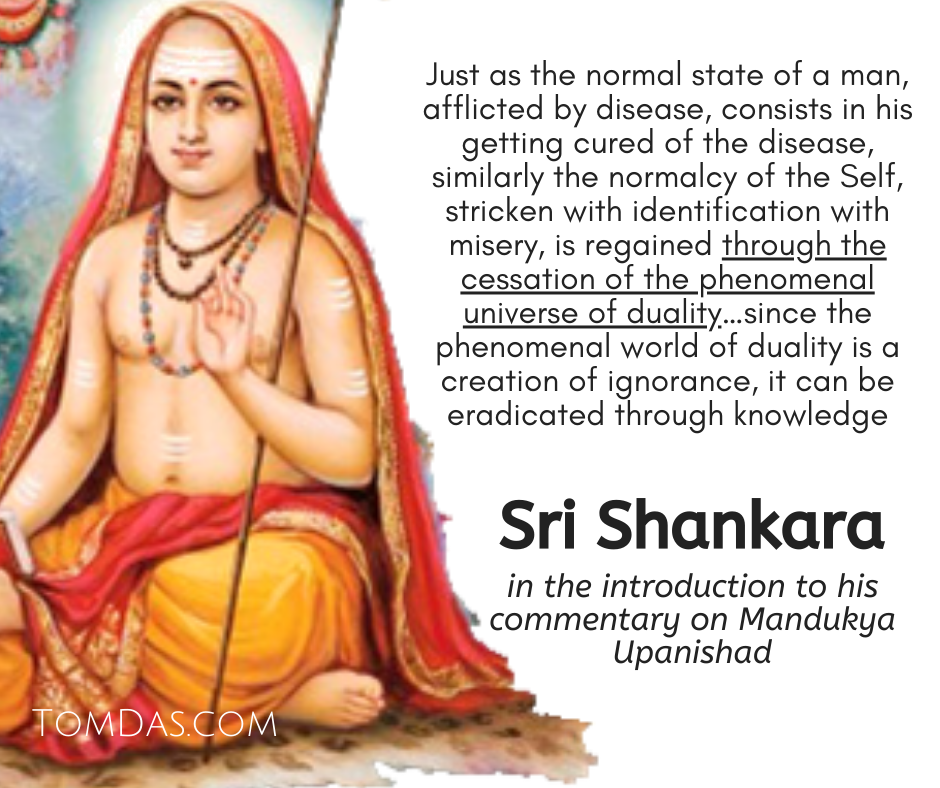
What is the aim of the text? Let me explain: just as a healthy person afflicted by disease will seek a cure for the disease in order to regain the natural state of health, the natural state of being the Self, when afflicted by suffering, will be returned to its ‘natural state of health’ through the cessation of the phenomenal universe of duality.
The aim therefore is the realisation of non-duality. Since the phenomenal world of duality is a creation of ignorance, it can be eradicated through knowledge.
Hence this text aims to reveal the knowledge of Brahman.
Tom: Shankara here is stating that the entire phenomenal world is a creation of ignorance, and that it needs to be eradicated for liberation to occur.This eradication of the phenomenal world can be attained through knowledge of Brahman, which is the same as liberation. The exact nature of knowledge of Brahman is explained later in this commentary here and how to attain this knowledge is explained by Gaudapada here and here.
Compare to Sri Ramana Maharshi when he says in the text Guru Vachaka Kovai in the following verses:
23. The Realised, who do not know anything as being other than Self, which is absolute Consciousness, will not say that the world, which has no existence in the view of the Supreme Brahman, is real.
28. O aspirants who hide yourselves away fearing this world, nothing such as a world exists! Fearing this false world which appears to exist, is like fearing the false snake which appears in a rope.
35. Since this world of dyads [knower-known] and triads [perceiver-perceiving-perceived] appears only in the mind, like the illusory ring of fire formed [in darkness] by whirling the single point of a glowing rope-end, it is false, and it does not exist in the clear sight of Self.
[Tom: The illusory ring of fire is a metaphor that Gaudapada himself uses throughout Chapter 4 of Gaudapada’s Karika].
87. Self appearing as the world is just like a rope seeing itself as a snake; just as the snake is, on scrutiny, found to be ever non-existent, so is the world found to be ever non-existent, even as an appearance.
Also compare also to Sri Ramana Maharshi when he writes in the beginning few paragraphs of his work entitled ‘Who Am I?’:
Q. When will the realization of the Self be gained? A. When the world which is what-is-seen has been removed, there will be realization of the Self which is the seer.
Q. Will there not be realization of the Self even while the world is there? A. There will not be.
Shankara will now justify his assertions by quoting from the highest scriptural authority in Vedanta, the Upanishads, let us see:
This fact is established by such Vedic texts as:
‘Because when there is duality, as it were, then one-smells something, one sees something…’ and so on (Brihadaranyaka Upanishad II. iv. 14);
‘When there is something else, as it were, then one can see something, on can know something’ (Brihadaranyaka Upanishad IV. iii. 31);
‘But when to the knower of Brahman everything has become the Self, then what should one see and through what? What should one know and through what?” (Brihadaranyaka Upanishad II. iv. 14).
Tom: we can see that Shankara is providing 3 quotes from the Brihadaranyaka Upanishad to back up this assertion, namely that appearances in the world, or perceiving things (apparently) through the senses, is the same as duality, and that all perceptions of the sense organs and all knowledge in the mind ceases with liberation. Now Shankara will summarise the contents of the 4 chapters of Gaudapa’s Karika (commentary) on the Mandukya Upanishad:
That being so, the first chapter explains the meaning of Om based on the traditional teachings [of Vedanta] and helps us to attain the reality that is the Self.
The second chapter aims to rationally prove the unreality of that phenomenal world of duality, on the cessation of which non-duality is attained, just as the reality of the rope is known on the elimination of the illusion of a snake imagined on it.
Tom: Shankara is again stating that non-duality or liberation is attained upon the cessation of the phenomenal world, which is duality, and Shankara gives the example of the rope and snake to justify his claim. We will only see the rope when the wrong-seeing or illusion of the snake (which causes fear and suffering) goes.Compare with Sri Ramana Maharshi when he writes in ‘Who Am I?’:
‘Just as the knowledge of the rope, which is the base, will not be obtained unless the knowledge of the snake, the superimposition, goes, so the realization of Self, which is the base, will not be obtained unless the perception of the world, which is a superimposition, ceases.’
Shankara continues to summarise the contents of the last 2 chapters of Gaudapa’s Karika, and thus ends Shankara’s introduction to the Mandukya Upanishad. If you wish, you can compare my translation of Shankara’s introduction to this wonderful text to the more scholarly translation below by Swami Gambhirananda:
The third chapter aims to rationally establish the truth of non-duality, and to prevent it too from being negated by a similar process of argument.
The fourth chapter seeks to logically refute all the non-Vedic points of view, which are counterproductive to attaining of the truth of non-duality, and which remain concerned with this unreal duality.
Tom: we can see that in the last sentence of his introduction, Shankara is stating that the false teachings, ie. the teachings that do not lead to liberation, keep on coming back to the unreal duality, ie. false teachings keep on wanting to come back to the world of names and form, also known as maya. There is no Maya in the Self, and in truth there never was. This is the doctrine of ajata vada (no creation or no birth) that is famously explained in Gaudapada’s commentary on this Mandukya Upanishad.
The two main ways that the truly liberating teaching is distorted is firstly by stating that we do not need to turn within in order to realise the self, and secondly by stating that once the self has been realised we must turn back towards the world and integrate our newly-found non-dual understanding/ knowledge/ realisation with the world of phenomenal appearances.
Some people say that eternal bliss is a fanciful myth, but eternal bliss is actually our true nature, and realisation of this, which DOES actually result in eternal bliss, is the entire point of the non-dual teachings.
If someone says this eternal bliss is not possible, it just means they have not found it themselves, not that it is not possible.
All the great sages testified that eternal bliss is our true nature and is the fruit of liberation, and to discover it, and thus also end all suffering, we must turn within.
Anything less than this eternal bliss will not satisfy us, and seeking (and suffering) will necessarily continue.
Anything less than eternal bliss means we have not truly discovered what the term ‘non-duality’ points to, and that we are still engaging, however subtly, on the mental/intellectual realm, where ego and suffering continue to (apparently) exist.
See what Ramana says here, in Guru Vachaka Kovai:
1062. The ever-present Self, the radiant Gem, this is the rarest, richest Treasure. Look within and find And hold it fast. Your penury, The grand illusion, source of every Trouble on earth, will vanish forthwith.
1063. Not knowing the value of this treasure, Their own by birthright, people perish Through mere sloth. The great ones who Have found the clue and traced and gained it, They enjoy eternal bliss.
~ Sri Ramana Maharshi, Guru Vachaka Kovai, verses 1062 and 1063
Traditionally in Vedanta teachings there are said to be 2 kinds of liberation, Jivanmukti (liberation in this life) where the body continues, and Videhamukti (liberation without a body), which is liberation after the body dies.
However in truth there is only one liberation.
From the point of the (ignorant) onlooker, it may appear that a sage has a body or doesn’t have a body (if their body has died), but from the point of view of the sage, there is never a body (or a mind or a world).
So various types of liberation are only for the (ignorant) onlooker, and never in Reality for the ‘Sage’.
(I put ‘sage’ in quotes as it is only from the ignorant onlookers view that such a things as a sage, a liberated person, appears to exist’)
There is only ‘One’ (although you cannot even say ‘one’ really, as Liberation or Self is beyond all conception).
This is why in Talks with Sri Ramana Maharshi, Talk number 265 Ramana says the following (my additions are in square brackets):
Questioner: There are said to be sadeha mukta (liberated in body) and videha mukta (liberated without body).
Sri Ramana Maharshi: There is no liberation, and where are muktas [the liberated ones]?
Questioner: Do not Hindu sastras [scriptures] speak of mukti [liberation]?
Sri Ramana Maharshi: Mukti is synonymous with the Self. Jivan mukti (liberation while alive) and videha mukti (liberation after the body falls) are all for the ignorant. The Jnani [liberated one] is not conscious of mukti or bandha (bondage).
Bondage, liberation and orders of mukti are all said for an ajnani [ignorant or unliberated one] in order that ignorance might be shaken off.


 Tom Das