You Have to Surrender the Mind | Self-Surrender

We have to surrender the mind. And then That what we are looking for is revealed naturally, spontaneously, effortlessly, but not to the mind.
If you start the practice, even if it is atrocious in the beginning, faith will come.
You will start to fall into the path and accelerate.
Every attempt at stilling the mind is a progress.
You are holding onto the branch of a tree (your mind is holding onto the illusion of body/mind/world – Maya) when your feet are on the ground (you are the Self already).
Only when you turn within and let go of the name and the form (the illusion/Maya) you will discover that you have always been standing on the ground (you have always been the Self).
Do not take this world to be real, or this body mind to be yourself.Do not take your thoughts to be your thoughts.
Abide as the Self.
Merge with the Knowledge that is within you.

These videos are recorded live during satsang meeting and put together by volunteers.

To attend satsang see tomdas.com/events

Is Self-Enquiry really the only way? | Sri Ramana Maharshi

Tom: Is Self-Enquiry really the only way? Let us see! Bold type has been added by myself for emphasis, and my comments are in red as usual. The following is taken from Letters from Sri Ramanasramam, no. 159, and records a conversation that took place on 29th November 1947:

This afternoon, a devotee asked Bhagavan, “Swami, forgaining Realization, is the enquiry ‘Who am I?’ the only way?”

Bhagavan answered him: “Enquiry is not the only way. If one does spiritual practice (sadhana) with name and form, repetition of holy names (japa), or any of these methods with grim determination and perseverance, one becomes THAT. According to the capacity of each individual, one spiritual practice is said to be better than another and several shades and variations of them have been given. Some people are a long way from Tiruvannamalai, some are very near; some are in Tiruvannamalai, while some get into Bhagavan’s hall itself.

For those who come into the hall, it is enough, if they are told as they step in, ‘Here is the Maharshi’, and they realize him immediately. For others they have to be told which route to take, which trains to catch, where to change, which road to turn into. In like manner, the particular path to be taken must be prescribed according to the capacity of the practiser (sadhaka).

These spiritual practices are not for knowing one’s own Self, which is all-pervading, but only for getting rid of the objects of desire. When all these are discarded, one remains as one IS.

That which is always in existence is the Self — all things are born out of the Self. That will be known only when one realizes one’s own Self.

So long as one has not that knowledge, all that is seen in this world appears as real.

Supposing a person sleeps in this hall. In his sleep he dreams of going somewhere, loses his way, wanders from one village to another, from one hill to another, and during that time, and for days together, searches without food or water. He suffers a good deal, enquiries of several people and finally finds the correct place. He reaches it, and feeling that he is stepping into this hall, greatly relieved, he opens his eyes with a startled look. All this will have happened within a short time and it is only after he wakes up that he realizes that he had not been anywhere.

Our present life is also like that. When the eye of knowledge is opened, a person realizes that he remains ever in his own Self.”

The questioner asked further: “Is it true that all spiritual practices, as is said, merge into the path of Self-enquiry?”

It is said that only he who has the assets of the four kinds of spiritual practice is fit for Vedantic enquiry. Of the four categories of practice the first is the knowledge of the Self and the non-Self (atma and anatma). That means a knowledge that the Self is eternal (nitya) and that the world is unreal (mithya).

How to know this is the question. It is possible to know this by enquiry as to ‘Who am I?’ and what is the nature of my self! Usually this procedure is suggested at the beginning of the spiritual practice, but generally it does not carry conviction. So all sorts of other spiritual practices are resorted to and it is only ultimately, as a last resort, that the practiser takes to Self-enquiry.

The alphabet A B C D E, etc., are learnt while young. If it is stated that these letters are the fundamentals for all education and that there is no need to study for B.A. or M.A., will people listen to such advice? It is only after studying and passing these examinations that it will be realized that all that has been studied is contained in those fundamental letters A B C, etc. Are not all the scriptures contained in the elementary thing, the alphabet? That it is so, is only known after learning by heart all the scriptures.

It is the same with every one of these things. There are a number of rivers, some flow straight, some wind and twistzig-zag, but all of them ultimately become merged in the ocean. In the same way, all paths become merged in the path of Self-enquiry, just as all languages become merged in Silence (mouna).

Mouna means continuous speech; it does not mean that it is a vacuum. It is the speech of self ,identifying with the Self. It is Self-luminous. Everything is in the Self. In Tamil Nad a great person composed and sang a song the purport of which is, ‘We are like a screen, and the whole world appears like pictures on it. Silence is full and all-pervading’.

So saying, Bhagavan was once more silent.

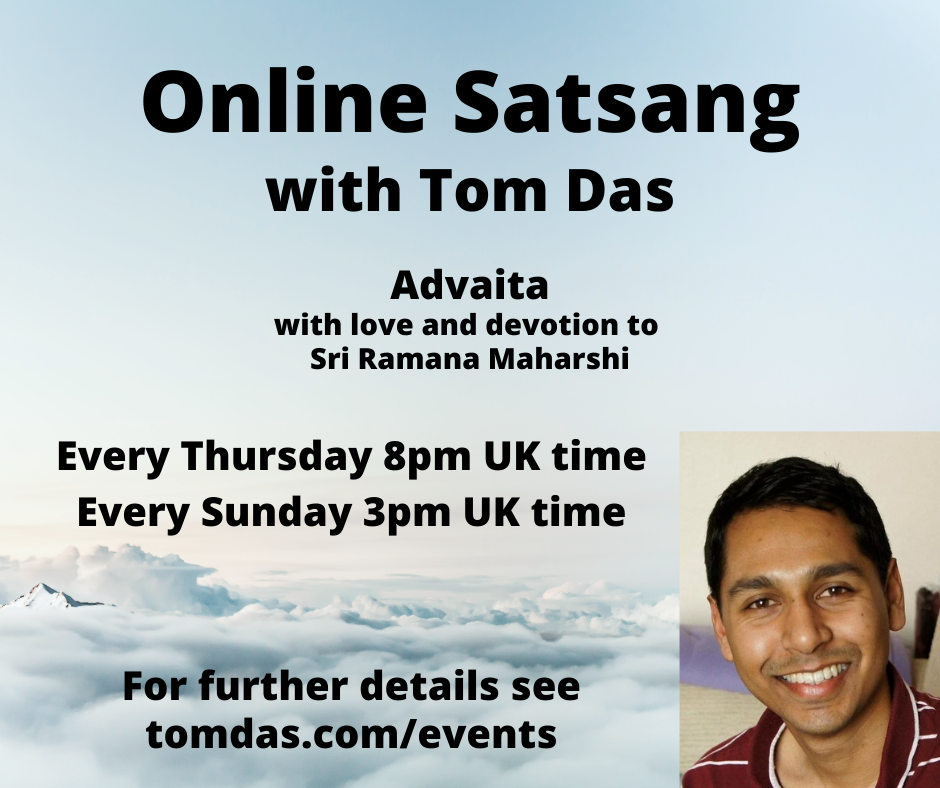
Online Satsang & post-satsang ‘social’ is now twice a week

We meet online every Thursday 8pm and every Sunday 3pm, UK time (currently BST, which is GMT+1)

After the meeting we have a post-satsang ‘social’ where attendees can informally chat and get to know each other better.

All are most welcome.

See tomdas.com/events for more information and how to join

Tom’s Recommended Films and Movies related to Spirituality, Non-Duality & Advaita

Here are some films that I have enjoyed that relate to Spirituality, Non-Duality and Advaita. The films may not be for everyone, but hopefully the themes will become fairly apparent as you watch them.

I haven’t made too much comment on them as you can always look them up for yourself should you wish to!

In no particular order:

  1. Revolver (directed by Guy Ritchie) – a treatise on the ego
  2. The Matrix – well it’s The Matrix! What more needs to be said?! So, do you want to take the blue pill or the red pill…
  3. The Truman Show – hmmm…wait a second…is THIS the Truman Show?
  4. V for Vendetta – go beyond your fears
  5. American Beauty – ‘look closer’…things are not as they seem
  6. Inception – Illusions, dreamscapes and creating reality
  7. Bliss (directed by Mike Cahil) – Illusion vs reality

Ok, a rather meagre post, but let me know your thoughts!

What are Dhyana and Samadhi (Zen/Chan Master Hui Neng, Platform Sutra) | Ramana Maharshi

The following is excerpted from The Sutra of Hui Neng (also known as the Platform Sutra), Chapter 5 entitled ‘On Dhyana’. My comments are interspersed in italicised red:

Learned Audience, what are Dhyana and Samadhi? Dhyana means to be free from attachment to all outer objects, and Samadhi means to attain inner peace. If we are attached to outer objects, our inner mind will be perturbed.

Tom: we can see Hui Neng has succinctly defined both Dhyana and Samadhi. In the next line he is essentially saying that these two are one and the same, in that when there is no attachment (ie. Dhyana), there will also be peace (ie. Samadhi):

When we are free from attachment to all outer objects, the mind will be in peace.

Tom: See if you can see the parallel with Sri Ramana Maharshi stating in ‘Who Am I?’:

‘Not to desire anything extraneous to oneself constitutes vairagya (dispassion) or nirasa (desirelessness). Not to give up one’s hold on the Self constitutes jnana (knowledge). But really vairagya and jnana are one and the same.’

Our Essence of Mind is intrinsically pure, and the reason why we are perturbed is because we allow ourselves to be carried away by the circumstances we are in.

He who is able to keep his mind unperturbed, irrespective of circumstances, has attained Samadhi.

Tom: Sri Ramana Maharshi states in ‘Who Am I?’: ‘If only the mind is kept under control, what matters it where one may happen to be?’

In the above two lines Hui Neng hints that your True Nature, or what Hui Neng refers to as Essence of Mind, is already ‘unperturbed’, and essentially is always undisturbed and ‘pure’. Realisation of this naturally leads to Freedom:

To be free from attachment to all outer objects is Dhyana, and to attain inner peace is Samadhi. When we are in a position to deal with Dhyana and to keep our inner mind in Samadhi, then we are said to have attained Dhyana and Samadhi. The Bodhisattva Sila Sutra says, “Our Essence of Mind is intrinsically pure.” Learned Audience, let us realize this for ourselves at all times. Let us train ourselves, practice it by ourselves, and attain Buddhahood by our own effort.

Realisation of Essence of Mind through ‘thoughtlessness'(Zen (Chan) Master Hui Neng) | Ramana Maharshi

The following is taken from The Sutra of Hui Neng (also known as the Platform Sutra), Chapter 2 entitled ‘On Prajna’. My comments are interspersed in italicised red:

The wisdom of Buddhas, past, present and future, as well as the teachings of the twelve sections of the canon are immanent in the mind, but in case we fail to enlighten ourselves, we have to seek the guidance of the pious and learned.

Tom: the essential teaching is within ourselves or ‘immanent in the mind’. Only if we do not enlighten ourselves with our own inner wisdom do we need the external teacher (‘the pious and the learned’)

On the other hand those who enlighten themselves need no extraneous help. It is wrong to insist upon the idea that we cannot obtain liberation without the assistance of the pious and learned. It is by our innate wisdom that we enlighten ourselves, and even the extraneous help and instruction of a pious and learned friend would be of no use so long as one is deluded by false doctrines and erroneous views.

Tom: ie. it is possible for illumination to occur without an outer teacher as the true wisdom of enlightenment is our very nature. How can this be done? All we have to do is realise our true nature, what Hui Neng here calls ‘Essence of Mind’, and we will certainly and immediately be Buddhas, let us see:

As we introspect our minds with Prajñā, all erroneous views will disappear of themselves, and just as soon as we realise Essence of Mind we will immediately arrive at the Buddha stage.

Tom: Hui Neng states that if we look within at our true nature or ‘minds’ with Prajna, all erroneous views or ignorance will disappear spontaneously, and this is realisation of Essence of Mind or True Nature, and this is also the same a Buddhahood or enlightenment. So, how ‘introspect with prajna’? Hui Neng will explain. Prajna means wisdom or insight:

When we use Prajñā for introspection we are illuminated within and without and are in position to know our own nature. To realise our own nature is to obtain fundamental liberation. To obtain liberation is to attain the Samadhi of Prajñā, which is ‘thoughtlessness’.

Tom: Hui Neng explains that realising our true nature is liberation. This is also known as ‘thoughtlessness’. What is this ‘thoughtlessness’? Let us see:

What is ‘thoughtlessness? ‘Thoughtlessness’ is to see and to realise all dharmas (things) with a mind free from attachment. In action Prajñā is everywhere present yet it “sticks” nowhere. What we have to do is to so purify the mind that the six vijnanas (aspects of consciousness sight, sound, smell, taste, touch, mentation) in passing through their six sense-gates will neither be defiled by nor attached to their six sense-objects. When our mind works freely without any hindrance and is at liberty “to come” or “to go, “then we have attained the intuitive insight of Prajñā, which is emancipation. To enable one to attain such a mental state of freedom is the function of intuitive insight.

Tom: In summary Hui Neng is stating that when the mind functions free from attachment to both gross and subtle objects, that is liberation. This non-attachment is also known as ‘thoughtlessness’. We can see this is in keeping with the Buddha’s more classical teachings which essentially state the same. We can also see this is in keeping with the Vedanta teachings in which lack of identification with and attachment to the body, mind and world is the same as Self-Realisation.

Sri Ramana Maharshi states the following in Maharshi’s Gospel, Chapter 3 entitled ‘Mind Control‘:

Questioner: Does Bhagavan condemn dvaita Philosophy?

Sri Ramana Maharshi :Dvaita can subsist only when you identify the Self with the not-Self. Advaita is non-identification.

Now Hui Neng will tell us what not to do:

To refrain from thinking of anything, in the sense that all mental activity is suppressed, is to be Dharma-ridden; this is an extremely erroneous view. (Discriminative thought which leads to desire and attachment, or to aversion and defilement, is to be controlled in the interests of intuitive thought which leads to self-realisation and freedom.)

Those who understand the way of ‘thoughtlessness’ will know everything; they will have the experience that all the Buddhas have had, and they will attain Buddhahood.


Tom: later on in the same chapter Hui Neng quotes a long verse that he composed himself for the benefit of those listening to him – here are a couple of excerpts I have chosen to quote here:

To illumine our gloomy tabernacle, which is stained by defilement,

We should constantly set up the Light of Wisdom.


Erroneous views keep us in defilement

While right views remove us from it,

But when we are in a position to discard both of them

We are then absolutely pure.

… and….

Right views are called ‘transcendental’;

Erroneous views are called ‘worldly’.

When all views, right or erroneous, are discarded

Then the essence of Bodhi appears.

This stanza is for the ‘Sudden’ School.

Can drugs and psychedelic substances lead to non-dual realisation or enlightenment? (Jiddu Krishnamurti)

Question: A well-known author has written a great deal about the use of certain drugs which enable man to arrive at some visionary experience of union with the divine ground. Are those experiences helpful in finding that state of which you speak?

Jiddu Krishnamurti: You can learn tricks, or take drugs, or get drunk, and you will have intense experiences of one kind or another, depressing or exciting. Obviously the physiological condition does affect the psychological state of the mind; but drugs and practices of various kinds do not in any way bring about that state of which we are talking. All such things lead only to a variety, intensity and diversity of experience – which we all want and hunger after, because we are fed up with this world. We have had two world wars, with appalling misery and everlasting strife on every side; and our own minds are so petty, personal, limited. We want to escape from all this, either through psychology, philosophy, so-called religion, or through some exercise or drug – they are all on the same level.

The mind is seeking a sensation; you want to experience what you call reality, or God, something immense, great, vital. You want to have visions; and if you take some kind of drug, or are sufficiently conditioned in a certain religion, you will have visions. The man who is everlastingly thinking about Christ, or Buddha, or what not, will sooner or later have experiences, visions; but that is not truth, it has nothing whatever to do with reality. Those are all self-projections; they are the result of your demand for experience. Your own conditioning is projecting what you want to see.

To find out what is real, the mind must cease to demand any experience. So long as you are craving experience, you will have it, but it will not be real – real in the sense of the timeless, the immeasurable; it will not have the perfume of reality. It will all be an illusion, the product of a mind that is frustrated, that is seeking a thrill, an emotion, a feeling of vitality. That is why you follow leaders. They are always promising something new, a Utopia, always sacrificing the present for the future; and you foolishly follow them, because it is exciting. You have had that experience in this country, and you ought to know better than anyone else the miseries, the brutality of it all. Most of us demand the same kind of experience, the same kind of sensation, only at another level. That is why we take various drugs, or perform ceremonies, or practise some exercise that acts as a stimulant. These things all have significance in the sense that their use indicates that one is still craving experience; therefore the mind is everlastingly agitated. And the mind that is agitated, that is craving experience, can never find out what is true.

Truth is always new, totally unknown and unknowable. The mind must come to it without any demand, without any knowledge, without any wish; it must be empty, completely naked. Then only truth may happen. But you cannot invite it.

Hamburg, Germany 4th Public Talk 14th September 1956

Ramana Maharshi: the path to self-realisation (Padamalai)

Tom Das's avatarTom Das

The following verses are taken from Padamalai, a record of teaching statements from Ramana Maharshi which were taken down by one of his foremost devotees, Muruganar. This version I am quoting from is translated by Dr T. V. Venkatasubramanian, Robert Butler and David Godman – my deep appreciation to them in making this wonderful and instructive work more widely available.

In their translation they have changed the order of the verses and grouped them thematically. The following verses are taken from the chapter entitled ‘The Self’.

My comments are interspersed in italics in grey.

padamalai godman ramana

Self-knowledge

5. True jnana* is only the removal of wrong knowledge. Only this is useful for liberation.

*Jnana is a Sanskrit word that means knowledge. It is etymologically related to the words gnosis and knowledge. In a spiritual context it implies the height of spiritual knowledge. In an Advaita/non-dual context it is synonymous with self-realisation, liberation/freedom…

View original post 2,514 more words

Neo-advaita and the highest ‘teachings’ of Advaita Vedanta (ajata vada) – are they the same?

In Advaita Vedanta it is said that the Ultimate Truth is that Maya never existed, and that there never was a world (Jagat), individual person (Jiva), or a God (Isvara). This is known as Ajata Vada – see here for an example of this teaching. Here in Guru Vachaka Kovai we have Sri Muruganar stating the same:

‘…I have known that in truth there is never in the least any attainment of bondage, liberation, and so on, which are fabricated when one imagines one is separate from reality’ Guru Vachaka Kovai, verse 1241

Someone recently made a comment to me that this sounds remarkably like Neo-Advaita, to which my response was as follows:

They sound remarkably similar because on the verbal level both traditional and neo-Advaita talk about Ajata Vada (the view that there is no maya, no objects truly exist, and therefore no true meaning, no seeker, no teaching, no teacher, etc) as being the ultimate truth, but traditional advaita also talks about teachings from vivarta vada (world is a projected illusion) and shristi dristi vada (world is real) viewpoints and prescribes self-enquiry as a (paradoxically) valid method for this to be realised on these latter 2 levels for those who cannot fathom ajata vada. Upon this realisation it is ‘realised’ there was never a seeker and no real realisation either. Sri Ramana Maharshi explains it more fully here if you are interested.

Also see:

Advaita Vedanta: Gaudapada’s Method (Mandukya Upanishad Karika)

Ramana Maharshi – three theories of reality of the world (shristi-dristi vada, dristi-shristi vada/vivarta vada, ajata vada)

The Ultimate or Highest Truth according to the Upanishads

Shankara – If I am Brahman already, why the need for effort? Advaita Vedanta

If You are That, if all is already Brahman, why the need for effort? Here is what Shankara has to say about this in his masterpiece Vivekachudamani. What do you think these verses from Shankara’s Vivekachudamani are trying to convey?

If you are interested in my view, I explain more about this teaching here.


62. A disease does not leave off if one simply utter the name of the medicine, without taking it; (similarly) without direct realisation one cannot be liberated by the mere utterance of the word Brahman.

63. Without causing the objective universe to vanish and without knowing the truth of the Self, how is one to achieve Liberation by the mere utterance of the word Brahman?- It would result merely in an effort of speech.

64. Without killing one’s enemies, and possessing oneself of the splendour of the entire surrounding region, one cannot claim to be an emperor by merely saying, ‘I am an emperor’ merely in an effort of speech.

65. As a treasure hidden underground requires (for its extraction) competent instruction, excavation, the removal of stones and other such things lying above it and (finally) grasping, but never comes out by being (merely) called out by name, so the transparent Truth of the self, which is hidden by Maya and its effects, is to be attained through the instructions of a knower of Brahman, followed by reflection, meditation and so forth, but not through perverted arguments.

66. Therefore the wise should, as in the case of disease and the like, personally strive by all the means in their power to be free from the bondage of repeated births and deaths.

Also see:

Ramana Maharshi on Jiddu Krishanmurti’s Choiceless Awareness

Advaita Bodha Deepika – vital teachings for Self-Realisation that are often missing in modern non-dual and Advaita Vedanta teachings

Turn Within? Really? Isn’t this dualistic and doesn’t this just strengthen the ego?