Poetry: Know thyself

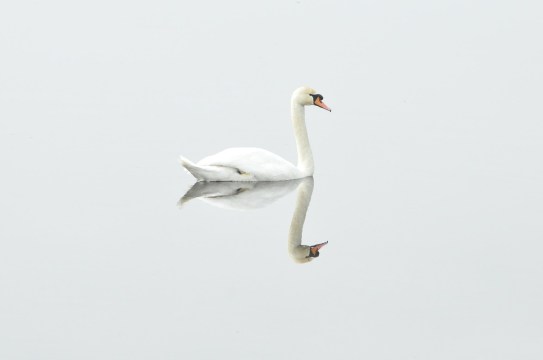
swan reflection

Not that which comes and goes,
But that which knows both comings and goings;

Not that which is confused or clear,
But that which sees both confusion and clarity;

Not that which is happy or depressed,
But that which knows both happiness and depression;

Not that which swells with pride, or is deflated by humiliation,
But that which sees both pride and humiliation, and their effects;

Not that which is damaged by disease or benefited by medicine,
But that which knows both disease and health;

Not that which has desires and fears,
But that which sees both attraction and aversion;

Not that which judges or is open-minded,
But that which knows judgement and open-mindedness.

Not that which thinks or acts,
But that to which both thoughts and actions appear;

Not the ear, tongue, skin, eyes or nose,
But that to which smell, taste, sensation, vision and sound appear;

That which, in our experience,
never changes,
is always present,
ever-aware,
and unblemished by experiences;

That which
looks with constancy,
is ever-patient,
unmoving,
always seeing things as they are;

That which
cannot be lost or removed,
is effortlessly present,
totally secure,
and is the innermost essence of your experience;

Know yourself to be that.

Shankara’s way to Enlightenment, with verses from Atma Bodha

Atma Bodha is a short text attributed to Shakara and was written approximately 1400 years ago. It literally means ‘Self Knowledge’ (atma = self, bodha = understanding or knowledge) and it outlines a methodology to lead a seeker from suffering to liberation. Incidentally, bodha is the same root word that forms the word Buddha, which means ‘the one who knows or understands’.

It comprises a class of scriptures called prakarana granthas. Prakarana means ‘procedure’ or ‘task’ and grantha means ‘text’. Taken together prakarana grantha means ‘instruction manual’. These instruction manuals were written for those who do not have the capacity or time to read the voluminous traditional texts such as the vedas and upanishads or for those who were looking for a synopsis of their vedantic studies, and so give us a summary teaching which we can practically apply to our lives.

Ramana Maharshi thought this text important enough to translate it from Sanskrit to Tamil so that Tamil-speaking locals who could not understand Sanskrit could still benefit from its teachings. In his introduction to his translation, Ramana describes Shankara as the one who brings forth enlightenment. Similarly in the Inchegarei Sampradaya, the lineage to which Nisargadatta Maharaj belonged, Shankara is considered an enlightened sage and his writings are studied as a matter of course.

Below are some selected quotes from Shankara’s Atma Bodha. We will see how in these quotes the basic methodology (after the entry criteria for this teaching are briefly alluded to) is:

1) Firstly viveka, or distinguishing between what is Brahman and what is not. Brahman is identified as the unchanging subject and the world of objects (ie. the body, mind and world) is said to be not-Brahman. This is an artificial duality that is temporarily set up in order to counter and remove the deeply ingrained belief in the doer-entity or ego (ahamkara). We will see how this duality is later resolved into non-duality and furthermore into non-conceptuality.

2) Once the subject-object distinction (viveka) has been properly made then this knowledge or understanding is to be practised. This is done by the practise of identification with the subject, Brahman, and turning away from the phenomena that arise in our awareness.

3) Eventually, after long practice of this, the doer-entity that we once took ourselves to be is seen to be an illusion. This ignorance is removed.

4) Once the doer-entity is seen to be unreal, then the interpretive notions of subject and object can also be done away with. Having completed their purpose, the concepts of subject and object are also seen to be false beliefs and are allowed to fall away.

5) Everything is ‘resolved into Brahman’, not literally, but in the way we label reality. Before, at the first step of viveka,  the unchanging subject was considered Brahman/Atman and the changing world of objects (the mind, body and world) were said to be not-Brahman/Atman. Now ignorance is removed, everything is seen to be Brahman and the duality set up by viveka is removed.

6) Eventually we stop needing to label reality at all. What we are left with is just this, this present experience, devoid of concepts of self or reality or even Brahman. So simple, so direct, how can it be put into words?

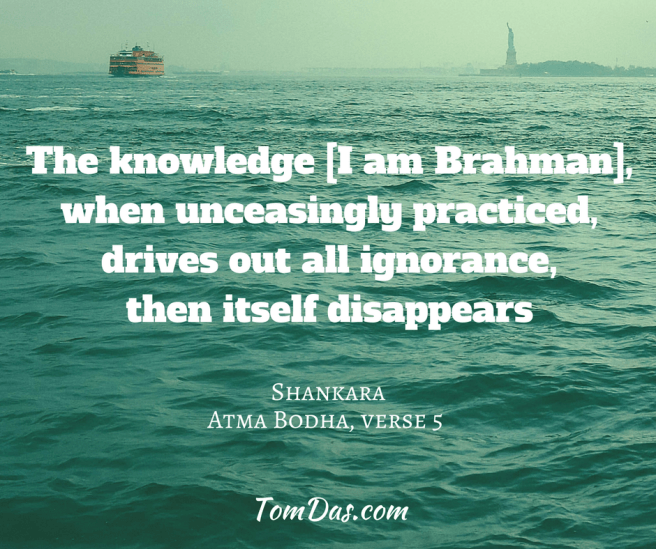
Verse 5. The knowledge [I am Brahman], when unceasingly practiced, drives out all ignorance, then itself disappears.

Shankara - the knowledge then itself disappears

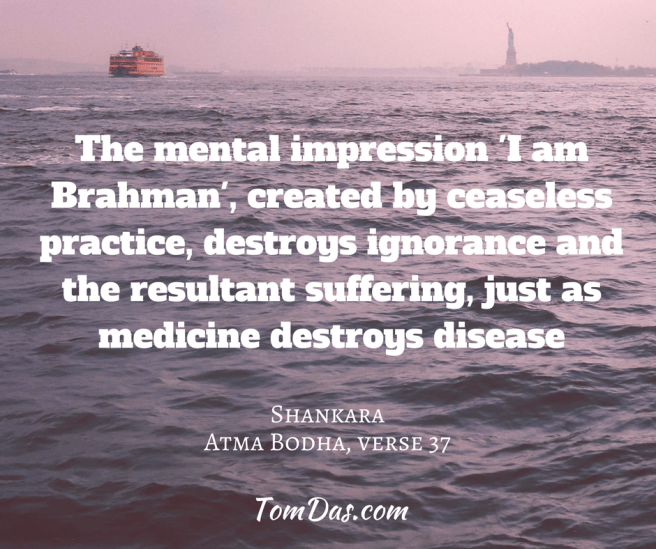
37. The mental impression ‘I am Brahman’, created by ceaseless practice, destroys ignorance and the resultant suffering, just as medicine destroys disease.

Shankara - I am Brahman destroys ignorance (1)

41. There are no distinctions such as ‘Knower’, the ‘Knowledge’ and the ‘Object of Knowledge’ in the Supreme Self

Shankara- there are no distinctions in the Supreme Self.

64. All that is perceived, or heard, is Brahman and nothing else

Shankara- All that is perceived is Brahman and nothing else

Do you know for certain that you are the body?

Sculpture Male Body Naked Gestures Man Human
Do you know for certain that you are the body?
Do you know for certain that you are not the body?
The honest answer to both these questions is ‘no’.
‘I am not the body’ is a tool by which one can weed out the ‘I am the body’ notion.
Then once the work is done, like the thorn used to remove a thorn, throw them both away.
What is reality then?
Reality is simply whatever is left over when concepts of self and no-self are no longer believed in.
Reality is the ineffable indescribable indefinable ever-obvious ever-present ‘now’.
Tom Das

These verses will be elucidated further in upcoming posts:

  1. Are you or are you not the body?
  2. Why does understanding the body matter?
  3. Why seeing/understanding alone may not be enough
  4. Integrating the understanding of no-doer
  5. Problems with utilising conceptual tools
  6. Practising Knowledge
  7. Discarding knowledge as ignorance
  8. Integrating knowledge/spontaneous action
  9. Am I the body?

Creating then resolving the duality of awareness vs objects in awareness

The following are adapted from recent Facebooks posts of mine
http://www.facebook.com/tomdas.nd

The body-mind entity can accept, reject or be indifferent to things. This is relative acceptance and is an action that can be performed. Awareness is all-accepting, always embracing ‘what is’. This is total/absolute acceptance and is not something that you can do, but something that can be recognised as already being here.


Awareness cannot accept or reject anything, as it does nothing. It just is: present and aware. All actions occur at the level of the body and mind (and world).

Awareness could be said to unconditonally/choicelessly ‘accept’ everything that occurs within it, in the same way a mirror ‘choicelessly accepts’ the reflection within it.

…but actually, as this example illustrates, the mirror-like awareness is not actually doing anything apart from ‘being itself’.


In the way I speak about this, awareness cannot identify with anything. It is only the mind that identifies with/as the mind.

Or to put it differently, thought imagines it’s a thinker and believes itself.

Awareness is ever-free, just like the mirror in the example above


Through identifying with choiceless awareness/consciousness for sometime, the ego/doer is seen through and no longer identified with. Then the identification as being choiceless awareness/consciousness also can be dropped.

What we are left with is ‘just this’: simple, direct, beyond words. This is the ‘realm beyond verbal teachings’.
Here the apparent duality conceptualised by differentiating (viveka) between that-which-changes (objects) and that which doesn’t change in our experience (the subject, I) is resolved into non-duality.

Levels of reality

water oceanic
Are there levels of reality?

I have often seen people talk and write about various levels of reality. Typically, they talk of the level of the absolute and the level of the relative. On the level of the absolute, everything is one, so they say. Whereas on the relative level, the level of being a person different rules apply. On the relative level differentiation exists, we talk to each other, we love one another, we get annoyed and irritated, we buy fast-food from time to time, and yet ultimately, at the highest and truest level we are told this is all oneness.

Well let me start off by saying that I reject the notion of levels of reality. I think reality has various aspects, but not levels per se. Now this may seem like a minor difference, a play of semantics if you will, but let me explain the difference.

Talking about the same thing in different ways

When I say reality has various aspects, all I really mean is that there are various ways you can talk about reality – actually there are various ways you can talk about anything. That doesn’t mean there are different levels of reality.

Lets take a simple example: lets take a human body. You can talk about a human body  in different ways. You can talk about it in terms of its size: you can say it is big, small, medium. You can talk about its age: is it a young or older body. You can talk about it in terms of organ systems such as the cardiovascular system or digestive system and how they function and describe the body that way, or you can talk about its anatomy and how various parts of it fit together. You can talk about the body’s name and culture – eg. maybe it is called John and it comes from the United Kingdom, you can talk about its occupation. You could talk about its fashion sense, its muscularity…

…ok ok, hopefully you get the idea: there are different ways you can talk about things. There are different conceptual frameworks from where we can view the body. And this is true for anything. We can talk about a pebble in terms of its age, size, geology or how good it would be to skim on a lake’s surface. We can talk about a lake in terms of its scenic beauty, how choppy its water are, its phosphorus content, or remark how it is all made up (mainly) of water.

Now, how many levels does a body or a pebble have? It doesn’t actually have any levels at all – there is only one body or stone (in the above examples) – it’s just that we can talk about them in various ways. In the same way there are no levels in reality, just different ways of talking about it.

No particular conceptual framework is intrinsically higher than another

Also note that no particular way of talking about the body or a pebble is intrinsically better that any other way. It just depends on what you want the conceptual framework to achieve. For example, if you want to skim a stone on the surface of a lake, then it’s less useful to talk about the geology of the stone, and more useful to look at it in terms of its shape and size with respect to achieving your goal (skimming it across the lake). You can’t legitimately claim that one way of viewing something is intrinsically higher and another way is lower, which is something you often hear when talking about ‘ultimate reality’ or the ‘highest level’. It just depends on how well the way you are conceptualising and viewing the object(s) in question fits in with your goal.

It depends on what you want to achieve

Similarly, it is not necessarily better to talk about the body in terms on physiology or organ systems compared to it’s occupation or fashion sense. As previously stated, it just depends on what you want to achieve. If the body has a disease, then understanding the physiology and how to correct any imbalance or defect in this is useful. Conversely if you are going out on a first date, then perhaps a degree of fashion sense would be useful.

No paradoxes, no contradictions

Also there in no contradiction in talking about a single object in different ways depending on the context. There is no paradox that a stone has both an age and a shape, or that a river is a single system made up of a variety of different things, all of which are in motion. There is a consistent underlying reality that underpins the various ways we talk about it. No contradiction or paradox at all.

Different ways of talking about the same experience

Remember, what we are talking about here is our experience of reality. Our reality is our experience – that’s all we know. We can talk about how everything we perceive is non-different to our consciousness, and we can also talk of how things interact within this consciousness, and the rules and consequences thereof. These are just different ways of talking about our experience and our experiences. No particular way is higher or lower, and there are no actual ‘levels’ that exist apart from our conceptualisations.

The description is not the described

We can chose how to conceptually carve up and talk about our experiential reality in order to achieve certain specific aims. To that end these conceptual maps are useful and often necessary. However we must not mistake any particular conceptual map of (our experience of) reality for reality, just as no particular way of describing the body is the body itself.


Is everything really consciousness?

consciousness buddha.jpg

Lots of spiritual teachers and teachings seem to be saying all there is is consciousness. But is this really true? And even if it was true, would we be able to know this as being true?

From the point of view of experience

Firstly, from the point of view of our experience, yes, everything is consciousness. Whatever you look at, smell, see, touch, feel, think or imagine, etc, appears within your consciousness or awareness. And all these things appear as modulations of that consciousness, so in effect, our entire experience is nothing but consciousness.

Also we cannot directly know or experience anything or go anywhere that is not within our consciousness. If we did then we would, by definition, be conscious of it, and so our experience of it would be consciousness.

Everywhere we go, no matter what we experience, consciousness is, it is always present, effortlessly shining.

So, there we have it. Everything is consciousness. Right? Well…

From the point of view of reality

Just because everything you experience is consciousness, doesn’t mean that everything is consciousness. You see, in one way this is just a play on words. In the way we are using the words, experience and consciousness are synonyms. You cannot have experience without consciousness. If you are conscious you are experiencing. Think about it. Can you have one without the other? So of course, in terms of experience everything is consciousness. But it’s a bit like saying in terms of vision everything is seeing.

You don’t have to be a genius to realise there may be things going on that we are not conscious of, and perhaps we will never be conscious of. From what we know of the universe (via our consciousness!) we know it is vast and complex. Of course all this vastness could be just all happening within our consciousness only, but we don’t know that for sure. It is easily foreseeable that there may exist something beyond our consciousness, something we can never sense (be conscious of) or understand.

From the point of reality, we do not know if all there is is consciousness, and to say that everything is consciousness is going too far. We can only say everything is consciousness in terms of our own experience, but not in terms of reality. If you think that everything is consciousness (and by implication that nothing exists outside of consciouness), I would say that is a belief. Ask yourself, do you know that for sure? How can you know that for sure?

Why is this important?

Does this actually matter? If all we experience is consciousness, then does it matter? If there is something beyond consciousness but we are not aware of it, who cares, right? Well, to me at least, it does matter. If you are interested in what’s true it does matter. If you are a spiritual seeker trying to figure this all out and it doesn’t make any sense, then it does matter. If you are interested in seeing through all false beliefs and discovering a genuine freedom, then yes, it does matter. And if you are interested in science and reducing human suffering through technology based on scientific discoveries, then yes, it does matter.

False beliefs breed suffering as they inevitability conflict with what is true, and false beliefs impede genuine philosophical, ethical and scientific inquiry. Beliefs like this affect how we approach and respond to life and how we treat each other. It affects the philosophical basis upon which scientific progress is made, and so it can affect the technologies we develop and how we develop them. The overall result of clinging to false beliefs is to the detriment of us as individuals and our society at large.

Does that mean that not everything is consciousness?

So, back to consciousness. Does that mean that not everything is consciousness? No! Perhaps everything is consciousness! Perhaps it isn’t. The point is that we do not know. Everything may or may not be consciousness. We don’t know. It’s actually a scientific question and we currently don’t have the evidence either way. It may be impossible to know, as how would you know that there is nothing beyond consciousness?

The point is we should be honest, with ourselves and each other, and not cling to beliefs unnecessarily and unknowingly. Whilst beliefs can be used to make us feel better and give us strength during hard times, clinging to them and thinking they are definately true and that we are definately right causes more suffering in the long term, both for us and often for those around us.

Can the teaching ‘everything is consciousness’ be useful?

Ironically, yes. Even though ultimately we don’t know, the teaching that everything is consciousness can still be useful. How so? Well the teachings aim to undermine the belief in a separate self, or the notion of being an independent doer-entity, and in that regard this philosophical idealism of everything being consciousness can be useful. The idea is that the teaching is an antidote to a fixed belief. More on how that works here.  The key is that once the job of the conceptual teaching is done, we don’t cling to this new concept which simply becomes a new problem and a new way of perpetuating the ego.

The consciousness teachings or awareness teachings, as I call them, can also point to a still-point in our experience that is always present, at least whilst we are awake. It is that which never changes and is always ever-present, un-touched and ever-aware. Recognising this aspect of our being can be very liberating and can give us the emotional security to open up to our thoughts and feelings, and allow our emotional-spiritual hearts to open, and can allow us to feel happier and whole.

What about Freedom?

So if we don’t know whether or not everything is consciousness, what do we do now? A part of Freedom, which is already here, is that everything is allowed. It’s ok to not know. That’s ok. There are lots of things we do not know, many things we will never know, and probably many things that are impossible for us to know. Freedom doesn’t mind. It’s just the way things are.

Ramana Maharshi: To remain as you are, without question or doubt, is your natural state

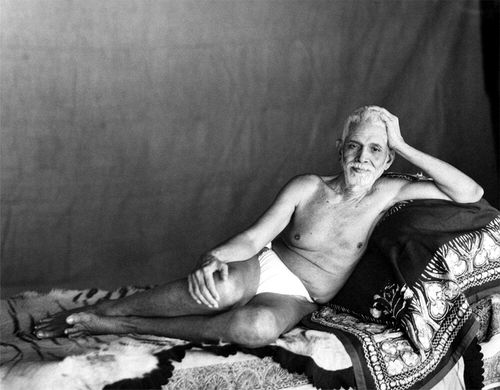
Ramana reclining

To remain as you are, without question or doubt, is your natural state
Ramana Maharshi

This is still an instruction for the spiritual seeker: ‘to remain as you are’.

With liberation, questions and doubts are irrelevant, as the natural state is simply whatever is. Nothing can obstruct it. It is always here and manifests as whatever is arising. It can never be obstructed and is always in plain sight.

However for the seeker, ie. the person that takes themselves to be the author of their thoughts and actions, the instruction to remain as you are and not worry about or get entangled with thoughts, questions and doubts, is one of the highest and most refined spiritual teachings available.

Be still, forget all concept of who you are, notice things as they happen. Regardless of what is happening, you know that you are, never what you are, only that you are.

When the mind and its concepts are no longer being believed, what use is there to talk of separation or no separation, self or no-self?

Spiritual Materialism

diamond.png

So many spiritual seekers start off on the wrong footing, so many spiritual teachings pander to the ego. If your main aim on the spiritual path is to gain super-powers, be permanently in a state of heightened bliss or to be the next great spiritual teacher, then you are primarily interested in accumulation and possession and perhaps not as deeply interested in truth as you may think. You should know this is the ego’s desire and the spiritual path you walk is not a genuine one.

So, first ask yourself honestly – do you want truth or pleasure? You may want both, but which one do you want more? If your perception is distorted by ego and desire, then the spiritual path you are attracted to will be similarly distorted. We get the spiritual teachings we deserve.

We get the spiritual teachings we deserve.

There is nothing wrong with seeking happiness of course. It is through suffering and seeking an end to suffering that most of us become spiritually inclined in the first place. But if we are clouded by our desires and insecurities then we become susceptible to false beliefs, magical thinking, exploitation and corrupt spiritual teachings. This ‘spirituality’ is in fact another form of materialism or hedonism in a different guise: the ego is still at play.

If you can see all of this, then you already know that you are apart from it. What is it that sees? Who are you at your innermost core? All that you have accumulated will pass away: pleasure, pain, psychic powers, fame, charisma and transcendental experiences. All are finite and transient. None of them are the Eternal.

The Eternal already is. Nothing is not It.