This article is an excerpt from a much longer article which you can view here, that gives further quotes on this same topic from others including Sri Ramana Maharshi, Sri Shankara, Yoga Vasistha and Ribhu Gita. The original article also expands on the disclaimer below and makes some suggestions as how to best appraoch these teachings.
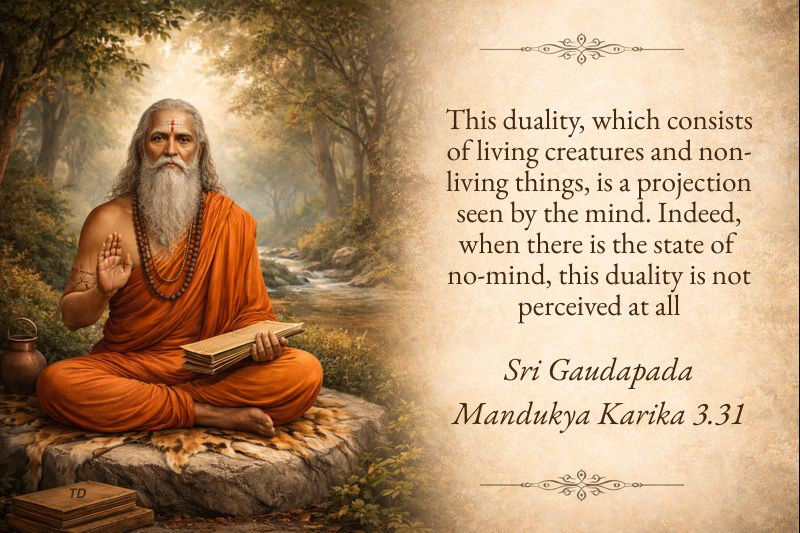
A warning/disclaimer
The teachings that are given below, whilst they are open to anyone, they are very radical in their nature. It is not recommended that you read them if you are not an earnest seeker of liberation or if your mind is likely to be destabilised by a more radical notion of the nature of the universe or what liberation looks like.
We will see that these same exact teachings have been given for many centuries, but traditionally these teachings would only be given to a prepared mind, a mind prepared by devotion, faith and loving surrender. This infuses the mind and heart with an energy of peace, calm and loving kindness and happiness. It is this stable peaceful mind that is most able to receive these teachings, although it is possible there can be some exceptions to this.
Some people can find these teachings quite distressing and destablising and the author of this post takes no responsibility for providing this information to you that has been traditionally written about and taught for many centuries and is already in the public domain.
Sri Suresvara – Shankara’s student and protege
Suresvara was a devoted student of Shankara who wrote the treatise Naishkarmya Siddhi (NS, you can download the text for free in this link) as well as some commentaries on Shankara’s works. As expected, he explains exactly the same things as Gaudapada and Shankara do above. We will see that Suresvara explains the following key points in his writings:
- That the world only appears due to ignorance
- The world itself is a form of ignorance
- The world refers to phenomenal arisings, also known as objects, and includes the body and the mind (thoughts, feelings, emotions, etc) and gross objects such as trees, stars, rivers, etc.
- Ignorance itself is ultimately not a real thing that ever exists
- When (apparent) ignorance is removed by self-knowledge, the world also no longer appears due to its cause (ignorance) being removed
- This world therefore no longer arises or appears to the self-realised Jnani.
- If we read carefully, we will see that Suresvara is not saying that the Jnani continues to see the world but sees it to be an illusion, and he is also not saying the Jnani continues to see the world but sees the world as Self or being one with the Self
- In truth, there is no connection between the Self on one hand, and ignorance/the world/the body on the other hand, the latter not really existing, and only appearing to exist due to ignorance
- The world also refers to all movement or action (karma), and this action or karma only appears or arises due to ignorance.
- Because karma or action is downstream from ignorance, in that ignorance is the cause of action, action cannot remove ignorance.
- Like action, desire also arises from ignorance, and so in self-realisation there is no desire, as ignorance, which is the cause of all desire, no longer exists.
- Similarly, all of time and space are products of ignorance and so time and space cease once ignorance has been removed (seen to have never existed)
- Similarly, all of samsara, the cycle of birth, death and rebirth, is due to ignorance and this entire process starting from birth no longer appears when our true nature (Self) has been realised. This is ajata vada – that birth or creation never really ever occurred in the first place, not even as an appearance.
Let us see some quotes from the writings of Suresvara:
Therefore all this (world-appearance) comes forth from ignorance (ajnana)
~ Sri Suresvara, Naishkarmya Siddhi, preamble to 2.45
and that non-self is ignorance (or duality):
‘For the very nature of the not-self is ignorance‘
~ Sri Suresvara, Naishkarmya Siddhi, preamble to 3.1
and again that the non-self is created by ignorance:
Further, the not-self is born of ignorance.
~ Sri Suresvara, Naishkarmya Siddhi, preamble to 3.1
and that ignorance is not actually a ‘thing’ at all:
…for ignorance is nothing but absence of knowledge, and since the latter is a non-entity (avastu) by nature…
~ Sri Suresvara, Naishkarmya Siddhi, preamble to 3.7
In NS, in his introduction to Chapter 3 he writes the following:
‘We have shown at some length that all this [world] from the Creator [Brahma] to a clump of grass, consisting of the empirical [relatie] knower, his instruments of knowledge, his knowledge and its objects, is but a false [unreal or untrue] superimposition. And it has been made clear that the Self is the changeless rock-firm Consciousness, void of the six states of phenomenal existence beginning with birth – and is that [changeless consciusness void of objects] alone. And between the world (as false superimposition) and the rock-firm Self there is no connection except ignorance (ajnana) [which itself is unreal]…’
~ Sri Suresvara, Naishkarmya Siddhi, introduction to chapter 3
See how Suresvara gives the same teaching as his Guru, Shankara, by clearly stating that the Self is changeless and void of all phenomenal happenings. The phrase ‘beginning with birth’ emphasises that all phenomenal arisings right from their very outset are denied or non-arising in the Self.
Indeed, there is never any real contact between the Self and the body, far less between the Self and objects.
~ Sri Suresvara, Naishkarmya Siddhi 1.19
How can there be no contact between Self and objects? Only if the latter does not actually exist in any way, shape, arising or form! As he says in Chapter 2:
‘The Self is changeless consciousness, and therefore does not contain the factors of action.’
~ Sri Suresvara, Naishkarmya Siddhi 2.113
Suresvara is stating that the factors of action are not present in the Self – the factors of action are the doer/agent, the deed/action performed and the instrument through which it is performed. Everything we see/feel/perceive is in the field of action, of cause and effect. Suresvara is stating none of these exist in the Self. We see this same teaching here:
For Self-knowledge is based on the self-revealed reality alone, and its nature is to destroy ignorance and the whole complex of factors of action that arise from it as effects.
~ Sri Suresvara, Naishkarmya Siddhi 1.35
Here again we see the notion that ignorance is the cause of the body, mind and world, which are its effects. Both Shankara and Suresvara repeatedly state that when ignorance is destroyed by Self-Knowledge, the effects of ignorance, namely all phenomenal arisings, are also destroyed, just as the illusory snake is destroyed when the rope is clearly seen as rope. Suresvara continues in the same verse as follows restating that action depends on ignorance for both its existance and continuation once it has arisen:
But action depends on ignorance both for its rise and (for the production of its effects) after it has arisen. For action is but a means resorted to by some agent. It does not maintain itself independently after its own component factors (agent, instrument, object etc.) have all disappeared
~ Sri Suresvara, Naishkarmya Siddhi 1.35
Suresvara states this more succinctly here in his preamble to 1.40:
Action arises from ignorance, it ceases with the destruction of ignorance.
~ Sri Suresvara, Naishkarmya Siddhi, preamble to 1.40
Action itself arises from nescience, hence it cannot destroy it. But right knowledge can destroy nescience for it is the opposite of it, as the sun is the oppositeof darkness.
~ Sri Suresvara, Naishkarmya Siddhi 1.35
Here is it very directly stated that there is no action or movement when ignorance is destroyed, as action is a consequence or effect of ignorance. Next we will see Suresvara stating that the teacher, the texts and the seeker are all illusions that do not exist in self-realisation – the teacher and teaching are the part of the illusion that take us out of illusion, and, being unreal, they do not persist with self-realisation:
In the same way, one who was ignorant of the Self and who is awakened from this ignorance by the Vedic text (sruti) sees nothing other than his own Self. The Teacher (guru), the texts and he himself as deluded individual soul have all disappeared.
~ Sri Suresvara, Naishkarmya Siddhi 4.37
In verse 43 of the same chapter Suresvara introduces the idea that it is our desire that creates/causes what is calls the ocean of suffering in verse 1.37 and what is here referred to as samsara, the cycle of birth-death-rebirth-suffering (also called transmigration):
Sruti has also declared this [teaching] in order to demolish desire (kama). All samsara has desire for its root. The destruction of desire arises from the destruction of ignorance.
~ Sri Suresvara, Naishkarmya Siddhi 1.43
The implication is that ignorance causes desire, which in turn creates or manifests the phenomenal arisings, similar to what we read in the karma kanda portion of the Vedas as well as the ‘new age’ Law of Attraction teachings. Suresvara quotes from Sruti to back this statement up:
“When all the desires that lie in a man’s heart are resolved.” (then the mortal becomes immortal and attains Brahman): “thus (does the man who desires transmigrate; but the man who does not desire never transmigrates)”. So says the Brhadaranyaka Upanishad [in verses 4.4.6 and 4.4.7]. Vyasa also spoke of this, as in “this our bondage is verily bondage through desire”
~ Sri Suresvara, Naishkarmya Siddhi 1.44
We can see that that idea of samsara, or transmigration, which consists of (the illusion of) being born as a person, then living and experiencing the joys and pains of life, eventually dying, and then repeating the process by being born again – this entire samsara is the phenomenal arising that we see, also known as suffering, that appears to appear in ‘our’ consciousness – all of this samsara is due to desire -ie. our desires manifest or project or create phenomenal arisisings such as bodies, minds, creatures and things. Desire itself is a consequence of ignorance, and when ignorance ceases, all the effects of ignorance, namely all desire and samsara, which is to say the entire mind and all phenomenal arisings, also cease.
It seems that Suresvara was likely reading or referring to Shankara’s commentary on the Brihadaranyaka Upanishad when he wrote the above verse, as Shankara writes the following:
They do not also know the contradiction, based on incongruity, between the attainment of knowledge, which obliterates all action with its factors and results, and ignorance together with its effects. [ie. all objects, duality, actions and suffering are removed with liberation, so there is no possibility of either desire or an object to desire in liberation] Nor have they heard Vyāsa’s statement (on the subject). The contradiction rests on the opposite trends of the nature of rites and that of knowledge, which are related to ignorance and illumination respectively.
~ Sri Shankara, Commentary on Brihadaranyaka Upanishad, introduction to section 2.4
We see Shankara say the the following in his commentary on Brihadaranyaka Upanishad about desires not being present in the Jnani, that is actually just the Self devoid of all illusion/arisings/birth.
But there are some who hold that even a knower of Brahman has desires. They have certainly never heard the Bṛhadāraṇyaka Upaniṣad [which states the Jnani has no desires]
~ Sri Shankara, Commentary on Brihadaranyaka Upanishad, introduction to section 2.4
Here in this next verse Suresvara says the following:
The sphere of ignorance is the unreal; the sphere of knowledge is the highest reality : conjunction between the two is like conjunction between the sun and the night.
~ Sri Suresvara, Naishkarmya Siddhi 1.56
And again here:
We have shown that action is an effect of ignorance, and that therefore there can be no association, either simultaneous or even successive, between knowledge and action
~ Sri Suresvara, Naishkarmya Siddhi, peramble to verse 1.76
We can see here Suresvara is stating that, just as when the sun rises nighttime cannot exist in any way, similarly the unreal cannot exist in any way in self-realisation, which is the highest reality. Note that this is essentially the same as when Sri Ramana writes in ‘Who am I?’:
Therefore, when the world appears, Self will not appear; and when Self appears (shines), the world will not appear.
~ Sri Ramana Maharshi, ‘Who Am I?’
and
Question 4. When will the realisation of the Self be gained?
Sri Ramana: When the world, which is what-is-seen, has been removed, there will be realisation of the Self, which is the seer
Question 5. Will there not be realisation of the Self even while the world is there?
Sri Ramana: There will not be
~ Sri Ramana Maharshi, ‘Who Am I?’
(Question and Answer version)
Suresvara makes the point there can be no identification whatsoever with the body-mind for the self-realised one:
The Self-realized man cannot identify himself with the individual body and mind, since such identification is due to demoniac (Asuric) ignorance. If the latter had power to afflict even the man of Self-realization, knowledge of the Absolute would be useless.
~ Sri Suresvara, Naishkarmya Siddhi 1.75
This is because there is no body-mind and world for the self-realised one, who is nothing but the pure objectless formless self. The notion that the Jnani has a body, a mind, and engages in actvities, in birth and death, is only from the ignorant point of view of the ‘onlooker’, none of which exist in truth if we investigate who we are. Here are some more verses from Suresvara on this topic, all taken from Naishkarmya Siddhi:
Preamble to 2.30: When the ego-limitation is removed, nothing in the whole range of duality is left standing, since that is the sole root of our relation with duality. So we proceed:
2.30 When the ego-sense ceases, the sense of possession, too, departs; for the ego-sense is its only cause. Can there be (the appearance of) a false snake except when it is dark?
2.31 It is only he whose mind is afflicted by darkness who sees a snake in a rope through error. Therefore noone sees a snake in a garland except through error
2.32 If the ego-sense were really a property of the Self it would continue after liberation and in deep sleep. Since it does not do so, we conclude that it is a property of something else.
2.44 Thus we have shown that this duality is different from the Self – this duality which is false, which has no definable essence, whose cause is ignorance and whose nature is hard to understand by mere reasoning.
Preamble to 2.51: Nor does this whole illusory display (abhasa), consisting in action, its factors and results, touch the supreme reality in any way, since it is founded in mere delusion.
2.61 If the Self of man changes with the rise of every new idea in his intellect, that Self is non-eternal; but if the Self does not change, it cannot be the knower of that cognition.”
2.63 The notion that the changeless Self can be an experiencer is due to an error set up by the ego-sense; it is like the notion that mountains are moving due to the error set up by the motion of a boat.
Preamble to 2.69: Thus this pure consciousness, “firm as a mountain peak” (kutastha), has no contact with duality whatever
2.93 This formless non-dual Absolute (Brahman) is conceived in millions of ways by those of weak intellect, like the blind men guessing at the nature of the elephant.
2.119 So saying, he pronounces “OM” and becomes awake to the partless Self, beyond action and the factors of action. He acquires the solitary state, estranged as it were from the intellect, the body and the external objects.
Suresvara explains many other points in his text, such as the nature of ignorance and the method of self realisation, and he repeats these teachings that I have given above elsewhere in the text too, but I think the point is hopefully made that Suresvara’s view is very clear, and in accordance with his Guru, Sri Shankara, as well as with Gaudapada and the Upanishads, namely that there are no phenomenal arisings whatsoever in the Self, not even as an appearance. It is not that there is the Self, and there is the non-self, and these two never meet, for this would be highly dualistic – it is that there is only self, and in truth (which is ‘seen’ in self-realisation) there has never been non-self at any time. This is also explained in this article here with respect to the three levels of the teaching (sristi-dristi vada, dristi-sristi vada and ajata vada).
This is the true meaning of ajata vada, and this cannot be understood by the mind, which has completely perished (or ‘seen’ never to have arisen, a bit like the snake in the rope although that analogy too falls short as it appears that the snake did arise for a point in time, but actually ajata is even more radical and unfathomable than this!) in Self-Realisation. As suresvara states, ignorance has never really ever occurred:
When the Self is pure knowledge by nature, void of the factors of knower, knowing and known, how could there be the faintest possibility of the existence of ignorance therein?
~ Sri Suresvara, Naishkarmya Siddhi 3.112
Here is a different point that Suresvara makes, that reasoning and intellectual knowledge alone will not lead to eradication of ignorance (and the subsequent or simultaneous self-knowledge)
The knowledge that the intellect, etc are not-self may be attained through reasoning. But reasoning does not suffice to annihilate ignorance.
~ Sri Suresvara, Naishkarmya Siddhi 3.33
Here Suresvara states that Self-knowledge or removal of ignorance only can happen once, and when that happen, no time and space (and therefore no phenomenal arisings) and no samsara remain:
Through knowledge of reality he brings empirical being (samsara) to a complete end. Right-knowledge destroys the path of renunciation as surely as it destroys the path of action.
~ Sri Suresvara, Naishkarmya Siddhi 4.56
By merely rising once, this (knowledge) destroys all becoming, through negation of ignorance once and for all. There is no more wrong knowledge afterwards.
~ Sri Suresvara, Naishkarmya Siddhi 4.57
Time and space, etc., are the effects of delusion, and do not inhere in the Self. Once the Self is known, there is no more knowledge to gain and no ignorance left unconsumed.
~ Sri Suresvara, Naishkarmya Siddhi 4.58
This article is an excerpt from a much longer article which you can view here, that gives further quotes on this same topic from others including Sri Ramana Maharshi, Sri Shankara, Yoga Vasistha and Ribhu Gita. The original article also expands on the disclaimer and makes some suggestions as how to best appraoch these teachings.



 Tom Das