Gaudapada’s commentary on Mandukya Upanishad with further comments by Tom Das – Chapter 1

Tom: Here are most of the verses from Chapter 1 of Gaudapada’s commentary on the Mandukya Upanishad, as translated by Swami Nikhilananda. I have made comments on some of these verses in italicised red. See here for the full text of Gaudapada’s commentary on the Mandukya Upanishad.

See here for my translation of Shankara’s Introduction to this great work.

Translation by Swami Nikhilananda

The Mandukya Upanishad is 12 verses on AUM Mantra. It is often cited as the most important of the Upanishads. Gaudapada’s Karika is a commentary relating to those 12 verses and is one of the most important and authoritative texts in the Advaita Vedanta tradition.

Chapter I [of Gaudapada’s Karika] – Agama Prakarana (The Chapter based on Vedic Testimony)

Mandukya Upanishad – Verses I-VI:

I: Harih Aum! AUM, the word, is all this, the whole universe. A clear explanation of it is as follows: All that is past, present and future is, indeed, AUM. And whatever else there is, beyond the threefold division of time—that also is truly AUM.

Tom: all there is is AUM

II: All this is, indeed, Brahman. This Atman is Brahman. This same Atman has four quarters.

Tom: AUM is Brahman, they are one and the same. Brahman is Atman. It has 4 parts – we will see later that 3 of these 4 parts do not actually exist at all

III: The first quarter is called Vaisvanara (Tom: the waker), whose sphere of activity is the waking state, who is conscious of external objects, who has seven limbs and nineteen mouths and who is the experiencer of gross objects.

IV: The second quarter is Taijasa (Tom: the dreamer), whose sphere of activity is the dream state, who is conscious of internal objects, who is endowed with seven limbs and nineteen mouths and who is the experiencer of subtle objects.

V: That is the state of deep sleep wherein one asleep neither desires any object nor sees any dream. The third quarter is Prajna (Tom: the sleeper), whose sphere is deep sleep, in whom all experiences become unified, who is, verily, a mass of consciousness, who is full of bliss and experiences bliss and who is the door leading to the knowledge of dreaming and waking.

VI: He is the Lord of all. He is the knower of all. He is the inner controller. He is the source of all; for from him all beings originate and in him they finally disappear.

Tom: note that Prajna, or the sleeper or deep sleep, here is characterised as being the source of all maya, the seed of ignorance from which arises all manifestation/duality – ‘He is the source of all; for from him all beings originate and in him they finally disappear.’

Gaudapada’s Karika

1 Visva is all—pervading, the experiencer of external objects. Taijasa is the cognizer of internal objects. Prajna is a mass of consciousness. It is one alone that is thus known in the three states.

Tom: Vivsa is the waker – that which experiences the waking state, taijasa is the dreamer – that which experiences the dream state, and prajna is the sleeper – that which experiences the deep sleep state

2 Visva is the cognizer through the right eye; Taijasa is the cognizer through the mind within; Prajna is the akasa in the heart. Therefore the one Atman is perceived threefold in the same body.

3—4 Visva experiences the gross; Taijasa, the subtle; and Prajna, the blissful. Know these to be the threefold experience. The gross object satisfies Visva; the subtle, Taijasa; and the blissful, Prajna. Know these to be the threefold satisfaction.

5 The experiencer and the objects of experience associated with the three states have been described. He who knows these both does not become attached to objects though enjoying them.

6 Surely a coming into existence must be predicated of all positive entities that exist. Prana manifests all inanimate objects. The Purusha manifests the conscious beings in their manifold forms.

7 Some of those who contemplate the process of creation regard it as the manifestation of God’s powers; others imagine creation to be like dreams and illusions.

8 Those who are convinced about the reality of manifested objects ascribe the manifestation solely to God’s will, while those who speculate about time regard time as the creator of things.

9 Some say that the manifestation is or the purpose of God’s enjoyment, while others attribute it to His division. But it is the very nature of the effulgent Being. What desire is possible for Him who is the fulfillment of all desires?

Mandukya Upanishad Verse VII:

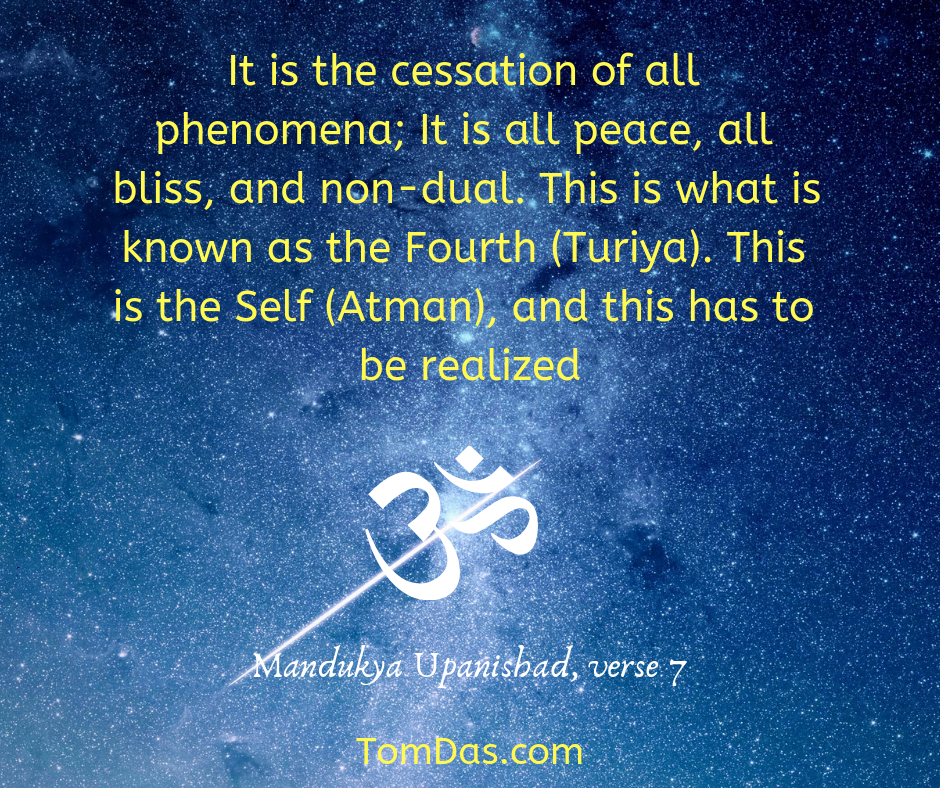
VII: Turiya is not that which is conscious of the inner (subjective) world, nor that which is conscious of the outer (objective) world, nor that which is conscious of both, nor that which is a mass of consciousness. It is not simple consciousness nor is It unconsciousness. It is unperceived, unrelated, incomprehensible, uninferable, unthinkable and indescribable. The essence of the Consciousness manifesting as the self in the three states, It is the cessation of all phenomena; It is all peace, all bliss and non—dual. This is what is known as the Fourth (Turiya). This is Atman and this has to be realized.

Tom: Turiya is here being equated with the Self, Atman, and it is this Turiya that is to be realised: ‘This is what is known as the Fourth (Turiya). This is Atman and this has to be realized’. This Atman is not conscious of the waking, dream or deep sleep state, nor is it mere ordinary consciousness – it is indescribable and it contains no phenomena within it, so states the Upanishad: ‘Turiya is not that which is conscious of the inner (subjective) world, nor that which is conscious of the outer (objective) world, nor that which is conscious of both…It is not simple consciousness…It is the cessation of all phenomena

 Gaudapada’s Karika continued

10 Turiya, the changeless Ruler, is capable of destroying all miseries. All other entities being unreal, the non—dual Turiya alone is known as effulgent and all—pervading.

Tom: Turiya ends all suffering, everything other than turiya is unreal

11 Visva and Taijasa are conditioned by cause and effect. Prajna is conditioned by cause alone. Neither cause nor effect exists in Turiya.

Tom: there is no cause or effect in Turiya

12 Prajna does not know anything of self or non—self, of truth or untruth. But Turiya is ever existent and all—seeing.

13 Non—cognition of duality is common to both Prajna and Turiya. But Prajna is associated with sleep in the form of cause and this sleep does not exist in Turiya.

Tom: In both deep sleep and Turiya there is no cognition of duality or cognition of objects – we can see that Gaudapada equates perception of objects with perception of duality. However in deep sleep the Self is not known as there is a cause or seed of ignorance present (the Sanskrit word ‘bija’ used in this verse means both cause or seed). In Turiya this sleep-seed of ignorance is not present.

14 The first two, Visva and Taijasa, are associated with dreaming and sleep respectively; Prajna, with Sleep bereft of dreams. Knowers of Brahman see neither sleep nor dreams in Turiya.

Tom: in Turiya (or for the knower of Brahman or the one who is Self-realised), there is no perception or arising of waking, dream or deep sleep

15 Dreaming is the wrong cognition and sleep the non—cognition, of Reality. When the erroneous knowledge in these two is destroyed, Turiya is realized.

16 When the jiva, asleep under the influence of beginningless maya, is awakened, it then realizes birthless, sleepless and dreamless Non—duality.

Tom: the reality (ie. Self or Turiya) is without birth (objects arising), without sleep, and without dream. ie. the waking, dream and deep sleep states are not present, nor do they arise in reality. So, do they disappear in self-realisation? Let us see…

17 If the phenomenal universe were real, then certainly it would disappear. The universe of duality which is cognized is mere illusion (maya); Non—duality alone is the Supreme Reality.

Tom: this verse is often quoted by itself without the preceding verses, and so misinterpreted. We can see in context that it is saying the following: if the phenomenal universe ever appeared, then it would certainly disappear. However, since the universe is maya, it (paradoxically to the mind) never actually appeared at all. There was only the non-dual Turiya or Self, nothing else. See here for more on this teaching.

18 If anyone imagines illusory ideas such as the teacher, the taught and the scriptures, then they will disappear. These ideas are for the purpose of instruction. Duality ceases to exist when Reality is known.

Tom: The same point is being made again – ie. in truth duality or maya or appearances never actually ever came about. Note that Gaudapada here, like elsewhere, equates appearances with duality.

Mandukya Upanishad – Verses VIII-XI:

VIII: The same Atman explained before as being endowed with four quarters is now described from the standpoint of the syllable AUM. AUM, too, divided into parts, is viewed from the standpoint of letters. The quarters of Atman are the same as the letters of AUM and the letters are the same as the quarters. The letters are A, U and M.

IX: Vaisvanara Atman, whose sphere of activity is the waking state, is A, the first letter of AUM, on account of his all— pervasiveness or on account of his being the first. He who knows this obtains all desires and becomes first among the great.

X: Taijasa Atman, whose sphere of activity is the dream state, is U, the second letter of AUM, on account of his superiority or intermediateness. He who knows this attains a superior knowledge, receives equal treatment from all and finds in his family no one ignorant of Brahman.

XI: Prajna Atman, whose sphere is deep sleep, is M, the third letter of AUM, because both are the measure and also because in them all become one. He who knows this is able to measure all and also comprehends all within himself.

Gaudapada’s Karika continued

19 When it is desired to describe the identity of Visva and the letter A, the chief ground given is the fact that each is the first in its respective sphere. Another reason for this identity is the all—pervasiveness of each.

20 The clear ground for realizing Taijasa as of the same nature as the letter U is the common feature of superiority. Another plain reason for such identity is their being in the middle.

21 The indisputable reason given for the identity of Prajna and M is the common feature that both are the measure. The other reason for such identity is another common feature, namely, that both represent the state of mergence.

22 He who knows for certain the similarity of the three states and the three letters of AUM, based upon their common features, is worshipped and adored by all beings and also is a great sage.

23 Through meditation on A the seeker attains Visva; through meditation on U, Taijasa; and through meditation on M, Prajna. Meditation on the “soundless” brings no attainment.

Mandukya Upanishad – Verse XII:

XII: The Fourth (Turiya) is without parts and without relationship; It is the cessation of phenomena; It is all good and non—dual. This AUM is verily Atman. He who knows this merges his self in Atman—yea, he who knows this.

Tom: like in verse 7, Turiya is again equated with Atman and AUM – it is without any parts, meaning there are no objects that can arise in it, again emphasised by stating it is without relationship – meaning there is no relative ‘truth’ present and it has no relation to objects or phenomena. This is further emphasised when it states ‘It is the cessation of phenomena’, as per verse 7 which states the same. It is all good, meaning it is pure positivity without any negativity whatsoever, without any opposite. It is non-dual, meaning without any time, space, people or objects. It is what you are. Aum Tat Sat. This will be further explained and elaborated upon in the following verses. See here for more on this teaching.

See here for the full text of Gaudapada’s commentary on the Mandukya Upanishad.
Shankara explains some fundamentals of Advaita Vedanta teachings in his introduction to his commentary on the Mandukya Upanishad | Do objects/does the world continue to appear in liberation? Gaudapada

Tom: Here in Shankara’s introduction to his commentary on the Mandukya Upanishad and his commentary on Sri Gaudapada’s Karika (ie. Sri Gaudapadas commentary on the same Mandukya Upanishad), Shankara explains some fundamental teachings of vedanta which may (or may not) suprise you!

Throughout, Shankara’s writings are in black whilst my comments are in italicised red.

Shankara gives these same teachings throughout his commentaries, eg. in the Brihadaranyaka Upanishad but also in many other places too. However these teachings are often missed, glossed over or re-interpreted by many current so-called traditional teachers of Vedanta.

The following translation is my own, and I have simplified the language to aid understanding. Below I have also provided the PDF of a more literal translation of this commentary by Shankara on the Mandukya Upanishad from Swami Gambhirananda of Advaita Ashrama (this is the translation that I recommend as it is the most literal of the available translations in English, and so has the smallest amount of distortion and re-interpretation according to the prior beliefs and prejudices of the translator) which you can also read, which states the same as my translation but perhaps using more complex and at times archaic language.

Shankara’s Introduction to his commentary on Mandukya Upanishad

Translated by Tom Das

Invocatory Mantra

Om! O gods, may we hear auspicious words with
the ears; while engaged in sacrifices, may we see
auspicious things with the eyes; while praising the
gods with steady limbs, may we enjoy a life that is
beneficial to the gods.

May Indra of ancient fame be auspicious to us;
may the supremely rich and all-knowing Pisa, god
of the earth, be propitious to us; may Garuda, the
destroyer of evil, be well disposed towards us; may
Brihashpati ensure our welfare.

Om! Shanti! Shanti! Shanti!
(Om! May there be peace! May there be peace! May there be peace!)

Tom: Some say that the Mandukya Upanishad, which is the smallest of the Upanishads consisting only of 12 verses, has no mention of God within it. They clearly have not read the invocatory verses above! Devotion and worship has always been a part of the nondual tradition of Vedanta. Below Shankara will provide 2 more invocatory verses that he has written:

Invocation by Shankara

I bow to that Brahman,
which after having enjoyed the gross objects [in the waking state],
by pervading all the worldly objects through a diffusion of Its rays of unchanging consciousness that embraces all that moves or does not move;
Which after having ‘drunk’ [during the dream state] all the variety of objects, produced by desire and lighted up by the intellect,
And sleeps [in the deep sleep state] while enjoying bliss
and making us enjoy through Maya;
and which is [in liberation] counted as the Fourth from the point of view of Maya,
and is supreme, immortal, and birthless.

Tom: Shankara in his first invocatory verses states that liberation, or Turiya, is called the Fourth state, but that this is only from the point of view of Maya (or ignorance), which admits of the 3 states. In true liberation, the 3 states, which are superimpositions on the Self, do not exist in any way shape or form, so Turiya is actually the Singular Reality and not the Forth state at all. This is explained in more detail later in the text by both Shankara and Gaudapada, and Shankara also explains this in more detail here in the text he wrote called Upadesa Sahasri.

The structure of Shankara’s invocatory verses also mimics the structure of the actual Mandukya Upanishad, which first explains the nature of the 3 states of waking, dream and deep dreamless sleep, before lastly explaining the nature of liberation (see verse 7 of the Mandukya Upanishad here), also known as the Self or Turiya, Turiya literally meaning ‘the fourth’ in Sanskrit. Let us continue with Shankara’s second invocatory verse:

May that Fourth one protect us which,
after having [in the waking state] identified Itself with the universe,
enjoys the gross objects created by the merits (and demerits) of past deeds;
After having [in the dream state] experienced through its own light the subtle objects of enjoyment that are called up by its own intellect;
Which [in deep sleep] withdraws promptly all these into Itself;
and which lastly [in liberation] becomes free from all attributes,
by discarding every distinction and difference [ie. by discarding all phenomenal appearances/objects].

Tom: the implication is that in liberation, there are no appearances of any objects, for these have been cast out, and that the appearance of any objects is tantamount to duality. This is further explained below. Let us read Shankara’s introduction to both the Mandukya Upanishad and to Gaudapada’s Karika:

Introduction to the text by Shankara

The word [or letter] Om is everything [idam sarvam, literally meaning ‘all this’ or ‘all things’]. This will all be explained in the rest of this following text.

The four chapters of Sri Gaudapada’s commentary on the Mandukya Upanishad, that sum up the quintessence of Vedanta, starts with the phrase ‘The word Om is everything…’. Because Gaudapada starts with this phrase, the stated aim and purpose of this text, which we would usually state at the start of any text on Vedanta, should be obvious and need not be stated here. Clearly the aim and purpose of the text is the unfolding of Vedanta.

However, as I am giving a commentary here, I should briefly state the purpose of the text. The text, as it explains the spiritual disciplines that lead to a desired goal, will naturally have an aim and subject matter.

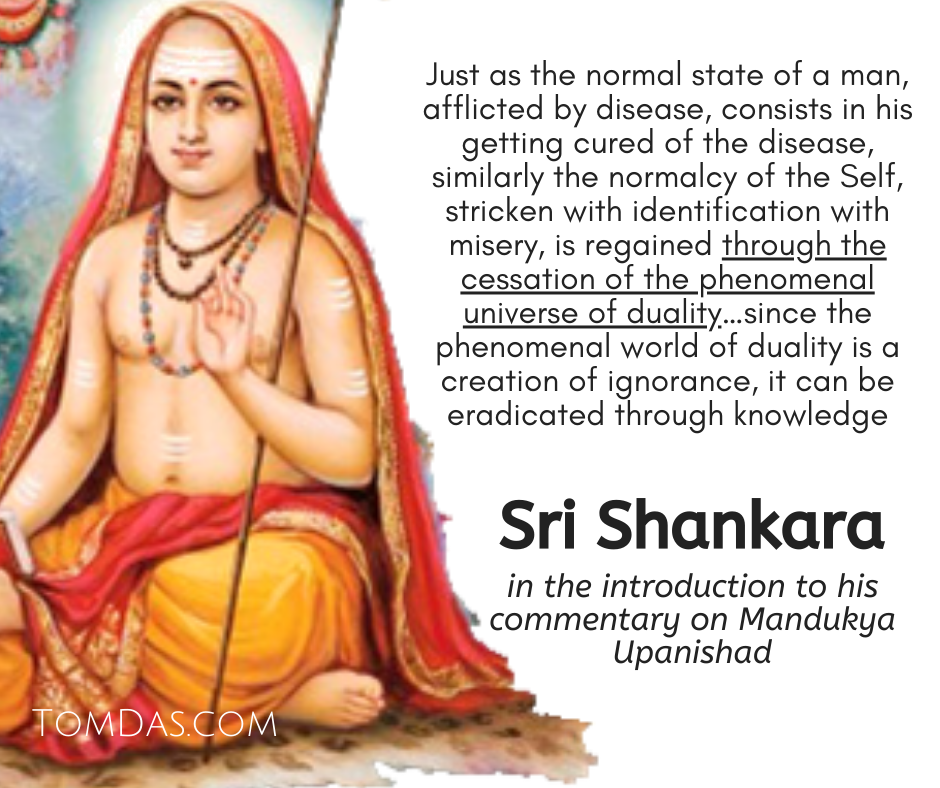
What is the aim of the text? Let me explain: just as a healthy person afflicted by disease will seek a cure for the disease in order to regain the natural state of health, the natural state of being the Self, when afflicted by suffering, will be returned to its ‘natural state of health’ through the cessation of the phenomenal universe of duality.

The aim therefore is the realisation of non-duality. Since the phenomenal world of duality is a creation of ignorance, it can be eradicated through knowledge.

Hence this text aims to reveal the knowledge of Brahman.

Tom: Shankara here is stating that the entire phenomenal world is a creation of ignorance, and that it needs to be eradicated for liberation to occur. This eradication of the phenomenal world can be attained through knowledge of Brahman, which is the same as liberation. The exact nature of knowledge of Brahman is explained later in this commentary here and how to attain this knowledge is explained by Gaudapada here and here.

Compare to Sri Ramana Maharshi when he says in the text Guru Vachaka Kovai in the following verses:

23. The Realised, who do not know anything as being other than Self, which is absolute Consciousness, will not say that the world, which has no existence in the view of the Supreme Brahman, is real.

28. O aspirants who hide yourselves away fearing this world, nothing such as a world exists! Fearing this false world which appears to exist, is like fearing the false snake which appears in a rope.

35. Since this world of dyads [knower-known] and triads [perceiver-perceiving-perceived] appears only in the mind, like the illusory ring of fire formed [in darkness] by whirling the single point of a glowing rope-end, it is false, and it does not exist in the clear sight of Self.

[Tom: The illusory ring of fire is a metaphor that Gaudapada himself uses throughout Chapter 4 of Gaudapada’s Karika].

87. Self appearing as the world is just like a rope seeing itself as a snake; just as the snake is, on scrutiny, found to be ever non-existent, so is the world found to be ever non-existent, even as an appearance.

Also compare also to Sri Ramana Maharshi when he writes in the beginning few paragraphs of his work entitled ‘Who Am I?’:

Q. When will the realization of the Self be gained?
A. When the world which is what-is-seen has been removed, there will be realization of the Self which is the seer.

Q. Will there not be realization of the Self even while the world is there?
A. There will not be.

Shankara will now justify his assertions by quoting from the highest scriptural authority in Vedanta, the Upanishads, let us see:

This fact is established by such Vedic texts as:

‘Because when there is duality, as it were, then one-smells something, one sees something…’ and so on (Brihadaranyaka Upanishad II. iv. 14);

‘When there is something else, as it were, then one can see something, on can know something’ (Brihadaranyaka Upanishad IV. iii. 31);

‘But when to the knower of Brahman everything has become the Self, then what should one see and through what? What should one know and through what?” (Brihadaranyaka Upanishad II. iv. 14).

Tom: we can see that Shankara is providing 3 quotes from the Brihadaranyaka Upanishad to back up this assertion, namely that appearances in the world, or perceiving things (apparently) through the senses, is the same as duality, and that all perceptions of the sense organs and all knowledge in the mind ceases with liberation. Now Shankara will summarise the contents of the 4 chapters of Gaudapa’s Karika (commentary) on the Mandukya Upanishad:

That being so, the first chapter explains the meaning of Om based on the traditional teachings [of Vedanta] and helps us to attain the reality that is the Self.

The second chapter aims to rationally prove the unreality of that phenomenal world of duality, on the cessation of which non-duality is attained, just as the reality of the rope is known on the elimination of the illusion of a snake imagined on it.

Tom: Shankara is again stating that non-duality or liberation is attained upon the cessation of the phenomenal world, which is duality, and Shankara gives the example of the rope and snake to justify his claim. We will only see the rope when the wrong-seeing or illusion of the snake (which causes fear and suffering) goes. Compare with Sri Ramana Maharshi when he writes in ‘Who Am I?:

Just as the knowledge of the rope, which is the base, will not be obtained unless the knowledge of the snake, the superimposition, goes, so the realization of Self, which is the base, will not be obtained unless the perception of the world, which is a superimposition, ceases.’

Shankara continues to summarise the contents of the last 2 chapters of Gaudapa’s Karika, and thus ends Shankara’s introduction to the Mandukya Upanishad. If you wish, you can compare my translation of Shankara’s introduction to this wonderful text to the more scholarly translation below by Swami Gambhirananda:

The third chapter aims to rationally establish the truth of non-duality, and to prevent it too from being negated by a similar process of argument.

The fourth chapter seeks to logically refute all the non-Vedic points of view, which are counterproductive to attaining of the truth of non-duality, and which remain concerned with this unreal duality.

Tom: we can see that in the last sentence of his introduction, Shankara is stating that the false teachings, ie. the teachings that do not lead to liberation, keep on coming back to the unreal duality, ie. false teachings keep on wanting to come back to the world of names and form, also known as maya. There is no Maya in the Self, and in truth there never was. This is the doctrine of ajata vada (no creation or no birth) that is famously explained in Gaudapada’s commentary on this Mandukya Upanishad.

The two main ways that the truly liberating teaching is distorted is firstly by stating that we do not need to turn within in order to realise the self, and secondly by stating that once the self has been realised we must turn back towards the world and integrate our newly-found non-dual understanding/ knowledge/ realisation with the world of phenomenal appearances.

Click here to a PDF of the full text as translated by Swami Gambhirananda of Ramakrishna Mission (Advaita Ashrama)

Q. How can I or Atman be beyond the EXPERIENCER as well as the doer? | Nisargadatta Maharaj

Q. Hello Tom , Thank you for your efforts in helping us. I have a doubt: Sri Nisargadatta Maharaj says that YOU ARE BEYOND THE EXPERIENCER – I understand that experiences changes but the experiencer is constant, but what can be beyond the experiencer, and does that mean we avoid experiences of our lives and even spirtiual realisation is a sort of experience, as we feel more peaceful and joyful, please explain this to me.

Tom:

Great question. The ego is both the experiencer AND the doer. These are both Maya (ie. illusion or fiction) or part of the waking dream. What you are, the Self, is beyond this Maya or waking dream.

Sometimes the Self is said to be the Witness, but this is not actually true, for it is the (fictional) ego that witnesses things/objects, it is also the ego that thinks, that emotes, etc. The Self is devoid of all phenomena. This can only really be understood fully by doing Self-Enquiry, eg. as per Sri Ramana’s instructions in the text Who Am I? or as more fully and clearly explained in The Path of Sri Ramana.

eg. See here verse 7 from the Mandukya Upanishad which explains that the Self is not truly the witness/observer of objects and also the Self is devoid of phenomena (note Turiya is another name for the Self (Atman means Self), as is also explained in the verse):

Turiya is not that which is conscious of the inner (subjective) world, nor that which is conscious of the outer (objective) world, nor that which is conscious of both, nor that which is a mass of consciousness. It is not simple consciousness nor is It unconsciousness. It is unperceived, unrelated, incomprehensible, uninferable, unthinkable and indescribable. The essence of the Consciousness manifesting as the self in the three states, It is the cessation of all phenomena; It is all peace, all bliss and non—dual. This is what is known as the Fourth (Turiya). This is Atman and this has to be realised.

~Mandukya Upanishad, Verse 7

Shankara, in his commentary on this verse also supports this reading of verse 7, where he also states that in Self-realisation, which is also called ‘Turiya’, there are no phenomena present at all; all the 3 states of waking, dream and deep sleep are no longer present in the Self in Truth (and they only appear due to ignorance).

For more see here in this post and also follow the links cited in the post.

Best wishes and Namaste

Gaudapada & Shankara: The Self is Attainable by ‘Samadhi’ | What is Samadhi according to Advaita Vedanta | Vedantic Samadhi

According to Advaita Vedanta, what is meant by Samadhi? And is this Samadhi necessary for Self-Realisation?

If you read the following carefully, you will see that Sri Gaudapada (in his Mandukya Karika) and Sri Shankara (in his commentary upon the Mandukya Karika) are both stating the following:

  1. The Self is realisable through Samadhi
  2. In Samadhi there are no thoughts present
  3. In Samadhi there are no gross or subtle objects present
  4. This Samadhi is not a state of mind, for the mind (and other objects) are not present in Samadhi
  5. This Samadhi leads to Jnana (Knowledge)

Whilst this is clearly explained in texts such as Shankara’s Vivekachudamani (see here for the series of verses in Vivekachudamani that emphasise the need for Samadhi) and many other Advaita texts, there are a minority who dispute the authorship of these texts saying it was not the original Shankara but a later Shankara that wrote these other texts. So here I will quote from Gaudapada’s Karika (Gaudapada’s commentary on the Mandukya Upanishad) and Shankara’s commentary on this.

Both Gaudapada and Shankara are considered authorities in Advaita Vedanta and in the case of these texts there is no dispute in the authorship – ie. everyone agrees that Gaudapada authored the Mandukya Karika and that Shankara’s commentary on this was actually authored by Shankara – so we can be clear this is the correct teaching that represents their views. Let us see:

1. The Self is realisable through Samadhi

The Self (Atman) is beyond all expression by words beyond all acts of mind; It is absolutely peaceful, it is eternal effulgence free from activity and fear and it is attainable by Samadhi.

~ Gaudapada, Mandukya Upanishad Karika 3.37

Some people translate the last phrase differently, but when we look at Shankara’s commentary on the verse, we can see the meaning is made clear, ie. the above translation is the correct one – the Self is attainable by Samadhi. In fact Shankara goes further, he states the Self is only realised through Samadhi:

Shankara’s commentary from the above verse from Gaudapada 3.37 states:
…The Self (Atman) is denoted by the word Samadhi as it can be realised only by the knowledge arising out of the deepest concentration (on its essence), Samadhi. Or the Self (Atman) is denoted by Samadhi because it is the object of concentration, the Jiva concentrates his mind on the Self (Atman)…

[Edit: since writing this article it has been pointed out to the me that the underlined word ‘only’ does not appear in the original Sanskrit, but this was an overzealous addition by the translator of this verse, Swami Nikhilananda, when he translated the commentary into English]

2. In Samadhi no thoughts are present

Now others will say that Samadhi doesn’t mean that all thoughts should cease, as that is yogic samadhi, and vedanta samadhi is something different in which thoughts and objects of perception can be present. However, what do Gaudapada and Shankara say? If we read carefully and slowly we will see that this question is also clarified:

In the next verse Gaudapada writes in verse 3.38 of his Mandukya Karika that all thoughts have stopped and that this leads to Jnana (Knowledge). Note that this verse is a continuation following on from the previous verse which has just stated the Self can be realised by Samadhi:

There can be no acceptance or rejection where all mentation stops. Then knowledge is established in the Self and is unborn, and it becomes homogenous

~Gaudapada, Mandukya Karika 3.38

We can see the emphasis is on cessation of all thoughts (‘all mentation stops’), implying this is what will happen in Samadhi. Then self-knowledge is established, the verse goes on to say, ie. once all mentation has stopped, then self-knowledge is established. Shanakra states this Self-Knowledge is unborn, meaning it was never created and is not subject to birth and death. This self-knowledge is also homogenous, meaning there are no differences in it whatsoever. This is another way of stating there are no objects perceived, for the presence of objects would make it heterogenous, not homogenous. Note that thoughts are also objects.

Again, some state this is not the correct interpretation of the verse, and that homogenous does not mean there are no objects present, but let us see what Shankara has to say in his commentary on the above verse:

Shankara’s commentary on this verse 3.38 is as follows:

…therefore there is no rejection or acceptance in It, where thought does not exist. That is to say, how can there be rejection or acceptance where no mentation is possible in the absence of the mind? As soon as there comes the realisation of the Truth that is the Self, then, in the absence of any object, knowledge (Jnanam) is established in the Self, like the heat of fire in fire. It is then birthless (ajati) and becomes homogenous.

Again, we can see that Shankara is clear that there are no thoughts, and therefore no mind (as mind is just the presence of thoughts, or the movement of thinking).

3. In Samadhi there are no gross or subtle objects present

Shankara also states clearly that Jnana (Self-Knowledge) arises in the absence of any objects being present in the above quote, the commentary on verse 3.38.

Later on we see this same theme being repeated, ie. that there are no objects or appearances present in this Samadhi which leads to Brahman-Realisation (ie. Liberation):

‘…when the mind becomes quiescent and does not give rise to appearances, it verily becomes Brahman’
~ Gaudapada, Mandukya Upanishad Karika 3.46

Shankara clarifies this further in his commentary on Mandukya Karika 3.46:

‘When the mind brought under discipline by the above-mentioned methods, does not fall into the oblivion of deep sleep, nor is distracted by external objects, that is to say, when the mind becomes quiescent like the flame of a light kept in a windless place; or when the mind does not appear in the form of an object – when the mind is endowed with these characteristics, it verily becomes one with Brahman.’

~ Shankara in his commentary on Gaudapada’s Mandukya Karika 3.46

We can see that Shankara is stating in Samadhi, which was earlier advocated as the means to liberation, is devoid of objective phenomena when he writes ‘the mind does not appear in the form of an object’ above. We can also see that he is stating there are no thoughts in Samadhi, when he writes ‘when the mind becomes quiescent’.

Anandagiri, a 13th century commentator on Shankara’s works, confirms this in his comments on Karika 3.46:
‘The external objects are nothing but the activities of the mind itself.’

So we can see that mind activity and external objects are one and the same, and that samadhi is devoid of both

4. This Samadhi is not a state of mind, for the mind (and other objects) are not present in Samadhi

So we can see that Samadhi is not simply a state of mind – Shankara states it is the absense of mind and thought and objects. How can samadhi be a state of mind if there is no mind present in Samadhi? Samadhi is beyond the mind. Samadhi is the Self.

States of mind come and go, and the mind, being an object, is a part of Maya. However Samadhi is to abide as Self.

This is the meaning of nididhyasana – to abide as Self, the pure Consciousness that we already are. It is explained in detail in traditional advaita texts like Vivekachudamani and Advaita Bodha Deepika, and Sri Ramana Maharshi’s teachings point us unwaveringly to this same teaching too.

5. This Samadhi leads to Jnana (Knowledge)

Well I have no further quotes for you in this section – you should hopefully already be able to see from the quotes given above that Jnana arises from Samadhi, and this Samadhi is devoid of thoughts and objects. However, in this section I will re-present the above quotes with the emphasis on Samadhi leading to Jnana. In order to do this I have abbreviated some of the quotes (as indicated by ‘…’), the unabbreviated versions being present above:

Eg. here Gaudapada states the Atman can be attained through Samadhi.

‘The Self (Atman)…is attainable by Samadhi.’ ~ Gaudapada, Mandukya Upanishad Karika 3.37

Shankara goes further and states that Samadhi leads to Knolwedge in his commentary on the above verse:

…The Self (Atman)…can be realised only by the knowledge arising out of…Samadhi.’

Then Gaudapada also states that when all thought ceases Knowledge arises:

‘…where all mentation stops. Then knowledge is established in the Self…’ ~Gaudapada, Mandukya Karika 3.38

Shankara’s commentary on this above verse 3.38 unsurprisingly states the same:

in the absence of any object, knowledge (Jnanam) is established in the Self…’

Conclusion

So hopefully we can now clearly see that, according to Gaudapada and Shankara:

  1. The Self is realisable through Samadhi
  2. In Samadhi there are no thoughts present
  3. In Samadhi there are no gross or subtle objects present
  4. This Samadhi is not a state of mind that comes and goes, for the mind (and other objects) are not present in Samadhi
  5. It is this Samadhi that leads to Jnana (Knowledge)

I hope the above verses are of help for you. The above is just one of a series of articles I have written on this topic – please see below for some of the other posts that discuss this further.

Namaste

Tom

Also see:

The need for nirvikalpa samadhi according to Advaita Vedanta – Swami Advayananda | Swami Chinmayananada

HOW SWAMI SATCHITANANDENDRA SARASWATI (SSS) DEFINES NIDIDHYASANA (VEDANTIC MEDITATION)

Shankara: How to Meditate for Self-Realisation |Nididhyasana | Samadhi

Advaita Vedanta: Gaudapada’s Method (Mandukya Upanishad Karika)

Recommended Reading: Books for Enlightenment, Liberation and Self-Realisation

What exactly is Jnana (knowledge) according to Shankara and Gaudapada and the scriptures?

Shankara: how to Realise the Self (Shankara’s commentary on the Brihadaranyaka Upanishad)

The Waking State is another Dream | Shankara, Gaudapada, Upanishads | Advaita Vedanta | Sri Ramana Maharshi

Here we will see, using quotes from Gaudapada, Shankara, the Upanishads and Sri Ramana Maharshi that the same essential teaching is taught regarding the reality of the waking and dream states – namely that they are both equally unreal, that both waking and dream are dream!

Gaudapada

Tom: Here is verse 1 from chapter 2 of Gaudapada’s Mandukya Karika (Gaudapada’s four chapter commentary on the Mandukya Upanishad – you can read the full text here), my comments are in red:

2.1. Harih Aum. The wise declare the unreality of all entities seen in dreams, because they are located within the body and the space therein is confined.

Tom: Gaudapada is essentially stating something we already know, namely that we dream of many things, but all these things we dream of are not actually real. They are all projections of the mind, which is what Gaudapa means by ‘located within the body and the space therein is confined’

2.2. The dreamer, on account of the shortness of the time involved, cannot go out of the body and see the dream objects. Nor does he, when awakened, find himself in the places seen in the dream.

Tom: Again, Gaudapada is stating what we already know about dreams. Shankara in his commentary on this verse explains this means that if we dream of going to a far away land many hundreds of miles away that would take several months to travel to, there is not enough time in dream, which only lasts a few hours, to actually travel there. Similarly, when we wake from the dream, we do not find ourself in this dream location far away.

2.3. Scripture, on rational grounds, declares the non-existence of the chariots etc. perceived in dreams. Therefore the wise say that the unreality established by reason is proclaimed by scripture.

Tom: Gaudapada in verses 2.1 and 2.2 has shown that the many things perceived in dreams are not real on the basis of our own experience. Now he is stating the same based on scripture, referring to Brihadaranyaka Upanishad 4.3.10, which states, referring to a dream about chariots:

‘There are no chariots, nor animals to be yoked to them, nor roads there, but he creates the chariots, animals and roads. There are no pleasures, joys, or delights there, but he creates the pleasures, joys and delights. There are no pools, tanks, or rivers there, but he creates the pools, tanks and rivers. For he is the agent’.

The idea from Gaudapada is that if we dream of a chariot, that chariot is not real, as confirmed by scripture. Note that the teaching that is given in the next two verses is essentially the same as the teaching given in Brihadaranyaka Upanishad 4.3 (please see this link for more).

2.4. The different objects seen in the confined space of dreams are unreal on account of their being perceived. For the same reason, ie. on account of their being perceived, the objects seen in the waking state are also unreal. The same condition ie. the state of being perceived exists in both waking and dreaming. The only difference is the limitation of space associated with dream objects.

Tom: Gaudapada is now equating the dream and waking states, stating that just as dream objects are perceived but not real, the same is with the waking state objects – they are also perceived yet utterly unreal. Does this mean we are to consider the waking state as unreal as a dream? The answer is yes, let us see:

2.5. Thoughtful persons speak of the sameness of the waking and dream states on account of the similarity of the objects perceived in both states on the grounds already mentioned.

Tom: The translation used thus far is that of Swami Nikhilanananda of the Ramakrishna Order. Swami Gambhirananda, also of the Ramakrishna Order, translates the last line of verse 2.5 as the wise say that the dream and the waking states are one.

Shankara

In his commentary on Gaudapada Karika verse 2.5 (above) Shankara states ‘…therefore discriminating people speak of the sameness of the states of waking and dream.

We can see that Gaudapada and Shankara are both explicitly stating that the waking state is another form of the dream state, and whilst we often distinguish between waking and sleep, they are actually both dream states, and all that is perceived within waking and dream are equally unreal.

Again, note that this teaching is also given in Brihadaranyaka Upanishad 4.3

We see the same teaching given much more concisely in Shankara’s masterpiece, Vivekachudamani:

170. In dreams, when there is no actual contact with the external world, the mind alone creates the whole universe consisting of the experiencer etc. Similarly in the waking state also; there is no difference. Therefore all this (phenomenal universe) is the projection of the mind.

Tom: We can see that Shankara is saying that the mind projects both the dream state and the waking state. Note that this is essentially equating the mind with maya. Shankara goes on to reiterate this view in subsequent verses:

171. In dreamless sleep, when the mind is reduced to its causal state, there exists nothing (for the person asleep), as is evident from universal experience. Hence man’s relative existence is simply the creation of his mind, and has no objective reality.

177. The mind continually produces for the experiencer all sense-objects without exception, whether perceived as gross or fine, the differences of body, caste, order of life, and tribe, as well as the varieties of qualification, action, means and results.

Tom: Above we can see that Shankara has equated Mind with Maya. Now he will equate Mind with Ignorance. We can deduce that all three, Mind-Maya-Ignorance, are just three names for the same phenomenon:

180. Hence sages who have fathomed its secret have designated the mind as Avidya or ignorance, by which alone the universe is moved to and fro, like masses of clouds by the wind.

Sri Ramana Maharshi

Like Shankara and Gaudapada, Sri Ramana also equates ignorance and maya, and he further says the same phenomenon is also called ego, jiva, conceit, and impurity – ie. all these various words mean the same thing, and that this ignorance is essentially the ‘I am the body idea’ – see here, taken from the text Vichara Sangraham (Self-Enquiry) in the answer to question 3:

Sri Ramana Maharshi:…Therefore, the ‘I-consciousness’ which at first arises in respect of the body is referred to variously as self-conceit (tarbodham), egoity (ahankara), nescience (avidya), maya, impurity (mala), and individual soul (jiva).

In question 10 of the same text, Vichara Sangraham (Self Enquiry), Sri Ramana says the following:

Question: If the entire universe is of the form of mind, then does it not follow that the universe is an illusion? If that be the case, why is the creation of the universe mentioned in the Vedas?

Sri Ramana Maharshi: There is no doubt whatsoever that the universe is the merest illusion. The principal purport of the Vedas is to make known the true Brahman, after showing the apparent universe to be false. It is for this purpose that the Vedas admit thecreation of the world and not for any other reason…this world arose like a dream on account of one’s own thoughts induced by the defect of not knowing oneself as the SelfThat the world is illusory, everyone can directly know in the state of Realisation which is in the form of experience of one’s bliss-nature.

In the text Nan Yar? (Who Am I?), Sri Ramana writes:

Sri Ramana Maharshi:…The world should be considered like a dream.

Question: Is there no difference between waking and dream?

Sri Ramana Maharshi: Waking is long and a dream short; other than this there is no difference. Just as waking happenings seem real while awake, so do those in a dream while dreaming.

So, what now? Now we must put the teachings into practice to realise the truth of them:

Also see:

Shankara: How to Meditate for Self-Realisation| Vivekachudamani | Nididhyasana |

Advaita Vedanta: Gaudapada’s Method (Mandukya Upanishad Karika)

Ramana Maharshi: how to abide as the Self, the world is not real, attend to yourself

IN BRIEF: HOW TO ATTAIN LIBERATION (MOKSHA)

Om red multiple


This is one of a series of introductory articles – please see the homepage of tomdas.com for more introductory articles. For more detailed explanations of the entire path to liberation please see this following link – I recommend you read and study the two texts found here and put them into practice: The Path of Sri Ramana

Alternatively you can explore one of more of these books: Recommended Reading: Books for Enlightenment, Liberation and Self-Realisation

Also see Q. I already know I am not the body-mind but I still have difficulty with the teaching and with aspects of daily life

Suffering: our predicament

Ever-obsessed with the transient*, we suffer. Ever-involved with that which changes*, the Self remains (seemingly) covered** and unrealised, and so we, taking ourselves to be a separate body-mind entity, remain in bondage and illusion and continue to suffer and feel confused.

Our True Nature

What you truly are has never suffered, has never undergone change, has never been confused and never been subject to birth, death, illusion or delusion. It is beyond both happiness/peace and suffering/sorrow. It is that pure consciousness ‘within’, it is That which you truly are.

How to Attain Liberation (Moksha)

Release yourself from this suffering and destroy ignorance in its totality by turning away from transient things and attending to your Self, that Pure Consciousness which is You. Turn your attention to That Which You Are and in doing this Be What You Are. Know the Knower, attend to the Seer, that is, Be Your Self and abide as such, until illusion/suffering/ignorance/doubt is no more.

Why This Practice is Necessary

For most, without this sadhana (spiritual practice), ignorance will continue to rise up again and again due to the strength of the habitual tendencies (vasanas) to identify as a separate body-mind entity, and so confusion and suffering will continue as will the seeking and various doubts.

See here for why other ways tend not to work.

In Summary

So Attend to what You Are, Be what You Are, Abide as the Self until ego/maya/ignorance/delusion is no more 🙏

Also see here: Self-Enquiry is not a ‘doing’, it is a ‘being’

🕉🕉🕉***

OBJECTIONS: Turn within? Really?

For objections that the mind throws our way, please see the following posts:

Q. Turn Within? Really? Isn’t this dualistic and doesn’t this just strengthen the ego?
Q. Isn’t it unhealthy and inhumane to turn away from the world? This kind of denial hasn’t worked for me. Integration is working.
Q. Why turn within? Nonduality as I have experienced it is the actual disappearance of what is considered within and without, one seamless blending
Q. Doesn’t the notion of ‘turning within’ to find yourself create an artificial duality? All is already one!
Q. Who or what does Self-Enquiry? Why still the mind? Isn’t this more mind?

Notes

*’the transient’ or ‘that which changes’ refers to the body, mind (thoughts, feelings, imaginings, experiences, conceptual knowledge) and the world, also known as Maya or illusion.

**for practice purposes of the teaching, in this context it is said that the Self is covered by Maya, as this is how it seems to the suffering seeker of truth and liberation. This aspect of the teaching has a practical orientation and places instruction on the path to liberation above mere conceptual/intellectual notions such as ‘the Self is never covered’, etc. These intellectual notions are are often used by the ego to avoid spiritual practice and liberation, which is the ending of egotism, and perpetuate ignorance-ego-suffering.

***the True Self is symbolised by the symbol ‘Om’, the Pure Consciousness within, that which is beyond name, form, description, conceptualisation, knowledge or experience. It is beyond both suffering and happiness/peace. It is also the meaning of the terms ‘true knowledge’ (Jnana) and ‘direct experience’ (Aparokshanubhuti), Bliss (Ananda) and Peace (Shanti), and Non-Duality (Advaita). It is what is signified in the Mandukya Upanishad as Turiya or AUM

Also see

This first link, The Path of Sri Ramana, contains detailed descriptions and explanations of the entire path in an easy to read way. I recommend you read, study and put into practice these two texts:

The entire path explained: the Path of Sri Ramana (Parts 1 and 2; PDF downloads)

Ramana Maharshi: how to abide as the Self

How to know God. How to see God.

Ramana Maharshi: Know the Knower

Ramana’s own writing: Who Am I? (Nan Yar?) by Sri Ramana Maharshi

Q. What in brief is the means to know one’s own real nature? What is the effort that can bring about the sublime inner vision?

Sri Ramana Maharshi: Strenuously withdrawing all thoughts from sense objects, one should remain fixed in steady, non-objective [ie. subjective] enquiry. This, in brief, is the means of knowing one’s own real nature; this effort alone bring about the sublime inner vision.

Sri Ramana Gita, Chapter 3, verses 4-6

If, on the contrary, you withdraw your mind completely from the world and turn it within and abide thus, that is, if you keep awake always to the Self, which is the substratum of all experience, you will find the world, of which alone you are now aware, just as unreal as the world in which you lived in your dream.

Ramana Maharshi, Maharshi’s Gospel

291. If one wants to be saved, one is given the following true and essential advice: just as the tortoise draws all its five limbs within its shell, so one should draw the five senses within and turn one’s mind Selfward. This alone is happiness.
 
Sri Ramana Maharshi, Guru Vachaka Kovai verse 291
 
Commentary from Sri Sadhu Om on the above verse:
This important advice, to withdraw the mind from the five senses and to turn it Selfward, is not given to one and all; it is given only for the benefit of those who wish to save themselves, and not for those who are still vainly hoping to save the world. Such people, who want to save the world, will find no taste for Self-attention, and thus they are not yet fit even to save themselves, let alone to save the world; unless one has first learnt to swim, it is vain and futile to jump into the water to save others.

The Upanishads and Vedanta

I have collated a whole series of quotes from the Upanishads, Shankara and Vedanta texts that give the same teaching here.

Some further very brief examples are given below:

Amritabindu Upanishad:

The mind severed from all connection with sensual objects, and prevented from functioning out, awakes into the light of the heart, and finds the highest condition. The mind should be prevented from functioning, until it dissolves itself in the heart. This is Jnana, this is Dhyana, the rest is all mere concoction of untruth.

Advaita Vedanta: Gaudapada’s Method (Mandukya Upanishad Karika):

When the mind…remains unshakable and does not give rise to appearances, it verily becomes Brahman.

The controlled mind is verily the fearless Brahman.

When the mind, after realising the knowledge that Atman alone
is real, becomes free from imaginations and therefore does not
cognise anything, for want of objects to be cognised, it ceases
to be the mind.

Shankara: How to Meditate for Self-Realisation:

Dwelling on external objects will only increase evil propensities, so wisely recognising this fact, one should abandon external objects and and constantly attend to one’s true nature within, the Atman [the Self].

Yoga Vasishta Sara (The essence of the Yoga Vasishta)

Katha Upanishad:

When the five organs of perception become still, together with the mind, and the intellect ceases to be active: that is called the Supreme State [Brahman]

Svetavastara Upanishad:

Be absorbed, through samadhi, in the eternal Brahman.

Brihadaranyaka Upanishad:

The Self alone is to be meditated upon.

Mandukya Upanishad:

Mandukya Up not simple consciousness

Mandukya Up cessation of all phenomena

Om red multiple