Ramana, Birthdays & The Deathless | Sri Ramana Teachings

In this Satsang moment with Tom Das, we explore death, non‑duality and the deathless truth that is never born and never dies. In this short clip that follows a longer talk on death, recorded in the video “Facing Death, Finding The Eternal”, Tom shares why Ramana Maharshi felt it made no sense to celebrate his birthday, and points us back to the timeless Self beyond birth and death. Tom also speaks about the dangers of organized religion when it loses its living spirit, the importance of not throwing out the “baby with the bath water,” and the risks of so‑called new religions that claim to offer a brand‑new way to the same eternal truth. With a gentle tone and the occasional hard‑hitting insight, this satsang invites you to question second‑hand beliefs and look directly at the unchanging awareness that you are.

This video was recorded live during a Satsang meeting with Tom Das on January 22nd, 2026 and put together by volunteers.

To download full unedited satsang recordings see here: https://payhip.com/tomdas

To attend satsang, see here: https://tomdas.com/events

For guided meditations see the ‘guided meditation’ playlist here:     / tomdasnonduality  

For recommended reading for liberation see here: Recommended Reading: Books for Enlightenment, Liberation and Self-Realisation

Q. Why are some of our prayers not answered? How to know if a Jnani is genuine? | Sri Ramana Maharshi | Aham Sphurana

The excerpt below is taken from the text Aham Sphurana (see here to find out more about this text and download a copy for free), 20th July 1936:

Questioner: It happens to some that they pray – in all good faith – to God, yet their prayers are unequivocally repudiated. What is the reason?

Bhagavan Sri Ramana Maharshi: Can you be trusted to know what is best for you?

Q.: I should hope so.

B.: That is your opinion.

Q.: What then is Sri Bhagawan’s opinion?

B.: ‘O Lord, thou hast searched me, and known me. Thou knowest my downsitting and mine uprising, thou understandest my thought afar off. Thou compassest my path and my lying down, and art acquainted with all my ways.’

Q.: The implication being?

B.: He knows what is best for you; you do not. Therefore unconditionally surrender yourself to him and leave your fate in his hands. That is the only thing to be done. Prayer is merely a lower form of surrender. It is highly prone to failure, because if what is asked does not aid Realisation, it may not be granted, even though you may be thinking that what you are asking is going to [serve as an] aid in Realisation. Or, your karma may not permit the request to be granted.

Q.: Spiritually-inclined people pray for strength to inrovert the mind. Or, they pray for Self-Realisation. How can that be not an aid in Realisation?

B.: Because it posits the dangerous notion that there exists an [individual] “I” who craves for himself the state called Realisation. Such prayers are unnecessary. Maam Aekam Sharanam Vraja. ‘Only surrender to Me.’

Q.: Why does God allow karma to meddle with even the efforts of sincere aspirants who are trying to Realise?

B.: The arrangement of karma – [for karma itself is] unavoidable – is actually adroitly done in such a way as to give the sadhaka the maximum possible chance of completely cleansing the mind of all vritts. So, if you are destined to Realise in this lifetime, rest assured that your karma has been ingeniously arranged in such a manner as to inevitably take you to the Goal.

Q.: And if I am destined otherwise?

B.: Perhaps you would not be here today.

Q.: The same astute God who manipulates karma so carefully – why was he not careful enough to safeguard the Self from slipping into the bondage of ignorance?

B.: Does the Self complain of having thus fallen?

Q.: No. But I do.

B.: Are you apart from the Self?

Q.: The mahavakyas state that I am supposed to be one with Brahman.

B.: And your Experience is in Corroboration?

Q.: Alas! No. All I feel is the miserable ego.

B.: Yes. Misery is one with the ego. Kill the ego.

Q.: It seems to be an impossible accomplishment even for those with decades of systematic training in the spiritual field.

B.: There is no accomplishment possible. What is intimate and inherent cannot be accquired. The only thing to do is destroy the useless accreations that cause all the nuisance. We are not trying to attain anything. On the other hand, we are trying to give up everything.

Q.: Should I not try to attain Realisation of the Self?

B.: No. Give up everything. Only the Self remains.

Q.: It sounds simple enough. Yet, only one in a million men manage to reach this supreme state, according to Sri Krishna. Does it mean that, at any given point of time in the world, the number of Jnanis living should be a precise 0.0001% of the total population?

B.: [laughing] Possibly!

Q.: In my view even this seems an outlandish estimate. Are there now circa 269 Jnanis living in India, then, regard having been had to the numbers available by the 1931 Census?

B.: [somewhat mordaciously but without deviating from his good cheer] Why not? Do you suppose all Jnanis are unfortunate enough to be put in a cage like this, and put up for ‘public examination’? [in English:] Ladies and gentlemen, presenting… THE FREAK SHOW! Exhibit No. 1 – Sharji, the Venus of the Hottentots! Exhibit No. 2 – Elephant-man Merrick! Exhibit No. 3 – The ‘Bhagawan’, Ramana! அ என்ன பாழாகப் ேபான பகவானே◌ா [Tom: What a waste, O Lord] . No. Only those whose prarabdha is destined to be exceedingly miserable suffer like this! Sri Gandhiji has written, ‘The woes of Mahatmas are known to Mahatmas alone.’ [laughs heartily]

Q.: Other Jnanis, who, according to Bhagavan, enjoy a better prarabdha – they would be meditating in solitary places such as inaccesible jungles and caves, well away from habitable zones of humanity, I presume…

B.: You may presume whatever you like, no doubt…

Q.: So I am wrong?

B.: It all varies according to prarabdha. The Jnani is unfazed by what happens to the body. He has nothing to do with it. He has no localised consciousness functioning from within it. Killing it cannot harm him. Torturing it cannot affect him. He is absorbed by the Beyond, and quite lost there – for good. He may have 4 wives and 32 children. He may be running a busy household with dozens of mouths to feed. He may be employed on both day and night shifts of duty. Or, again, he may be sitting in an inaccesible cave with sensory organs in an inactive state, body rotting. It may be either way, but all this can be only from the point of view of the onlooker, since action is altogether alien to the Jnani; he himself knows nothing, sees nothing, does nothing. He has quite perished. Only a Jnani can tell who is a Jnani.

A person might look like a simpleton, yet he might know himself as the immortal Self. Another may display an unending spout of vedantic learning, yet his mind may not in the least have subsided. In this topsy-turvy world, which must needs always judge by its usual yardstick of ‘doing’, it is the latter who is generally extolled as the genuine case. The result? Misery for all involved. People cheat themselves into believing that they are in the vicinity of a great Mahatma. The pretender eventually himself foolishly comes to believe that he must indeed be a great Jnani, since so many people praise him day and night. So his ego becomes bloated; as a consequence he lands himself in all sorts of unpleasant situations. So, display of vedantic learning may cause a great very many problems for all involved. It is best to keep quiet.

Q.: Bhagavan said a Jnani may have numerous wives. Polygamy is a sin as per Hindu dharma. Can a Jnani sin, then? As far as my knowledge goes, the Manusmriti allows taking the next wife only if the existing wife or wives are mentally ill, infecundous, or unable to participate in rituals for the departed ancestors.

B.: What the Jnani does is always right. This does not mean that a man is morally excused in pretending to be a Jnani and then conveniently committing all sorts of crimes.

Q.: But how to tell who is a genuine Jnani?

B.: Only by yourself becoming lost in Jnana. However, there is one exceedingly rare exception. If a particular Jnani is destined to be your Jnanaguru, when you meet him there is an inexplicable mutual outpouring of ecstatic Love. The Love mentioned here is not consummated by any physical act. It is consummated only by surrendering to the object of such Love. The Jnani himself never loves or hates; only, when he meets one who is destined to be placed in his ultimate care, he directs his attention toward that person. It is not volitionary, but rather Automatic Divine Activity. There is nothing in him left to choose. Unto one who has the pakkuvam [Tom: ripeness], the Grace or Love begins to flow of its own accord. The Jnana-guru might not look at the mature devotee or exchange words with him, yet, one who is Ready feels the irresistible onslaught of inevitable rapid mental introversion in the form of blissful divine Love. This way you can tell that the person in whose presence you have such experience, is your Jnana-guru. Again, this might not happen in the case of all aspirants.

Q.: I have so far not had any such novel experiences with Bhagavan. Can I still Realise in this lifetime?

B.: All will turn out Right in the end.

Q.: Sometimes Bhagavan does not look at visitors. He does not respond to their queries. Does he refuse them his impartial Grace?

B.: Have you seen how they seperate chaff from the Grain here? They pour the seeds on the றம◌் , and then trenchantly shake it in a speedious upand-down motion. Can you guess the scientific principle underlying the act?

Q.: What is worthless and light in weight is blown away by the wind. What is precious and heavy is not affected by the movement. Yes, it is clear now.

B.: நல்லத◌ ! [Tom: good]

Q.: One imagines things and enjoys them by virtue of his strength of imagination. It is said that gross manifestations of such mental creations are possible for Brahma the Creator. Should the same power not be available with His creation, man?

B.: That is your opinion.

B.: J.K. says that man should try to find out the ‘I’. Then ‘I’ dissolves away, being only a bundle of circumstances. There is nothing assertible behind the ‘I’. His teaching seems to be very much like the Buddha’s.

B.: Yes. The truth is well beyond possibility of conceptual expression or explanation. It is pure Experience only, for there is no experiencer. When you finally do reach the Self, you will be shocked to discover that you have been foolishly searching frantically for something that was always right in front of your nose – no, even closer, for the nose and the object in front of it must be seen with the eye to ascertain their apparent existence, whereas the Self requires no perception to support its actual existence. The Self is pratyakshasakshathswayamprakasha-swaroopam. Everything shines in and by its light, but it knows nothing but itself. It shines by its own light alone. The lusturous beauty of it never fades. It is truly immutable, indestructible and imperishable. One who loses himself in it has no more cares or worries. It is the one true goal of man’s life, yet it is here and now. That is the great mystery.

Ramana Maharshi: Q. How to surrender and how to live and survive if we have completely surrendered? Partial surrender vs total surrender | Aham Sphurana

3rd August, 1936

Q.: After conversing with several devotees here, I have arrived at a rough observation that Sri Bhagavan gives spiritual advice which pertains to every conceivable genre, depending upon the inclination, maturity or palate of the aspirant in question. What, if any, is his nativistic teaching?

B.: [no response]

Q.: Is it Silence?

B.: Yes.

Q.: For those unfit to understand it?

B.: They are advised to keep quiet. [Summa iru.]

Q.: For those even this?

B.: The inquiry ‘Who-am-I?’ is suggested.

Q.: For those like me who lack the determination to practise this inquiry?

B.: Unconditional surrender.

Q.: To whom shall I surrender? To Sri Bhagawan or to my Guru Sri Chandrasekara Barathi of the Sringeri Mutt?

B.: Does surrender need a recepient? Simply surrender or let go of everything.

Q.: If I let go of everything, is Mukti assured unto me?

B.: To let go of everything is to let go of this question also.

Q.: So, expecting a reward for surrender is not appropriate?

B.: How can one who has surrendered expect anything? To surrender is to give up the spurious ‘you’ once and for all. When you are not there at all, where is the question of expecting or anticipating anything? Who would be there to do the expecting or anticipating? If there is still anyone left to engage in expecting or anticipating, no surrender has really taken place.

Q.: If I give up everything, what will happen to my body? How then will it be able to find food for itself, leave alone earn a living or maintain a family?

B.: Were you asked to neglect the body? You were asked to not deliberately take care of the body – that is all. How is it that you translate the directive, ‘Let go of everything.’ into ‘Neglect the body and its duties.’? The problem in its totality lies in the fact that you are labouring under the delusive impression that it is you as the ego who are maintaining your body, attending to your vocation, taking care of the household and everything else that it has fallen upon the body’s prarabdha to execute in this lifetime. So, when asked to give up everything, that is to say give up the ego, you give yourself to understand that your regular routine will come to a standstill.

No. Whether you are aware of it or not, whether you like the fact or not, the truth is that it is the Higher Power that does everything. We imagine ourselves to be the doer. When asked to give up the personal self, we imagine that the body’s actions also should come to cessation, because according to us, it is the personal self that is the cause and source of all action. No. It is a mistake. The ego merely fraudulently assumes responsibility for the actions of the body. Doerless doing or actorless action is not for the Jnani only; it is true – as an actual fact – in the case of all. In the case of the ajnani, something called “I” rises up to falsely claim responsibility for the body’s actions. This fictitious accreation is absent in the case of the Jnani. That is the only difference between them.

If you give up the ego or ‘Body-am-I.’ idea completely, some power effortlessly takes over the body and makes it run through its ordained course of prarabdha without the need for the least mental involvement or participation on your part. This is a matter for experience. To surrender is to totally let go of everything. People attached to concepts of the intellect or things of the world cannot possibly let go; vairagyam is necessary to let go. How to cultivate vairagyam? Proximity to the Guru.

Worldly attachment and the Guru pull the mind in opposite directions. If Love for the Guru is unequivocal and unconditional, His pull eventually wins. Again, how to cultivate this Love? By nature the minds of most men are occupied with the problems of the personal self. What vocation shall I pursue? Shall I study further or shall I opt for employment? Shall I marry the girl I like, or shall I marry the other one, the rich, obese character that I was introduced to by my parents? What measures shall I take to safeguard myself from penury in old age? How shall I ideally invest my wealth so that it stands me in good stead when I am no longer in a position to actively work to earn a living? Will my children take care of me in old age or will they abandon me and go their seperate ways? And so on and so forth.

This is how lifetime after lifetime is wasted. If you would only keep quiet without thinking these thoughts, providence would admirably take care of you; but no, you must have your ‘knowledgeable say’.

It so happens that in rare cases a man ceases to take thought of his personal self and wholeheartedly gives himself to an ideal of beauty, be it sport, literature, art, patriotism or anything else. The quantum of importance attributed to the personal self becomes negligible when the loftier pursuit occupies the whole of his attention. Thus he begins, for the first time, to experience a Love in which the personal self has no space. Such is the sweetness of this passionate Love that he yearns to experience the pinnacle thereof. The desire for this feeling of Love is not motivated by the objective of personally experiencing it. The Love for the higher ideal eventually comes to dominate and possess the soul with such complete fervour that his desire for such Love is not on account of any motive to personally experience it, but simply for the sake of such Love itself.

He does not think, I must experience more of this Love. He thinks, this Love must shine forth with the utmost possible intensity! Then, the ideal towards which Love hitherto had been directed merges imperceptibly into Love itself. Thus, the man is left with Love and only Love in his hands: Love without rhyme or reason.

Feeling it but unable to attain it, he becomes crazed with longing. It is at this stage that God or Guru appears to him as the manifestation of his Love: the manifestation may or may not be an anthropomorphic form; it may be an abstract image or ideal altogether deviod of form or even name. Eager to consummate his Love, he surrenders totally to the Guru and Realisation devours him by operation of the Guru’s benevolent grace.

Swami Vivekananda has said, ‘Take up one idea. Make that one idea your life – think of it, dream of it, live on that idea. Let the brain, muscles, nerves, every part of your body, be full of that idea, and just leave every other idea alone. This is the way to success.’.

So, volitionless Love, which, allowed to wax indefinitely, surely leads to Kaivalyam, may as well come to an inveterate materialist or atheist: belief or faith in God is not of any considerable importance, for it stops at the level of the intellect – it is Love that matters, uncaused, blind, mad, unconditional Love. In the work The Pilgrim’s Progress by John Bunyan, when Christian is about to drown in the dreaded river of Death, he has a vision of the Christ who reminds him of the verse: ‘When thou passest through the waters, I will be with thee; and through the rivers, they shall not overflow thee…’. The next moment the Christian finds steady ground to stand upon, and he manages to ford the remaining strech of the river safely.

Likewise, when Vasudeva was travelling to the house of Nandagopa and Yashodha, carrying the infant Krishna in his arms, the Yamuna river was in full spate, ready to devour him should he behave so unwisely as to step into it. Vasudeva thought of God and was immediately assisted by the giant 10-headed celestial serpent, Vasuki; thus he managed to ford the flooded river without incident.

Again, when Sri Abbanacharyal heard the news that his Guru, Swami Raghavendra, was about to enter into his brindavanam, he forthwith rushed to Mantralayam, but did not know what to do when he was faced with the flooded Tungabhadra. He gathered courage, closed his eyes, thought of his Guru, and threw himself into the raging deluge. He was not swept away by the river, but landed safely on the other bank.

How did all this become possible? Is not genuine Love for the Lord on the part of the devotee the reason? Thus, develop a deep obsessive infatuation with any particular ideal, and of itself that will plunge you into unfathomable Love; such Love invariably leads to Kaivalyam.

Q.: I am too weak to surrender, in the total sense of the term that I find Bhagawan suggesting. Also, I do not feel attracted to any one particular ideal or idea. What am I to do?

B.: It is holding on or doing anything that requires strength. If you feel you are weak, letting go of everything should be very easy, for that alone is non-doing.

Nevertheless, if total surrender is found too hard, practise surrender as a sadhana. This is called partial surrender. In course of time it leads to complete surrender.

Q.: Various descriptions of God are given by scriptures belonging to the different religions. Which is the description that tallies with Bhagavan’s teachings?

B.: Words cannot convey the Real. Yet, the closest is, Ehyeh asher ehyeh.[Tom: Hebrew, from Exodus 3:14 meaning ‘I am that I am’]

Q.: What is the difference between attempting on one’s own to Realise the Self and taking the help of a Guru?

B.: Suppose you want to go to America. Which is the sensible method? Taking a spade in hand and digging into the Earth, saying, ‘I am confident that I shall eventually reach America, which must be located on the exact other side of this very spot.’ or booking a place for yourself on the next outbound steamer?

The above excerpt is taken from Aham Sphurana, 3rd August 1936, see here for more information on this text.

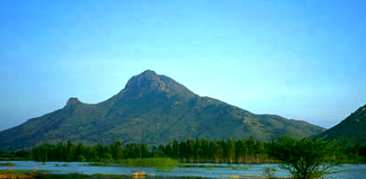
The power of contemplating Arunachala | Sri Ramana Maharshi | Self-Enquiry | Aham Sphurana

The following is taken from the text Aham Sphurana, from the date 20th July 1936. See here to find out more about this text and also to download it for free:

Questioner: It is said that the legendary Sanjeevani herb is found somewhere in this Arunachala hill, by consuming which one attains to state of Immortality. Will Bhagavan please let me know where it is in the hill?

Bhagavan Sri Ramana Maharshi: The hill itself bestows immortality.

Q.: How?

B.: Constant rememberance of Arunachala’s form steadily but surely introverts the mind. Then the mind accquires the strength to plunge inward, or rather loses the strength to move outwards, towards thoughts, intellectual concepts or physical objects. Eventually it becomes still entirely; then the Arunachala within pulls it into itself and destroys it once and for all. This is the Sanjeevani shakti [Tom: shakti means ‘power’] of Arunachala about which you are asking.

[Tom’s comments: here we have Bhagavan explaining how remembrance of Arunachala introverts the mind, pulling it inwards away from both gross and subtle objects, until it becomes entirely still. Arunachala then does the final step of destroying the mind, the result of which is explored below]

Q.: Is it not a herb?

B.: I have said what I know.

Q.: Is the ultimate aim of spiritual practice, only destruction of mind?

B.: Yes.

Q.: One whose mind is dead would perhaps have life in the body, but he would be in a state of comatose senselessness, like a stony, frigid vegetable, unable to understand anything. Is that the perverse fate toward which all spiritual aspirants are gravitating?

B.: Absence of mind is pure Bliss. It is possible to function in the world normally, without mind.

Q.: Oh! How so?

B.: Some power takes over his body and animates it without his knowledge.

Q.: Is it God?

B.: Give it any name you like- God, Providence, Fate, Karma, etc.; the nomenclature matters not.

[Tom’s comments: Bhagavan first confirms that manonasa, or destruction of mind, is indeed the ultimate aim of spiritual practice, thus equating manonasa with both self-knowledge or liberation. Then he goes onto explain that the body can continue to function without the mind under another higher power. This is done without the Jnani’s knowledge or awareness. Of course, Bhagavan is describing this form the relative standpoint, or the standpoint of ignorance/maya. Below we will see a higher teaching given later]

Q.: Are names unimportant in the scheme of things, then? How to call someone if he has no name?

B.: The fact is that in order to escape its own destruction the mind creates a world of name and form over the pure vastu [Tom: vastu means reality] that is the Atman. It abhors chaos and randomness and prefers order and systematisation. It creates cause-consequence relationships and gives itself to understand ideas about its environment, which is actually merely its own projection. It tries to study the nature of its body’s physical surroundings and formulates laws by means of which it then expects those surroundings to function; deviations from existing laws give rise to the birth of new laws! Never once does it wonder, ‘What is my self?’; thinking to conquer its surroundings, it foolishly occupies itself with sensory perceptions, thoughts, and intellectual hypotheses. Thus it is born again and again and needlessly undergoes all sorts of tribulations. Then it asks, ‘Alas! Why has God done this to me?’. Who is to blame for our mistake, if not ourselves?

[Tom’s comments: here Bhagavan explains that the mind creates the universe of name and form and superimposes this onto the formless objectless reality that is Atman, one’s true self. It then projects cause and effect, or karma, and starts to study the environment around it, which is actually nothing but its own projection, never asking or enquiring ‘who am I?’. Below Bhagavan will again confirm, as he has done many times in his own writings, the nature of Jnana:]

Q.: The state without mind is called Jnana?

B.: Yes.

Q.: Then what or who is a Jnani?

B.: One who has mastered the art of not knowing anything and not doing anything.

Q.: I am unable to divine the explication underlying Bhagavan’s sibylline [Tom: mysterious] words.

B.: The Jnani’s senses are unhinged from the world about him. He is sunk in the Self and quite irrevocably lost there.

[Tom’s comments: Bhagavan is explaining that the Jnani does not truly perceive the world, something he only intimated above, and he will expand on this below]

Q.: How is he different from the man on the Clapham omnibus (சாதாரண மனிதன) [Tom: the Tamil phrase given here means ‘the common man/person’ which the translator has translated as ‘the man on the Clapham omnibus’ a phrase popular in the 1930s which also means ‘the common everyday person’; this latter phrase was very common amongst lawyers, and the person who was said to have recorded these dialogues, Sri Gajapathi Aiyyer, was also said to have been a lawyer]

B.: The standard of reality employed by the man on the Clapham omnibus is the jagrat [Tom: waking] state in the jagrat state, and so on. For the Jnani the standard of reality is Reality itself.

Q.: What is this Reality?

B.: Man’s true Self.

Q.: How am I to realise this true Self?

B.: Whose Self is it?

Q.: Mine… but really who am I?

B.: Yes. All other questions lead up only to this supreme question.

[Tom’s comments: all paths eventually lead to self-enquiry]

Q.: What is the answer to the question?

B.: The discovery that the personal self, including the one making the discovery, never existed.

Q.: What remains thereafterward?

B.: Only the Truth; it is the state where the world of word, name and form perishes and silence alone prevails.

[Tom: here Bhagavan has clearly stated that for the jnani there is no world or name and form, only the Self or Silence remaining. Now Bhagavan will explain the method of Self-Enquiry:]

Q.: How to communicate thoughts to others without the assistance of words?

B.: That is only necessary so long as duality still persists in the mind.

Q.: How to get abiding shanti [Tom: peace]?

B.: Shanti is the natural state. The mind obstructs one’s inherent peace. Atma-vichara is only in the mind; it does not affect the Self. Investigate the mind; it will disappear. There is no entity by name mind. Because of emergence of thoughts, we surmise the existence of something from which they must originate; this we term mind. When we probe inwards to see what it is, there is nothing to be found except the real Self. After the false mind has vanished, Peace will be found to be Eternal.

Q.: Then what is buddhi?

B.: The thinking or discriminating faculty. These are only names. Call it the ego, the mind or the intellect; it is all the same. Whose mind? Whose intellect? The ego’s. Is the ego real? No. We confound ourselves with the ego and call it intellect or mind. This is because of the evil influence of avidyamaya [Tom: avidya means ignorance, maya means the power which projects the illusion of the body, mind and world. Here Sri Ramana is equating or compositing the two], which has superimposed this ephemeral, illusory, and worthless world of name and form over the ever-existing substratum, which is verily pure Reality and the supreme Peace itself. How to escape from the illusion? By searching for the mind and finding it, including that very finder, to be non-existent, to have been always non-existent, and in fact impossible of existence.

Q.: Emerson says, “Soul answers soul by itself – not by description or words.”

B.: Quite so. However much you learn, there can never be an end to objective knowledge. You ignore the doubter but try to solve the doubts. On the other hand, search for the doubter, and the doubter and his doubts will both disappear.

Q.: Therefore, the question resolves itself into one of knowing the Self.

B.: Quite so.

Q.: How to know the Self?

B.: Enquire into what the self is. What you are now imagining to be your Self, is really either the mind, the intellect or the ‘I-thought’. [Tom: Bhagavan has already said above that these three are the one same thing] Other thoughts are able to arise only after the ‘I-thought’ rises. So, hold on to the I-thought without pause. Soon, you will find that all thoughts vanish leaving the Self alone as the residue.

Q.: The difficulty lies in reaching the Self.

B.: There is no reaching it at all because it is eternal, here and now. If the Self were to be gained anew, it would not be permanent. What is impermanent is not worth striving for.

Q.: How to obtain equilibrium of mind? What is the best way?

[Tom’s comments: We will see Bhagavan subtly rebuking the questioner here – Bhagavan has advised self-enquiry in which the mind is no more, and instead the questioner is asking ‘how to obtain equilibrium of the mind?’]

B.: Just now you were asked to investigate the mind. It is eliminated and the Real you remain over. Let your standpoint become that of Jnana and then the world will be found to be not apart from the Self. Drishtin jnanamayim kritva pashyaet Brahmamayam jagat [Tom: ‘Having made your outlook one of Jnana, one will see the world full of Brahman’ ~Tejobindu Upanishad 1.29; this was a phrase often repeated by Sri Ramana, eg. also see Talks with Sri Ramana Maharshi, Talk 238, which is likely a record of the same conversation given here]. So, the question is one of outlook. The Atman pervades all. You have now lost hold of your Self and go on doubting about other things. Find your Real Self and all your problems and doubts will disappear.

Q.: But how to find this Real Self?

B.: Are there two ‘I’s in the same One? How do you know your own existence now? Do you see yourself with these eyes? Investigate into yourself. How does this question arise? Do I remain to ask it or not? Can I find my Self as in a mirror? Because your outlook has, owing to the poisonous delusion of ignorance, become outward-bent, it has lost sight of the actual Self and your vision is external. The Self is not to be found in external objects. Turn your gaze within and plunge within; you will be the Self.

Q.: It is said that the unknowable can be attained only by the grace of the unknowable.

B.: Yes. He helps you to Realise, if only you would forsake the external world of word, name and form. Such is His merciful Grace.

Q.: How to kill the mind, since the death of the mind is said to bring about Realisation easily?

B.: Will a thief betray himself? Will the mind find itself? The mind cannot kill the mind. You abandon what is real and are holding on to the mind which is unreal and also trying to find what this unreal mind is. Was there any mind in your sleep? No. It is now here. It is therefore impermanent. Can the mind be found by you? You are not the mind. You think you are the mind and therefore ask me how it is to be checked. If it is there it can be checked. But it does not exist at all. Understand this truth by search. Search for unreality is fruitless. Therefore seek the reality, i.e., the Self. That is the way to ruin the mind. There is only one thing Real, and that is Reality, which is the same as man’s true Self.

Q.: What is the nature of the true Self of man? Is it always happy?

B.: It alone is what IS: the ‘other elements’ are only appearances. Diversity is not the nature of the Real. We read the printed characters on the newspaper but ignore the paper which is the background. Similarly you are obsessed with the modifications of the mind and ignore the ever-present background of pure consciousness. Whose fault is it?

Q.: Is there a limit to the Real Self?

B.: What is the Real Self?

Q.: The Individual soul is the only self I know. According to Bhagavan it is unreal.

B.: What is the individual soul? What is the cosmic soul? Is there any difference between the two or are they identical? Any appearances are bound to disappear. Anything created will certainly be destroyed. The eternal is not born – consequently, nor can it die. We are now confounding appearances on Reality with Reality itself. Any appearance carries its own end in itself. Can there be anything that appears newly? If you cannot find the Self through the Jnana-vichara method, surrender to the substratum of appearances unreservedly; then, actual Reality will be left over as the residue.

Q.: What happens to a man after death?

B.: Engage yourself in the living present. The future will take care of itself. There is no need to worry about the future. The state before creation, the process of creation, etc., etc. are all dealt with in the scriptures in order that you may finally endeavour to know the present. Because you say you are born, therefore they say, yes, and add that God created you. But do you see God or anything else in your sleep? If God be real why does He not shine forth in your sleep also? You are always – now the same as you were in sleep.

You are not different from the one in sleep. Thus, why should there be any difference in the feelings or experiences governing the two states? Did you ask, while asleep, the question regarding your birth? Did you ask then, where do I go after death? Why think of all this now in the wakeful state? Let what is born think of its birth, the remedy, the cause and the ultimate results. What is birth? Is it of the ‘I-thought’ or of the body? Is ‘I’ separate from the body or identical with it? How did this ‘I-thought’ arise? Is the ‘I-thought’ your nature? If not, what is your Real nature?

Q.: To whom to ask these questions?

B.: Exactly – that is it. There is no end to it all.

Q.: Are we then to merely keep quiet?

B.: Doubts cease when your apparent ignorance is transcended.

Q.: How did this ignorance originally arise?

B.: Is ignorance asking you, ‘Why have I arisen?’. It is you who are asking the question. So, find out who you are. Then other things will take care of themselves.

Q.: The vichara again! Why should I engage in this Atma-vichara?

B.: Because if Atma-vichara is not pursued, loka-vichara creeps in [Tom: Loka means world, vichara means enquiry, Atma means self]. Engage in Self-investigation; thereby the non-self disappears. The true Self is left over. This is self-investigation of the Self. The one word ‘தான்’ [Tom: ‘Thaan’ or ‘Self’ or ‘oneself’] is equivalent to the mind, body, man, individual, the Supreme and all else.
New recommended reading text: Aham Sphurana

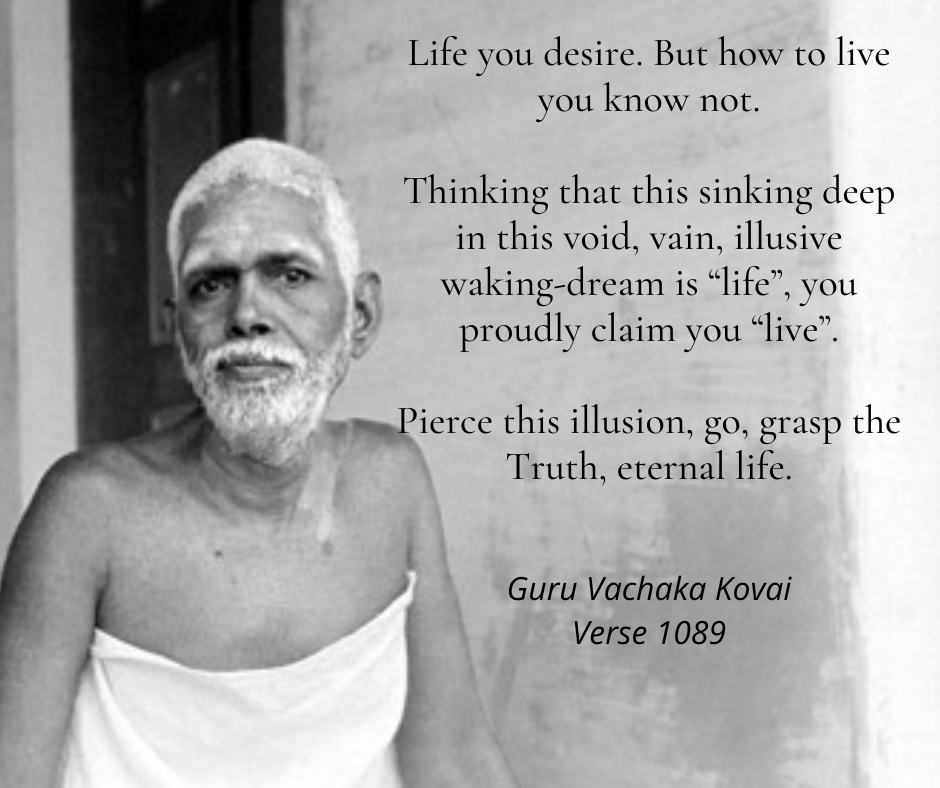
I have decided to add the book Aham Sphurana to the recommended reading list. Please see the list here for more information about this decision, which may be controversial for some. For clarity, the version I am recommending is the original unabridged version and not the edited selections published by others which may contain distortions to the teachings. See here to download the text for free.

Radical Indifference and the End of Doership

This Satsang arose after an hour of silent self-inquiry, with the teaching emerging from a settled recognition rather than from theory. Tom begins by revisiting the familiar Advaita pointer, “We are not the doer, we are not the enjoyer”.

He then reads Question and Answer 13 from the text Self Enquiry in the The Collected Works of Sri Ramana Maharshi, turning attention to Ramana’s uncompromising instruction on action, agency, and the Self. The emphasis is on the mind resting in its source so completely that even subtle movements such as “Is this right? Is that wrong? Should I do this or that?” are seen as vasanic ripples to be noticed and not followed.

From here, Tom speaks about Ramana’s “indifference” not as dullness or avoidance, but as the natural non-grasping of a heart absorbed in the Divine. When happiness is tasted at the core, the world is not rejected, yet its pull softens; functioning continues, prarabdha unfolds, but the “I am the one doing” thought is not given a foothold.

For seasoned seekers, this meeting points less to managing life and more to a radical, practical abidance: staying as the Self while activity and karma play out on the surface. The flavour is one of resolute devotion — Bhakti expressed as a quiet refusal to leave the Self for the mind’s next concern, and a willingness to let love of God outshine every other priority.

This video was recorded live during a Satsang meeting with Tom Das on January 1, 2026 and put together by volunteers.

To download full unedited satsang recordings see here: https://payhip.com/tomdas

20 key points in this Liberating Teaching | Advaita Vedanta | The higher teachings

This is one of a series of introductory articles – please see the homepage of tomdas.com for more introductory articles.

This post is also an extract of a much larger post which you can read here which provides extensive quotes from Shankara, Gaudapada, Sri Ramana Maharshi, Yoga Vasistha and Ribhu Gita to give scriptural backing to the 20 points below.

There was a particular conceptual world-view that great sages such as Sri Ramana Maharshi encouraged us to take on, if we are able to, in order to facilitate our spritual practice and thereby attain self-realisation or liberation.

For lower seekers of liberation, meaning for those whose minds were unable to be open to the higher teachings, Sri Ramana Maharshi and the great sages often did not give the teachings we will outline below, but for those whose minds were ready and ripe, he would often encourage this following view of creation and the world, as it is this conceptual view that most readily allows the seeker’s mind to properly do self-enquiry and thereby realise the Self.

However, rest assured, that regardless of how one conceives of the world, meaning that even if you do NOT agree with the teachings below, if one makes an earnest attempt to understand and carry out Self-Enquiry, liberation will be assured irrespective of your conceptual view on liberation and the world. Then you will discover the truth for yourself.

A warning/disclaimer

The teachings that are given below, whilst they are open to anyone, are very radical in their nature. It is not recommended that you read them if you are not an earnest seeker of liberation or if your mind is likely to be destabilised by a more radical notion of the nature of the universe or what liberation looks like.

We will see that these same exact teachings have been given for many centuries, but traditionally these teachings would only be given to a prepared mind, a mind prepared by devotion, faith and loving surrender. This infuses the mind and heart with an energy of peace, calm and loving kindness and happiness. It is this stable peaceful mind that is most able to receive these teachings, although it is possible there can be some exceptions to this.

Some people can find these teachings quite distressing and destabilising and the author of this post takes no responsibility for providing this information to you that has been traditionally written about and taught for many centuries and is already in the public domain.

Be open minded to receive these teachings

Similarly, the ego-mind will often reject these teachings when it first hears them. Often a person’s ego will only be able to come to these teachings once it has suffered enough. The more insight the ego has into suffering, and the more it is able to contemplate the causes of suffering, then the more likely it is able to appreciate the truth of these teachings.

Usually only a sharp intellect is usually able to discern these teachings. Many people read these types of spiritual teachings and immediately project their own preconceived ideas onto them, and so distort the teachings from the very beginning. If we keep an open mind and read the range of quotes given, we will inevitably see what they are truly pointing too. If we cling to our own preconceived notions then we are less likely to receive these teachings in the way they were intended.

These teachings are rare and often misunderstood

Many prominent spiritual teachers, including prominent teachers of advaita and non-duality, give out distorted versions of these teaching, so it is important to be able to temporarily put aside all you have learnt whilst reading or listening to these teachings if you really want to understand what the intended communication actually is.

It is also important to not assume that all spiritual teachers are teaching their own versions of the Same One Teaching, and be open to the fact that they may be teaching very different things; just because a teaching is helpful, doesn’t mean it is liberating; and just because a teaching isn’t liberating, it doesn’t mean it will not be helpful to you.

My recommendation is that you listen to what Sri Ramana Maharshi has to say, and the best way to do that now that his body has passed is to read his own writings themselves.

The Jnani does not see the world

Sri Ramana often said that the Jnani (self-realised or liberate Sage) is totally unaware of the body, the mind and the world, and that the liberated sage also has no awareness of the 3 states of dream, deep sleep or waking, all of which are a projection of ignorance (aka the mind). We will see below that Sri Shankara says the same, as does his guru’s guru, Sri Gaudapada, as well as his student, Sri Suresvara. The quotes given in the later part of this post will concentrate on demonstrating that this was indeed the teachings of these great teachers.

The Conceptual Teaching Framework for the Teachings

The following conceptual teaching framework is consistently given from the Vedas, the Upanishads, Sri Ramana Maharshi, Sri Gaudapada, Sri Shankara, and Sri Suresvara as well as others such as Ramakrishna, Vasistha and Ashtavakra, and it is this larger framework that the quotes that will be given later fit into. It is essentially a combination of the Ajata Vada and Dristi Sristi Vada views. The reason for different views on how the world is created in explained by Sri Ramana Maharshi in his answer to question 10 in his text Self-Enquiry (click here to download the text) as follows:

Question: If the entire universe is of the form of mind, then does it not follow that the universe is an illusion? If that be the case, why is the creation of the universe mentioned in the Veda?
Sri Ramana Maharshi: There is no doubt whatsoever that the universe is the merest illusion. The principal purport of the Veda is to make known the true Brahman, after showing the apparent universe to be false. It is for this purpose that the Vedas admit the creation of the world and not for any other reason. Moreover, for the less qualified persons creation is taught, that is the phased evolution of prakriti (primal nature), mahat-tattva (the great intellect), tanmatras (the subtle essences), bhutas (the gross elements), the world, the body, etc., from Brahman [Tom: ie. the lower seeker is taught a traditional creation model of the world in which the subtle elements progressively evolve into more complex structures, etc], while for the more qualified simultaneous creation is taught, that is, that this world arose like a dream on account of one’s own thoughts induced by the defect of not knowing oneself as the Self [Tom: ie. the defect of not knowing oneself is ignorance, and this creates thoughts, and these project the world akin to a dream, so the world is a creation of ignorance or delusion]. Thus, from the fact that the creation of the world has been described in different ways it is clear that the purport of the Vedas rests only in teaching the true nature of Brahman after showing somehow or other the illusory nature of the universe. That the world is illusory, every one can directly know in the state of realization which is in the form of experience of one’s bliss-nature

Without understanding the creation framework that the teachings are operating in, the teachings are much more difficult to follow. The opposite is also true, in that understanding this framework may greatly aid our journey to liberation. Please note that all of the following points have strong scriptural support and form the clearest most consistent interpretation of the scriptures according to the great sages who have proclaimed them – see the recommended reading list for books that explain these teachings more thoroughly and in greater detail:

1. There is only the Self and you are That. Self-realisation and liberation are synonyms and they represent the highest possible ‘attainment’ in which duality, suffering and any sense of individuality are competely destroyed never to return again. See a summary of Sri Ramana Maharshi’s teachings here for more on this and how to realise this for yourself.

2. In the Self there are no objects or arisings or appearances at all (this is the doctrine of ajata vada – no phenomena are created or born in it, not even as an appearance, see link for more). The Self is:

  • homogenous (the same throughout, without any variation whatsoever)
  • unchanging (without possibility of change arising within or being projected upon it)
  • ‘one without a second’
  • formless (ie. without form and without the possibility of any form arising in it)
  • without karma (without action or movement, also known as ‘silence’ or ‘stillness’) or the possibility of karma/action (karma literally means action or change, more commonly refering to the chain of cause and effect)
  • without thoughts or the possibility of thoughts
  • non-dual (without duaity)
  • devoid of time and space and therefore devoid of samara (the cycle of birth and death)
  • blissful – it is heaven, the culmination of all desires, everything you have ever wanted and more, devoid of suffering and without any problems or questions or doubts.
  • Peace, Silence and Stillness. See here for what it really means to be still according to Sri Ramana Maharshi.
  • Infinte unconditional Love – the Self is the only infinite unconditional love, infinite unconditional love not being possible in the realtive realm of objects, people and things, all of which are conditional, under the sway of cause and effect and temporary.
  • Divine, heavenly, godly
  • devoid of the appearances or arising of the 3 states (waking, dream and deep sleep)
  • devoid of body and mind and thought
  • without ignorance or the possibility of ignorance or any arisings ever arising in it
  • without describable characteristics; although it is often said to be Sat Chit Ananda, this is a metaphorical description, all descriptions of the Self ultimately fall short and can only be metaphorical at best
  • unable to be conceived, understood or thought about. All metaphors ultimately fall short when trying to describe or explain the Self, even though they may be provisionally be used as a pedagogical device (teaching aid).
  • The Self is also known as Turiya (the fourth), Samadhi, Nirvilkalpa Samadhi, Pure consciousness (the word ‘pure’ refers to the absense of arisings), Pure Being, Truth, Reality, True Nature, Jagrat-Susupti (waking-sleep), God, Heaven, the Abosolute, Brahman, etc.
  • In truth Deep Sleep is the Self

See Mandukya Upanishad verse 7 where much of the above is described in concise form.

3. The self is both the only ‘thing’ that is real and the only ‘thing’ that exists, although it is not actually ‘a thing’ at all. To know the Self is to know all, and there is no real ‘knowing’ of the self, the word ‘knowledge’ being a metaphor for the removal of ignorance or another word for the Self. To know the Self is just to be the Self devoid of any phenomenal arisings. See here for more on this teaching which explains the true nature of Jnana, or self-knowledge, according to Shankara, Ramana and the scriptures. Reality and Existence are in fact synonyms and the idea that something can be both unreal but still appear or arise is fallacious (a false teaching) and not a teaching found anywhere in the Vedanta scriptures or the Upanishads – see here for more on this teaching. Also see this article here: The Meaning of Real and Unreal in Advaita Vedanta

4. It is due to ignorance that the range of phenomenal appearances appear to arise – ie. the appearance of one’s apparent body-mind, apparent other people and living beings, and apparent things such as tables, chairs, cars, trees, plants, planets, celestial bodies and stars,etc – all of these are a mere projection of ignorance, as explained by Sri Ramana Maharshi in his answer to question 10 in his text Self-Enquiry which you can read here. This projection is known as ‘duality’. In the Self or in non-duality, there is no duality. We will see Shankara and others clearly give this teaching below many times. It is also explained in this video here:

5. This root ignorance also goes by other names such as ego, mind, maya (illusion), imagination, hallucination, nescience, delusion, the I-thought and the I am the body-mind idea. (See the text Self-Enquiry by Sri Ramana Maharshi where this is explained in the answer to question 3) Therefore it could equally just as well be said that the world (ie. body, mind and world) are a projection of any of the above words.

In some teachings it is said that there are 2 forms of ignorance, the macro-form called maya which projects the body mind and world, and the micro-form called ignorance which gives rise to the individual sense of being a person, and that vedanta teachings removes only ignorance, the limited sense of being a jiva, but not maya, and so the body-mind world continues after liberation. Please note this is not the teaching given in the Upanishads or by Shankara at all and is a later development by later commentators who were not able to understand the radical nature of the original true and liberating teachings, and changing the teachings in this way renders a potentially liberating teaching potentially non-liberating. We repeatedly see how the terms ignorance and maya are used interchangably throughout the scriptures.

6. It is also explained that ignorance creates the subtle sense of being identified as a seperate entity (ego), and then this subtle entity (ego) itself projects the body and mind and identifies with this, which is called being a jiva (a living embodied entity). Subsequently, or simultaneously, depending on how it is expounded, the ego also projects the appearance of an environment for the body-mind entity which we call the world, and within this world the body-mind entity roams and experiences various sense objects via the body and subtle objects via the mind (thoughts, feelings, emotions, imaginings). This is explained succinctly in the text ‘Who Am I?’ by Sri Ramana Maharshi – I recommend the Sri Sadhu Om version which is the more accurate of the main translations.

7. In this same way the ego or ignorance projects the 3 states which it then experiences in turn. This is all the realm of ignorance. When objects arise, it is called either the dream or waking state, and when objects temporarily cease, that is called deep sleep. In fact the scriptures go on to explain here that we could say there are only 2 states, one called dream, when object appear, and another called sleep, when there are no objects, and that what we call the waking state is merely another form of dream. These refer to ignorance and reality respectively, or maya (illusion) and satya (truth or reality) – see here for this rare teaching.

8. This ignorance or ego or maya is itself not a real entity and in truth (ie. in self-realisation) it is ‘seen’ to have never actually occurred at all. Nothing (phenomenal) ever really happened at all. This is the ajata teaching, that nothing was ever created or arose at all. There was never any ignorance/maya or even any appearance of ignorance.

9. Within the waking dream, there is a specific way for the apparent ego to apparently remove ignorance (self-enquiry, also known as surrender; these are analgous to the paths of knowledge, jnana, and devotion, bhakti), and when ignorance is removed, the entire effects of ignorance, namely all phenomenal arisings, also cease, the effects no longer having a cause to sustain them. Karma or action refers to movement which can only occur. This specific method is clearly explained in the The Path of Sri Ramana – part 1 and in the book The Most Direct Means to Eternal Bliss by Michael Langford, which you can download for free from the links given. The method specifially involves discovering who or what you really are – this is done by allowing the mind to quieten, allowing the attention to no longer go towards gross and subtle objects, and with attention inward turned discovering the true nature of the ‘I’ or ‘I Am’. Importantly no objects/ phenomena arise at the time of the discovery – it is Pure Self alone, devoid of duality/objects. The method is also explained in brief here and supporting quotes from Shankara and others can be found here.

Just because the waking dream is ultimately an illusion, it doesn’t mean there is not a specific method to escape it. Effort on this specific path is required for liberation.

It is important to listen not only to our own hearts and inner knowing, but to also listen to the words and teachings of the Guru who has already crossed over to the other shore of liberation. Why? Because even though the same teaching the True Guru (Sat Guru) gives is already shining and being sung in our hearts, due to ignorance our minds are turned outwards and emeshed with thoughts, we are often not able to truly listen to our Hearts (the True Guru Within) and instead our ego distorts the teachings. Therefore the Guru’s words are supremely important in aiding us who are genuinely interested in liberation and this is why tradition exaults the value of the Guru on the path to Self-Realisation.

There is no other newer or quicker way that can be discovered to know or realise the Self. This is not a dogmatic assertion, but should become clear once you start to understand the teachings and why Self-Enquiry is the only way to liberation, although the same process can go by other names. Similarly there is no different way for men versus women, for this, like any other science, is universal and is applicable for all.

10. This removal of ignorance is not a real thing at all, ignorance itself being unreal, the whole thing being an imagination that never happened. This paradoxical teaching only appears paradoxical to the mind, which is unable to understand it, the mind being a product or the nature of ignorance. In truth there was only the Self, which cannot even be said to be called the self, as it is beyond all words and concepts, but it is called the Self or witness (the self is not truly a witness) for the purpose of the teaching only – see here for more on this teaching.

11. In self-realisation only the real remains, and the false or unreal no longer appears or exists; only the Self remains and what was previously called non-self, ie. all objects, these no longer remain or appear/arise. When the scriptures say that the jnani sees all phenomenal arisings and objects as being unreal or being illusory, this is a lower teaching for those whose minds are unable to fathom that the jnani is (and themselves are) not a body-mind entity at all. In truth the illusory appearances no longer appear at all and the jnani is not a person.

12. Similarly, the self cannot be known by a body-mind entity or by the mind or the ego. There is no such thing as a ‘person who is self-realised’, although it may appear that way to a person (the ignorant onlooker). There is only the Self and you are that. This also means that, relatively speaking, a jnani cannot be identified by the way they act or behave in the world – what is important is the teaching they give – are they giving a liberating teaching either verbally or non-verbally?

13. Is is the ego or ignorance that creates or projects the world, so the ego is also known as Brahma (the creator deity) or Hiranyagarbha (the cosmic womb or cosmic egg that gives rise to the world) or Isvara (the creator and ruler of the world) or Maya (the magical power that creates the appearance of the world). Sometimes it is said that all creation proceeds from the Self, but this is a simpler or lower teaching for those who consider the world to be real. See here for more on levels of the teaching and how they are taught.

14. Whilst all phenomenal arisings are ultimately illusory, as long as the body mind and world appears, ‘you’ (ego) will think yourself to be a person (a body-mind entity, ie. a jiva) living in a world of people places and things (the world or jagat in Sanskrit). This world is governed by apparent rules and forces which can be personified as a ruler deity (Isvara, which means ruler or Lord). These three, jiva, jagat and isvara, are all illusory.

15. As long as the body mind and world appear, we will consider ourselves to be a jiva (person) living in a jagat (world), we will suffer accordingly, as these appearances are downstream from the root ignorance. Whilst this is the case, there is a clear method, often called Self-Enquiry, also known as the Path of Knowledge, that can be followed to attain liberation – this involves effort and application of the mind (as explained in the video above at point 12). Note that this means it is therefore not possible for appearances to arise and be experienced and simultaneously not indentify as a person/jiva or identify with what is arising. It is not possible for objects to arise in our consciousness and for ignorance to not be fully present. This is explained further in this video here:

16. The self only has to be realised once, and can only be realised once, and then that is the end of the spiritual journey. Then illusion and ignorance ends once and for all. Then all duality and suffering end once and for all, duality being another term for the arising of phenomena. There is no possibility of sadhana after realisation or integration after realisation, for there is no action or entities that exist after realisation. There is also no possibility of falling back into duality again – if that occurs, then it means the self was never truly realised to being with. The self can only be ‘experienced’ once, it can only be ‘abided’ in once, it can only be ‘known’ once (it cannot be truly experienced or known or abided in as it is not an object or container and no words truly apply, all words just being metaphors or pedagogical devices), and then the entire house of cards that is duality and maya and ignorance ends.

Expositions that advise repeated abidance or resting in the Self are just teaching devices to encourage repeated efforts in sadhana, for if we ‘rest’ in the Self just once, then Self is known in its entirely, that is all that is needed. Then there will be no question, no doubts, nor will there be possibility of questions or doubts. Whilst there can be degrees of ignorance and delusion, there are no degrees of liberation or self-knolwedge, which is one. Similarly ideas of different forms of liberation such as jivanmukti (liberation in the body whilst alive) and videhamukti (liberation after the body has died) are ultimately false view given as lower teachings for those requiring explanations on the level of ignorance – this is explained in Sri Ramana Maharshi’s answer to Question 40 in the text Self-Enquiry.

17. The idea that the sage is a person living in the world is only from the view of the ignorant ‘onlooker’ who considers themselves to be a peron, and so projects their own jivahood onto that of the ‘sage’. What we call the body-mind of a sage is in fact a projection of our own self/ignorance. The true Jnani is the self, devoid of thoughts or arisings. See here for more on this teaching. Ideas such as the ego of a Jnani being like a burnt rope or some kinds of karma persisting in liberation are lower teachings, as Sri Ramana Maharshi has explained here.

Relatively speaking, this also means that we are unable to tell who a True Jnani or Sat Guru is by outward signs such as the behaviour of their body-mind; the apparent Jnani can appear and manifest to us in a multitude of ways, according to what suits our own needs and our own ideas.

18. The parts of Maya (the appearance or waking dream) that lead us towards bhakti and self-enquiry and therefore self-realisation or liberation are called the teaching and the teacher. The teaching and the apparent teacher are themselves projections of ego, manifested by our desire for liberation, hence when the student is ready the teacher will appear. See here for more on this teaching.

19. Just as there is in truth only One Self, there is actually (if we concede to the existance of ignorance, which is truly non-existent, like the snake in the rope – see the quotes below for more on this) only one ignorance or one ego. There is only one jiva, just like in a dream. This is called Ek Jiva Vada (the doctrine of one jiva) – see here for more. Similarly, just as there is One Self and one ignorance, there is only One Teacher in truth (and you are That).

20. Note that whilst it is often said that it is the Self that witnesses or perceives the world, the Self, as we will see from the quotes below, is not a perceiver or a witness at all. To be technically correct, it is the ego or mind that sees the world. The self never sees any objects or any things, these objects and things being duality, and the self never admits of any duality or ignorance or multiplicity whatsoever. The self cannot see, hear, feel, think, etc, these all being unreal effects of ignorance only. Even to say the Self knows itself is mere poetic sentiment – the most we can say about the Self is that it IS.

Much of this teaching is given in the book Sadhanai Saram by Sri Sadhu Om, which bears repeated reading and study for those who need it, as well as in the book The Path of Sri Ramana which also explains much of the above but in less detail and can be found on the same link as Sadhanai Saram above.

This teaching is also given in Ribhu Gita, Yoga Vasista and many other places too – please click on the links for texts which concicely summarise these teachings in a wonderful way. See the recommended reading list for more.

Also see: Does the Sage (Jnani) see the world? Does the world appearance exist after liberation?

Now, in the following multitude of quotes we will concentrate on the nature of the world, and how the Jnani doesn’t see the body mind or world because they are all non-existant in truth, as explained by Sri Ramana Maharshi, Sri Shankara, Sri Gaudapada (the Guru of Shankara’s Guru) and Sri Suresvara (Shankara’s student).

See here for the rest of this article which provides extensive quotes from Shankara, Gaudapada, Sri Ramana Maharshi, Yoga Vasistha and Ribhu Gita to give scriptural backing to the 20 points above.

May you attain liberation!

May you make contact with the Grace of God!

May you be lovingly ferried to the shore of liberation, which is just your own Self!

May your mind be turned inwards and thereby find Peace!

Om Shanti Shanti Shanti Om!

Can Everyone Benefit From This Silence?

From: Talks with Sri Ramana Maharshi, Talk 569.
Question: Can everyone benefit from this silence?

Bhagavan:
Silence is the true upadesa. (Teaching)
It is the perfect upadesa.
It is suited only for the most advanced seeker.
The others are unable to draw full inspiration from it.
Therefore they require words to explain the Truth.
But Truth is beyond words.
It does not admit of explanation.
All that is possible to do
is only to indicate It.
How is that to be done?

In this meditative Satsang talk by Tom, he gently guides us with words, presence and silence towards meeting and imbibing Ramana’s highest teaching.

This video was recorded live during a Satsang meeting with Tom Das on November 27, 2025 and put together by volunteers. To download full unedited satsang recordings see here: https://payhip.com/tomdas