Ramana Maharshi
You have done ENOUGH (You Don’t Have To Pretend To Be A Person Anymore)
The meaning of ‘Real’ and ‘Unreal’ in Advaita Vedanta | The Mirage analogy vs the Rope and Snake | The world and self-realisation
Also see this post on Ajata Vada and this post on Turiya
‘Unreal’, both in Vedanta and in common parlance, means that which doesn’t actually exist; ‘real’ means that which exists.
This means that if something exists it is real, and vice versa. This is highlighted by the fact that in Sanskrit, the most common word for both ‘real’ and ‘exists’ is the same word ‘satya’ or ‘sat’. ie. the Sanskrit word ‘sat’ means both ‘real’ and ‘exists’. I have seen some commentators say that something can be unreal but still exist, and vice versa. In doing so they have uncoupled the meaning of these synonymous words, ‘real’ and ‘exists’, which is particularly ironic as in Sanskrit they are one and the same word, ‘sat’.
Vedanta texts say that which changes is unreal, or the things that are subject to change are unreal, meaning that which changes does not truly exist (ie. They do not exist in self-realisation, or they are non-existent when the self is realised).
Vedanta texts do not define ‘real’ as being ‘that which doesn’t change’, nor does the word ‘unreal’ simply refer to things that exist but change/are subject to change. Never do we see this false definition in the Vedanta scriptures.
I hope you can see the difference. If you cannot see the difference, then please reflect on the above as it is in important part of the teaching, and this is an important way the teaching is distorted by the ego-mind.
Note that if the teaching is distorted in this way it is likely not to lead to liberation.
So how does this all fit together?
The idea is that if you discover Sat (reality) in its true essence, meaning as it really or truly is, devoid of illusion or ignorance, all that is anitya (impermanent) will disappear, and so be revealed to be asat (unreal or non-existent), its only having appeared to exist due to ignorance/error.
This has been explained by Sri Ramana Maharshi many times, for example, see the following verses of Sri Ramana Paravidyopanishad:
88. That which survives in the experience of the real Self is the supreme state. [That] alone is real. All else is only unreal. This is the distinction between the real and the unreal, revealed to us by the teachings of all the sages.
91 As the dream world is known to be unreal for the reason that it vanishes upon waking, so this waking world is also proved to be unreal by its vanishing in the light of the real Self.
92 But ignorant men, who are averse to winning the supreme state, put forth an endless series of arguments, [trying to refute this teaching]. The sages clear the doubts generated by these arguments so that earnest aspirants may not be deluded by them.
We are then cautioned about teaching this teaching to those who are attached to the notion that they are the body mind (living in a world), or those who cling to the notion of the self being the owner of the body mind:
93 This teaching of the unreality of the world is not addressed to those who look upon the body itself as the Self, or consider the Self to be the owner of the body. For these people the world is real, not unreal.
However, for those who genuinely seek liberation, this teaching is given:
95 To those who seek deliverance, the teaching is that all these three are equally unreal. This teaching must [therefore] be accepted, exactly as it is taught, by those who are earnestly seeking to win deliverance by the extinction of ignorance.
How can something that we perceive be unreal? Sri Ramana explains:
98 Everyone who is ignorant [of the real Self] thinks the world is real because it is seen. This is no proof because it proves too much. The same reason would prove the reality of the mirage, the rope in the snake, etc.
And so the text continues in this vein, drumming home the teaching. See the introductory articles on tomdas.com to explore this further, especially this article. I have made a YouTube video on this that explains this more here.
AN OBJECTION TO THIS TEACHING – THE MIRAGE vs ROPE & SNAKE
Q. Tom, a mirage exists yet it is unreal. In the same sense a separate ego-mind-body-world exists yet is unreal in the sense that its existence is dependent. Knowing that on which it depends as oneself is bliss…..
Just some early morning musings…
Tom: this is not the vedanta teaching given in the Upanishads. This is a modern re-writing of the vedantic teaching.
Vedanta usually uses the rope and snake metaphor, eg, Sri Ramana Maharshi writes in Who Am I?:
Q. When will the realization of the Self be gained?
A. When the world which is what-is-seen has been removed, there will be realization of the Self which is the seer.
Q. Will there not be realization of the Self even while the world is there?
A. There will not be.
Q. Why?
If the mind, which is the cause (and base) of all knowledge (all objective knowledge) and all action, subsides, the perception of the world (jagat-drishti) will cease. Just as the knowledge of the rope, which is the base, will not be obtained unless the knowledge of the snake, the superimposition, goes, so the realization of Self (swarupa-darsanam), which is the base, will not be obtained unless the perception of the world (jagat-drishti) which is a superimposition, ceases.
And later from the same text:
When the mind comes out (rises) from Self, the world appears. Therefore, when the world appears, Self will not appear; and when Self appears (shines), the world will not appear.
And later:
The mind will subside only by means of the enquiry Who am I?’. The thought ‘Who am I?’ (which is but a means for turning our attention Selfwards), destroying all other thoughts, will itself finally be destroyed like the stick used for stirring the funeral pyre.
And later:
By repeatedly practising thus, the power of the mind to abide in its source increases. When the mind (the attention), which is subtle, goes out through the brain and sense-organs (which are gross), the names-and-forms (the objects of the world), which are gross, appear; when it abides in the heart (its source, Self), the names-and-forms disappear. Keeping the mind in the heart (through the above-described means of fixing our attention in Self), not allowing it to go out, alone is called ‘Selfwardness’ (ahamukham) or ‘introversion’ (antarmukham). Allowing it to go out from the heart alone is called ‘extroversion’ (bahirmukham). When the mind thus abides in the heart, the ‘I’ (the thought ‘I’, the ego), which is the root of all thoughts, having vanished, the ever-existing Self alone will shine.
And later:
The place (or state) where even the slightest trace of the thought ‘I’ does not exist, alone is Self (swarupam). That alone is called ‘Silence’ (maunam). To be still (summa iruppadu) in this manner alone is called ‘seeing through (the eye of) knowledge’ (jnana-drishti). To be still is to make the mind subside in Self (through Self-attention). Other than this, knowing the thoughts of others, knowing the three times (past, present and future), knowing events in distant places – all these can never be jnana-drishti (knowledge realisation).
And later:
What really exists is Self (atma-swarupam) alone. The world, soul and God are superimpositions in it like the silver in the mother-of-pearl; these three appear simultaneously and disappear simultaneously.
🙏🙏🙏
Aham Sphurana – Scintillations of Jnana from Sri Ramana Maharshi – PDF download of the complete unedited text
Aham Sphurana [‘I Shining’ or ‘I vibration’ or ‘I Am shining’ or ‘Shining of the I AM’], an unedited text of over 1000 pages, claims to contain a collection of previously unpublished talks with Sri Ramana Maharshi as apparently recorded by a visitor to Sri Ramana Ashrama, Sri Gajapathi Aiyyer, in 1936.

This is a controversial text and the authenticity of the teachings as being genuinely from Sri Ramana Maharshi cannot be confirmed, a fact acknowledged in the manuscript preamble itself, but I share these teachings here in case they are of interest to you. Note that the essential teachings presented here are no different to the teachings from Sri Ramana Maharshi you will find elsewhere, but the way they are presented may be helpful to many.
At the time of writing this post, there is also a 280 page version of this text which is available from Open Sky Press – this is a beautifully arranged set of teachings collated from Aham Sphurana – but the teachings have been edited and therefore subtly changed. Sometimes this makes the teachings easier to access, but sometimes the meaning of the text may inadvertently be altered.
For example, this post, which I have presented in unedited form, is also present in the Open Sky Press version but the word ‘solipsism’ was removed from the edited version of the text on page 57 and for some reason replaced with the word ‘egoism’; the reference to Berkeley was also removed and the Latin phrase was (slightly) wrongly translated. For some this may make it easier to access, as the word solipsism is a philosophical term that some may not be familiar with, but for others reading Sri Ramana’s alleged view on solipsism may be fascinating and useful, and the removal of this term could take away from the depth of the teaching; similarly with the reference to the philosopher Berkeley.
Having read many spiritual texts, my personal preference is to read as near to the source material as possible (and where possible to go to primary sources themselves), as this gives the most accurate presentation of the teachings. I have read many texts that try to be helpful through editing but many end up inadvertently distorting the teachings. This is also why when I make comments on texts, I try to make it very clear what is added by me as opposed to what is present in the original, so the reader has an opportunity to assess my comments in light of the actual source material. To this end I am sharing the unedited PDF here for those who find it useful.
Best wishes & Namaste
Tom
Aham Sphurana book excerpt – Solipsism and the shock of hearing the Ajata teachings | Sri Ramana Maharshi | Advaita Vedanta
The following is a teaching excerpt from a large unedited manuscript, well over 1000 pages long, called ‘Aham Sphurana’. You can find out more and download the entire text here.
Aham Sphurana [‘I Shining’ or ‘I vibration’ or ‘I Am shining’ or ‘Shining of the I AM’] claims to contain a collection of previously unpublished talks with Sri Ramana Maharshi as apparently recorded by a visitor to Sri Ramana Ashrama, Sri Gajapathi Aiyyer, in 1936.
The authenticity of the teachings as being genuinely from Sri Ramana Maharshi cannot be confirmed, a fact acknowledged in the manuscript preamble itself, but I share these teachings here in case they are of interest to you. Note that the essential teachings presented here are no different to the teachings from Sri Ramana Maharshi you will find elsewhere, but the way they are presented may be helpful to many.
11th July 1936
Sri Ramana Maharshi: When a man is told he is neither the body nor the mind, he is initially puzzled, because all along his life his experience of self has been confined to these two only. When he hears the words of the Jnana-guru for the first time, he learns to his shock that these two [Tom: ie. body and mind] are suddenly to be regarded as unreal, insignificant and immaterial, and Consciousness of Being alone is to be treated as Real and material.
To one whose understanding of the world is sustained by conceptual knowledge and whose life is ruled by subject-object relationships, this can be too much of a shock to bear. He either laughs off the Ajata-advaita doctrine as sheer nonsense developed by mischievous minds that have nothing better to do, or takes it seriously and is shocked by the implications – everything he has ever known and cherished in his life is now suddenly revealed to be meaningless, fungible, evanescent and mutable, and thus unreal and unworthy of consideration, whereas what he had never before paid attention to is revealed as the only permanent, abiding Reality.
To one who has up till that point in time been regarding himself as a subject, finite across time and space, occupying an objective world, this revelation comes as a great emotional and mental upheaval, because he is attached to the things of the world.
One whose past sadhanas [Tom: spiritual practices] have weakened all attachment takes naturally to the idea that the world is a dream – either way it is not going to matter to him because he is not interested in it. The idea that the world does not exist as a collection of independent objects, but rather depends upon perception for its apparent existence, shocks some people. The evidence of the 5 sensory organs is merely random ‘information’. It does not denote that any such object is actually ‘out there’; there is no ‘out there’.
The inlet of consciousness is only one; therefore, all perceived depends upon the perceiver only; this consciousness, turned outside, is the world and its perceiver; turned inside it finds that it is the Self. Jagrat-prama [Tom: Knowledge of the waking state; Jagrat means the waking state, prama means knowledge] is the prama of jagrat-pramata [Tom: knower of the world; pramata means knower] [Tom: This entire sentence means that the [knowledge] of the waking state is knowledge for the knower of the waking state, ie. It is the ego that knows the waking state]. Apart from the perceiver there is no such thing as the perceived. The pramata [Tom:knower] believes he knows so many things about the world; he is merely accessing the contents of his own mind. All thoughts and perceptions are intra-mental modifications. The light of the Self falls on the aham-vritti and its children, the other vrittis, and a jiva [Tom: the (apparent) individual person] is born. It is for the aspirant to destroy all the other vrittis. The Self takes care of the nude ahamvritti – that is, destroys it. Then it will remain without reflection.
Questioner: This is pure solipsism – Berkeley’s Esse est percipi aut percipere [Tom: ‘to be is to be perceived or to perceive’ as expressed by George Berkeley].
Sri Ramana Maharshi: The solipsist says the mind is real, that everything, including the world and thoughts, that proceed from it is a phantom or shadow. He does not question the reality of the mind itself. I am asking you to go even further. I say that the mind itself is a shadow or phantom proceeding from the Self.
You will discover this as a matter of direct experience – if only you will probe into the source of the mind.
You ask why some do not Realize. You wonder whether prarabdha [Tom: fate or destiny] might be the reason. No. Prarabdha has no power to pull back into the world a jiva that is adamantly determined to disappear in its source forever. Then what is the reason, you ask. This is the reason – clinging fast to objective knowledge [Tom: this is the reason why some do not realise the Self – because they cling to objects].
There are learned pandits who have written rich commentaries volume after volume – upon various Advaitic texts which directly propound the Ajata-advaita doctrine- Ashtavakra Gita, Ribhu Gita, Panchadasi, Kaivalya Navaneetam, Ozhivil Odukkam, etc, etc. Go to their houses when a loved one has died, and ask how they feel. You may be met with a hostile stare. If you sit down then and there and explain all this, you may count yourself lucky if permitted thereafter to leave with your life. Where does the problem lie? All the learning has been in vain, because it has stopped at the level of the intellect.
It is unable to crush the Ego, because there was no practice. The only effort made was to read more books, go on writing commentaries, and go on receiving accolades for being ‘an Expert in the field of Advaita’, thus making the ego grow bigger and bigger. Never was effort made to still the ceaseless waves of thought. Even some effort in that direction might have brought a reciprocal flow of Grace from the Self. But no. Read, write, receive shawls at book-launch festivals, imagine oneself to be acting in a highly intelligent manner in saying the words, “No, no, it is all God’s work… I am an instrument in his hands, that is all…” there, receive applause, and inflate the ego further and further.
The Sun and the Earth may one day decide to interchange their positions out of boredom, but such people, who are infatuated with the poisonous wine of love for book-learning, cannot obtain True Knowledge. Objective knowledge and book-learning are the most deadly enemies on the path to Self-Realistion, because they are expertly disguised as sweet friends, and the disguise runs deep indeed.
Ramana Maharshi’s English Handwriting (with wonderful teachings!) – The Mountain Path 2005 (April & July)
Here we have wonderful teachings from Sri Ramana Maharshi in his own handwriting – and best of all for us English speakers and readers – he has written these teachings in English himself!
Many of the core themes of the teachings are given and because they have been written by Bhagavan, and because he was writing out in English the verses he himself corrected (see below for the full context), this means we can be sure of the authoritativeness of these teachings given below.
Be sure to download the PDF files below which contain even more verses than what I have included in this post. They were taken from editions of The Mountain Path (a quarterly Journal founded in 1964 by Arthur Osborne and published by Sri Ramanansramam) from 2005.
The following are all Sri Ramana Maharshi’s own English handwriting:
Sri Ramana Maharshi’s English Handwriting PDF 1 (Mountain Path April 2005)
Sri Ramana Maharshi’s English Handwriting PDF 2 (Mountain Path July 2005)
The following images are taken from The Mountain Path April 2005:

In the Mountain Path (April 2005) it explains the following:
In 1917 Bhagavan Sri Ramana Maharshi composed five cryptic Sanskrit slokas in Arya metre entitled Arunachalapancharatnam. These verses, the quintessence of upanishadic teachings, he later translated into Tamil and they are chanted by devotees at the end of the Tamil parayanam. Sri K. Lakshmana Sharma (WHO) wrote a Sanskrit commentary on these slokas entitled Laghu Vritti (Short Commentary) and this he submitted to Sri Bhagavan, who, on perusal of the text, corrected the title to vartikam. Vartikam is defined as a supplement which elucidates that which is said, that which is left unsaid, or that which is imperfectly said and needs clarification. There is a historical precedent in Sri Sureswaracharia, a direct disciple of Adi Sankara, who was known as Vartikakara because he had written a Vartikam on Sri Sankara’s bhashya (commentary) on Brihadaranyaka Upanishad and Dhakshinamoorthy stotra among others. Since Bhagavan corrected Sri Sarma’s title to Vartikam, he also named him Vartikakara.
A second note book containing Bhagavan’s corrections was submitted to Bhagavan who confirmed his original corrections and added some more verses. The original commentary of 79 slokas was increased to 108 slokas. The corrections made by Bhagavan with English and Tamil translations of this Vartikam was again rewritten in a pocket size note book by Bhagavan himself, and this book is maintained in the Ashram Archives. We have a rare example here of Bhagavan’s handwriting in three languages, namely Sanskrit, Tamil and English. This is one of the few instances of his written English; for reasons of its rarity we decided to print here only the English translation of some verses. In the next issue, Advent 2005 [see PDF downloads on this page], we will publish examples of Bhagavan’s handwriting in all three languages together for specific verses. We have slightly magnified the writing. Any discrepancies in size are due to the varying sizes Bhagavan used to accommodate the verses in the limited space available in the notebook.

In verses 1 and 2, above, Sri Ramana declares that he is nothing other than the Self, pure consciousness.
In verse 3 above, Bhagavan Sri Ramana states that the Self, also known as Turiya, is worldless, that is, without objective phenomena, and in verse 4 he states it is blissful and free from evil.
In verses 5 (above) and 6 (below), Sri Ramana writes that his teaching is the true Upanishad (ie. the genuine revealed teaching or shruti).
In verse 7 (below) it is stated that because the teachings are authoritative, the conclusions will be stated in brief (without the need to provide logical reasoning as a support or proof).
Verse 8 (below) starts with ‘O Sea of the Nectar of Grace…’ and states how Arunachala, which is the Self, will swallow up the worlds (objective phenomena) just as light ‘swallows’ darkness, indicating how the world, which is illusion (see below) is merely ignorance (darkness).
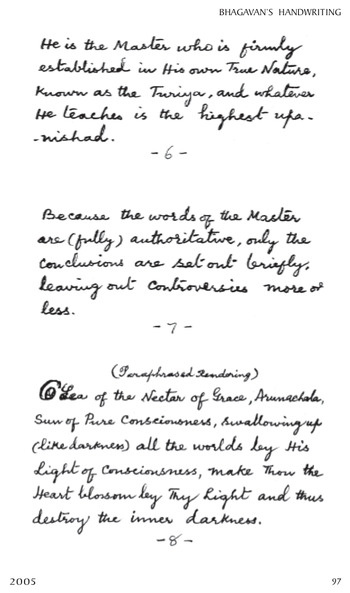
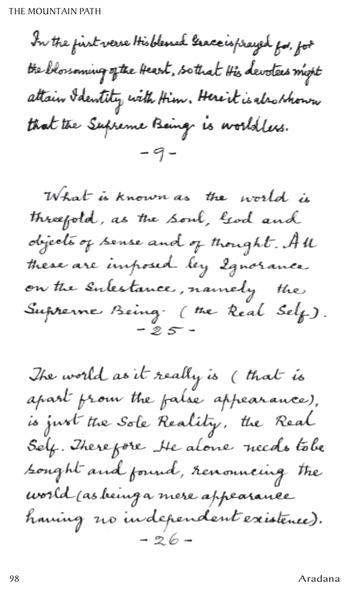
Below Sri Ramana explains ‘Here it is also shown that the Supreme Being is worldless’ (verse 9), meaning that the world appearance does not appear in the Self, and that the world appearance is due solely to ignorance (verse 25).
The triad of ‘soul, God and object’ in verse 25 refers to Jiva, Iswara and Jagat.
Verse 26 shows that ‘the world as it really is’ refers to pure consciousness devoid of objective phenomena, ie. when the nama rupa (names and forms) have been removed the Self is revealed, as the verse says, the world needs to be renounced.
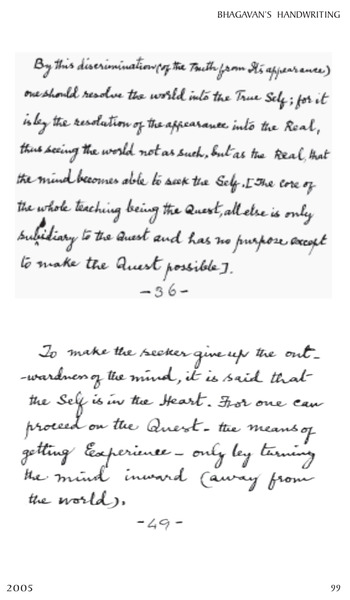
Below in verse 36 Sri Ramana states that the whole teaching is only to facilitate Self Enquiry (‘The Quest’), and in verses 36 and 49 he states that to do Self Enquiry one must ‘turn inwards’ explaining this means to turn ‘away from the world’:
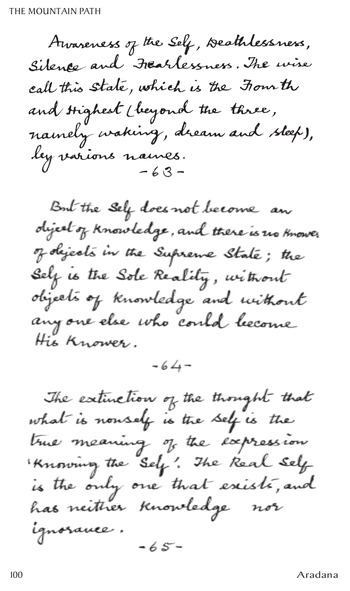
Here in verse 63 Bhagavan Sri Ramana states that Awareness of Self is Deathlessness, Silence and Fearlessness, also known as the Fourth (Turiya).
In verse 64 below Sri Ramana states that there are no objects and no knower of objects in the Self (which is formless and objectless, One Whole without any differentiation whatsoever):
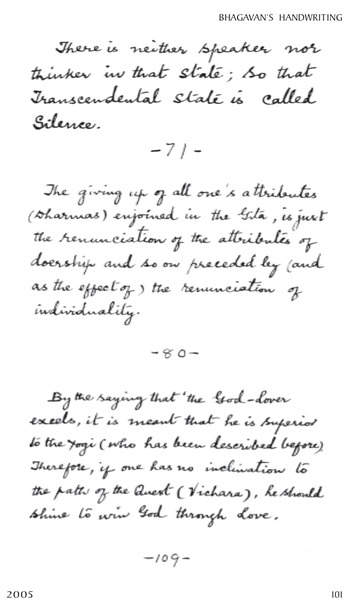
The following images are from The Mountain Path July 2005:
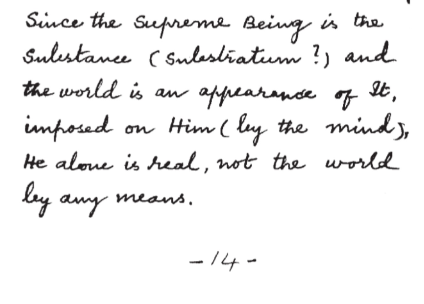
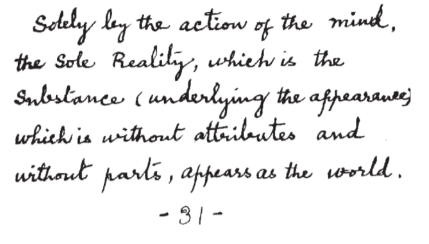
Here in verses 14 and 31 Sri Ramana states that the world is certainly not real, the world being a creation or projection of the mind:, only the Self, the Pure Consciousness devoid of objects and full of bliss is the only reality (and this must be known directly through Self-Enquiry, see verse 97 below)
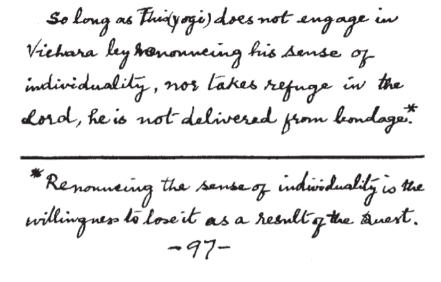
Here in verse 97 Sri Ramana states that unless one does Self-Enquiry (Vichara) or Self-Surrender, one will not end suffering. The asterixed portion confirms that Self-Surrender itself is essentially Self-Enquiry, there being truly onle One Path to the One Self:
Does the Sage (Jnani) see the world? Does the world appearance exist after liberation? Lakshmana Sarma explains verse 18 of Ramana Maharshi’s Ulladu Narpadu | Maha Yoga | Sri Ramana Paravidyopanishad
2024: More teachings from Sri Ramana Maharshi and also from Shankara on this subject here.
Many have misinterpreted Sri Ramana Maharshi’s teachings and the Vedanta/Upanishadic teachings (which both say and teach the same thing).
One devotee of Sri Ramana’s, a certain Lakshmana Sarma (LS), was unhappy about how Sri Ramana’s teachings had been misrepresented even by other devotees, so after consulting with Sri Ramana Maharshi he wrote several texts aimed at correcting these distorting teachings.
Below are some of his writings and some of Bhagavan Sri Ramana’s writings on the nature of Liberation.
Lakshmana Sarma, who was with Sri Ramana for over 20 years, was uniquely qualified to comment on Sri Ramana’s teachings as he was one of only 2 people who received personal 1 to 1 tuition from Sri Ramana on the deeper meaning of the teachings which went on for several years. He was also a Vedic and Sanskrit scholar, having studied the Upanishads and Shankara’s vast works as well as many other works too. Many of LS’s works were published during Sri Ramana’s lifetime, were written with the help of Sri Ramana and were thereafter recommended by Sri Ramana himself.
In LS’s book entitled ‘Maha Yoga‘, he explains Sri Ramana Maharshi’s teachings in the context of the Upanishads and Advaita Vedanta; and he also gives Sri Ramana’s view on how the Sage sees the world.
LS’s commentary on Ramana’s masterpiece Ulladu Narpadu (40 verses on Reality) was said by Sri Ramana to be the best available commentary on this work, which is hardly suprising as Ramana instructed LS on the deep meaning of this text over a 2-3 year period.
As a multilinguist, LS translated these texts into English himself, so we can be sure of the accuracy of the English translations too.
A caution before reading further
Whilst these teachings are open to all, these specific teachings are only for those who have a deep interest in liberation through the path of self-enquiry, as is explained in the post below.
It should be emphasised that understanding what is written in this post is NOT a prerequisite for realisation – see my personal note below for an example of this. This information is just provided for those who are interested, as it can be very helpful for some. Even if we disagree with this post, all we have to do is lovingly turn within and discover our own true nature, and then the truth (or falsehood) of this will be discovered for our self, first-hand 
Ramana cautions us not to spend time arguing whether or not the world exists or does not exist in realisation and rather our time is better spent in turning inwards in surrender and devotional self-enquiry. This entire teaching can become a distraction. Let us remember what Sri Ramana writes in Ulladu Narpadu, verses 3 and 34:
3. ‘The World is true’; ‘No, it is a false appearance’; ‘The World is Mind’; ‘No, it is not’; ‘The World is pleasant’; ‘No, it is not’ – What avails such talk? To leave the world alone and know the Self, to go beyond all thought of ‘One’ and ‘Two’, this egoless condition is the common goal of all.
34. The natural and true Reality forever resides in the Heart of all. Not to realise It there and stay in It but to quarrel ‘It is’, ‘It is not’, ‘It has form’, ‘It has not form’, ‘It is one’, ‘It is two’, ‘It is neither’, this is the mischief of maya.
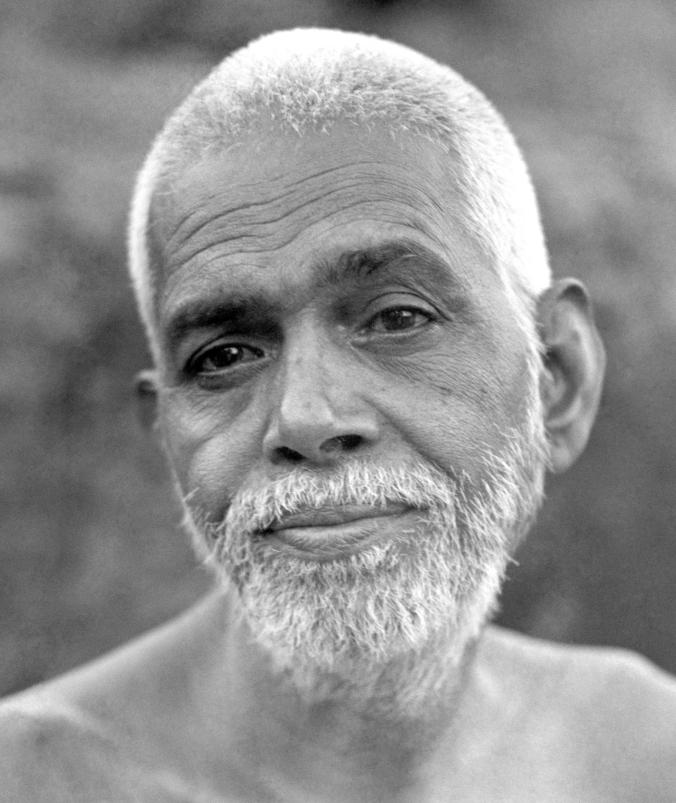
Does the sage see the world?
Tom: The following is an excerpt from Maha Yoga, pages 167-8; as usual, my comments are in italiscised red:
A question was put to the Sage [Sri Ramana Maharshi]: “Does the Sage see the world as others do?”
The Sage [Sri Ramana Maharshi] replied: “The question does not arise for the Sage, but only for the ignorant. He puts the question because of his ego. To him the answer is. ‘Find out the Truth of him to whom the question occurs.’ You ask the question because you see the Sage active like other men. The fact is, the Sage does not see the world as others do. Take for an illustration, the cinema. There are pictures moving on the screen. If one goes up to them and tries to seize them, he seizes only the screen. And when the pictures disappear, the screen alone remains. Such is the case with the Sage.”
Tom: there is a false vedanta teaching that states that the Sage (jnani) sees the world just as the ignorant jiva (ajnani) does. Here above LS refutes that view when he says ‘the Sage does not see the world as others do’. We will see many more quotes like this in the rest of the post below.
The same question is answered by the Sage also as follows: “The world is real, both to the ignorant and to the Sage. The ignorant one believes the Real to be co-extensive with the world. To the Sage the Real is the formless One, the basic Substance on which the world appears. Thus great indeed is the difference between the Sage and the ignorant one.”
Tom: the above answer in italics forms verse 18 of Ulladu Narpadu, or Forty Verses on Reality, written by Sri Ramana Maharshi. The paragraphs below form LS’s explanation of the true meaning of this verse:
Here the Sage begins by saying that, superficially considered, the ignorant one and the Sage are alike. For they both say that the world is real. But it is here pointed out that what the Sage means by the words is quite the opposite of what the other means.
The ignorant man takes the world to be real as such, with all its variety of name and form and, has no idea of the basic Reality which, as shown before, is like gold to the jewels made of it – is the Substance that is real as opposed to the forms that are unreal.
The Sage rejects the unreal part of the world and takes as real only the Substratum, the formless Pure Consciousness, the Self, which is unaffected by the false appearances. “The Self is real”, says the Sage, “not the world, because He exists alone in His State of Purity as the Pure Consciousness, without the world. The world cannot exist without the Self.” Thus we have to conclude that the Sage does not see the world and has no part or lot in it.
Tom: we see the same explanation given by Lakshmana Sarma in the footnotes of the first 15-20 verses of Guru Ramana Vachana Mala, and small but wonderfully comprehensive collection of Sri Ramana Maharshi’s teachings compiled by LS that are well worth reading. Also see verse 31 of LS’s translation of Ulladu Narpadu (picture quote below) which drives the same point home, even more clearly perhaps:
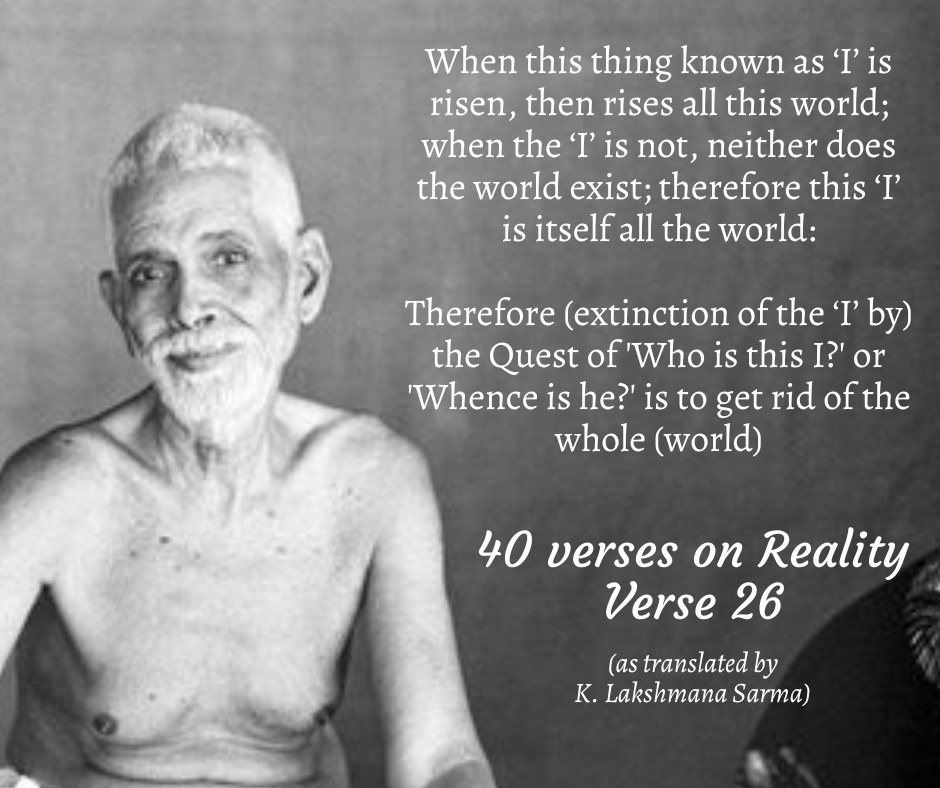
Tom: this is why Sri Ramana Himself wrote the following verse from Guru Vachaka Kovai:
The sage Self-realised knows not
Whether the transient body comes
And stays, or dies and leaves, even as
The senseless drunkard knows not what
Happens to his clothes.
~ SRI BHAGAVAN 24
Tom: this is also the true meaning of the Upanishadic verse, a form of which is here written by Sri Ramana, also in Guru Vachaka Kovai:
There is no creation, no destruction.
None bound, none seeking, striving,
Gaining freedom. Know that this
Is the Truth supreme.
~ SRI BHAGAVAN 28
Tom: please note that Sri Ramana wrote the above 2 verses himseld. A version of this above verse is found in the Amritabindu Upanishad in verse 10 and in the Atma Upanishad in verse 2.31. It was later incorporated by both Gaudapada (Mandukya Karika 2.32) and Shankara (Vivekachudamani verse 574) in their writings. A very similar teaching is given in the text Guru Ramana Vachana Mala, in the section that describes the Jivanmukti (the one liberated in this life):
313. As one that is profoundly alseep in a carriage in unaware of the varying states of the carriage – (its running, stoppages and unyoking of horses [Tom: – ie. the 3 states of waking, dream and deep sleep]) – so the one in the Transcendental State is unaware of the varying states of the body.
And another verse from the same text:
21. There is no mind, nor body, nor world, nor any one called a soul; the One pure Reality alone exists, without a second, unborn and unchanging, abiding in utter Peace.
We see the same teaching recorded in another text by LS, Sri Ramana Paravidyopanishad. He wrote a whole series of verses dotted throughout the text to make his point – he is one example in verse 39 (see below for more verses like this):
39. Unless and until the mind becomes utterly extinct, these three states will continue to prevail. When the mind becomes extinguished the supreme state is won, wherein this world once and for all ceases to appear.
LS then writes in his own commentary on this verse, as follows. Note that LS often uses the word ‘quest’ to refer to self-enquiry:
During the prevalence of ignorance the three states conceal the supreme state. The latter cannot be experienced because of these. To be able to experience that state the mind must be destroyed so that the world-creation will also cease. To this end, the quest must be taken up and pursued until the mind-free state is established.
We see a similar teaching, again in Maha Yoga, page 50:
So long as the Self appears to us as the world, we shall not realise Him as the Self; the world-appearance effectually conceals the Self; and it will do so until we get rid of the appearance.
And in Talks with Sri Ramana Maharshi, talk 187:
The activities of such a being [the realised Jnani] are like the feeding of a somnolent boy, perceptible to the onlooker (but not to the subject). The driver sleeping on his moving cart is not aware of the motion of the cart, because his mind is sunk in darkness. Similarly the sahaja Jnani remains unaware of his bodily activities because his mind is dead – having been resolved in the ecstasy of Chit Ananda (Self)
And in Talks with Sri Ramana Maharshi, talk 82:
Just as a passenger when asleep in a carriage is unaware of the motion, the halting or the unharnessing of the horses, so also a Jnani in sahaja samadhi is unaware of the happenings, waking, dream and deep sleep.
…In sahaja samadhi the activities, vital and mental, and the three states are destroyed, never to reappear. However, others notice the Jnani active e.g., eating, talking, moving etc. He is not himself aware of these activities, whereas others are aware of his activities. They pertain to his body and not to his Real Self, swarupa. For himself, he is like the sleeping passenger – or like a child interrupted from sound sleep and fed, being unaware of it.
And in Maya Yoga, page 120:
He that sees the unreal appearances does not see the Reality; he that sees the Reality does not see the unreal appearances.
And Maha yoga, page 125:
So too the world and the Reality are negations of each other. They cannot be seen simultaneously. The rope is unrelated to the snake; it did not give birth to the snake. So too the world and the Reality are negations of each other, in the sense that he that sees one of them does not and cannot at the same time see the other. The two cannot be experienced simultaneously. He that sees the world sees not the Self, the Reality; on the other hand he that sees the Self does not see the world. So one of them alone can be real — not both. Hence there is no real relation between them. The world did not come into existence from the Reality. The latter is wholly unrelated to the former. Therefore it is clear that the bridge that the intellect demands does not exist and cannot be built.
Or course many of you will recognise how the above quote from LS’s ‘Maha Yoga’ mimics Sri Ramana’s own writing in ‘Who Am I?’ when he writes:
Just as the knowledge of the rope, which is the base, will not be obtained unless the knowledge of the snake, the superimposition, goes, so the realization of Self, which is the base, will not be obtained unless the perception of the world which is a superimposition, ceases.
And also from Sri Ramana’s ‘Who Am I?’:
Therefore, when the world appears, Self will not appear; and when Self appears, the world will not appear
Going back to Maha Yoga, p. 138:
Deliverance is here and now – if only we lose the ego. Ignorance, bondage and the incidents of bondage, namely all this multiplicity and difference, do not exist even now. Therefore it follows that the Sage who is egoless does not see all this, which seems so real to us. For him this cinema-show of the world and its seer, the ego, have ceased; so he does not recognise its having been seen before. For him the screen alone remains, the Light of Consciousness; the moving pictures have vanished.
From Maha Yoga, p. 139:
The true Self, it is here expressly pointed out, is not Itself the cause of this variety. It has no becoming, as shown before. What becomes the universe is Maya, the mysterious power that has to be assumed as belonging to the Self, to account for the world-appearance. This Maya is the same as mind, which is the ego. Out of this Maya come forth the four, of which the individual soul is one, that is why he is unreal. Therefore it follows that this false appearance will persist only so long as the ego-sense continues, not after the extinction of the ego. Therefore we have to understand that to the Sage the world does not appear, though it may appear to others that the Sage sees the world, and though the Sage himself does not always deny seeing the world.
From Maha Yoga, p. 158:
For the Sage, therefore, nothing exists except the Self; there is neither body, nor mind, nor world, nor other persons
And in Maha Yoga page 159 it is explained that from the Jnani’s point of view, not only is there no body, mind nor world, but that these never existed in the first place, and they were never even seen as an appearance:
From his [the sage’s] point of view all the three bodies are non-existent. Not only that, he does not even recognise that they existed before. Hence it is only as a concession to the semi-ignorant disciple that the distinction is mentioned in the books. The absolute truth of Deliverance is that It is bodiless and worldless, because Deliverance is the state where the Truth [ie. the formless objectless Self] alone shines.
Some argue the world is not real but it still remains as an appearance upon realisation…
…LS explains that this view is only held by those who only have an intellectual understanding of the teaching, and who have not therefore actually discovered the Self through self-enquiry/turning within, see here from page 57 of Maha Yoga:
But when a rope is first mistaken for a serpent, and then recognised to be a rope, the serpent ceases to appear [italics to emphasise ‘ceases’ are by LS]. That does not seem to be the case with the world. Even when it is known that the world is only an appearance of the real Self, the world continues to appear. This is the objection raised by one that has heard the teaching and been more or less convinced. The correct explanation is that mere theoretical knowledge does not dissolve the world-appearance, but only the actual Experience of the Self.
In the last sentence of the above quote, LS reiterates that the ‘Experience of the Self’ does ‘dissolve the world-appearance’.
It is commonly argued that ‘dissolve the world appearance’ and ‘the world not appearing’ really just means that the world does not appear separate from the self – ie. that the world does appear, but not as a separate reality. However, note that this would be a dristi-shristi teaching and not ajata vada.
A personal note
On a personal note – I usually don’t talk too much about myself in these posts as I prefer the teachings to focus on Sri Ramana rather than myself – it may be of interest to you to know that my own personal view of the teaching when I was seeking was that the world does not disappear upon realisation but just is seen as one with the Self. I thought the types of views presented in this post were dogmatic, ideological and overly-intellectual, and were taking a too literal stance on what was meant to be a more poetic of metaphorical teaching perhaps.
It was only when my seeking ended that the direct radical truth of the teachings was actually revealed to me – there is only the formless objectless worldless Self, one without a second, with no mind to know anything, and no body to suffer. It was only then that the true meaning of the scriptures became clear to ‘me’! My mind would not let me see this truth beforehand as I could not understand, and did not even desire, the disappearance of the body, mind and world. My concept of realisation was to be happy and free in the world, or at least with the world and those I love still appearing.
Luckily for me, all I wanted was to be with Bhagavan in my Heart, and this love took me home.
Some further questions arising from this teaching
There are several obvious questions that arise from this teaching, such as is this state of liberation even desirable? (quick answer: yes, it is actually total unending freedom and bliss and what we are truly longing for), if the world does not appear for a jnani, then how does a sage function in the world? (quick answer: it only appears as if the Jnani is a person that carries out actions due to ignorance, they are actually the formless reality itself – see here and here for more on this) If the three states are no longer present for the sage, then why do I see them eating, sleeping, dreaming, etc? (quick answer is the same answer as for the previous question) Isn’t this a dualistic teaching if we are separating Reality from illusion? (quick answer – no! but see here and here for more), how to realise this for oneself (quick answer: self-enquiry, turn within) and if this world is illusory how should I live my life and what is the role of spiritual practice (quick answer: be good to yourself and others and the world/envoronment, act kindly and responsibly and engage with Bhagavan Sri Ramana’s teachings which will lead you to realisation of this for yourself) – do let me know if other questions also arise.
All these questions are answered in much more detail in the texts in the recommended reading list, such as The Path of Sri Ramana, Maha Yoga, Ramana Paravidyopanishad, Sadhanai Saram, The Happiness of Being and Manonasa, just to name a few. The articles at the end of this post also answer some of these questions too, especially the Manonasa post and the post about how a Jnani functions with no thoughts.
Most people find this strange teaching confusing or difficult to understand – it cannot truly be understood with the mind, after all – so don’t worry if you are confused (isn’t it commonly said that liberation cannot be understood with the mind? But then don’t many go on to explain the nature of liberation in detail in a way that it actually makes sense? This should be a red flag). It will all become clear if you truly have a desire for liberation – your desire for truth and reality and happiness will create the clarity that you seek.
But don’t many scriptures and texts state the Sage continues to sees the world as other do?
This is true; there are many instances of verses in the vedanta scriptures and in Sri Ramana’s teachings where it is said that the sage sees the world as others do. How can we reconcile this with the verses above and below contained in this post?
Bhagavan Sri Ramana explains that this is because these teachings that admit to the existence of the body mind and world (ie. Maya) are lower teachings for those who are not willing or able to accept there is not world or maya at all. There are many instances when after giving such a teaching to someone, once the questioner had left the room, Sri Bhagavan would therafter turn to those close devotees who remained in the room and explain to them that that was just a lower teaching given on a level that was appropriate for them.
This is rather like how we explain the workings of the universe to a child as opposed to a university graduate. It is not duplicitous, but rather it is presenting information in a way the audience of that information can understand it and therefore make use of it. Typically there are three levels on which the teachings are given, and the quotes in this post point to the highest level, ajata vada, a teaching that is rarely given, generally speaking, but a teaching which Bhagavan Sri Ramana was adamant was the only real truth.
Here is how LS describes this in Maha Yoga pages 59-60; here LS speaks of 2 levels of the teaching, the higher (true) and lower (ultimately untrue); note that LS uses the English word ‘revelation’ to refer to Shruti (the revealed scriptures consisting primarily of the Vedas and Upanishads):
The ancient lore is twofold. One part of it is addressed to those who are not conscious of being in ignorance, and therefore have no use for a teaching intended to dispel that ignorance. The other part of the ancient lore is addressed to those that are conscious of the ignorance and are in earnest to escape from it. These two parts are quite distinct. But this feature of the ancient Revelation is not known to these believers. Besides they are offended by the inevitable corollary that theirs is a lower position; they also feel it a grievance that the world, which they believe to be real, should be dismissed as unreal, and often want to quarrel with us who are followers of the Sages; we however have no quarrel with them, as the Sages have pointed out, because we realise that for them it is all right to believe as they do, and, so believing, to make the best of the world while it lasts. They are like dreamers who are persuaded that their dreams are real, and do not want to awake. We have begun to see that this worldly life is only a dream, because the Sages tell us so; and we want to awake.
How Ramana sometimes ‘watered down’ the teachings
LS testifies about how he often saw Bhagavan Sri Ramana ‘water down’ the teachings to suit those who were unwilling or unable to hear the true teachings. Even many of Sri Ramana’s devotees were unable or unwilling to accept the higher teachings. See here in Maha Yoga pages 160-161:
Even among the Sage’s disciples, there are some who cannot understand the answer [that the world is not real and has never even actually appeared]; but that is so because they are believers in a fascinating, but complicated creed, in which the chief tenet is that the world is real as such; it is therefore quite natural that they should refuse to understand the Sage’s teachings, of which the essential part is that the world is not real as such. They are dualists in fact, and as such violent haters of Advaitic teaching.
In this connection we may take note of the tenderness the Sage shows for the weaknesses of believers. The Sage observes the rule enunciated in the Gita (3.26) that no one’s faith should be disturbed. Therefore when ardent dualists are present, the Sage is very careful in what he says. He does not, while they are present, give out clear Advaitic teaching. But as soon as the dualists go out, he turns round to the Advaitis that remain, and apologetically explains to them that he had to water down the teaching to suit the dualists.
Tom: This is important to note, as Sri Ramana’s closest devotees were all in agreement about this point, that Sri Ramana’s highest teaching to those who knew him best was ajata vada, and that the body-mind-world does not even appear to a Jnani, not even as an appearance. Lower teachings stating that the world still remained were often given out to those who were not willing or able to receive these higher teachings.
In the Bhagavad Gita verse 3.26, referred to above by LS, Lord Krishna recommends that we do not disturb the minds of the ignorant who are attached to a life of doing and action (karma) and who are not yet ready to hear the higher teaching:
3.26 Let not the wise disrupt the minds of the ignorant who are attached to action, they should not be encouraged to refrain from work, but to engage in work in the spirit of devotion
He thus treats the latter as immature ones, and the Advaitis as adults who can understand that allowances have to be made to the immature. But he leaves us in no doubt at all, that the Advaitic teaching is the highest there can be*.
*On many occasions the Sage has clearly testified to this. One such occasion was this. Somebody had written in a book, that the Truth would be whole only if the world be real as such – with all its variety – not else. When this writer was reading this, the Sage exclaimed: ‘As if the Truth would be mutilated otherwise.’
How many times have we heard the (false) teaching that true non-duality would and must include the world! Here above Sri Ramana is clearly refuting this.
An example of how teachings can be subtly distorted
Interestingly, there is a PDF version of Sri Ramana Paravidyopanishad on David Godman’s website here, which has been edited and amended by David Godman. Whilst presumably this is well-intentioned, he unfortunately distorts the teaching when he changes the translation of verse 39 to:
39. Unless and until the mind becomes utterly extinct, these three states will continue to prevail. When the mind becomes extinguished, the supreme state, in which this world once and for all ceases to appear [as real], is won.
Comparing it to the original version of the verse, which was translated into English by LS himself, you can see David Godman has slightly changed the words themselves as well as the word order, but more noteably he has added ‘[as real]’ in square brackets. This small addition in square brackets could imply that the world still appears but is just somehow identified as being unreal.
Here is how the verse was originally translated by LS before David Godman edited it:
39. Unless and until the mind becomes utterly extinct, these three states will continue to prevail. When the mind becomes extinguished the supreme state is won, wherein this world once and for all ceases to appear.
Hopefully you can see how a small addition has potentially changed the meaning of the verse. I have had discussions with people who use these types of [amended] quotes to cling onto their erroneous view,something that LS comments on below in this post. Unfortunately this is not the first time I have seen distortions of these kinds in books edited by David Godman. This is a shame as LS went to such efforts to dispell these types of views!
If a distortion could happen so easily within only a few years of a text being published, it is easy to see how the older traditional scriptures can be distorted over time, even by those who have the best of intentions.
A second example of a similar distortion in the teaching
We see a similar distortion in the Sri Ramana Ashram publication of the English translation of ‘Who Am I?’ where the translator has similarly inserted text in brackets, presumably again with good intentions, but having the effect of distorting the actual meaning of the teachings. First we will see how Question and answer 4 is correctly translated:
- [Question:] When will the realization of the Self be gained?
[Answer:] When the world which is what-is-seen has been removed, there will be realization of the Self which is the seer
We can see how this teaching above is in line with the above article and this has been correctly translated; now here is the subtle distortion in the next question and answer, where the bracketed portion is not present in the original text, but has been ‘helpfully’ added by the translator:
- [Question:] Will there not be realization of the Self even while the world is there (taken as real)?
[Answer:] There will not be.
However, as the bracketed text does not appear in the original Tamil, an accurate translation should simply read:
- Q. Will there not be realization of the Self even while the world is there?
A. There will not be.
Hopefully you do not need me to re-explain how this slight alteration by the translator can distort the actual meaning of the teachings!
More Verses from Sri Ramana Paravidyopanishad on this topic
All of the verses below are taken from Sri Ramana Paravidyopanishad. ‘LS’ designates LS’s own commentary upon these verses, my comments or additions are in italicised red – enjoy!:
9 The world appearance is ignorantly superimposed by the mind upon that substratum, which is the truth of the Self. It [the world appearance] conceals that reality and shines [as if it is] real so long as the ignorance persists.
LS: Ignorance and mind are inseparable; where there is mind, there alone is ignorance; where there is no mind, there is no ignorance, since in the mind-free state the real Self is not concealed. This explains why the real Self is not known to men in general.
Tom: as a slight aside, we see the teaching that ignorance and mind are the same thing multiple times in Shankara’s Vivekachudamani, eg. in verses 169 & 180:
169. There is no Ignorance (Avidya) outside the mind. The mind alone is Avidya, the cause of the bondage of transmigration. When that is destroyed, all else is destroyed, and when it is manifested, everything else is manifested.
180. Hence sages who have fathomed its secret have designated the mind as Avidya or ignorance, by which alone the universe is moved to and fro, like masses of clouds by the wind.
For more on this teaching see here where Shankara also explains that the mind/ignorance creates the entire universe/world; see also Ramana Paravidyopanishad verse 85 below:
13 As one seeing the false snake fails to see the real rope, so, seeing the world – in which are included the personal God and the individual soul – he does not see the real Self as it really is, that is, as the supreme reality [Brahman].
Tom: Note that LS translates the word ‘Jiva’ as ‘soul’ or ‘individual soul’ as at the time of translation the notion of jiva, the (false) notion of being a seperate body-mind entity or person, was not well known in the English-speaking world.
LS: How long will this effect of ignorance continue?
14 The Self will remain concealed [in this way] as long as the world is taken to be real. It will cease to be so taken when the mind is once and for all extinguished; hence one must strive towards extinguishing the mind.
LS: The world-appearance being the obstacle to right awareness of the Self, and the mind being the cause of the world-appearance, the cure of this evil is the attainment of the mind-free state, which is done by the quest, which will now be briefly described.
15-16 The mind projects on the Self the illusory world appearance. He who, seeing the Self, becomes firmly established in the true state as that Self, thus uncovering that Self and dissolving the mind, which comprises ignorance and the whole world, will enjoy his own true state, which is without samsara, which is not covered by the vehicles, which is identical with Brahman, and which exists alone, without a second.
LS: The full significance of these revelations will be understood in due course, in the course of this book.
28 Since that state is changeless, worldless and calm, beyond the states of waking and the rest, it is called the fourth state. Such is the teaching of the Mandukya Upanishad.
LS: This means that for the one who has transcended the ignorance, the three states do not exist.
Tom: The forth state or ‘Turiya’ (literally meaning ‘the forth’), refers to the formless Self (Atman) which is beyond the 3 states (of waking, dream and deep sleep), and in which the 3 states do not appear, as explained in the Mandukya Upanishad, verse 7, as follows:
7. Turiya [the forth] is not that which is conscious of the inner (subjective) world, nor that which is conscious of the outer (objective) world, nor that which is conscious of both, nor that which is a mass of consciousness. It is not simple consciousness nor is It unconsciousness. It is unperceived, unrelated, incomprehensible, uninferable, unthinkable and indescribable. The essence of the Consciousness manifesting as the self in the three states, It is the cessation of all phenomena; It is all peace, all bliss and non—dual. This is what is known as the Fourth (Turiya). This is Atman and this has to be realised.’
We can see that Turiya is explained in the Upanishad as being the Self which ‘has to be realised’. Note the Upanishadic verse also states that in Turiya there is no consciousness of the inner world (thoughts, feelings, dreams), and also no consciousness of the outer world (ie. the waking state and gross objects).
30 The whole of this world is contained within this trinity of states. The reality of the fourth state, which is wordless, transcends these three states.
31 Deep sleep is just dreamless sleep; the other two are sleep with dream. The fourth state, being without sleep and without dream, is the abode of deliverance.
LS: Thus it is stated that, because of the underlying sleep of ignorance, the so-called waking is really a state of dream. This will be elaborated later, when the question of the reality of the world is discussed. The fourth state is in perfect contrast with the other three, being sleepless, dreamless and therefore worldless.
LS: The world-appearance, therefore, is just a dream. In fact, it often assumes the quality of a nightmare. It arises in the sleep that is ignorance of the real Self. This is stated next.
Tom: as the waking state is considered to be another form of dream, to say deliverance (liberation) is without sleep and without dream is to also say it is without the waking state; see also verse 39 below.
33 Those that are overwhelmed by this sleep of ignorance are the seers of this bad dream, the world. And so long as this ignorance does not cease by the right awareness of the real Self, the souls have to wander in this maze of the three states. The only way to escape from this bad dream is to become fully aware of the real Self.
39. Unless and until the mind becomes utterly extinct, these three states will continue to prevail. When the mind becomes extinguished the supreme state is won, wherein this world once and for all ceases to appear.
LS: During the prevalence of ignorance the three states conceal the supreme state. The latter cannot be experienced because of these. To be able to experience that state the mind must be destroyed so that the world-creation will also cease. To this end, the quest must be taken up and pursued until the mind-free state is established. This is often styled the state of knowledge. But this description is misleading for the reason stated presently.
Tom: note that LS uses the English word ‘quest’ to refer to self-enquiry
40 Though that state of being the real Self is called the state of knowledge, it is one in which there is none of the three: the knower, the object known, and the act of knowing. That being the case, what does one know there, by what means, and who is there to know? It must be understood that knowledge is just a name for the state of being the Self.
LS: That state is different from anything else because it is a state of non-duality (advaita). There is no object to be known, nor is there a knower – the soul [Jiva]– and hence there is no knowing. So ‘knowledge’ or ‘awareness’ are just arbitrary names for this state. This will be explained later.
Tom: note that LS uses the English word ‘soul’ to refer to the jiva, which is the false identification as a body-mind entity.
74 The aspirant will naturally turn away from the world at once and, with his mind turned inwards, will strive for the goal. It is by turning the mind away from the world that the quest is made, and for that reason the world is certainly to be renounced.
LS: The knowledge derived from worldly experience is ignorance. Hence, it cannot be used as evidence. If relied on, it will lead to wrong conclusions. The reason is next given briefly.
78 All worldly experience is rooted in ignorance. It is dream-like; it takes place in worldliness; it pertains to men ignorant [of the real Self]; and it is false. It is therefore no evidence for the seeker of deliverance in [this] discrimination between the real and the unreal.
LS: It has been explained that the three states of life, waking, dream and sleep, take place in the profound sleep of ignorance, and hence even waking experience is dreamlike.
84 The Guru, who is a sage, teaches the unreality of the world in accordance with his own experience, also giving reasons supporting it. The disciple who aspires to become free should accept this teaching with perfect faith and [with its help] strive for this goal.
85 The universe, comprising these three – the soul, God and the world of visible objects – is superimposed by the mind on the real Self, which is the sole reality of the supreme state. Hence all this [universe] is just an outcome of ignorance.
LS: The mind is the creator of the universe. Ignorance is the primal cause of the mind. Hence it is said here that this ignorance is the cause of the universe.
86 That being so, when this ignorance is annihilated by the light of awareness of that Self, then, along with it, the consequence of it [the world] will, like the darkness that disappears before sunlight at dawn, cease to appear.
LS: This will become more and more intelligible as we proceed. What is stated above are the actual facts of the Guru’s own experience. The conclusion that follows for the disciple is given next.
87 This universe [we see] shines in the dense darkness of ignorance, but does not shine in the great splendour of the light of Self-awareness. If this universe were real, why does it not shine in the supreme state, lit as it is by the conscious, effulgent light of the real Self?
LS: An axiomatic distinction between the real and unreal, which is implicit in vedantic metaphysics, is next enunciated.
88 That which survives in the experience of the real Self is the supreme state. [That] alone is real. All else is only unreal. This is the distinction between the real and the unreal, revealed to us by the teachings of all the sages.
LS: By this test the world is shown to be unreal. The next verse elaborates on this.
89 Since multiplicity is experienced only in the state of ignorance, it is declared to be unreal. On the other hand, because the unity of the Self is experienced on the liquidation of ignorance, that unity is real.
LS: The reality is only that which survives in the supreme state.
90 ‘The sole reality is that peaceful Self which shines by the light of its own nature as pure consciousness in the supreme state wherein the world is lost.’ Such is the teaching of our holy Guru.
LS:Here it is shown that the state is one of peace because there is no duality there. This is what we learn from all the Upanishads. This teaching is further confirmed by the analogy of the dream world.
91 As the dream world is known to be unreal for the reason that it vanishes upon waking, so this waking world is also proved to be unreal by its vanishing in the light of the real Self.
Tom: What about those who seek to discredit this teaching? Are they really interested in turning within, away from the world, and discovering the self? Let us see:
LS: It is next pointed out that those who seek to discredit this teaching are those who do not ardently aspire to the supreme state.
92 But ignorant men, who are averse to winning the supreme state, put forth an endless series of arguments, [trying to refute this teaching]. The sages clear the doubts generated by these arguments so that earnest aspirants may not be deluded by them.
LS: The teaching is addressed not to all men, but only to those who aspire to win the supreme state, because they alone are qualified to receive it.
93 This teaching of the unreality of the world is not addressed to those who look upon the body itself as the Self, or consider the Self to be the owner of the body. For these people the world is real, not unreal.
LS: The teaching has to be adapted to the person being taught. The same teaching is not good for all. Here it is shown that he who believes that the Self is not the body, but the owner of it, or the dweller therein, is for this purpose in the same category as the one who believes the body itself to be the Self.
LS: Why is it that the world is real to these people?
94 The teaching – that the trinity of the soul, God and the world is unreal – is indivisible. If one is convinced that one of these is real, the other two also will appear to be real.
LS: That is, the teaching must either be accepted as a whole or rejected wholly. There is no option to split it up and accept it partially, rejecting some of it.
95 To those who seek deliverance, the teaching is that all these three are equally unreal. This teaching must [therefore] be accepted, exactly as it is taught, by those who are earnestly seeking to win deliverance by the extinction of ignorance.
98 Everyone who is ignorant [of the real Self] thinks the world is real because it is seen. This is no proof because it proves too much. The same reason would prove the reality of the mirage, the rope in the snake, etc.
101 Only the sage who knows the substratum of the world appearance, the reality, by being firmly established in the supreme state, is competent to reveal the truth of the world.
LS: By his unawareness of that truth the common man, being a victim of his ignorance, cannot know the truth about the world.
102 When vision is focused on the outside, who can know the truth, whether of the real Self or of the world? But, with the mind turned inwards, the sage knows the truth of both by the eye of right awareness.
LS: It is with the knowledge of this uniqueness of the sage that the disciple has to approach him and listen to his teaching.
116 In the state of ignorance both the world and the Self are seen as forms. [But] on the extinction of ignorance both are [found to be] formless, because in the supreme state the infinite Self is the eye.
LS: In the true state, which is the supreme state, the Self alone is. It is described as infinite, and therefore formless. There are no objects to be seen, nor is there any real seeing. Hence, forms are unreal. If they were real, they would survive in that state.
117 By the vision of right awareness, the world, along with the soul, merges into the formless, real Self. The sages call that the vision of right awareness, wherein there is neither seer nor spectacle.
118 In that natural state [of the Self] there survives only the Self, which is consciousness, worldless, alone, and without the six modes of change, such as birth, and so on. Hence, it alone is real in its own right.
121 It is only by conceiving the formless Self as a form that one sees this world as consisting of forms. All this is really an ignorant superimposition on the formless, infinite reality, the Self.
122 It is only to him that sees himself as having a form that the names and forms appear as real. They have been fabricated by ignorance and superimposed on the nameless, formless Self, which is consciousness.
123 Thus it has been made plain by the Master that the seeing of the world is an effect of the primary ignorance. Thus, the claim that the world is real has been refuted by him. Also, it has been shown by him that the aloneness of the real Self in the true state is real.
124 Our Master confirms this teaching first by showing that the world is mental [inseparable from the mind], then by proving the unreality of the mind and the ego, and finally by teaching that even the primary ignorance is non-existent.
Tom: saying the world is mental is essentially vivarta vada, the idea that the world is a mere projection or appearance in consciousness; to say that the primary ignorance, which resulted in the world appearance, never existed, is tantamount to saying that the projection of the world never occurred, not even apparently/as an appearance. This is ajata vada.
131 The truth that the world is unreal is taught by the sages only to him who aspires to attain the highest state by the quest of the Self. It is not addressed to others, and hence the contentions of these objections are wholly in vain.
LS: The uniqueness of Vedanta is that no one is coerced by threats of hell or otherwise to accept its highly elusive teachings. It is given out only to those whose minds are ripe and have become receptive to these metaphysical truths. Indeed, Vedanta advises ordinary people not to dabble in vedantic studies.
132 No one is able to know the unreality of the dream world during the dream itself. In the same way, no one is able to know the unreality of the waking world while he is in the waking state.
144 The mind itself creates the world in the waking state, as it does in dream. But the mind does not know, either in waking or in dream, that this is its own creation.
146 This is the very nature of the mind, that it takes as real all that it creates. This is seen in day-dreaming, witnessing dramas, or listening to stories.
147 Creation is not other than seeing; seeing and creating are one and the same process. Annihilation is only the cessation of seeing and nothing else, for the world comes to an end by the right awareness of oneself.
Tom: Here we see that merely seeing objects is itself creation, jata. Therefore ajata vada, the doctrine of non-creation, states that the world was never even created, and the world never appeared, not even as an appearance.
330 There is no creation apart from seeing; seeing and creation are one and the same. And because that seeing is due to ignorance, to cease seeing is the truth of the dissolution (of the world).
334 Therefore the aspirant, being firmly convinced that space and time are unreal, should give up the whole world and seek to know the substratum, the Self, through the quest of his own true nature.
341 Therefore the aspirant must cease from thoughts of the worldly life and strive to become aware of the truth of the Self, which is the same as Brahman, by means of the quest of that Self.
448 The Supreme Being did not become mind, neither did it become the world. It remains unswerving from its true nature as pure, unmodified, consciousness, transcending time, space and the rest.
449 The world did not come into being, nor is it going to be destroyed. No one called ‘the individual self’ was really born. There is no one in bondage, no one who has become free, nor is there any spiritual seeker. This is the most excellent truth that has been clarified.
LS: This is the truth of non-becoming [ajata], demonstrated by the sage Gaudapadacharya, in his Mandukya Karikas, which is strictly in agreement with the experience of all the sages.
456 When, forgetting the Self, one thinks that the body is oneself and goes through innumerable births and in the end remembers and becomes the Self, know this is only like awakening from a dream wherein one has wandered all over the world.
LS: In a dream one may go on a world-tour and in the dream itself return home and lie down in one’s own bed; but when one awakes one knows that it was all a dream. In the same way all of one’s samsaric reincarnations are only a long-drawn out dream, at the end of which only the Self remains, unaffected by all this. There is a difference here, because it was not the Self that dreamed, but only the ego-mind.
523 How can any man understand, by the unaided power of his own intellect, one who is mind-free, bodiless and worldless?
LS: The one who is established in that state of deliverance is called a sage, or ‘Prabuddha’ or Buddha. He cannot be known because he has none of the attributes of an individual. He is one with the eternal subject, the supreme reality, and so cannot be made an object for anyone to know.
LS: Does the world survive after the egolessness is established?
541 The statement of the vedantic text that the Self swallows up the moving and the unmoving, means that the world, which is only darkness, is consumed by the effulgence of that Self.
LS: The Upanishads thus clearly state that the world, being only darkness, cannot possibly survive in the presence of the light of right awareness. The very same truth has been expressed by Bhagavan in the first verse of his Arunachala Pancharatnam, which is paraphrased here.
Tom: ‘Darkness’ in the verse above refers to ignorance, as LS confirms in the commentary on the next verse.
542 The essential nature of the Self has been sung by Guru Bhagavan in the following words: ‘The Supreme Self, named Arunachalesa [The Lord of Arunachala], shines alone without a second, having swallowed this solid-seeming universe by his own consciousness-light.’
LS: This confirms the statement that creation is composed of darkness (ignorance) alone, and has no substantial reality even now, when ignorance and ego are rampant. An inaccuracy of statement that is unavoidably made is corrected.
543 The statement that the Self, by attaining oneness with Brahman, becomes freed from the bondage of samsara is not true, because the Self never fell from its true state.
544 Just as white cloth does not acquire a new whiteness, whiteness being its nature, so the Self does not become Brahman because the Self is eternally Brahman by nature.
545 Two names are commonly in use to designate the sage, namely ‘Knower of Brahman’ and ‘Knower of the Self’. Since the sage is himself Brahman, as well as the Self, how can they become known to the sage?
LS: Neither of the two, which are identical with each other, can become the object of knowledge. The Self, as the eternal subject, is not an object to be known, and Brahman is therefore not an object. The unknowability of Brahman is due to its being the Self. So the terms, taken literally, are inapplicable. What then are their proper meanings?
552 The state of the non-dual, real Self, experienced by the sage who attains the supreme state, is not the fruit of the practice of sadhana. It is the eternal nature of that Self.
Tom: Some mistakenly think that the Self will be gained as a result of practice. Whilst it may seem this way, it is not actually the truth. There is only everlastingly the Self. The non-self never really existed at any time.
578 The sage in his worldly activities may appear to be aware of worldly differences, but he is really no more aware of them than a sleepwalker who moves about, performing actions.
583 Though he appears as embodied, he is really bodiless, being egoless. His subtle body does not survive and go forth somewhere when the gross body falls, but undergoes disintegration here.
584 Some believers in the reality of the world say that the sage has a body. Others say that the sage, being bodiless, can assume a body if he so pleases.
585 By the dawn of right awareness of the real Self, the ego, the root cause of the appearance of forms, has been lost. Therefore for the sage, all forms are unreal, and hence this talk of forms is foolishness.
586 Since it is not proper to say that this [world] existed before [enlightenment], but was lost afterwards, and since [even in ignorance] no one has a form from the point of view of the reality, how can the sage have a form?
587 In the case of the sage who is established in his own natural state, free of all the three bodies, how can a desire arise to have a body? This talk of forms is in vain, being merely a concession to the unenlightened.
592 The popular notion that there are many sages is also not true. All differences belong to the world. In the worldless state they do not exist.
593 He who says, ‘I have today seen this sage; I shall see others also,’ does not know the true nature of sages, which is reality-consciousness-bliss. This is what Bhagavan has told us on this point.
594 For him who knows not the sage who is within himself there appear many sages. For him who knows that one, which is his own Self, this plurality [of sages] is non- existent.
600 It is the deluded men with outward-turned minds, hankering for worldly enjoyments, who talk of these siddhis [Tom: special supernatural powers, the literal meaning of siddhi is attainment], namely becoming minute, etc. Revelation mentions these siddhis for attracting the dull-witted ones also to the path for deliverance.
645 The statement in revelation that prarabdha karma [the apparent actions destined for the body-mind] survives [in the liberated sage] is only in conformity with the view of the ignorant. From their point of view, those actions have results, because in their view the sage is embodied.
654 The sleeper in the carriage does not know anything about the going, the stopping and the unyoking of the horses [of the carriage]. Just so, the sage who is asleep [to the world] in the carriage, the body, does not know its changing conditions.
For more on this topic also see the following links where Sri Shankara, Sri Gaudapada and Sri Sadhu Om, amongst others, give this same teaching. The Michael Langford link also goes into great depth about this topic that is rare to find elsewhere:
Non-duality, Self-Realisation and the appearance of the world | Sri Sadhu Om
Ramana Maharshi – the 3 levels of the teaching
The entire path explained: the Path of Sri Ramana (Parts 1 and 2; PDF downloads)
Shankara: how to Realise the Self (commentary on the Brihadaranyaka Upanishad)
The nature of Liberation | Manonasa by Michael Langford
How can the Jnani (sage) function with NO THOUGHTS? Sri Ramana Maharshi
The nature of Self-Realisation according to Shankara and Gaudapada | Mandukya Upanishad and Karika
!Om Namo Bhagavate Sri Ramanaya Om!
The Most Direct Means To Eternal Bliss by Michael Langford
This is a wonderful book – it is one of my recommended books for liberation – that clearly shows the way to liberation and also nicely points out some of the many ways the ego tries to preserve itself. Its tone may not be for everyone, but it is well worth the time to read and put into practice.
The author has made this text freely available online but I encourage you to buy the latest edition of the book yourself in paperback to support the author of this text.
After reading ‘The Most Direct Means to Eternal Bliss’, the book ‘How to Practice the Teachings‘ should also then be read, as this 2nd book suggests additions and changes that further enhances and clarifies the teachings.
Click on the link below to download the book in PDF format.
The Most Direct Means To Eternal Bliss PDF
There are several other books from the same author, all of which are also worth exploring, including the following titles:
-The Importance of Practice and Effort
-How to practice the teachings
The Seven Steps to Awakening is in particular one of the best books ever written on how to attain liberation, and you can download this free using the link above.
The Ten most important verses of Shankara’s Vivekachudamani according to Sri Ramana Maharshi
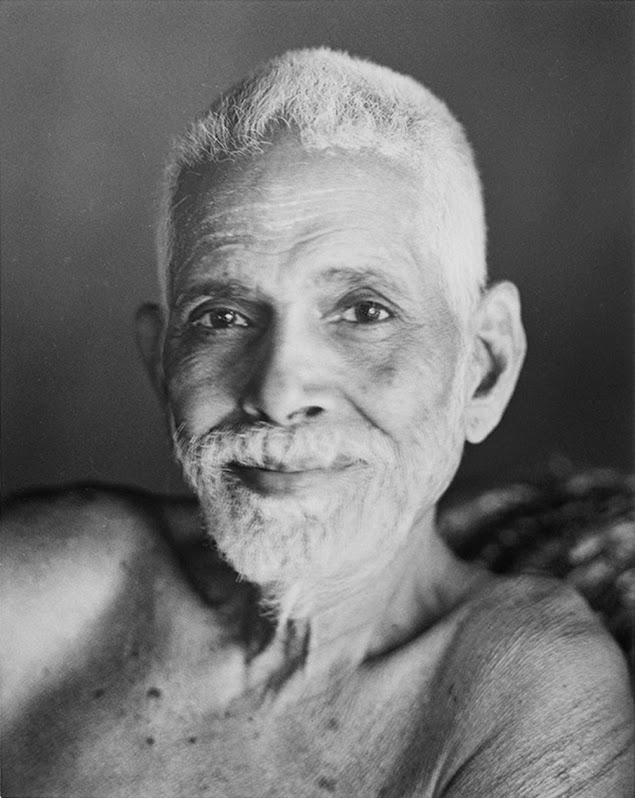
Ramana Maharshi stated that Shankara’s text Vivekachudamani contains in detail all the points required for a seeker of liberation ‘thereby directing them to the true and direct path‘.
Vivekachudamani contains 580 verses. Ramana Maharshi evidently placed this text in high regard, so much so that he translated the entire text into Tamil for those who could not read or understand the original Sanskrit. He also selected what he felt were the ten most important verses, which are as follows:
The ten most Significant Verses From Sri Sankara’s Vivekachudamani
As selected by Sri Ramana Maharshi
1. Among things conducive to Liberation, devotion (Bhakti) holds the supreme place. The seeking after one’s real nature is designated as devotion. (Verse 31)
2. The Supreme Self, the eternal, indivisible, non-dual Consciousness, the Witness of buddhi and the rest, is other than the real (Sat) and the unreal (asat), and is the ultimate significance of the notion conveyed by the term ‘I’. It is the immediate Reality, the embodiment of Bliss. (Verse 351)
3. Different from matter (prakriti) and its modifications is the Supreme Self, of the nature of pure Knowledge. It is Absolute and directly manifests the entire gross and subtle universe, in waking and other states, as the substratum of the steady sense of egotism. It manifests Itself as the Witness of the intellect (buddhi). (Verse 135)
4. That which clearly manifests itself in the waking, dream and deep sleep states; that which shines inside uniformly and continuously as I-I; witnesses the ego, the intellect etc, which are of different forms and modifications; which shines as Eternal bliss (nitya ananda) and consciousness (chit), know this, within your heart, as your own Self. (Verse 217)
5. With a regulated mind and a purified intellect, directly know yourself as the essential Self, in the form ‘This I Am’. Cross the shoreless ocean of worldy existence (samsara) with its waves of births and deaths. Firmly established as Brahman, which is your own true essence, be blessed (Verse 136)
6. The self-shining witness (sakshi) of everything, this Atman shines eternally, in the sheath of the intellect (vijnanakosha). Making this Atman, which is distinct from the unreal, the aim of contemplation, meditate upon It as your own Self, eliminating all other thoughts (Verse 380)
7. Extremely subtle is the Truth of the Self Supreme, and it is not discernible to the gross vision (of the mind). It is knowable to the noble-minded of very pure intellect, through samadhi, brought about by an extraordinarily subtle mind. (Verse 360)
8. Thus purified by constant practice when the mind merges with Brahman, then Samadhi passes from the Savikalpa stage [where objects still arise] to the Nirvikalpa stage [where no objects arise], leading directly to the experience of the Bliss of Brahman, the Non-dual. (Verse 362)
9. By this [Nirvikalpa] Samadhi are destroyed all the knots of vasanas and all karma is destroyed. One‘s Real Nature (swarupa) manifests spontaneously and effortlessly, forever, everywhere and always, within and without. (Verse 363)
10. In the cave of the intellect, there is the Brahman, the Supreme non-dual Reality, distinct from [relative] truth (sat) and untruth (asat). One who dwells in this cave as Brahman has no rebirth*. (Verse 266)
*Tom: The literal rendering of this last line of verse 266 is a play on the word ‘cave’ and states ‘One who dwells in this cave as Brahman does not enter into the cave of the body’. The ‘word ‘cave’ is used in the Upanishads to describe the location of Brahman, whilst ‘cave of the body’ refers to the mother’s womb, which in turn refers to rebirth in samsara and continued suffering.
Sri Ramana Maharshi also said that the entirety of Advaita Vedanta can be found in in verse 170 of Vivekacudamani:
170. In dreams, when there is no actual contact with the external world, the mind alone creates the whole universe consisting of the experiencer, etc. Similarly in the waking state also, there is no difference. Therefore all this [phenomenal universe] is the projection of the mind.
Ramana Maharshi – three theories of reality of the world (shristi-dristi vada, dristi-shristi vada/vivarta vada, ajata vada) – the 3 levels of the teaching
This is one of a series of introductory articles – please see the homepage of tomdas.com for more introductory articles. Also see: For those attached to the world, the world is considered to be a divine manifestation. For the advanced seeker, the world is considered to be an illusion
And The Suprising Meaning of ‘Real’ and ‘Unreal’ in Advaita Vedanta
In classical Advaita (Non-Dual) Vedanta, there are three main theories or viewpoints of reality, called shristi-dristi vada, dristi-shristi vada and lastly ajata vada. Whilst these Sanskrit words may appear complex, the idea is actually very simple, and Bhagavan Sri Ramana Maharshi explains the meaning of these terms below.
It may be helpful to note that ‘vada’ means ‘theory’ or ‘viewpoint’, ‘shristi’ means ‘the world’ or ‘creation’, ‘dristi’ literally means ‘sight’ but in this context refers to consciousness, and ‘jata’ means ‘birth’ (or creation). Adding ‘a’ as a prefix to ‘jata’ negates the meaning so that ‘ajata’ means ‘unborn’ or ‘no creation’.
Therefore:
1) Shristi-dristi vada is the view that the world is primary and gives rise to consciousness, which is the most commonplace model of the universe, ie. that first there was a universe in which life gradually evolved on planet Earth and eventually human life and human consciousness evolved. In Western philosophy this is known as the Realist view of reality. This view also broadly corresponds to the waking state and to the Dvaita (dualistic) world view.
2) Dristi-shristi vada is the view that consciousness is primary and gives rise to the world appearance, ie. like in a dream, consciousness exists first and then this consciousness manifests the apparent dream-world and dream-subject/object duality. In Western philosophy this is known as the Idealist view of reality. This view broadly corresponds to the dream state and the view of Vasistadvaita (qualified non-duality or partial non-duality as I like to call it). This view is also known as, or at least is very similar to vivarta vada, which is the view that the world and individual are both projected illusions that simultaneously appear, and that the world and individual appear to appear but do not actually appear, rather like a dream. Vivarta vada could therefore be considered to be a sub-type of Drist-Shristi-Vada.
and
3) Ajata vada is the radical view that there never was any creation at all, and that there is only The Absolute, and that there never has even been the appearance of creation. This view broadly corersponds to the deep sleep state and also to Turiya, the ‘fourth’ state. This is the true Advaita (non-duality). In Vivarta-vada, it is said that Maya (the entire phenomenal appearance) appears to exist, but actually doesn’t, but in ajata vada it is almost imcomprehensibly stated that Maya never even came into existence, not even as an appearance. Hence the difference between Vivarta Vada and Ajata Vada. Vivarta vada states the snake appears to exist in the dimly lit rope, but that it isn’t real, whereas ajata vada states that the snake never even appeared to exist at ‘any time’ (‘any time’ is in quotes as the notion of time and space are also ‘seen’ to never have existed).
Note that whilst (1) and (2) can be understood conceptually with the mind, Ajata vada is an advanced and highly radical teaching that is very difficult to comprehend and it makes little sense to the mind. This is why liberation is said to be unfathomable. Ajata Vada is usually associated with Gaudapada’s commentary on the Mandukya Upanishad but also features in several other scriptures such as Ribhu Gita, Yoga Vasishtha, the final few verses of Shankara’s Vivekachudamani, the Ashtavakra Gita and Avadhuta Gita to name a few. Shankara’s commentaries on the Upanishads also commonly point to the radical ajata teachings.
Vedanta teachings often start by working in a Realist framework, which is the default conceptual framework of reality for most seekers especially at the start of their journey. Then the Idealist conceptual framework is introduced, and later the Ajata or no-creation viewpoint is brought in when the seeker is ready, in step-wise progression depending on how the seeker is progressing with the teachings. The nature and content of teachings differ depending on what framework of reality is being used. Note the purpose of the teachings is not that they are true, but the view is to be adopted in order to remove ignorance and reveal THAT which cannot be taught, explained or expressed in words – THAT which you – THAT which is all there is – beyond words.
Note that the stronger the ego (ie. the identification with being a body-mind), the stronger the attachment to the belief-concept that the world is real, and this means that the higher teachings are more likely to be rejected by the ego-mind. Conversely, the weaker the attachment to body-mind, the weaker the attachment to the belief in the world being real, and the more likely the higher teachings are to be accepted. This in turn facilitates Self-Enquiry and ‘attainment’ of Moksha (liberation).
Similarly, whenever we come across a teaching, it can be very helpful to see which of the 3 levels the teaching belongs to – this can be very helpful to avoid unnecessary confusion in what can otherwise seem to be contradictory teachings.
To explain further, here is an excerpt from Day by Day with Bhagavan from 15th March, 1946:
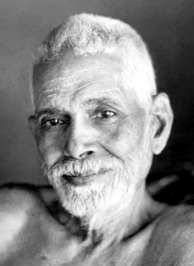
[Ramana Maharshi:] I do not teach only the ajata doctrine. I approve of all schools. The same truth has to be expressed in different ways to suit the capacity of the hearer. The ajata doctrine says, “Nothing exists except the one reality. There is no birth or death, no projection or drawing in [of the world], no sadhaka [no seeker], no mumukshu [no one seeking liberation], no mukta [no liberated person], no bondage, no liberation. The one unity alone exists ever.”
‘To such as find it difficult to grasp this truth and who ask. “How can we ignore this solid world we see all around us?” the dream experience is pointed out and they are told, “All that you see depends on the seer. Apart from the seer, there is no seen.”
Tom: Note here how Sri Ramana is distinguishing and differentiating vivarta vada/drist-sristi vada from ajata vada. Many people erroneously think that ajata vada states that world appears as a dream and non-creation means that the world is merely a dream-like appearance (as a dream appears, but is not real, and in that sense has not been created) – ie. many people erroneously equate ajata vada with vivarta vada/dristi-sristi vada. However here in the section above, if we read carefully, we can see that Sri Ramana is stating the Ajata vada is actually different to the idea that ‘all appears as the Self’. See here and here for more on this.
In Sri Ramana Paravidyopanishad we also see this same teaching in verses 147 and 330:
147. Creation is not other than seeing; seeing and creating are one and the same process. Annihilation is only the cessation of seeing and nothing else, for the world comes to an end by the right awareness of oneself.
330. There is no creation apart from seeing; seeing and creation are one and the same. And because that seeing is due to ignorance, to cease seeing is the truth of the dissolution (of the world).
‘This is called the drishti-srishti vada, or the argument that one first creates out of his mind and then sees what his mind itself has created.
‘To such as cannot grasp even this and who further argue, “The dream experience is so short, while the world always exists. The dream experience was limited to me. But the world is felt and seen not only by me, but by so many, and we cannot call such a world non-existent,” the argument called srishti-drishti vada is addressed and they are told, “God first created such and such a thing, out of such and such an element and then something else, and so forth.” That alone will satisfy this class. Their mind is otherwise not satisfied and they ask themselves, “How can all geography, all maps, all sciences, stars, planets and the rules governing or relating to them and all knowledge be totally untrue?” To such it is best to say, “Yes. God created all this and so you see it.”’
Dr. M. said, ‘But all these cannot be true; only one doctrine can be true.’
Bhagavan said, ‘All these are only to suit the capacity of the learner. The absolute can only be one.’
In Guru Vackaka Kovai (Garland of Guru’s Sayings), Ramana says the following (with a comment by Sri Sadhu Om):
100. Although Guru Ramana taught various doctrines according to the level of understanding of those who came to Him, we heard from Him that ‘Ajata’ alone is truly His own experience. Thus should you know.
Sri Sadhu Om’s comments: ‘Ajata’ is the knowledge that nothing – neither the world, soul nor God – ever comes into existence, and that ‘That Which Is’ ever exists as IT is.
Tom: here in Sri Sadhu Om, we have a close and direct devotee of Sri Ramana’s clearing stating what Ajata Vada actually is.
114. When the limited light [which is used to project pictures on the cinema screen] is dissolved in the bright sunlight [which enters the cinema], the pictures also will disappear instantaneously. Similarly, when the limited consciousness [chittam] of the mind is dissolved in supreme Consciousness [Chit], the picture show of these three prime entities [God, world and soul] will also disappear.
Here Sri Ramana explains why the teachings may initially concede the existence of the three primal entities (the individual or jiva, the world or jagat, and God the ordainer or Isvara):
115. Thus, since the Truth of the Source is One, why do all religions [and sometimes even Sages] start their teachings by at first conceding that these three prime entities are real? Because the mind, which is tossed about by objective knowledge, would not agree to believe in the One unless the Sages condescended to teach It as three.
122. Whatever high and wonderful state of tapas one may have attained, if one still identifies oneself with an individuality, one cannot be a Sahaja-Jnani [i.e. One in the State of Effortlessness]; one is only an aspirant of, perhaps, an advanced stage.
Here it is explained that for the teaching to ‘condescend’ to vivartha vada is the most practical method for seekers:
83. From his condescending opening words, “Because we see the world”, it is to be understood that the Great Master, Bhagavan Sri Ramana, who gives the most practical assistance to aspirants, sets aside all other doctrines and teaches that only the ‘Doctrine ofVivartha’is suitable to be taken as true.
Sri Sadhu Om’s comments: Though His experience of the Truth can only be adequately expressed by the ‘Doctrine of Ajata’, Bhagavan Sri Ramana uses only the ‘Doctrine of Vivartha’ for His Teachings…The ‘Doctrine of Vivartha’ is recommended to explain the standpoint of Advaita, ie. to explain how the world-appearance, its seer, and the seer’s knowledge of the appearance all come into existence simultaneously, unconditioned by cause and effect. However, since this accepts the appearance of the world, souls and God, it is only a working hypothesis to help aspirants. The‘Doctrine of Ajata’, on the other hand, never accepts even the appearance of this trinity, but proclaims that the One Self-shining Reality alone exists eternally and without modification; Ajata is therefore the highest of all doctrines and it is only suitable for the fully-ripened aspirants. Bhagavan Sri Ramana therefore comes down condescendingly and, setting aside ‘Ajata’ and the two lower doctrines He advocates through His Forty Verses on Reality the ‘Doctrine of Vivartha’ which is suitable for the ripe aspirants who have no faith in the lower doctrines, yet do not have the maturity to grasp the highest, ‘Ajata’.
Also see Ramana Maharshi: how to abide as the Self, the world is not real, attend to yourself
and How spiritual teachings work and Ramana Maharshi on those who claim to have surpassed the traditional notion of enlightenment
and Manonasa and The nature of Liberation | Ramana Maharshi | PDF download
Ajata Vada as taught in the Bhagavad Gita
 Tom Das