Here Swami Advayananda of the Chinmaya International Foundation explains the need for Nirvikalpa Samadhi according to Advaita Vedanta and how to overcome the obstacles to it:
Here Swami Advayananda of the Chinmaya International Foundation explains the need for Nirvikalpa Samadhi according to Advaita Vedanta and how to overcome the obstacles to it:
Note – you can find a summary of the essential points of the article at the end
It’s a funny strange world, and when we explore spirituality the mind boggles with all the different teachings that are out there, available for our consumption. One of the more popular teachers of Vedanta in recent years is Swami Sarvapriyananda, a monk from the Ramakrishna Order. This Order of monks was not set up by Ramakrishna, but was set up by Swami Vivekananda, a devotee and disciple of Ramakrishna, shortly after Ramakrishna’s death.
As a teenager I found a book of Swami Vivekananda’s on my parent’s bookshelf and started to read it. It was this book that propelled me into becoming a ‘spiritual seeker’ – the book was called Raja Yoga. After reading this book I started to read all I could on the teachings of Sri Ramakrishna and Swami Vivekananda.
It is worth noting that Ramakrishna learnt and was initiated into traditional Advaita Vedanta from the monk Tota Puri, who is purported to have been part of a teaching lineage dating back to at least Adi Shankara – ie. Sri Ramakrishna was taught and initiated into Advaita Vedanta in a traditional way – this will become more relevant as you read on. Anyway, through reading so much of their material as a teenager, I became very familiar with the respective teachings of both Swami Vivekananda and Sri Ramakrishna.
More recently, having come across Swami Sarvapriyananda, who is currently the head of the outpost of the Ramakrishna Mission in New York, I was surprised to see that in some quite important ways what Swami Sarvapriyananda teaches departs from what Swami Vivekananda and Ramakrishna taught – I hope to demonstrate this below. I will also comment on how Swami Sarvapriyananda’s teaching differs to Sri Ramana Maharshi’s teaching, illustrating this with quotes.
As always, these articles are not written in order to put anyone down or criticise. Personally I have the utmost respect and appreciation for Swami Sarvapriyananda and what he is doing to share the teachings of Vedanta in such an accessible manner. I also understand that a range of teachings and teachers can be a part of one’s spiritual journey, and if you are finding a certain teacher or teaching to be helpful to you, who am I to say otherwise? In fact, I am happy for you! Ultimately it is all good, and if we are earnest and honest, we will find what we are looking for (ie. Liberation/Self-Realisation) – it is only a matter of time. Discussing the teachings of vedanta have always been part of the vedanta tradition and I only offer you my point of view in case it is of assistance to you.
I usually prefer not to write articles that may appear to be critical about other teachers/teachings as I do not want to detract others from their own path. So if you enjoy and benefit from the teachings of Swami Sarvapriyananda and do not want to read about any potential flaws in them, or how they may be improved, please do not read any further.
Both Swami Vivekananda and Ramakrishna emphasised the need for samadhi for liberation, even in the path of Advaita Vedanta. In fact the frequent mention of samadhi is one of the most notable parts of the teaching that comes through when you read either of them and their respective teachings. However with Swami Sarvapriyananda, he discourages this very practice that is emphasised by his Gurus, stating that samadhi is not necessary for liberation, and that this is essentially a false path that one should not undertake.
This is a common trend that we are seeing more and more – the notion that samadhi is not needed for liberation for most people. However, for at least the last 1400-1600 years, the dominant traditional view in Advaita Vedanta was that Samadhi is required for liberation for most people, and this is what has been handed down generation to generation, century after century, for over a millenium. We have very strong evidence for this as many Advaita texts written during this time clearly state the need for samadhi to attain liberation. Prior to this time, there is very little written textual evidence that we have available to us, unless we go back much further to the Upanishads, several of which also state the need for Samadhi or equivalent. Note that the Upanishads are the highest authority in Vedanta teachings – in fact vedanta teachings strictly speaking refer to the teachings in the Upanishads, eg.
The knot of ignorance in the heart is broken completely only when one sees his Self as secondless through Nirvikalpa Samadhi
~ Adhyatma Upanishad 1.17
The mind severed from all connection with sensual objects, and prevented from functioning out, awakes into the light of the heart, and finds the highest condition. The mind should be prevented from functioning, until it dissolves itself in the heart. This is Jnana, this is Dhyana, the rest is all mere concoction of untruth.
~ Amritabindu Upanishad, verses 4-5
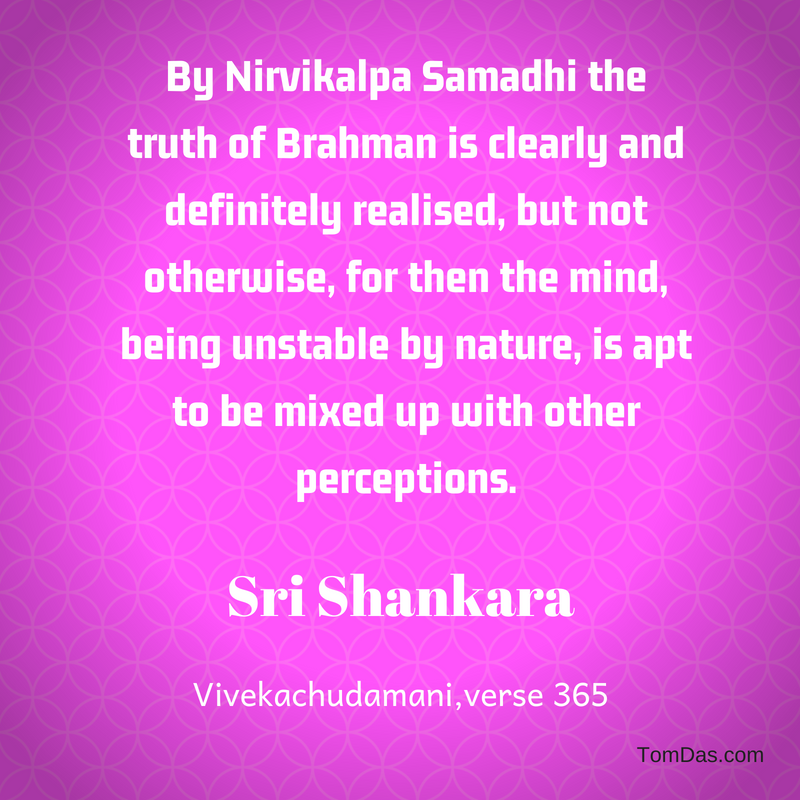
By the Nirvikalpa Samadhi the truth of Brahman is clearly and definitely realised, but not otherwise, for then the mind, being unstable by nature, is apt to be mixed up with other perceptions.
~ Shankara, Vivekachudamani verse 365
Note this above verse is one of a whole series of verses by Shankara in which he drums home the importance of nirvikalpa samadhi as being the only way to attain Self-Realisation, see this link to read the other verses in the series: Shankara on the the need for Samadhi. Here is another:

We see the same teaching given again and again in the Upanishads:
By expelling (from the mind) without any remainder all objects which are superimposed on one’s Atma, one becomes himself Parabrahman the full, the secondless and the actionless
~ Adhyatma Upanishad 1.21
The Self (Atman) is beyond all expression by words beyond all acts of mind; It is absolutely peaceful, it is eternal effulgence free from activity and fear and it is attainable by Samadhi
~ Gaudapada, Mandukya Upanishad Karika 3.37
When the five organs of perception become still, together with the mind, and the intellect ceases to be active: that is called the Supreme State [Brahma-Vidya or Self Knowledge]
~Katha Upanishad 2.3.10
In his commentary on Katha Upanishad verse 1.2.20 Sri Shankara writes:
‘…One whose intellect has been withdrawn from all objects, gross and subtle, when this takes place, this is known as ‘inactivity of the sense organs’. Though this ‘inactivity of the sense organs’ one sees that glory of the Self. ‘Sees’ means he directly realises the Self as ‘I am the Self’ as thereby becomes free from suffering’
Vidyaranya Swami (1296-1386), author of the wonderful Advaita Vedanta text Panchadasi and Shankaracharya (head monk in the Shankara-Vedanta tradition) of Sringeri Math, wrote another less well known text called Jivanmukti Viveka. In it he, in some considerable detail, outlines the path to Jivanmukti, or liberation in this life. He write the following:
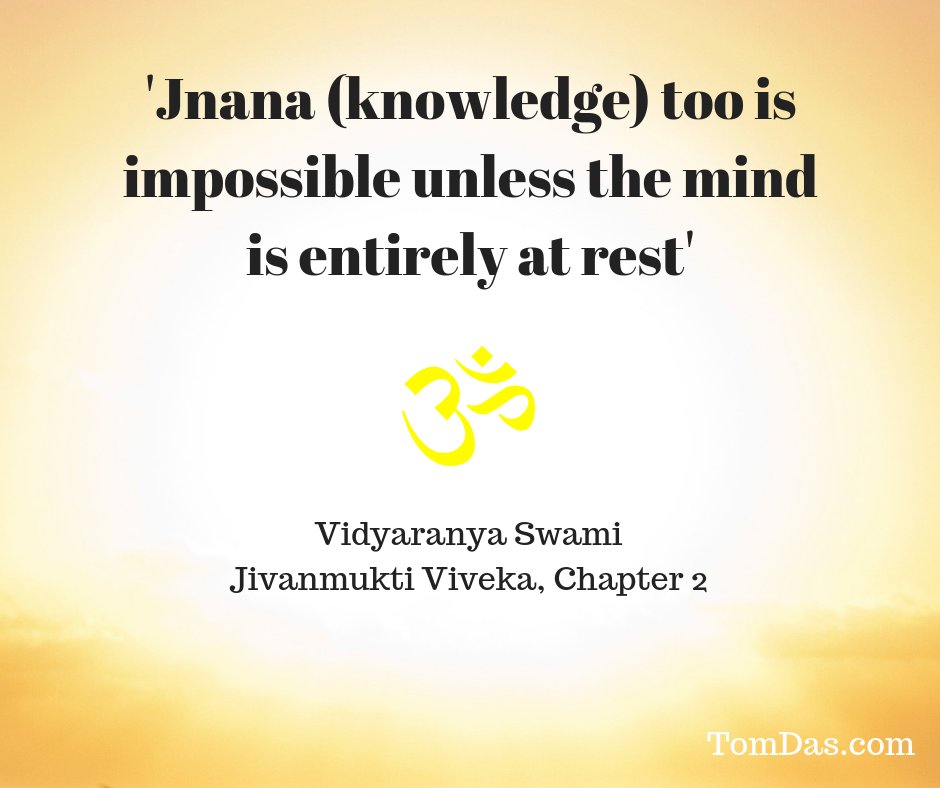
This mind being ‘entirely at rest’ is what is meant by Nirvikalpa Samadhi or the Turiya state. To read more about Vidyaranya Swami see this link: Jivanmukti Viveka – The path to liberation in this life by Swami Vidyaranya
The two main great sages of recent times, Sri Ramakrishna (1836-1886) and Sri Ramana Maharshi (1879-1950) both stressed the need for samadhi in order for liberation to be attained, thus continuing this traditional view. eg. in Talks with Sri Ramana Maharshi the following is recorded in Talk 226:
A visitor from Tirukoilur asked if the study of the sacred books will reveal the truth.
Sri Ramana Maharshi.: That will not suffice.
Devotee.: Why not?
Maharshi.: Samadhi alone can reveal it. Thoughts cast a veil over Reality
and so it cannot be clear in states other than Samadhi.
Devotee.: Is there thought in Samadhi? Or is there not?
Maharshi.: There will only be the feeling ‘I am’ and no other thoughts.
Devotee.: Is not ‘I am’ a thought?
Maharshi.: The egoless ‘I am’ is not thought. It is realisation. The meaning or significance of ‘I’ is God. The experience of ‘I am’ is to Be Still.
Swami Gambhirananda, the former president of Ramakrishna Mission who translated all of Sri Shankara’s commentaries from Sanskrit into English, wrote in his introduction to Shankara’s commentary on the Chandogya Upanishad on page xxxii that ‘Brahman is realised in the state of Samadhi‘.
According to Sri Ramana Ashram, the text Guru Vachaka Kovai ‘provides the most precise, systematic and authoritative exposition of Sri Bhagavan’s [Ramana Maharshi’s] teaching‘, and here is a definitive teaching given in verse 291 of this very text:
291. If one wants to be saved, one is given the following true and essential advice: just as the tortoise draws all its five limbs within its shell, so one should draw the five senses within and turn one’s mind Selfward. This alone is happiness.
Compare with Bhagavad Gita 2.58:
‘One who is able to fully withdraw the senses from their objects, just as a tortoise withdraws its limbs into its shell, is established in Divine Knowledge’.
Here, once again, the method to attain Self-Realisation, which is perfect infinite eternal Happiness, is made clear by Sri Ramana Maharshi in verse 293 of Guru Vachaka Kovai:
293. Having known for certain that everything which is seen, without the least exception, is merely a dream, and that it [the seen] does not exist without the seer, turn only towards Self – Sat-Chit-Ananda – without attending to the world of names and forms, which is only a mental conception.
However, more recently, mainly only in the twentieth century, a new line of thought has arisen which claims that the traditional view is incorrect, and that samadhi is not really a requisite for liberation for most people. The idea is that samadhi can be a helpful practice for some, but for most it is not needed. Moreover, they state that this view that samadhi is not required is the actual traditional view that was distorted and corrupted some c. 1400 years ago. ie. they state that the traditional view that has been ongoing for at least 1400 years, if not longer, is not the actual traditional view, and that their view is actually the traditional view that was corrupted c.1400 years ago.
It seems that is is this school of thought that Swami Sarvapriyananda loosely belongs to. The other prominent recent teacher who teaches that samadhi is not required is Swami Dayananda Swaraswati. Of note, Swami Dayananda’s guru, Swami Chinmayananda was of the view that Samadhi is required for liberation for most people, so Swami Dayananda has effectively broken away from the teaching tradition that he was initated into. This means that he is the first Guru in a new teaching ‘tradition’, and that this new teaching ‘tradition’ claims to be a traditional teaching tradition! As far as I can tell, the so-called teaching ‘tradition’ of Swami Dayananda’s unique vedanta teaching (unique because it is unlike other vedanta teachings before it) only dates back to the 1980s.
So here is a summary of various more recent teachers and their views on Samadhi with respect to liberation:
| Teachers who state samadhi IS required for liberation | Teachers who state samadhi is NOT required for liberation |
| Sri Ramakrishna | Swami Dayananda Swaraswati (disciple of Swami Chinmayananda, left) |
| Sri Ramana Maharshi | Swami Paramarthananda (disciple of Swami Dayananda, above) |
| Swami Vivekananda | Swami Sarvapriyananda (of the Ramakrishna Order, see left) |
| Swami Sivananda | |
| Swami Chinmayananda (disciple of Swami Sivananda, above) | |
| Almost all the Sages and Gurus of Advaita Vedanta for the last 1400-1600 years (there is very little documentation of Advaita Vedanta before this time unless we go back to the Upanishads themselves) |
We should see the irony that many of the gurus of those in the right column, are in the left column, so some of these teachers in the right column have actually left the teachings of their lineage and set up a new teaching in its place!
Just to be clear, all of the above teachers say that Meditation and Samadhi can be a useful part of one’s spiritual practice, but the teachers/sages in the left column stress the necessity of turning inwards, towards the Self or I Am, away from objects, which culminates in samadhi whereas the teachers on the right say turning inwards and samadhi are not essential to Self-Knowledge/Self-Realisation/Moksha/Liberation.
Well essentially, without extreme purity of mind and turning within, the teachings remain predominantly on the intellectual level and realisation does not dawn. This means the blissful and infinite nature of the Self is not really revealed, and duality continues. The Jnana (knowledge) of the scriptures is not mere intellectual knowledge, but a synonym for Self-Realisation which is beyond any intellectual comprehension and does not depend on the mind/thought. This, for most, is revealed only when the mind is turned within towards the Subject-Self and made extremely pure and subtle, as we shall see below.
Well to confuse things further, there are various definitions as to what constitutes samadhi, but as this post is focussing on Swami Vivekananda and Swami Sarvapriyananda, we will see what Swami Vivekananda states about samadhi and the need for it. You will see that Swami Vivekananda is of the view that Samadhi is needed for both liberation as well as it being an essential part of the Advaita Vedanta path. Here are a few quotes from Swami Vivekananda which explain his view – all the following are from Swami Vivekananda:
‘The conclusion of the Vedanta is that when there is absolute [ie. nirvikalpa] samadhi and cessation of all modifications, there is no return from that state’
‘When the mind proceeds towards self-absorption in Brahman, it passes through all these stages one by one to reach the absolute (Nirvikalpa) state at last. In the process of entering into Samadhi, first the universe appears as one mass of ideas; then the whole thing loses itself in a profound “Om”. Then even that melts away, even that seems to be between being and non-being. That is the experience of the eternal Nada. And then the mind becomes lost in the Reality of Brahman, and then it is done! All is peace!‘
‘Concentration is Samadhi, and that is Yoga proper; that is the principal theme of this science, and it is the highest means. The preceding ones are only secondary, and we cannot attain to the highest through them. Samadhi is the means through which we can gain anything and everything, mental, moral, or spiritual.‘
[Tom: In the next quote we can see that Swami Vivekananda clearly is stating that in the path of Jnana (knowledge), not just in Yoga, the culmination is in Nirvikalpa Samadhi:]
‘While the aspirant in the path of Jnana, pursuing the process of Neti, Neti, “not this, not this”, such as “I am not the body, nor the mind, nor the intellect”, and so on, attains to the Nirvikalpa Samadhi when he is established in absolute consciousness.‘
[Tom: we can see in the next quote that Swami Vivekananda is stating how we have to turn away from objective phenomena and only be with the Pure Consciousness devoid of objects, and that state is Samadhi]
‘In order to reach the superconscious state in a scientific manner it is necessary to pass through the various steps of Raja-Yoga I have been teaching. After Pratyahara and Dharana, we come to Dhyana, meditation. When the mind has been trained to remain fixed on a certain internal or external location, there comes to it the power of flowing in an unbroken current, as it were, towards that point. This state is called Dhyana. When one has so intensified the power of Dhyana as to be able to reject the external part of perception and remain meditating only on the internal part, the meaning, that state is called Samadhi.’
‘…It is the highest and last stage of Yoga. Samadhi is perfect absorption of thought into the Supreme Spirit, when one realises, ‘I and my Father are one.”
‘Samadhi is the means through which we can gain anything and everything, mental, moral, or spiritual.’
‘The powers of the mind should be concentrated and the mind turned back upon itself’
To see what traditional scriptures state about the need for samadhi to attain realisation, see these links:
What is Samadhi according to Advaita Vedanta?
The need for nirvikalpa samadhi according to Advaita Vedanta – Swami Advayananda
Do we need to turn away from the world of objects to realise the Self? Advaita Vedanta & Upanishads
Shankara on the Mind, Samadhi (stillness of mind), Manonasa (destruction of mind), and Liberation
Sri Ramana Maharshi – Turn Within (Guided Meditation & Quotes)
Swami Chinmayananda’s commentary on Shankara’s Vivekachudamani: Nirvkalpa samadhi is the only way
We can see how Swami Vivekananda emphasises the need for meditation in Advaita Vedanta, in which we turn away from the world/objective phenomena, and that this culminates in Samadhi, which in turn leads to liberation. Later we will see how Sri Ramana Maharshi and others state the same. However we see something different from Swami Sarvapriyananda.
I specifically wanted to see what Swami Sarvapriyananda states about verse 7 of the Mandukya Upanishad as this is often cited by some as being as the most important verse in the most important Upanishad in all of Advaita Vedanta. Here is verse 7 of the Mandukya Upanishad:
‘Turiya [the forth] is not that which is conscious of the inner (subjective) world, nor that which is conscious of the outer (objective) world, nor that which is conscious of both, nor that which is a mass of consciousness. It is not simple consciousness nor is It unconsciousness. It is unperceived, unrelated, incomprehensible, uninferable, unthinkable and indescribable. The essence of the Consciousness manifesting as the self in the three states, It is the cessation of all phenomena; It is all peace, all bliss and non—dual. This is what is known as the Fourth (Turiya). This is Atman and this has to be realized.’
Most vedantins, historically and at present, interpret this verse as showing the need to turn within, away from gross and subtle objects, to discover and realise the Self within, in which all phenomena have ceased to appear. This turning within away from objects towards the Self goes by many names such as ‘Self-Enquiry’, ‘abiding as the Self’, ‘Turiya’, ‘Samadhi’, ‘Nididhyasana’, ‘Diving inwards’, etc. Here is Ramana Maharshi talking about this in Letters From Sri Ramanashramam, 8th September 1947, letter 138:
Questioner: It is stated in the Mandukya Upanishad that, unless Samadhi ,i.e., the 8th and last stage of Yoga, is also experienced, there can be no Liberation (Moksha) however much meditation (dhyana) or austerities (tapas) are performed. Is that so?
Sri Ramana Maharshi: Rightly understood, they are the same. It makes no difference whether you call it meditation or austerities or absorption, or anything else. That which is steady, continuous like the flow of oil, is austerity, meditation and absorption. To be one’s own SELF is Samadhi.
Questioner: But, it is said in the Mandukya Upanisahd that Samadhi must necessarily be experienced before attaining Liberation (Moksha).
Sri Ramana Maharshi: And who says that it is not so ? It is stated not only in the Mandukya Upanishad, but in all the ancient books.
So I would expect that when commenting upon this verse 7 of Mandukya Upanishad, the teaching given would be to turn within away from objects, as per verse 7 which states Turiya, which is ‘the cessation of all phenomena’, is to be realised. However Swami Sarvapriyananda has a different interpretation. Here is a video of his in which he discourages this type of meditation or turning inwards (please go to timestamps 24:58 and 33:49) and states that this is a ‘fatal error’, or see the transcript I have written out below:
Here is what Swami Sarvapriyananda states:
[timestamp 24:58] ‘I would like to correct possibly what might be called a fatal error – a lot of people make it – a deep misconception which even people who should know better in Vedanta, who have been studying, they make it…you see the nature of the error is this – I am warning you in advance so that we don’t fall into that….‘
[timestamp 33:49; Swami Sarvapriyananda now describing what he sees as being the ‘fatal error’] ‘Now you have got this idea you have to go into the fourth state [ie. Turiya or Nirvikalpa Samadhi] which is a separate state and find the real self, the Turiya, and then they will go further to link it to that state is the nirvikalpa samadhi.
It will not help to sit in class in the Vedanta society with your books open, eyes open – no, you have to close your eyes, not fall asleep, not to dream, but go into a deep meditative state called the fourth state [Tom: note this is what Swami Sarvapriyananda is saying we should NOT do!].
Some people are nodding, no! Don’t nod! This is this is wrong! What I’m saying [ie. about the need for Nirvikalpa Samadhi above] is wrong. It’s a nice selling point, it’s [ie. liberation is] available at the fourth state that you will attain through esoteric meditation practices and then you will be realized – no no no! You have forever shut the doors to enlightenment...!’
You can see that Swami Sarvapriyananda is stating that one should not turn within, or rather, that this ‘turning within’ to enter into Nirvikalpa Samadhi/Turiya is not required for liberation.
More than that, he is stating that if you take on this view, you will have ‘forever shut the doors to enlightenment’. He does not even acknolwedge that this turning inwards and attaining samadhi is another path to liberation, but categorically states this path is a false path and does not lead to liberation. This is in direct constrast with the quotes from Swami Vivekananda above which advocate the attainment of Samadhi as a valid means to liberation and as an integral and essential part of the Advaita Vedanta path.
Now contrast what Swami Sarvapriyananda has said with the quotes I have given above, both in the links and from this article, or with the following from Sri Ramana Maharshi:
Ramana Maharshi: Conscious Immortality – here Sri Ramana emphasises the need for repeated meditation, entering into samadhi and the need to turn away from objective phenomena (what he calls here ‘nama-rupa’ or ‘name and form’). Here is an excerpt from the above article, the following is a quote from Sri Ramana Maharshi:
‘It is necessary to practise meditation frequently and regularly until the condition induced becomes habitual and permanent throughout the day. Therefore meditate…It is not by a single realisation that “I am not the body but the Atman” that the goal is reached. Do we become high in position by once seeing a king? One must constantly enter into samadhi and realise one’s Self, and completely blot out the old vasanas and the mind, before it becomes the Self’
Sri Ramana Maharshi also wrote an essay in which he outlines the entire path to liberation and summarises the Advaita Vedanta teachings of Shankara. In that essay he states that Nirvikalpa Samadhi leads directly to liberation, as follows:
‘Just as butter is made by churning the curds and fire by friction, so the natural and changeless state of Nirvikalpa samadhi is produced by unswerving vigilant concentration on the Self, ceaseless like the unbroken flow of oil. This readily and spontaneously yields that direct, immediate, unobstructed, and Universal perception of Brahman, which is at once knowledge and experience and which transcends time and space.‘
To further cement this point, here is a quote from Swami Chinmayananda from this link, who says the complete opposite of Swami Sarvapriyananda. Please note that Swami Chinmayananda is explaining Shankara’s Advaita Vedanta teachings here – he states that Nirvikalpa Samadhi is the only way:
‘In the condition of nirvikalpa samadhi alone can this great Reality be apprehended with certainty. With cent per cent certainty you apprehend the Truth when all the waves and ripples in your mind have ended. Sankara is positive and declares, ‘Never by any other method’; bringing the mind to quietude is the only method‘.
Note that when Swami Sarvapriyananda states in the video/transcript above ‘you have to close your eyes, not fall asleep, not to dream, but go into a deep meditative state called the fourth state.’ – Swami Sarvapriyananda here is describing what he sees as the error – ie. he is advising that this is not the way. This teaching he is denouncing here as being false is the teaching of wakeful sleep (Jagrat Sushupti) that Sri Ramana Maharshi often used to teach.
The idea of this teaching is that one should not fall asleep or go into dream, but one should stay conscious and awake but without any thoughts. This teaching is clearly found in the Upanishads and also explained in more detail by Sri Ramana Maharshi – see this link for details. It shows that Swami Sarvapriyananda is fully aware of this teaching but is advising against it, in direct contrast to Sri Ramana!
The text Guru Vachaka Kovai (Garland of Guru’s Sayings) is, according to Sri Ramana Ashram, ‘the most precise, systematic and authoritative exposition’ of Sri Ramana’s teachings. Here is verse 17 of Guru Vachaka Kovai where Sri Ramana equates wakeful sleep with Turiya, and refers to Tuirya as being a state to attain:
17. To those who look within, the highest good gained by the Master’s grace is wakeful sleep, the turiya state, the undying flame, the sweet, uncloying fruit forever fresh.
Here are some more verses on Turiya from Guru Vachaka Kovai which speak of Turiya as a state to be attained:
196. The unlimited Space of Turiyatita which shines suddenly, in all its fullness, within the Heart of a highly mature aspirant during the state of complete absorption of mind, as if a fresh and previously unknown experience, is the rarely attained and true Shiva-Loka [i.e., Kingdom of God], which shines by the Light of Self.
Here Sri Ramana states Turiya is to be attained when the mind and senses are brought under control ‘day and night’:
685. If the inner instruments of knowledge [ie. mind, intellect, chittam and ego] and the outer instruments of knowledge [ie. the eyes, ears, nose, tongue and skin] have been brought under control day and night [i.e. always], the supreme Reality which shines in the inexpressible state of turiya will dawn.
Here again Sri Ramana equates Turiya with waking sleep and also with Jnana:
940. Whether it is called a grand sleep devoid of waking, or a single waking untouched by in-slipping sleep, it will aptly fit the venerable Jnana-turiya.
You can see that the teachings are in direct contrast. Sri Ramana, in the verses above and in many other places, speaks of Turiya as a state to be attained through turning inwards and not attending to sense-objects. This indeed is the traditional view found in Advaita Vedanta texts for many centuries. Whereas Swami Sarvapriyananda is stating that this is a false teaching and that people who teach this ‘should know better’.
Ok, one more quote from Sri Ramana Maharshi, from a text he himself wrote called Vichara Sangraham (Self-Enquiry), in which prolonged meditation is advocated in order to attain Turiya:
‘The experience of Self is possible only for the mind that has become subtle and unmoving as a result of prolonged meditation. He who is thus endowed with a mind that has become subtle, and who has the experience of the Self is called a jivan-mukta. It is the state of jivan-mukti that is referred to as the attributeless Brahman and as the Turiya.‘
We see the same teaching in the Upanishads, which are the highest authority in Vedanta teachings, eg. from the Annapurna Upanishad:
2.12. The quiescent state of the attenuated mind, free from all objective reference, is said to be the deep sleep in wakefulness (Jagrat-Sushupti).
2.13. This state of slumber, O Nidagha, fully developed through practice, is styled the Fourth (Turiya) by the best knowers of Truth.
You will find similar differences in the teachings given by Swami Sarvapriyananda on other areas too – eg. you can find for yourself a video where Swami Sarvapriyananda explains how to do Self-Enquiry. Then you can compare this with what Sri Ramana wrote in the text ‘Who am I?’, which is a text in which Sri Ramana instructs us on the method of Self-Enquiry, and you will see the teachings are actually very different.
For some reason I have found that many seekers I come across are often not able to discern these differences in the teachings, especially in the text ‘Who Am I?’ or think that they are pointing at the same thing in different ways, but if you listen carefully, you will see the differences. And these differences can make all the difference!
Please note that I am not trying to denigrate anyone, rather I am just attempting to make clear the path to liberation, in my view, as taught in the vedanta scriptures and by Sri Ramana Maharshi. I am simply presenting this information to you and you can make your own descision on this topic thereafter for yourself.
As many seekers do not see these differences upon reading ‘Who Am I?’, which is a very concise text with the teachings densely packed in, I recommend you read The Path of Sri Ramana – Part 1 which makes the teachings much clearer and gives much fuller explanations of the method of Self-Enquiry and how Sri Ramana maintained that it is the only way to liberation (ie. there are many ways to liberation, many paths, but they all eventually lead to Self-Enquiry). This book also makes it clear what the teachings are not, which is just as important in today’s world where lots of conflicting teachings are available for us to consume.
Here are also a couple of videos I have created to explain the teaching. The first one is a teaching from me given spontaneously during satsang. The second video contains quotes read out loud that explain the practice of Self-Enquiry clearly and concisely.
Similarly you will see how Swami Sarvapriyananda has to change the definitions, as found in scripture, of the four qualifiations, as the definitions found in scripture support the view that one needs to turn away from objects towards the Self and this then culminates in Nirvikalpa Samadhi/Turiya.
This is also true of all the Vedanta teachers in the right hand column of the table above – they all have to change the definitions given in the scriptures of various terms in order for their versions of the teaching to make sense. I’m sure you can find videos online of how these teachers describe the four qualifications and compare their definitions to the scriptural ones (see link above) and see how they are different. Let me know in the comments if you agree!
My own personal view is that I have found Sri Ramana’s teachings to be entirely liberating and to be completely in line with the Upanishads and Advaita scriptures, but other teachings that teach something different almost invariably lead one to stay entrapped in maya.
The teaching can be very subtle, and for some reason (ok…the reason is the ego or maya!) many seekers are not able to discern a true teaching even when it is clearly taught to them. The teaching is also easily distorted by third parties, even if this isn’t their intention, as the presence of ego (ie. ignornace) is a distorting factor.
Many want liberation without having to engage with practice/sadhana/meditation. Many want liberation without having to dissolve their ego-mind in samadhi/turiya/self-abidance. And so they advocate teachings that state that you do not need to do these things. Note how these teachings remain predominantly on the level of the mind-intellect (ie. ego).
How to know if this is what you are doing? Answer: the suffering keeps on coming back. Until the true teaching is discerned, and then followed, the suffering will keep on returning and the illusion of duality/multiplicity will persist.
For some of you this may seem to be an exageration, but I try to explain in more detail why this is the case in this video here – this video explains the fundamental difference between teachings that lead to libertion and teachings that do not – let me know what you think! Some people have told me that this is one of the most important videos of mine they have seen:
I have also written an article here that also attempts to explain the difference between liberating and non-liberating teachings:
HOW TO END EGO-SUFFERING (and why other spiritual paths tend not to ultimately work)
If you are interested in learning more about these teachings there is a recommended reading list I have compiled here:
Recommended Reading: Books for Enlightenment, Liberation and Self-Realisation
Traditionally for over 1500 years and in the present day most Vedantins state that Samadhi is required for liberation for most people. Sri Ramakrishna and Swami Vivekananda also emphasise the need for Samadhi. However it seems that Swami Sarvapriyananda has departed from this view from what I can see – he states that Samadhi may be helpful in some ways but is not essential for liberation.
eg. Swami Chinmayananda states that Nirvikalpa Samadhi is the only way, the following is Swami Chinmayananda explaining Shankara’s Advaita Vedanta teachings (link to full text above):
‘In the condition of nirvikalpa samadhi alone can this great Reality be apprehended with certainty. With cent per cent certainty you apprehend the Truth when all the waves and ripples in your mind have ended. Sankara is positive and declares, ‘Never by any other method’; bringing the mind to quietude is the only method‘.
The traditional teaching is that without Samadhi, the limitless nature and blissful aspect of the Self will not be apprehended, and the teachings will remain at the mental level; suffering and duality will continue, even if genuine insights have been made. eg:
The knot of ignorance in the heart is broken completely only when one sees his Self as secondless through Nirvikalpa Samadhi
~ Adhyatma Upanishad 1.17
I give quotes from the Upanishads, other prominent teachers of Vedanta and Sri Ramana Maharshi to make my points. Please note that this article is not intended to criticise anyone – personally I have the utmost respect for Swami Sarvapriyananda and the way he is sharing the vedanta teachings. However discussing teachings in this way has also been a long time part of the vedanta tradition. This article aims to clarify the teachings being presented and offer my view on this in the hope that it may be helpful for some of you.
I recommend you read The Path of Sri Ramana which can be downloaded for free on this link below. Not only is this a great book on Sri Ramana Maharshi’s teachings, it is also one of the best primers I have come across to understand the true Vedanta teachings. It is the book I most often recommend, and having read this you should at least be able to see the differences between the two main types of Vedanta being prescribed, as per the table above. You can then, having seen for yourself the difference in the teachings, decide which one is for you:
The entire path explained: the Path of Sri Ramana (Parts 1 and 2; PDF downloads)
Please remember, these articles are not written in order to put anyone down or criticise. Personally I have the utmost respect and appreciation for Swami Sarvapriyananda and what he is doing to share the teachings of Vedanta. However discussing teachings in this way has been a long time tradition in Vedanta. I also understand that a range of teachings and teachers can be a part of one’s spiritual journey, and if you are finding a certain teacher or teaching to be helpful to you, who am I to say otherwise? In fact, I am happy for you! Ultimately it is all good, and if we are earnest and honest, we will find what we are looking for (ie. Liberation/Self-Realisation) – it is only a matter of time.
In the meantime I only offer you my point of view in the hope that it is helpful to at least some of you.
Namaste
Tom

According to Advaita Vedanta, what is meant by Samadhi? And is this Samadhi necessary for Self-Realisation?
If you read the following carefully, you will see that Sri Gaudapada (in his Mandukya Karika) and Sri Shankara (in his commentary upon the Mandukya Karika) are both stating the following:
Whilst this is clearly explained in texts such as Shankara’s Vivekachudamani (see here for the series of verses in Vivekachudamani that emphasise the need for Samadhi) and many other Advaita texts, there are a minority who dispute the authorship of these texts saying it was not the original Shankara but a later Shankara that wrote these other texts. So here I will quote from Gaudapada’s Karika (Gaudapada’s commentary on the Mandukya Upanishad) and Shankara’s commentary on this.
Both Gaudapada and Shankara are considered authorities in Advaita Vedanta and in the case of these texts there is no dispute in the authorship – ie. everyone agrees that Gaudapada authored the Mandukya Karika and that Shankara’s commentary on this was actually authored by Shankara – so we can be clear this is the correct teaching that represents their views. Let us see:
The Self (Atman) is beyond all expression by words beyond all acts of mind; It is absolutely peaceful, it is eternal effulgence free from activity and fear and it is attainable by Samadhi.
~ Gaudapada, Mandukya Upanishad Karika 3.37
Some people translate the last phrase differently, but when we look at Shankara’s commentary on the verse, we can see the meaning is made clear, ie. the above translation is the correct one – the Self is attainable by Samadhi. In fact Shankara goes further, he states the Self is only realised through Samadhi:
Shankara’s commentary from the above verse from Gaudapada 3.37 states:
…The Self (Atman) is denoted by the word Samadhi as it can be realised only by the knowledge arising out of the deepest concentration (on its essence), Samadhi. Or the Self (Atman) is denoted by Samadhi because it is the object of concentration, the Jiva concentrates his mind on the Self (Atman)…
[Edit: since writing this article it has been pointed out to the me that the underlined word ‘only’ does not appear in the original Sanskrit, but this was an overzealous addition by the translator of this verse, Swami Nikhilananda, when he translated the commentary into English]
Now others will say that Samadhi doesn’t mean that all thoughts should cease, as that is yogic samadhi, and vedanta samadhi is something different in which thoughts and objects of perception can be present. However, what do Gaudapada and Shankara say? If we read carefully and slowly we will see that this question is also clarified:
In the next verse Gaudapada writes in verse 3.38 of his Mandukya Karika that all thoughts have stopped and that this leads to Jnana (Knowledge). Note that this verse is a continuation following on from the previous verse which has just stated the Self can be realised by Samadhi:
There can be no acceptance or rejection where all mentation stops. Then knowledge is established in the Self and is unborn, and it becomes homogenous
~Gaudapada, Mandukya Karika 3.38
We can see the emphasis is on cessation of all thoughts (‘all mentation stops’), implying this is what will happen in Samadhi. Then self-knowledge is established, the verse goes on to say, ie. once all mentation has stopped, then self-knowledge is established. Shanakra states this Self-Knowledge is unborn, meaning it was never created and is not subject to birth and death. This self-knowledge is also homogenous, meaning there are no differences in it whatsoever. This is another way of stating there are no objects perceived, for the presence of objects would make it heterogenous, not homogenous. Note that thoughts are also objects.
Again, some state this is not the correct interpretation of the verse, and that homogenous does not mean there are no objects present, but let us see what Shankara has to say in his commentary on the above verse:
Shankara’s commentary on this verse 3.38 is as follows:
…therefore there is no rejection or acceptance in It, where thought does not exist. That is to say, how can there be rejection or acceptance where no mentation is possible in the absence of the mind? As soon as there comes the realisation of the Truth that is the Self, then, in the absence of any object, knowledge (Jnanam) is established in the Self, like the heat of fire in fire. It is then birthless (ajati) and becomes homogenous.
Again, we can see that Shankara is clear that there are no thoughts, and therefore no mind (as mind is just the presence of thoughts, or the movement of thinking).
Shankara also states clearly that Jnana (Self-Knowledge) arises in the absence of any objects being present in the above quote, the commentary on verse 3.38.
Later on we see this same theme being repeated, ie. that there are no objects or appearances present in this Samadhi which leads to Brahman-Realisation (ie. Liberation):
‘…when the mind becomes quiescent and does not give rise to appearances, it verily becomes Brahman’
~ Gaudapada, Mandukya Upanishad Karika 3.46
Shankara clarifies this further in his commentary on Mandukya Karika 3.46:
‘When the mind brought under discipline by the above-mentioned methods, does not fall into the oblivion of deep sleep, nor is distracted by external objects, that is to say, when the mind becomes quiescent like the flame of a light kept in a windless place; or when the mind does not appear in the form of an object – when the mind is endowed with these characteristics, it verily becomes one with Brahman.’
~ Shankara in his commentary on Gaudapada’s Mandukya Karika 3.46
We can see that Shankara is stating in Samadhi, which was earlier advocated as the means to liberation, is devoid of objective phenomena when he writes ‘the mind does not appear in the form of an object’ above. We can also see that he is stating there are no thoughts in Samadhi, when he writes ‘when the mind becomes quiescent’.
Anandagiri, a 13th century commentator on Shankara’s works, confirms this in his comments on Karika 3.46:
‘The external objects are nothing but the activities of the mind itself.’
So we can see that mind activity and external objects are one and the same, and that samadhi is devoid of both
So we can see that Samadhi is not simply a state of mind – Shankara states it is the absense of mind and thought and objects. How can samadhi be a state of mind if there is no mind present in Samadhi? Samadhi is beyond the mind. Samadhi is the Self.
States of mind come and go, and the mind, being an object, is a part of Maya. However Samadhi is to abide as Self.
This is the meaning of nididhyasana – to abide as Self, the pure Consciousness that we already are. It is explained in detail in traditional advaita texts like Vivekachudamani and Advaita Bodha Deepika, and Sri Ramana Maharshi’s teachings point us unwaveringly to this same teaching too.
Well I have no further quotes for you in this section – you should hopefully already be able to see from the quotes given above that Jnana arises from Samadhi, and this Samadhi is devoid of thoughts and objects. However, in this section I will re-present the above quotes with the emphasis on Samadhi leading to Jnana. In order to do this I have abbreviated some of the quotes (as indicated by ‘…’), the unabbreviated versions being present above:
Eg. here Gaudapada states the Atman can be attained through Samadhi.
‘The Self (Atman)…is attainable by Samadhi.’ ~ Gaudapada, Mandukya Upanishad Karika 3.37
Shankara goes further and states that Samadhi leads to Knolwedge in his commentary on the above verse:
‘…The Self (Atman)…can be realised only by the knowledge arising out of…Samadhi.’
Then Gaudapada also states that when all thought ceases Knowledge arises:
‘…where all mentation stops. Then knowledge is established in the Self…’ ~Gaudapada, Mandukya Karika 3.38
Shankara’s commentary on this above verse 3.38 unsurprisingly states the same:
…in the absence of any object, knowledge (Jnanam) is established in the Self…’
So hopefully we can now clearly see that, according to Gaudapada and Shankara:
I hope the above verses are of help for you. The above is just one of a series of articles I have written on this topic – please see below for some of the other posts that discuss this further.
Namaste
Tom
Also see:
HOW SWAMI SATCHITANANDENDRA SARASWATI (SSS) DEFINES NIDIDHYASANA (VEDANTIC MEDITATION)
Shankara: How to Meditate for Self-Realisation |Nididhyasana | Samadhi
Advaita Vedanta: Gaudapada’s Method (Mandukya Upanishad Karika)
Recommended Reading: Books for Enlightenment, Liberation and Self-Realisation
What exactly is Jnana (knowledge) according to Shankara and Gaudapada and the scriptures?
Shankara: how to Realise the Self (Shankara’s commentary on the Brihadaranyaka Upanishad)

The following is excerpted from The Sutra of Hui Neng (also known as the Platform Sutra), Chapter 5 entitled ‘On Dhyana’. My comments are interspersed in italicised red:
Learned Audience, what are Dhyana and Samadhi? Dhyana means to be free from attachment to all outer objects, and Samadhi means to attain inner peace. If we are attached to outer objects, our inner mind will be perturbed.
Tom: we can see Hui Neng has succinctly defined both Dhyana and Samadhi. In the next line he is essentially saying that these two are one and the same, in that when there is no attachment (ie. Dhyana), there will also be peace (ie. Samadhi):
When we are free from attachment to all outer objects, the mind will be in peace.
Tom: See if you can see the parallel with Sri Ramana Maharshi stating in ‘Who Am I?’:
‘Not to desire anything extraneous to oneself constitutes vairagya (dispassion) or nirasa (desirelessness). Not to give up one’s hold on the Self constitutes jnana (knowledge). But really vairagya and jnana are one and the same.’
Our Essence of Mind is intrinsically pure, and the reason why we are perturbed is because we allow ourselves to be carried away by the circumstances we are in.
He who is able to keep his mind unperturbed, irrespective of circumstances, has attained Samadhi.
Tom: Sri Ramana Maharshi states in ‘Who Am I?’: ‘If only the mind is kept under control, what matters it where one may happen to be?’
In the above two lines Hui Neng hints that your True Nature, or what Hui Neng refers to as Essence of Mind, is already ‘unperturbed’, and essentially is always undisturbed and ‘pure’. Realisation of this naturally leads to Freedom:
To be free from attachment to all outer objects is Dhyana, and to attain inner peace is Samadhi. When we are in a position to deal with Dhyana and to keep our inner mind in Samadhi, then we are said to have attained Dhyana and Samadhi. The Bodhisattva Sila Sutra says, “Our Essence of Mind is intrinsically pure.” Learned Audience, let us realize this for ourselves at all times. Let us train ourselves, practice it by ourselves, and attain Buddhahood by our own effort.

Tom: I highly recommend this version of Shankara’s Vivekachudamani, which is complete with detailed commentary by Swami Chinmayananda on every verse in case there is any doubt of the meaning of the text. You can download a copy of the text here but I recommend you buy a print copy:
Talks on Vivekachoodamani
[Edit May 2023: I have asked to remove the PDF of this work by Chinmayamission]
Shankara’s Vivekachudamani, verse 366:
Swami Chinmayananda’s Commentary:
In the condition of nirvikalpa samadhi alone can this great Reality be apprehended with certainty. With cent per cent certainty you apprehend the Truth when all the waves and ripples in your mind have ended. Sankara is positive and declares, ‘Never by any other method’; bringing the mind to quietude is the only method.
To quieten the mind there are many methods. You may quieten your mind through devotion, or through knowledge, or through karma-yoga or through pranayama. Whether standing on the head or sitting down, whether by going to the Himalayas or by living in your own home – you have the freedom to choose these – but your mind you must quieten.
The mind’s nature is to be constantly active. ‘Thought flow’, it is called. Therefore, it is impossible to realise the changeless Self with the mind, which, by its very nature is unstable. Whenever you try to grasp anything through the mind and intellect, the object of knowledge gets entangled in your own thought patterns. Pure Self can never be understood [Tom: Brihadaranyaka Upanishad states that Brahman is unknowlable, see ‘Another definition of Jnana’ here for more], so all that you understand about the Atman through the mind and intellect is Saguna Brahman and not Nirguna Brahman.
The unconditioned Absolute is never understood; you just become It when the mind ends [Tom: also compare with Ulladu Narpadu – invocation verse 1 and verses 8, 12 and 21 which essentially state the same]. As long as you look at It through the mind. It is only the conditioned, the limited (Saguna) version of the eternal absolute Self.
Here are several other articles explaining the need for Nirvikalpa Samadhi according to Advaita Vedanta for liberation:
Also see:
What is Vedantic Meditation (Nididhyasana)?
Do we need to turn away from the world of objects to realise the Self?
Shankara on the Mind, Samadhi (stillness of mind), Manonasa (destruction of mind), and Liberation
Sri Ramana Maharshi – Turn Within (Guided Meditation & Quotes)
HOW TO END EGO-SUFFERING (and why other spiritual paths tend not to ultimately work)
Turn Within? Really? Isn’t this dualistic and doesn’t this just strengthen the ego?
A reminder that online Satsang is every Sunday at 3pm BST and every Thursday at 8pm BST (UK time). See here for details.
Also see the wonderful text The Essence of the Ribhu Gita
Sri Ramana Maharshi often mentioned the Ribhu Gita in his teachings. It is reportedly said that he especially recommended the recitation of chapter 26, and that reciting it could lead one directly to the natural state or sahaja samadhi.
I have subdivided the chapter into four sections: the introduction, ‘without a trace of sankalpa’, ‘I am that, that am I’ and the concluding portion of the chapter.
Recite and be free!
You can download the PDF version of Ribhu Gita Chapter 26 here:
!Om Namo Bhagavate Sri Ramayana!
!Om Namo Bhagavate Sri Ramayana!
!Om Namo Bhagavate Sri Ramayana!
Translated from the Tamil version of the Ribhu Gita
Introductory verses
1.
Nidagha! in this explanation,
I shall tell you about being established in the Undivided,
Which has nothing apart from itself, which is full of itself.
May you be in the Bliss of being That itself, as being proclaimed to you.
This teaching is highly secret and rare to come by
In the Vedas and the scriptures.
Moreover, this is rare to come by for even the gods and yogis
And is dear to their hearts.
2.
Son ! it has been said by those who know fully
That being at one with the perfectly full non dual Brahman,
The mass of Existence Consciousness Bliss, the immutable
The Self of all, the serene,
With the vikalpas (imaginations, notions) of the fickle mind ended
And thought dissolved wholly and indistinguishably herein,
Like a solute such as cumin seed dissolved in water,
Is the abidance in That itself.
3.
When inquired into deeply, all the multitude of differences
Will be seen to be never existent.
All is the undivided Supreme Brahman, which is not different from the Self,
And That am I.
Be always correctly practicing
In this exalted certitude
And relinquishing all else,
Be in the Bliss of being ever That itself.
4.
That in which all these apparent differences of duality
Cease to exist when inquired into,
In which all cause and effect –
Even a trace thereof – cease to exist,
And in which not a trace of this fear of duality exists
When the mind is merged therein –
Being that itself,
Ever abide in unwavering Bliss.
5.
That in which there is neither a sankalpa (intention) nor vikalpa (notion)
In which there is neither peace nor perturbance,
In which there is neither mind nor intellect,
In which there is no confusion or conviction,
In which there is no bhava (conviction or feeling) or absence of bhava,
And in which there is no cognition of duality at all –
Being as That itself, without the least fear of duality
Ever abide in unwavering Bliss.
‘Without a Trace of Sankalpa (intention, volition, will)’
6.
That in which there is nothing bad or good,
In which there is neither sorrow nor pleasure,
In which there is neither silence nor speech.
In which there are no pairs of opposites.
In which there is no distinction of ‘I’ or ‘body’ (or I am the body)
And in which there is not the least thing to perceive –
Ever abide in Bliss, without a trace of sankalpa (intention).
In That itself as That itself.
7.
That in which there is no activity of body,
In which there is no activity of speech,
In which there is no activity of any other kind,
In which there is nothing sinful or meritorious,
And in which there is no trace of desire or its consequences –
Ever abide in Bliss, without a trace of sankalpa,
In That itself as That itself.
8.
That in which there is never any imagination,
In which there is no one who imagines,
In which he universe has not arisen,
In which the universe does not exist,
In which the universe does not get dissolved,
And in which nothing exists at any time –
Ever abide in Bliss, without a trace of sankalpa,
In That itself as That itself.
9.
That in which there is no appearance of maya (illusion),
In which there are no effects of maya (delusion),
In which there is neither knowledge nor ignorance,
In which there is neither Lord (Isvara) nor individual (jiva),
In which there is neither reality, nor unreality,
And in which there is not the least appearance of the world –
Ever abide in Bliss, without a trace of sankalpa,
In That itself as That itself.
10.
That in which there are no manifold gods,
In which there is no worship or service to these,
In which there is no differentiation as the triad of forms (Brahma, Vishnu, Siva),
In which there is no meditation on the triad of forms,
In which there is no form of the Supreme Siva,
And in which there is no meditation on the Supreme Siva –
Ever abide in Bliss, without a trace of sankalpa,
In That itself as That itself.
11.
That in which there is no action suggesting differentiation,
In which there is neither devotion nor knowledge,
In which there is no result to be obtained,
Bereft of which there is no supreme abode
In which there is nothing of means for attainment,
In which there is nothing to be attained –
Ever abide in Bliss, without a trace of sankalpa
In That itself as That itself.
12.
That in which there is nothing of the body or senses or life.
In which there is nothing of mind or intellect or thought,
In which there is nothing of ego or ignorance,
In which there is no experiencer of these,
In which there is no macrocosm or microcosm,
And in which there is not a trace of samsara (cycle of birth and death) –
Ever abide in Bliss, without a trace of a sankalpa –
In that itself as That itself.
13.
That in which there is no desire and no anger,
In which there is no covetousness and deluded infatuation,
In which there is no arrogance and envious malice,
In which there are no other impurities of the mind,
And in which there is no delusive notion of bondage,
And in which there is no delusive notion of liberation –
Ever abide in Bliss, without a trace of sankalpa
In That itself as That itself.
14.
That in which there is neither beginning nor end,
In which there is no bottom or middle or top,
In which there is neither shrine nor deity,
In which there is neither charity nor righteous conduct,
In which there is neither time nor space,
And in which there is no object to be perceived –
Ever abide in Bliss, without a trace of sankalpa,
In That itself as That itself.
15.
That in which the fourfold means for realisation of Brahman (sadhana chatushtaya) do not exist,
In which there is no Sadguru (true guru) nor diligent disciple,
In which there is no illustrious jnani (the Knower or sage).
In which there is neither of the two kinds of liberation (jivanmukti and videha mukti)
Ever abide in Bliss, without a trace of a sankalpa.
In That itself, as That itself.
16.
That in which there are no scriptures like Vedas and such,
In which there is no inquiring individual,
In which there is no confusion and clarification,
In which there is no position to be established,
In which there is no position to be rejected,
In which there is nothing at all except oneself –
Ever abide in Bliss, without a trace of sankalpa,
In That itself as That itself.
17.
That in which there is no disputation,
In which here are no victories or defeats,
In which there is no text or its meaning,
In which there are no words with which to give expression,
In which there is no differentiation of individual (jiva) and the Supreme,
and in which there are no conditionings –
Ever abide in Bliss, without a trace of a sankalpa
In That itself, as That itself.
18.
That in which there is no listening (sravana) or connected practices (manana, nididhyasana),
In which here is no exalted samadhi,
In which there is no differentiation between objects of the same particular group,
In which there is no differentiation as affording pleasure or otherwise,
And in which there are no words or their meanings –
Ever abide in Bliss, without a trace of sankalpa
In That itself, as That itself.
19.
That in which there is no trace of the fear of hell,
In which there is no pleasure of heaven, either,
In which there are no worlds of the Creator or others,
In which there are no fruits to be enjoyed there,
In which there are no other worlds,
And in which there exists no universe –
Ever abide in Bliss, without a trace of sankalpa,
In That itself as That itself.
20.
That in which there are no elements,
In which there is not even a trace of any derivatives of the elements,
In which there is no egoism or sense of possession,
In which there is no trace of the kingdom of the mind,
In which there is no defect of attachment,
And in which there is not the slightest trace of vikalpa
Ever abide in Bliss, without a trace of sankalpa
In That itself as That itself.
21.
That in which there is no triad of bodies (gross, subtle, causal),
In which there is no triad of states of existence (waking, dream and deep sleep),
In which there is no triad of souls (ever free, having attained freedom, bound),
In which there is no triad of afflictions, (caused by bodily and mental factors, caused by external factors, caused by supernatural and cosmic factors),
In which there is no pentad of sheaths, (physical, vital energy, mental, intellectual, blissful),
And in which there is no experiencer of any of these –
Ever abide in Bliss, without a trace of sankapa,
In That itself as That itself.
22.
That in which there is no sentient being,
In which there is no power of veiling,
In which there is no array of differences,
In which there is no power of false projection,
In which there is no delusion of a manifest world –
Ever abide in Bliss, without a trace of sankalpa,
In That itself as That itself.
23.
That in which there is nothing of action,
In which there is no performer of action,
In which arises unsurpassed Bliss,
Which is, indeed, the changeless state,
Knowing and realizing which none returns (to mortality or illusion)
And becoming which one is freed from bondage of worldly existence –
Ever abide in Bliss, without a trace of a sankalpa
In That itself as That itself.
24.
That by realizing which and in Bliss of which
All other joys appear to be the joys of That,
That after realizing which with very firm certitude as oneself
Nothing else will be something apart,
That by realizing which with very firm certitude as oneself
All kinds of jivas will attain Liberation –
Ever abide in Bliss, without a trace of a sankalpa
In That itself as That itself.
25.
That which by knowing firmly as oneself
One has no need to know anything else in the least,
By knowing which with full conviction as oneself
All is know for ever,
And by knowing which as oneself in complete certitude
All actions are accomplished in their entirety –
Ever abide in Bliss, without a trace of sankalpa,
In That itself as That itself.
26.
That which can be easily attained in an unimpeded manner
By the certitude that I am Brahman,
In which, by quiescence after such certitude,
One completely full, ineffable Bliss will reveal itself,
And by merger of the mind in which
One will be joined with unsurpassed, incomparable contentment –
Ever abide in Bliss, without a trace of sankalpa,
In That itself as That itself.
27.
That by merger of the mind in which
All sorrows will cease to exist in the least,
By merger of mind in which
Neither you nor I nor anything else will exist,
And by merger of the mind in which
All these differences will disappear –
Ever abide in Bliss, without a trace of sankalpa,
In That itself as That itself.
28.
That by merger of the mind in which
One abides as oneself with no sense of duality,
By merger of the mind in which
Not a trace of anything separate will remain,
and by merger of the mind in which
Incomparable Bliss alone will reveal itself –
Ever abide in Bliss, without a trace of sankalpa,
In That itself as That itself.
‘I Am That, That Am I’
29.
That which is, indeed, of the nature of undifferentiated Existence,
Which is, indeed, of the nature of undifferentiated Consciousness,
Which, is, indeed, of the nature of undifferentiated Bliss,
Which is, indeed, of the nature of non duality,
Which, is indeed, not different from the Self,
And which, indeed, is of the undivided Supreme Brahman –
In the firm certitude that ‘I am That’,
Abide in the Bliss of ever being That itself.
30.
That which, indeed, is ‘I’ and ‘you’,
Which, indeed, is everyone else,
Which, indeed, is the substratum of all,
Which, indeed, is One without a trace of anything else,
Which, indeed, is utmost purity,
And which, indeed, is the undivided, complete, perfect fullness –
By the conviction that ‘I am That’,
Be in the Bliss of ever being That itself.
31.
That in which there are no varying modes,
In which there is not the least thing different,
In which all egoism is extinguished,
In which all desires or imaginings get destroyed,
In which mind and such perish,
And in which all delusion is destroyed –
By the firm conviction that ‘I am That’,
Be in the Bliss of ever being That itself.
32.
That in which the body and others cannot be discerned,
In which there is no perception of manifestation whatsoever,
In which the thought itself is destroyed,
In which merges the jiva,
In which all the imaginings get dissolved,
And in which even certitude disappears –
By the deep conviction that ‘I am That’,
Be in the Bliss of every being That itself.
33.
That in which all meditation is merged,
In which all yoga is obliterated,
In which all ignorance is dead,
In which all knowledge is nullified,
In which there are no interactions involved,
And which is the state of Absolute Truth –
By the very firm conviction that ‘I am That’,
Be in the Bliss of ever being That itself.
34.
Merging in which one attains happiness always,
Merging in which one never experiences sorrow,
Merging in which one perceives nothing,
Merging in which one never takes birth at all,
Merging in which one never experiences a sense of being separate,
Merging in which one abides as the Supreme (Para) itself –
By this deep conviction of ‘I am That’
Be in the Bliss of ever being That itself.
35.
That which is verily the nature of the Supreme Brahman,
Which is verily is of the nature of Supreme Siva,
What verily is of the nature of the Supreme State,
Which is verily of the nature of the Knowledge of Reality,
And which verily is of the nature of the Supreme Truth –
That, indeed, am I.
By such conviction, be in the Bliss of ever being That itself.
36.
That which is verily of the nature of the Pure Absolute,
Which verily is of the nature of a mass of Bliss,
Which verily is of the nature of the subtle Supreme,
Which verily is of the nature of the non dual,
Which verily is of the nature of self luminous,
And which verily is of the nature of the meaning of the undifferentiated –
That, indeed, am I.
By such conviction, be in the Bliss of ever being That itself.
37.
That which is verily of the nature of Truth,
Which is verily of the nature of the peaceful Absolute,
Which verily is of the nature of the eternal,
Which verily is of the nature of the attribute-less,
Which verily is of the nature of the Self,
Which verily is of the nature of the undivided Absolute –
That, indeed, am I.
By such conviction, be in the Bliss of ever being That itself.
38.
That, indeed, which constitute the entirety of interactions,
That even the least of which, cannot indeed, be conveyed by the ‘highest truth’,
Which, indeed, is the Existence Consciousness Bliss,
Which, indeed, is ever peaceful,
From which, indeed, there is nothing apart,
And which, indeed, abides self existent, all by itself,
That, indeed, am I.
By such conviction, be in the Bliss of ever being That itself.
Concluding Verses
39.
Thus, have I explained to you, Nidagha!
The state of being established as That itself, without any duality.
You shall enjoy perpetual Bliss
By attaining this state by constant
Continuous, changeless certitude
Of the undifferentiated Absolute
There are no more miseries of mundane existence at all at any time in the future
For you are Brahman alone.
40.
Casting aside all impure Vasanas
By the pristine tendency left by the practice of
‘The Absolute Existence Consciousness Bliss, is all,
And That I ever am’,
And subsequently effacing even that tendency,
Son! You will be established in the perfect, full absorption
In and as the non dual Supreme Brahman itself
And attain the Liberation of being the undifferentiated, undivided One.
41.
All impure vasanas are of a state of the mind.
The tendencies (vasanas) about the Pure Absolute are also of a state of the mind.
The Supreme has no such tendencies (vasanas).
Hence, be established in this state,
Without any tendencies (vasanas) of the mind,
Whether considered pure or considered impure,
Like a motionless piece of stone or wood
And without any strain, be in Bliss.
42.
Having disassociated from the imaginings of all other thoughts,
By the conviction (bhava) of being the undivided Absolute,
And forgetting even the said conviction (bhava) of being the Absolute,
You yourself abide as the perfectly full Supreme Brahman.
Even if a great sinner in this world
Hears this explanation now proclaimed
And understands it, he shall, rid of all the great sins of his ego,
Abide as the nature of the undivided, undifferentiated Absolute
43.
The endless Vedas
In revealing here and there,
The means of meditation for mental purification,
Have indicated only rock-like, motionless merger with and absorption in
The unafflicted mass of Bliss,
The undivided, completely, perfectly full Siva,
As the means for the happy Liberation
Of those who are mentally purified.
44.
Therefore, one can here attain
The undifferentiated Liberation by abiding as just That itself
And with a purified mind arising out of the practice of the meditation
That whatever is known is Siva
And that Siva am I.
Whatever stated here is the Truth
Thus, the Sage Ribhu explained in full to Nidagha
The abidance in the True State.
45.
It is the undivided form of our Supreme Lord in a state of sublime, joyous dance that says:
By the conviction that I am ever the Reality, which is Existence Consciousness Bliss,
And by the state of abiding at one with That being That itself,
The empty bondage of the world can be cut asunder and pure Liberation attained.
Question: Thank you for this post on Laya and Samadhi. What is the difference between ‘Laya’ and Samadhi? And what is the difference between Nirvakalpa Samadhi, and Nirvakalpa Sahaja Samadhi? Thank you. 🙏
Tom: There are several different definitions of each term, depending on the scripture and school (eg. yoga, vedanta, etc). However, in essence, when the mind has been made still but I-thought (ie. ego) has NOT been removed, that is laya, so the ego remains latent and does not end up being destroyed. Instead, once the samadhi is over, the ego sprouts up again and causes suffering. This ‘Laya’ is sometimes known as Nirvikalpa Samadhi.
Abiding as the self is to remain as the Self without the I-thought. This is called Mauna (Silence), and naturally, over time, leads to Moksha once the vasanas (egoic tendencies) are rooted out. This is because the root cause of suffering, namely ignorance or the ‘I thought’ is directly attacked in this practice. Moksha is also called Sahaja Samadhi (which roughly translated means ‘the natural state’), as it is unforced and natural, but there is no sense of egotism/I-thought.
Confusingly, these terms are often used in different ways, even within a single philosophical school such as Advaita Vedanta. Sometimes the word Laya is used to mean Moksha, for example, and Mauna, Self-Abidance and Nirvikalpa Samadhi are also equated at times. At these times it will be said that Nirvikalpa Samadhi does lead to Moksha.
Best wishes!
Here are some very important teachings from Annamalai Swami regarding some dangers of meditation and entering into laya, a trance-like state:

A foreign woman came to see Annamalai Swami. While she was prostrating to him she seemed to become unconscious of her surroundings and she remained lying on the floor at his feet for about ten minutes. This was not the first time that she had fallen into this state while in Annamalai Swami’s presence. After watching her for some time, he shouted at her:
Annamalai Swami: You should not go into laya [a trance-like state] like this! It is becoming a habit with you. It may give you some kind of temporary happiness, but it is not a happiness that helps you spiritually. It is the same as sleep. Even worldly activities are better than this laya. Get out of this habit!
[Addressing the other people present]
People occasionally went into states like this in front of Bhagavan [Sri Ramana Maharshi]. He never encouraged them, even the ones who appeared to be in deep meditation. I remember one occasion when Bhagavan noticed a man who had been sitting motionless in the hall for at least an hour, apparently in a deep meditation. Bhagavan was not fooled. He called to Kunju Swami and others who were present, ‘Shout at him, shake him, and when he wakes up, take him on giri pradakshina This is no better than sleep. This state is not good for him. He is just wasting his time sitting like this.’
Bhagavan warned us about this state, and he often cited stories of sadhus who had been stuck in this state for years. One of the most frequently told was a story about a sadhu who asked his disciple for a glass of water. While he was waiting for the man to return, he went into a deep laya state that persisted for many, many years. He was in this state so long, his disciple died, the river changed its course, and different rulers came and went. When he opened his eyes, his first comment was, ‘Where is my glass of water?’ Before he went into laya, this thought was uppermost in his mind, and decades later, this thought was still there.
Bhagavan’s comment on this story was, ‘These states are not helpful. They are not samadhi.’
[The woman who had been in laya then asked the next question:]
Question: Whenever I start meditating, soon after I start, I fall into these states. How can I prevent these laya states from coming and taking me over?
Annamalai Swami: Keep practising self-enquiry. This is the way to avoid laya. The mind usually has two habits; either it is occupied with many thoughts and engaged in activities, or it goes back to sleep. But for some people, there is this third option, falling into this laya state. You should not indulge in it because once it becomes a habit, it becomes addictive.
[Tom – note the habitual nature of going into laya which becomes familiar to the mind and so becomes a familiar state of consciousness:]
It is a pleasant state be in, but if you fall very deeply into it, it becomes very hard to get out of it. You know what this state is like because you have been in it many times. As soon as you feel the first symptoms of an approaching trance, get up and walk around. Don’t remain sitting or lying. Walk around or do some work, and above all, keep up the practice of self-enquiry.
If you practise self-enquiry constantly, you will never find yourself falling into laya. You can conquer this habit. You just need to be attentive and to do self-enquiry.
[Tom – we see the same teachings in traditional Advaita texts too, eg. in Gaudapada’s commentary on the Mundakya Upanishad – see verse 3.44.]
Here Annamalai Swami gives a similar teaching, this time from the book Living by the Words of Bhagavan, page 345:
Questioner: It is clear that vasanas are not destroyed during sleep. Are they destroyed by nirvikalpa samadhi, or does this state have no effect on them?
Annamalai Swami: Bhagavan taught that we should aim for sahaja samadhi, not nirvikalpa samadhi. He said that it was not necessary to experience nirvikalpa samadhi prior to enjoying sahaja samadhi.
One form of nirvikalpa samadhi is like laya, like deep sleep. There is peace while the samadhi persists, but when the experience is over the mind rises and the vasanas become just as active as before.
Laya [temporary suspension of all mental faculties in a trance-like state] is virtually the same as sleep. Experiencing this state is not helpful to your sadhana. Laya is not meditation, it is unconsciousness; it is tamo-guna in a very strong form. Meditation needs an awake mind, not an unconscious one.
Sleep and laya increase the identification with the mind. You may feel a little peace during laya, but when you wake up from this state the mind becomes very active again and the peace is all lost.
 Tom Das