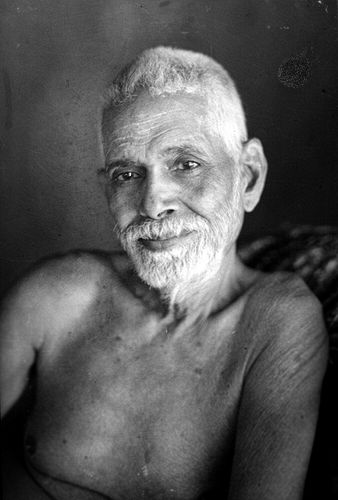
Does stillness of mind lead to liberation?

51m5pnpvk0l

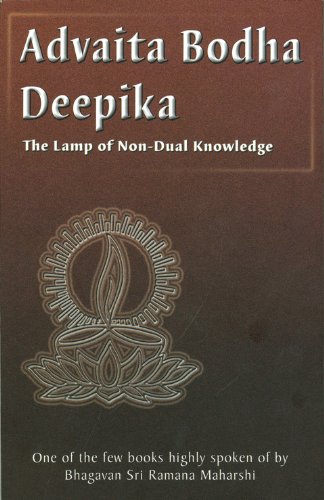
Advaita Bodha Deepika is a traditional text and a masterpiece, summarising the methods and techniques of advaita vedanta. It was a favourite text of Sri Ramana Maharshi and was often recommended by him. Here is what it says about how to attain liberation, the following is from Chapter 3:

17…Master: With complete stillness of mind, samsara will disappear root and branch. Otherwise there will be no end to samsara, even in millions of aeons (Kalpakotikala).
18. Disciple: Cannot samsara be got rid of by any means other than making the mind still?
M: Absolutely by no other means; neither the Vedas, nor the shastras nor austerities, nor karma, nor vows, nor gifts, nor recital of scriptures of mystic formulae (mantras), nor worship, nor anything else, can undo the samsara. Only stillness of mind can accomplish the end and nothing else.
19. D: The scriptures declare that only Knowledge can do it. How then do you say that stillness of the mind puts an end to samsara?
M: What is variously described as Knowledge, Liberation, etc., in the scriptures, is but stillness of mind.
D: Has any one said so before?
20 M: Sri Vasishta had said…

41k1lywu0sl

Beloved Ramana Maharshi says the same in Guru Vachaka Kovai, verse 141:

All the jnana* scriptures that teach the way to redemption proclaim in unison that restraining and stilling the mind is the best means for liberation. This is also emphasised by jnanis*. If, after a certain amount of study, one knows this to be the inner purport of the scriptures, one should then direct ones whole effort towards that [practice]. What is the use of continuously studying more and more scriptures without doing this?

*Jnana, literally meaning knowledge, refers to the teachings of spiritual liberation, whereas jnani, literally ‘knower’, refers to the spiritually liberated sage.


In Ramana’s ‘Who am I?’, the question as to the nature of Jnana arises and is simply answered:

Questioner: What is wisdom-insight (jnana-drsti)?
Ramana Maharshi: Remaining quiet is what is called wisdom-insight.


The Katha Upanishad states the same, in verse 2.3.10:

When the five organs of perception become still, together with the mind, and the intellect ceases to be active: that is called the Supreme State [Brahma-Vidya or Self Knowledge].

Shankara’s commentary on this above verse (Katha Upanishad, verse 2.3.10) states the following:

‘At the time when the five senses…, together with the mind…, which is now no longer functioning and thinking, are at rest in the Self alone, after turning away from objects, and with the intellect…no longer engaging with its functioning, that they call the highest state [Brahma-Vidya or Self-Knowledge].’

Earlier in the Katha Upanishad we see the following verse:

The Lord created the senses out-going: therefore, one sees outside and not the Self within. Some intelligent man, with his senses turned away (from their objects), desirous of immortality, sees the Self within.
~ Katha Upanishad 2.1.1

In his commentary on this above verse (Katha Upanishad 2.1.1), Shankara writes:

‘…the perceiver sees the external objects which are not-Self/not the Atman, such as sound, etc., and not the Self within. Though this is the nature of the world, some (rare) discerning man, like turning back/ reversing the current of a river, sees the Self within…The group of sense organs, beginning with the ear, should be turned away from all sense-objects. Such a one, who is purified thus, sees the indwelling self. For it is not possible for the same person to be engaged in the thought of sense-objects and to have the vision of the Self as well.

In his commentary on Katha Upanishad verse 1.2.20 Sri Shankara writes:

‘…One whose intellect has been withdrawn from all objects, gross and subtle, when this takes place, this is known as ‘inactivity of the sense organs’. Though this ‘inactivity of the sense organs’ one sees that glory of the Self. ‘Sees’ means he directly realises the Self as ‘I am the Self’ as thereby becomes free from suffering’


The Amritabindu Upanishad equates the controlled/stilled mind with Jnana (knowledge) and liberation:

2. It is indeed the mind that is the cause of men’s bondage and liberation. The mind that is attached to sense-objects leads to bondage, when unattached from sense-objects it tends to lead to liberation. So they [the sages] say.
3. Since liberation is based on the mind devoid of desire for sense objects, therefore, the mind should always be made free of such desire, by the seeker after liberation.
4. When the mind, with its attachment for sense-objects annihilated, is fully controlled within the heart and thus realises its own essence, then that is the Supreme State (Brahma-Vidya or Self-Knowledge is gained).
5. The mind should be controlled [made still] so that it becomes merged in the heart. This is Jnana (knowledge) and this is Dhyana (meditation). All else is argumentation and verbiage.

The Advaitic giant, Sri Gaudapada, (Shankara’s guru’s guru) writes in his Mandukya Karika:

The controlled mind is verily the fearless Brahman’ Chapter 3, verse 35

And in verse 37 of the same chapter he writes:

[Atman is] beyond all expression by words and beyond all acts of mind; It is all peace, eternal effulgence free from activity and fear and attainable by samadhi’ Chapter 3, verse 37

In the wonderfully authoritative Advaita Vedanta text Yoga Vasistha it is written:

The rock-like state in which all thoughts are still and which is different from the waking and dream states, is one’s supreme state [Brahma-Vidya or Self-Knowledge].

And elsewhere in the same Yoga Vasistha it is said:

Just as the great ocean of milk became still when the Mandara Mountain (with which it was churned by the Devas and the Asuras) became still, even so the illusion of samsara comes to an end when the mind is stilled.

And again from Yoga Vasistha…

He who casts away from his mind all objects ofperception and, attaining perfect quiescence, remains still as space, unaffected by sorrow, is a liberated man; he is the Supreme Lord.


Shankara states the same multiple times, eg, in Vivekachudamani, and also in his many commentaries, eg. in his commentary upon the Kena Upanishad – in his introduction to the Kena Upanishad Shankara writes:

And [the Self] being eternal, it is not to be secured by any means other than the cessation of ignorance. Hence the only duty is to renounce all desires after the realisation of the unity of the indwelling Self and Brahman.

Also see:

The key to nonduality and yoga

In brief: How to attain liberation

The ‘ultimate means’ to liberation

Shankara on Samadhi (stillness of mind)

Ramana Maharshi: be still

Ramana Maharshi: a quick and simple method to self-realisation

False enlightenment

Shankara on the Mind, Samadhi (stillness of mind), Manonasa (destruction of mind), and Liberation

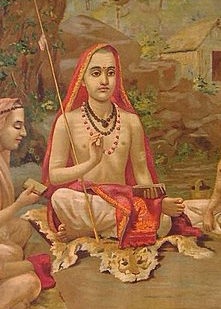
Shankara shankaracharya

Also see:

   Shankara: How to Meditate for Self-Realisation

Gaudapada – The Self is attainable by Samadhi

The following are quotes from Shankara’s Vivekachudamani on the Mind, samadhi (stillness of mind), manonasa (destruction of mind) and it’s relationship to moksha (liberation). There are many false teachings around, so I hope you find these teachings to be helpful and instructive.

Vivekachudamani is one of the most important in the Advaita Vedanta tradition. Attributed to Shankara, for centuries it has traditionally been used as a practice manual for seekers of spiritual liberation. Many mahatmas (great souls) have considered this text to contain all that is required to know in order to attain liberation.

Swami Chinmayananda, that great Sanskrit scholar and traditional teacher of Advaita Vedanta, said Vivekachudamani contained the distilled wisdom from the Upanishads and Bhagavad Gita and presents it in a systematic readable form for a seeker of liberation, in which both ‘the goal and path are exhaustively dealt with’. He wrote of Vivekachudamani that ‘no other help is needed’ other than this text on the quest to liberation.

A very young (and already enlightened) Sri Ramana Maharshi also translated the entire text into Tamil for the benefit of his companions and devotees who were unable to read Sanskrit, in what was perhaps Ramana’s first spiritual work. The fact that Ramana wrote very little yet bothered to translate this in its entirely, that this was the first scripture he chose to translate, and that this is the longest of the scriptures he ever translated (to my knowledge) perhaps gives you an indication of the significance of this text. Ramana himself wrote an introduction to his own translation and in it he said that Vivekachudamani explained ‘in detail the points that have to be grasped by those who seek liberation, and thereby directing them to the true and direct path’ and also that Vivekachudamani contained the essence of Shankara’s commentaries on the triple canon of Vedenta (Bhagavad Gita, Upanishads and Brahma Sutras), in an easy to read form.

Indeed, there is nothing in Vivekachudamani that cannot be found in the Vedantic triple canon.

So here is some of what Shankara says about Mind and Liberation, my comments are in italicised red:


The mind is ignorance

First Shankara equates mind with ignorance, saying they are one and the same, hinting the mind must be destroyed (manonasa), a theme that is taken up again later on:

169. There is no Ignorance (Avidya) outside the mind. The mind alone is Avidya, the cause of the bondage of transmigration. When that is destroyed, all else is destroyed, and when it is manifested, everything else is manifested.

Shankara in these next two verses repeats that mind is synonymous with ignorance and the cause of bondage or suffering.

179. Man’s transmigration is due to the evil of superimposition, and the bondage of superimposition is created by the mind alone.

180. Hence sages who have fathomed its secret have designated the mind as Avidya or ignorance, by which alone the universe is moved to and fro, like masses of clouds by the wind.

The mind (ie. ignorance) creates the world

Then he states the world is but an illusion projected by the mind, like a dream:

170. In dreams, when there is no actual contact with the external world, the mind alone creates the whole universe consisting of the experiencer etc. Similarly in the waking state also; there is no difference. Therefore all this (phenomenal universe) is the projection of the mind.

This is essentially equating the mind with maya.

171. In dreamless sleep, when the mind is reduced to its causal state, there exists nothing (for the person asleep), as is evident from universal experience. Hence man’s relative existence is simply the creation of his mind, and has no objective reality.

172. Clouds are brought in by the wind and again driven away by the same agency. Similarly, man’s bondage is caused by the mind, and Liberation too is caused by that alone.

177. The mind continually produces for the experiencer all sense-objects without exception, whether perceived as gross or fine, the differences of body, caste, order of life, and tribe, as well as the varieties of qualification, action, means and results.

Stay away from the mind

Shankara warns the seeker to stay away from the mind:

176. In the forest-tract of sense-pleasures there prowls a huge tiger called the mind. Let good people who have a longing for Liberation never go there.

Manonasa (destruction of the mind)

Shankara teaches us that the mind eventually must die, and the method of how to do this:

277. The Yogi’s mind dies, being constantly fixed on his own Self.

What happens when we do not follow this teaching?

309. Even though completely rooted out, this terrible egoism, if revolved in the mind even for a moment, returns to life and creates hundreds of mischiefs, like a cloud ushered in by the wind during the rainy season.

325. If the mind ever so slightly strays from the Ideal and becomes outgoing, then it goes down and down, just as a play-ball inadvertently dropped on the staircase bounds down from one step to another.

326. The mind that is attached to the sense-objects reflects on their qualities; from mature reflection arises desire, and after desiring a man sets about having that thing.

407. This apparent universe has its root in the mind, and never persists after the mind is annihilated. Therefore dissolve the mind by concentrating it on the Supreme Self, which is thy inmost Essence.

481. My mind has vanished, and all its activities have melted, by realising the identity of the Self and Brahman; I do not know either this or not-this; nor what or how much the boundless Bliss (of Samadhi) is

502. How can there be merits and demerits for me, who am without organs, without mind, changeless, and formless – who am the realisation of Bliss Absolute? The Shruti also mentions this in the passage “Not touched”, etc.!

Shut out the world, focus attention on Brahman

327. Hence to the discriminating knower of Brahman there is no worse death than inadvertence with regard to concentration. But the man who is concentrated attains complete success. (Therefore) carefully concentrate thy mind (on Brahman).

328. Through inadvertence a man deviates from his real nature, and the man who has thus deviated falls. The fallen man comes to ruin, and is scarcely seen to rise again.

335. When the external world is shut out, the mind is cheerful, and cheerfulness of the mind brings on the vision of the Paramatman. When It is perfectly realised, the chain of birth and death is broken. Hence the shutting out of the external world is the stepping-stone to Liberation.

339. To realise the whole universe as the Self is the means of getting rid of bondage. There is nothing higher than identifying the universe with the Self. One realises this state by excluding the objective world through steadfastness in the eternal Atman.

The need for Nirvikalpa Samadhi

Shankara, over many verses, makes it clear that the mind must be totally stilled in Nirvikalpa Samadhi, in which there is awareness present without thoughts and other objects:

341. To the Sannyasin who has gone through the act of hearing, the Shruti passage, “Calm, self-controlled.” Etc., prescribes Samadhi for realising the identity of the universe with the Self.

Shankara drums home the necessity of Samadhi over many verses, here using the phrase ‘barring those’ to clearly state that only through nirvikalpa samadhi can egotism be destroyed (and liberation attained). He makes it clear that in nirvikalpa samadhi no objects/phenomena will be present, and there will be ‘no oscilation of mind‘.

342. Even wise men cannot suddenly destroy egoism after it has once become strong, barring those who are perfectly calm through the Nirvikalpa Samadhi. Desires are verily the effect of innumerable births.

344. …But the victory is undoubtedly (complete and) free from obstacles when there is no oscillation of the mind due to the unreal sense-objects.

The term Samadhi refers to a state of mind that is stilled but also aware and not asleep:

353. When the Atman, the One without a second, is realised by means of the Nirvikalpa Samadhi, then the heart’s knot of ignorance is totally destroyed.

354. Such imaginations as “thou”, “I” or “this” take place through the defects of the Buddhi. But when the Paramatman, the Absolute, the One without a second, manifests Itself in Samadhi, all such imaginations are dissolved for the aspirant, through the realisation of the truth of Brahman.

355. The Sannyasin, calm, self-controlled, perfectly retiring from the sense-world, forbearing, and devoting himself to the practice of Samadhi, always reflects on his own self being the Self of the whole universe. Destroying completely by this means the imaginations which are due to the gloom of ignorance, he lives blissfully as Brahman, free from action and the oscillations of the mind.

Shankara again stresses the importance of Samadhi, stating those alone are free or liberated.

356.Those alone are free from the bondage of transmigration who, attaining Samadhi, have merged the objective world, the sense-organs, the mind, nay, the very ego, in the Atman, the Knowledge Absolute – and none else, who but dabble in second-hand talks.

The above verse is a rendering from the Amritabindu Upanishad – see here for what the Amritabindu Upanishad states.

357. Through the diversity of the supervening conditions (Upadhis), a man is apt to think of himself as also full of diversity; but with the removal of these he is again his own Self, the immutable. Therefore the wise man should ever devote himself to the practice of Nirvikalpa Samadhi, for the dissolution of the Upadhis.

Again, Shankara uses the word only to drive home the importance of Samadhi:

360. The truth of the Paramatman is extremely subtle, and cannot be reached by the gross outgoing tendency of the mind. It is only accessible to noble souls with perfectly pure minds, by means of Samadhi brought on by an extraordinary fineness of the mental state.

361. As gold purified by thorough heating on the fire gives up its impurities and attains to its own lustre, so the mind, through meditation, gives up its impurities of Sattva, Rajas and Tamas, and attains to the reality of Brahman.

Nirvikalpa Samadhi refers to the complete absence of ‘mind waves’ or modifications of consciousness, in which there is only pure awareness or consciousness present devoid of thoughts and perceptions. Again and again Shankara states that it is Samadhi of the Nirvikalpa variety (ie. no thoughts and no objects) that leads directly to self-realisation :

362. When the mind, thus purified by constant practice, is merged in Brahman, then Samadhi passes on from the Savikalpa to the Nirvikalpa stage, and leads directly to the realisation of the Bliss of Brahman, the One without a second.

363. By this Samadhi are destroyed all desires which are like knots, all work is at an end, and inside and out there takes place everywhere and always the spontaneous manifestation of one’s real nature.

How much clearer can Shankara make the case for the essential practice of Nirvikalpa Samadhi?

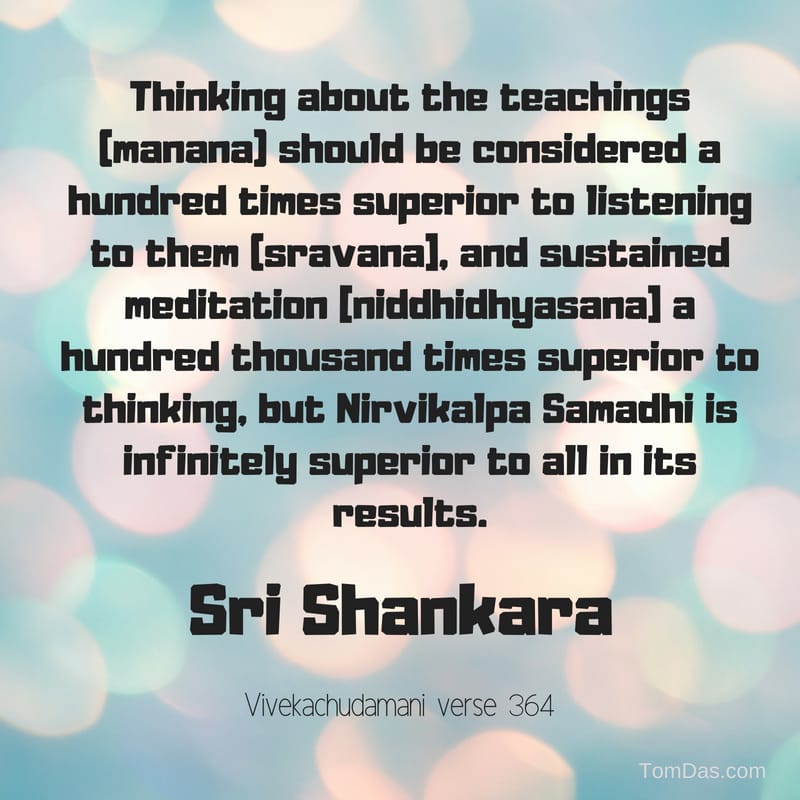
364. Reflection should be considered a hundred times superior to hearing, and meditation a hundred thousand times superior even to reflection, but the Nirvikalpa Samadhi is infinite in its results.

Shankara continues to stress the importance of the thoughtless aware state of samadhi, or, to put it more simply, being still of mind:

365. By the Nirvikalpa Samadhi the truth of Brahman is clearly and definitely realised, but not otherwise, for then the mind, being unstable by nature, is apt to be mixed up with other perceptions.

Drown or destroy the mind by turning away from the world and fixing in on Brahman

Drowning the mind implies its death, meaning the death of ignorance. As Shankara has already equated mind with ignorance, this is the same as manonasa (destruction of the mind) and the same as self-realisation:

366. Hence with the mind calm and the senses controlled always drown the mind in the Supreme Self that is within, and through the realisation of thy identity with that Reality destroy the darkness created by Nescience, which is without beginning.

375. The extremely dispassionate man alone has Samadhi, and the man of Samadhi alone gets steady realisation; the man who has realised the Truth is alone free from bondage, and the free soul only experiences eternal Bliss.

376. For the man of self-control I do not find any better instrument of happiness than dispassion, and if that is coupled with a highly pure realisation of the Self, it conduces to the suzerainty of absolute Independence; and since this is the gateway to the damsel of everlasting liberation, therefore for thy welfare, be dispassionate both internally and externally, and always fix thy mind on the eternal Self.

377. Sever thy craving for the sense-objects, which are like poison, for it is the very image of death, and giving up thy pride of caste, family and order of life, fling actions to a distance. Give up thy identification with such unreal things as the body, and fix thy mind on the Atman. For thou art really the Witness, Brahman, unshackled by the mind, the One without a second, and Supreme.

378. Fixing the mind firmly on the Ideal, Brahman, and restraining the external organs in their respective centres; with the body held steady and taking no thought for its maintenance; attaining identity with Brahman and being one with It – always drink joyfully of the Bliss of Brahman in thy own Self, without a break. What is the use of other things which are entirely hollow?

379. Giving up the thought of the non-Self which is evil and productive of misery, think of the Self, the Bliss Absolute, which conduces to Liberation.

Continuously meditate on Brahman

380. Here shines eternally the Atman, the Self-effulgent Witness of everything, which has the Buddhi for Its seat. Making this Atman which is distinct from the unreal, the goal, meditate on It as thy own Self, excluding all other thought.

381. Reflecting on this Atman continuously and without any foreign thought intervening, one must distinctly realise It to be one’s real Self.

382. Strengthening one’s identification with This, and giving up that with egoism and the rest, one must live without any concern for them, as if they were trifling things, like a cracked jar or the like.

383. Fixing the purified mind in the Self, the Witness, the Knowledge Absolute, and slowly making it still, one must then realise one’s own infinite Self.

384. One should behold the Atman, the Indivisible and Infinite, free from all limiting adjuncts such as the body, organs, Pranas, Manas and egoism, which are creations of one’s own ignorance – like the infinite sky.

398. When the mind-functions are merged in the Paramatman, the Brahman, the Absolute, none of this phenomenal world is seen.

More on Samadhi

Again, Shankara says we must end the mind (Manonasa):

407. This apparent universe has its root in the mind, and never persists after the mind is annihilated. Therefore dissolve the mind by concentrating it on the Supreme Self, which is thy inmost Essence.

408. The wise man realises in his heart, through Samadhi, the Infinite Brahman, which is something of the nature of eternal Knowledge and absolute Bliss, which has no exemplar, which transcends all limitations, is ever free and without activity, and which is like the limitless sky, indivisible and absolute.

409. The wise man realises in his heart, through Samadhi, the Infinite Brahman, which is devoid of the ideas of cause and effect, which is the Reality beyond all imaginations, homogeneous, matchless, beyond the range of proofs, established by the pronouncements of the Vedas, and ever familiar to us as the sense of the ego.

410. The wise man realises in his heart, through Samadhi, the Infinite Brahman, which is undecaying and immortal, the positive Entity which precludes all negations, which resembles the placid ocean and is without a name, in which there are neither merits nor demerits, and which is eternal, pacified and One.

411. With the mind restrained in Samadhi, behold in thy self the Atman, of infinite glory, cut off thy bondage strengthened by the impressions of previous births, and carefully attain the consummation of thy birth as a human being.

Shankara again makes it clear that when he speaks of Samadhi, he is speaking of that aware state in which there are no objects or ‘limiting adjuncts’ present:

412. Meditate on the Atman, which resides in thee, which is devoid of all limiting adjuncts, the Existence-Knowledge-Bliss Absolute, the One without a second, and thou shalt no more come under the round of births and deaths.

480. Concentrating the mind for some time on the Supreme Brahman, he rose, and out of supreme bliss spoke as follows.

More on Manonasa

Manonasa (destruction of the mind), a synonym for moksha, is declared by this scripture:

481. My mind has vanished, and all its activities have melted, by realising the identity of the Self and Brahman; I do not know either this or not-this; nor what or how much the boundless Bliss (of Samadhi) is

502. How can there be merits and demerits for me, who am without organs, without mind, changeless, and formless – who am the realisation of Bliss Absolute? The Shruti also mentions this in the passage “Not touched”, etc.!

Ajata (‘unborn’)

Here Shankara repeats the line found in Guadapada’s Karika, which itself is a repetition of the Upanishadic verse:

574. There is neither death nor birth, neither a bound nor a struggling soul, neither a seeker after Liberation nor a liberated one – this is the ultimate truth.

True vedanta

This is the true vedanta:

575. I have today repeatedly revealed to thee, as to one’s own son, this excellent and profound secret, which is the inmost purport of all Vedanta, the crest of the Vedas

Also see:

FALSE VEDANTA – a warning from Shankara

False enlightenment

Advaita vedanta scholars and false teachers

Advaita Bodha Deepika – vital teachings for Self-Realisation that are often missing in modern non-dual and Advaita Vedanta teachings

Here are some very potent nondual teachings that are well worth taking the time and making the effort to read. The teachings here tend not to be found in many other places. I have found that even many so-called teachers of Advaita Vedanta seem to teach something else, especially in the West, so it pays to read the traditional teachings for yourself and learn the true path to liberation directly from the source texts.

Advaita Bodha Deepika was one of Ramana Maharshi’s favourite scriptures and he often recommended it for seekers to read. It is one of the few traditional scriptures that comprises a structured and comprehensive explanation of the various methods of Advaita Vedanta. All chapters of this work are great, but this following chapter on ‘Sakshatkara’ or ‘Realisation’ has some key teachings that are often lost in some contemporaneous renditions of Advaita Vedanta and nondual teachings in general.

Without the  vital understanding presented in this chapter, true liberation is unlikely to result. The opposite is also true – putting the words of this chapter into practice sets one off on the direct path to liberation.

This particular teaching starts at Chapter 7. Thus far in the text, the Self or Awareness has already been pointed out and described to the student, and the student, being open to the teachings, has gained a first-hand understanding of this. The student now feels that liberation has been gained, but then the teaching continues…the teacher points out the egotism-ignorance is still at play and then explains how to remove it…

Please let us make obeisance to the Lord-our-Self, and without further ado – enjoy;

The chapter starts with a recap of what has been discussed thus far in preceding chapters, and I have added bold type for emphasis of what I felt are some key points:

Advaita Bodha Deepika

Chapter 7 – Sakshatkara or Realisation

1. In the foregoing chapter it was said that direct knowledge must first be gained and then the latent tendencies of the mind wiped out so that Brahman may be realised. Now Realisation is dealt with. The master says: Wise son, now that you have gained direct knowledge by enquiry into the Self, you should proceed with meditation.

2. DISCIPLE: Master, now that I have gained direct knowledge by enquiry and my task is finished why should I meditate further and to what end?

3-4. MASTER: Though by reflection, direct knowledge of the Self has been gained, Brahman cannot be realised without meditation. In order to experience `I am Brahman’ you must practise meditation.

5-6.: D.: You ask me to pursue meditation for realising Brahman. I have already gained direct knowledge by enquiry into the sacred text. Why should I now practise meditation?

M.: If you mean to say that enquiry into the sacred text results in realising Brahman, who can deny it? No one. Truly this enquiry must end in the realisation of Brahman. Let us now enquire into the meaning of the text. Whose identity with whom is implied in it? It must be of the consciousness witnessing the five sheaths of the individual, the implied meaning of `thou’ with Brahman, the implied meaning of `That’; it cannot be of the Jiva, i.e., the personal soul with Brahman. By enquiry the identity of the witnessing consciousness with Brahman has certainly been found. Of what use can this identity of the witness with Brahman be to you?

7. D.: On enquiry into the meaning of the sacred text, when one has realised that the witness is Brahman and vice versa, how can you raise the question `Of what use can it be to the person?’ Its use is evident. Formerly the seeker was ignorant of the identity and now by enquiry he is aware of it.

M.: By enquiry you have certainly known that the witness is Brahman and that the unbroken, all-perfect Brahman is the witness. Still this knowledge is not the end and cannot serve your purpose. Suppose a poor beggar who was ignorant of the fact that a king residing in a fort was the emperor of the world, later knew it. How does this newly acquired knowledge improve his position? It cannot serve any useful purpose for him.

  1. D.: Before enquiry, ignorance prevails. After enquiry, knowledge is gained that the witness is Brahman. Now knowledge has taken the place of ignorance. This is the use.

M.: How does this affect the fact? Whether you have known it or not, the witness ever remains Brahman. Your knowledge of the fact has not made Brahman, the witness. Whether the poor beggar knew it or not, the king in the fort was the emperor. His knowledge did not make an emperor of the king in the fort. Now that you have known the witness to be Brahman, what has happened to you? Tell me. There can be no change in you.

  1. D.: Why not? There is a difference. The sacred text teaches `That thou art’. On enquiring into its significance I have found that the witness of the five sheaths in me is the same as Brahman. From this I have known that I am Brahman, which forms another sacred text. To me who was ignorant of the witness being the same as Brahman, this knowledge has dawned, with the result that I have realised Brahman.

M.: How can you claim to have realised Brahman? If by the text `I am Brahman’ you understand yourself to be Brahman, who is this `I’ but the Jiva, the individual soul or the ego? How can the ego be Brahman? Just as even with his knowledge of the king, the beggar cannot himself be the king, so also the changeful ego can never be identical with the changeless Brahman.

10-14. D.: Certainly so. But on enquiring `Who am I?’ it becomes plain that by non-enquiry the unchanging witness had mistaken the changing ego for himself. Now he knows `I am not the changing ego but remain its unchanging conscious witness’. Now it is but right that the witness should say, `I am Brahman’. What can be discordant in this?

M.: How can you hold that the witness says `I am Brahman?’ Does the unchanging witness or the changing ego say so? If you say that it is the witness, you are wrong. For the witness remains unchanging as the witness of the `false-I’. He is not the conceit itself. Otherwise he cannot have the quality of being the witness for he will himself be changing. Being unchanging the witness is free from the least trace of any notion such as `I’ or Brahman and cannot therefore know `I am Brahman’. There is no ground for your contention that the witness says so.

D.: Then who knows `I am Brahman’?

M.: From what has been said before, it must follow that the individual soul, the jiva, or the `false-I’ must have this knowledge.

D.: How does this follow?

M.: In order to be free from the repeated cycle of births and deaths, the ignorant man is obliged to practise the knowledge `I am Brahman’. There is no ignorance for the witness. When there is no ignorance, there can be no knowledge either. Only the ignorant must seek knowledge. Who but the `false-I’ can be the subject of ignorance or of knowledge? It is self-evident that the witnessing Self being the substratum on which knowledge or ignorance appears, must itself be free from them. On the contrary the `false-I’ is known to possess knowledge or ignorance. If you ask him `Do you know the Self witnessing you?’ And he will answer `Who is that witness? I do not know him’. Here the ignorance of the `false-I’ is obvious. On hearing the vedanta that there is an inner witness to him, indirectly he knows that the Self is his witness. Then enquiring into the Self, the veil of Ignorance that It does not shine forth, is drawn off and directly he knows the witnessing Self. Here again the knowledge of the `false-I’ is also clear. It is only the jiva and not the witness who has the knowledge or ignorance that there is, or is not, the inner witness. You must now admit that the jiva has the knowledge that `I am Brahman’. Now for the reason that the changing Jiva has become aware of the unchanging witness, he cannot be the same as the witness. Because he had seen him, the poor beggar cannot be the king. So also the changing Jiva cannot be the witness. Without being the witnessing Self, the changing entity cannot be Brahman. So this experience `I am Brahman’ is impossible.

  1. D.: How can you say that merely seeing the witness, I cannot know that I am the witness? Ignorant of his true being as the substratum or the witnessing consciousness, the Jiva moves about as the `false-I’. However on a careful enquiry into his true nature he knows the witness and identifies himself as the witness who is well-known to be the unbroken, all perfect Brahman. Thus the experience, `I am Brahman’, is real.

M.: What you say is true provided that the jiva can identify himself as the witness. The witness is undoubtedly Brahman. But how can the mere sight of the witness help the jiva merge himself into the witness? Unless the jiva remains the witness, he cannot know himself as the witness. Merely by seeing the king, a poor beggar cannot know himself to be the king. But when he becomes the king, he can know himself as the king. Similarly the jiva, remaining changeful and without becoming the unchanging witness, cannot know himself as the witness. If he cannot be the witness, how can he be the unbroken, all-perfect Brahman? He cannot be. Just as at the sight of the king in a fort, a poor beggar cannot become king and much less sovereign of the universe, so also only at the sight of the witness who is much finer than ether and free from traffic with triads, such as the knower, knowledge and the known, eternal, pure, aware, free, real, supreme and blissful, the jiva cannot become the witness, much less the unbroken, all-perfect Brahman, and cannot know `I am Brahman’.

  1. D.: If so, how is it that the two words of the same case ending (samanadhikarana) — `I’ and `Brahman’ — are placed in apposition in the sacred text `I am Brahman’? According to grammatical rules the sruti clearly proclaims the same rank to the jiva and Brahman. How is this to be explained?

17-18. M.: The common agreement between two words in apposition is of two kinds: mukhya and badha i.e., unconditional and conditional. Here the sruti does not convey the unconditional meaning.

D.: What is this unconditional meaning?

M.: The ether in a jar has the same characteristics as that in another jar, or in a room, or in the open. Therefore the one ether is the same as the other. Similarly with air, fire, water, earth, sunlight etc. Again the god in one image is the same as that in another and the witnessing consciousness in one being is the same as that in another. The sruti does not mean this kind of identity between the jiva and Brahman, but means the other, the conditional meaning.

D.: What is it?

M.: Discarding all appearances, the sameness of the substratum in all.

D.: Please explain this.

M.: `I am Brahman’ means that, after discarding the `false-I’, only the residual being or the pure consciousness that is left over can be Brahman — It is absurd to say that, without discarding but retaining the individuality, the jiva, on seeing Brahman but not becoming Brahman, can know himself as Brahman. A poor beggar must first cease to be beggar and rule over a state in order to know himself as king; a man desirous of god-hood first drowns himself in the Ganges and leaving this body, becomes himself a celestial being; by his extraordinary one-pointed devotion a devotee leaves off his body and merges into god, before he can know himself to be god. In all these cases when the beggar knows himself to be king, or the man to be celestial being, or the devotee to be god, they cannot retain their former individualities and also identify themselves as the superior beings. In the same way, the seeker of Liberation must first cease to be an individual before he can rightly say `I am Brahman’. This is the significance of the sacred text. Without completely losing one’s individuality one cannot be Brahman. Therefore to realise Brahman, the loss of the individuality is a sine qua non.

D.: The changeful individual soul cannot be Brahman. Even though he rids himself of the individuality, how can he become Brahman?

  1. M.: Just as a maggot losing its nature, becomes a wasp.A maggot is brought by a wasp and kept in its hive. From time to time the wasp visits the hive and stings the maggot so that it always remains in dread of its tormentor. The constant thought of the wasp transforms the maggot into a wasp. Similarly, constantly meditating on Brahman, the seeker loses his original nature and becomes himself Brahman. This is the realisation of Brahman.
  2. D.: This cannot illustrate the point, for the jiva is changing and falsely presented on the pure Being, Brahman, which is the Reality. When a false thing has lost its falsity, the whole entity is gone; how can it become the Reality?
  3. M.: Your doubt, how a superimposed falsity turns out to be its substratum, the Reality, is easily cleared. See how the nacre-silverceases to be silver and remains as nacre, or a rope-snake ceasing to be snake remains ever as rope. Similarly, with the jiva superimposed on the Reality, Brahman.

D.: These are illusions which are not conditioned (nirupadhika bhrama) whereas the appearance of the jiva is conditioned (sopadhika bhrama) and appears as a superimposition only on the internal faculty, the mind. So long as there is the mind, there will also be the jiva or the individual, and the mind is the result of past karma. As long as this remains unexhausted, the jiva must also be present. Just as the reflection of one’s face is contingent upon the mirror or water in front, so is individuality, on the mind, the effect of one’s past karma. How can this individuality be done away with?

M.: Undoubtedly individuality lasts as long as the mind exists. Just as the reflected image disappears with the removal of the mirror in front, so also individuality can be effaced by stilling the mind by meditation.

[Tom: this ‘stilling of mind’ means the stilling or removal of all thoughts, and is also known as Nirvikalpa Samadhi]

D.: The individuality being thus lost, the jiva becomes void. Having become void, how can he become Brahman?

M.: The jiva is only a false appearance not apart from its substratum. It is conditional on ignorance, or the mind, on whose removal the jiva is left as the substratum as in the case of a dream person.

22-23. D.: How?

M.: The waking man functions as the dreamer (taijasa) in his dreams. The dreamer is neither identical with nor separate from the waking man (visva). For the man sleeping happy on his bed has not moved out whereas as the dreamer he had wandered about in other places, busy with many things. The wanderer of the dream cannot be the man resting in his bed. Can he then be different? Not so either. For on waking from sleep, he says `In my dream I went to so many places, did so many things and was happy or otherwise’. Clearly he identifies himself with the experiencer of the dream. Moreover no other experiencer can be seen.

D.: Not different from nor identical with the waking experiencer, who is this dream-experiencer?

M.: Being a creation of the illusory power of sleep the dream experiencer is only an illusion like the snake on a rope. With the finish of the illusory power of dream, the dreamer vanishes only to wake up as the real substratum, the original individual self of the waking state. Similarly the empirical self, the jiva is neither the unchanging Brahman nor other than It. In the internal faculty, the mind, fancied by ignorance, the Self is reflected and the reflection presents itself as the empirical, changing and individual self. This is a superimposed false appearance. Since the superimposition cannot remain apart from its substratum, this empirical self cannot be other than the absolute Self.

D.: Who is this?

M.: Successively appearing in the ignorance-created mind and disappearing in deep sleep, swoon etc., this empirical self is inferred to be only a phantom. Simultaneously with the disappearance of the medium or the limiting adjunct (upadhi), the mind, the jiva becomes the substratum, the True Being or Brahman. Destroying the mind, the jiva can know himself as Brahman.

  1. D.: With the destruction of the limiting adjunct, the jiva being lost, how can he say `I am Brahman’?

M.: When the limiting ignorance of dream vanishes, the dreamer is not lost, but emerges as the waking experiencer. So also when the mind is lost, the jiva emerges as his true Being — Brahman. Therefore as soon as the mind is annihilated leaving no trace behind, the jiva will surely realise `I am the Being-Knowledge-Bliss, non-dual Brahman; Brahman is I, the Self ‘.

D.: In that case the state must be without any mode like that of deep sleep. How can there be the experience `I am Brahman’?

M.: Just as at the end of a dream, the dreamer rising up as the waking experiencer says `All along I was dreaming that I wandered in strange places, etc., but I am only lying down on the bed,’ or a madman cured of his madness remains pleased with himself, or a patient cured of his illness wonders at his past sufferings, or a poor man on becoming a king, forgets or laughs at his past penurious state, or a man on becoming a celestial being enjoys the new bliss, or a devotee on uniting with the Lord of his devotion remains blissful, so also the jiva on emerging as Brahman wonders how all along being only Brahman he was moving about as a helpless being imagining a world, god and individuals, asks himself what became of all those fancies and how he now remaining all alone as Being-Knowledge-Bliss free from any differentiation, internal or external, certainly experiences the Supreme Bliss of Brahman. Thus realisation is possible for the jiva only on the complete destruction of the mind and not otherwise.

  1. D.: Experience can be of the mind only. When it is destroyed,who can have the experience `I am Brahman’?

M.: You are right. The destruction of the mind is of two kinds: (rupa and arupa) i.e., in its form-aspect and in its formless aspect. All this while I have been speaking of destroying the former mind. Only when it ceases to be in its formless aspect, experience will be impossible, as you say.

D.: Please explain those two forms of the mind and their destruction.

M.: The latent impressions (vasanas) manifesting as modes (vrittis) constitute the form-aspect of the mind. Their effacement is the destruction of this aspect of mind. On the other hand, on the latencies perishing, the supervening state of samadhi in which there is no stupor of sleep, no vision of the world, but only the Being-Knowledge-Bliss is the formless aspect of mind. The loss of this amounts to the loss of the formless aspect of mind. Should this also be lost, there can be no experience — not even of the realisation of Supreme Bliss.

D.: When does this destruction take place?

M.: In the disembodiment of the liberated being. It cannot happen so long as he is alive in the body. The mind is lost in its form-aspect but not in its formless one of Brahman. Hence the experience of Bliss for the sage, liberated while alive.

26-27. D.: In brief what is Realisation?

M.: To destroy the mind in its form-aspect functioning as the limiting adjunct to the individual, to recover the pure mind in its formless aspect whose nature is only Being-Knowledge-Bliss and to experience `I am Brahman’ is Realisation.

D.: Is this view supported by others as well?

M.: Yes. Sri Sankaracharya has said: `Just as in the ignorant state, unmindful of the identity of the Self with Brahman, one truly believes oneself to be the body, so also after knowing to be free from the illusion of the body being the Self, and becoming unaware of the body, undoubtingly and unmistakably always to experience the Self as the Being-Knowledge-Bliss identical with Brahman is called Realisation’. `To be fixed as the Real Self is Realisation’, say the sages.

  1. D.: Who says it and where?
  2. M.: Vasishta has said in Yoga Vasishta: ‘Just as the mind in a stone remains quiet and without any mode, so also like the interior of the stone to remain without any mode and thought free, but not in slumber nor aware of duality, is to be fixed as the Real Self’.

[Tom: again, this ‘the mind…remains quiet and without any mode…not in slumber [sleep] nor aware of any duality’ clearly refers to nirvikalpa samadhi, also known as the state of wakeful sleep (jagrat sushupti)]

30-31. Therefore without effacing the form-aspect of the mind and remaining fixed as the true Self, how can anyone realise `I am Brahman’? It cannot be. Briefly put, one should still the mind to destroy one’s individuality and thus remain fixed as the Real Self of Being-Knowledge-Bliss, so that in accordance with the text `I am Brahman’ one can realise Brahman. On the other hand, on the strength of the direct knowledge of Brahman to say `I am Brahman’ is as silly as a poor beggar on seeing the king declaring himself to be the king. Not to claim by words but to be fixed as the Real Self and know `I am Brahman’ is Realisation of Brahman.

  1. D.: How will the sage be, who has undoubtingly, unmistakably and steadily realised Brahman?

M.: Always remaining as the Being-Knowledge-Bliss, nondual, all perfect, all-alone, unitary Brahman, he will be unshaken even while experiencing the results of the past karma now in fruition. (prarabdha).

33-35. D.: Being only Brahman, how can he be subject to the experiences and activities resulting from past karma?

M.: For the sage undoubtingly and unmistakably fixed as the real Self, there can remain no past karma. In its absence there can be no fruition, consequently no experience nor any activity. Being only without mode Brahman, there can be no experiencer, no experiences and no objects of experience. Therefore no past karma can be said to remain for him.

D.: Why should we not say that his past karma is now working itself out?

M.: Who is the questioner? He must be a deluded being and not a sage.

D.: Why?

M.: Experience implies delusion; without the one, the other cannot be. Unless there is an object, no experience is possible. All objective knowledge is delusion. There is no duality in Brahman. Certainly all names and forms are by ignorance superimposed on Brahman. Therefore the experiencer must be ignorant only and not a sage. Having already enquired into the nature of things and known them to be illusory names and forms born of ignorance, the sage remains fixed as Brahman and knows all to be only Brahman. Who is to enjoy what? No one and nothing. Therefore there is no past karma left nor present enjoyments nor any activity for the wise one.

36-37. D.: However we do not see him free from the experience of past karma; on the other hand he goes through them like an ordinary ignorant man. How is this to be explained?

M.: In his view there is nothing like past karma, enjoyments or activities.

D.: What is his view?

M.: For him there is nothing but the pure, untainted Ether of Absolute Knowledge.

D.: But how is he seen to pass through experiences?

M.: Only the others see him so. He is not aware of it.

38-39. D.: Is this view confirmed by other authorities?

M.: In Vivekachudamani, Sri Acharya [Shankara] has said `Simultaneous with the dawn of knowledge, ignorance with all its effects flees away from the sage and so he cannot be an enjoyer. However, the ignorant wonder how the sage continues to live in the body and act like others. From the ignorant point of view, the scriptures have admitted the momentum of past karma, but not from the point of view of the sage himself ‘.

  1. D.: If truly he is no enjoyer, why should he appear to others to be so?

M.: Owing to their ignorance, the others regard him as an enjoyer.

41-43. D.: Can this be so?

M.: Yes. To the ignorant only the non-dual, pure Ether of Absolute Knowledge manifests Itself as various beings, the world, God, different names and forms, I, you, he, it, this and that. Like the illusion of a man on a post, silver on nacre, snake on rope, utensils in clay, or ornaments in gold, different names and forms on the Ether of Knowledge delude the ignorant. The sage who, by practice of knowledge, has destroyed ignorance and gained true knowledge, will always remain only as the Ether of Absolute Knowledge, unaware of enjoyments of fruits of actions or of worldly activities. Being That, he can be aware as the Ether of Knowledge only. Nevertheless, owing to their ignorance others see him otherwise, i.e., as an embodied being acting like themselves. But he remains only pure, untainted ether, without any activity.

44-46. D.: Can it be illustrated how the sage remaining himself inactive, appears active to others?

M.: Two friends sleep side by side. One of them reposes in dreamless sleep whereas the other dreams that he is wandering about with his friend. Though in complete repose, this man appears active to the dreamer. Similarly although the sage remains inactive as the blissful Ether of Absolute Knowledge, he appears to be active to those who in ignorance remain always caught up in names and forms.

It must now be clear that the realised sage being the pure Self is not involved in action but only appears to be so.

47-48. D.: Not that there are no experiences whatever for the realised sage, but they are only illusory. For Knowledge can destroy the karma already stored and the future karma (sanchita and agamya) but not the karma which having already begun to bear fruit (prarabdha) must exhaust itself. As long as it is there, even from his own point of view, activities will persist, though illusory.

M.: This cannot be. In which state do these three kinds of karma exist — knowledge or ignorance? Owing to delusion; it must be said `they are operative only in ignorance.’ But in knowledge there being no delusion, there is no prarabdha. Always remaining undeluded as the transcendental Self, how can the delusion of the fruition of karma occur to one? Can the delusion of dream-experience return to him who has awakened from it? To the disillusioned sage there can be no experience of karma. Always he remains unaware of the world but aware of the Self as the non-dual, unbroken, unitary, solid, without any mode Ether of Absolute Knowledge, and of nothing besides.

  1. D.: The Upanishad admits past karma in the Text `As long as his past karma is not exhausted the sage cannot be disembodied, and there will be illusory activities for him’.

M.: You are not right. The activities and experiences of the fruits of action and the world seem illusory to the practiser of Knowledge and they completely vanish to the accomplished sage. The practiser practises as follows: `I am the witness; the objects and activities are seen by and known to me. I remain conscious and these are insentient. Only Brahman is real; all else is unreal.’ The practice ends with the realisation that all these are insentient consisting of names and forms and cannot exist in the past, present or future, therefore they vanish. There being nothing to witness, witnessing ends by merging into Brahman. Only the Self is now left over as Brahman. For the sage aware of the Self only, there can remain only Brahman and no thought of karma, or worldly activities.

D.: Why then does the sruti mention past karma in this connection?

M.: It does not refer to the accomplished sage.

D.: Whom does it refer to?

M.: Only to the ignorant.

D.: Why?

M.: Although from his own point of view, the sage has no enjoyment of the fruits of actions, yet the ignorant are deluded on seeing his activities. Even if told there is no enjoyment for him, the ignorant will not accept it but continue to doubt how the sage remains active. To remove such doubt, the sruti says to the ignorant that prarabdha still remains for the sage. But it does not say to the sage `You have prarabdha’. Therefore the sruti which speaks of residual prarabdha, for the sage, really does not speak of it from his point of view.

50-51. D.: Realisation can result only after complete annihilation of individuality. But who will agree to sacrifice his individuality?

M.: Being eager to cross over the ocean of the misery of repeated births and deaths and realise the pure, eternal Brahman, one will readily sacrifice one’s individuality. Just as the man desirous of becoming a celestial being, willingly consigns himself to the fire or the Ganges in order to end this human life and emerge as a god, so also the seeker of Liberation will by practice of sravana, manana, and nidhidhyasana, (i.e., hearing, reflection and meditation) sacrifice his individuality to become the Supreme Brahman.

  1. Here ends the Chapter on Realisation. Diligently studying and understanding this, the seeker will kill the mind which is the limiting adjunct that causes individuality to manifest and ever live as Brahman only.

See here for how the teachings in this chapter lead to Silence or the Ultimate Means to Liberation

Also see here for Shankara’s writing on this: Shankara on the Mind, Samadhi, Manonasa (destruction of mind), and Liberation
Swami Chinmayananda and Shankara: the need for Samadhi

Below is verse 357 from Shankara’s Vivekachudamani together with Swami Chinmayananda’s brief commentary on the verse, stating the need for Samadhi, and how without this experience the whole of written and verbal vedanta is just empty talk (this is paraphrasing the teachings given in the Amritabindu Upanishad in verse 5). BMI is Swami Chinmayananada’s shorthand for Body-Mind-Intellect:

Here we can clearly see both Sri Shankara and Swami Chinmayananda stating Samadhi is a pre-requisite for liberation.

Here are several other articles explaining the need for Nirvikalpa Samadhi according to Advaita Vedanta for liberation:

The need for nirvikalpa samadhi according to Advaita Vedanta – Swami Advayananda | Swami Chinmayananada

Shankara, Gaudapada and Ramana Maharshi all say Samadhi leads to liberation, as do the Upanishads. But what is this Samadhi exactly?

Does Swami Sarvapriyananda teach the same as Swami Vivekananda and Sri Ramakrishna? | Swami Dayananda | Swami Satchidanendra Saraswati

Do we need to turn away from the world of objects to realise the Self? | The need to turn within according to Advaita Vedanta

Also see:

What is Vedantic Meditation (Nididhyasana)?

The Union of Meditation and Self-Enquiry – The two paths of Vedanta – Panchadasi by Vidyaranya Swami

Advaita Bodha Deepika – vital teachings for Self-Realisation that are often missing in modern non-dual and advaitic teachings

Ramana Maharshi: the path to self-realisation (Padamalai)

Shankara on the Mind, Samadhi (stillness of mind), Manonasa (destruction of mind), and Liberation
Q. What are the stages of awakening?

Question: So there are two stages in the path to liberation?  (1) Realizing all is one and (2) abiding as the Self until vasanas (egoic habitual tendencies) are rooted out?

Tom: The Vedanta scriptures generally describe 3 or 4 stages in the path to liberation:

1. Sravana (listening to the teachings) – this leads to a theoretical understanding

2. Manana (contemplating the teachings in a relatively quiet mind) – this leads to direct or experiential understanding in the mind/intellect. Many mistake this for full realisation as there is much freedom from suffering here, the truth of no-self is often seen, but unethical behaviour and subtle identification with the body-mind continues, as does the associated suffering. The scriptures warn about mistaking this for full realisation, but of course many never read the actual scriptures themselves.

smns.jpg

3. Nididhyasana (meditation) – this is abiding until the vasanas are rooted out

4. Samadhi – this is the natural culmination of meditation/nididhyasana, also known as Silence/Mauna, in which the most sticky vasanas (habitual egoic tendencies) and the depths of ignorance are rooted out.

Almost everyone apparently goes through these stages and they naturally flow one to another even if you have never heard of them.

Read Vivekachudamani or Advaita Bodha Deepika for more information – it’s all in there.

Interestingly you will find the same stages in Buddhist teachings using almost exactly the same language.


Ramana Maharshi: Conscious Immortality

Conscious Immortality Ramana Maharshi

The following is taken from Chapter 14 of Conscious Immortality and is instructive about the path to complete liberation. As often is the case with Ramana’s writings, there is much packed into each phrase. My comments have been interspersed in blue italics, and I pray you find these to be of assistance. If they are not, please feel free to ignore them:

“The Self is like a powerful hidden magnet within us. It draws us gradually to itself, though we imagine we are going to it of our own accord.

Tom: we imagine that we are seeking, whereas actually we are being moved by the Self, as is everything else likewise being orchestrated by Oneness. Next the basic teaching is given in concise form:

“When we are near enough, it puts an end to our other activities, makes us still, and then swallows up our own personal current, thus killing our personality. It overwhelms the intellect and over floods the whole being.

Tom: the teaching goes like this: first we naturally drop and turn away from outer (egoic) activities as we realise that we no longer need them. Then we become still. Lastly after having been still for some time, our personhood is ‘swallowed up’ by the self. Then all that remains is fullness, the Self. That’s all there ever was.

“We think we are meditating upon it and developing towards it, whereas the truth is that we are as iron filings and it is the Atman-magnet that is pulling us towards itself. Thus the process of finding Self is a form of Divine Magnetism.

Tom: again the notion of personal doership is being undercut here – we are all but puppets of the Lord. We take ourselves to be the orchestrator of our actions, whereas we are His instruments playing His song. So does this mean that we do not have to practice?

It is necessary to practise meditation frequently and regularly until the condition induced becomes habitual and permanent throughout the day. Therefore meditate.

You lost sight of the bliss because your meditative attitude had not become natural and because of the recurrence of vasanas. When you become habitually reflective, the enjoyment of spiritual beatitude becomes a matter of natural experience.

Tom: Ramana instructs us to practice meditation regularly, so that the meditative attitude becomes the predominant habitual way of being. How to meditate? This will be explained below:

“It is not by a single realisation that “I am not the body but the Atman” that the goal is reached. Do we become high in position by once seeing a king? One must constantly enter into samadhi and realise one’s Self, and completely blot out the old vasanas and the mind, before it becomes the Self.

Tom: here Ramana makes a central point. It is often mistakenly thought that realising who you are is a one time affair. However here Ramana emphasises that this realisation alone is insufficient for true liberation to dawn. One must time and time again sink into Samadhi and remove the habitual tendencies (vasanas) that cause us to identify as a finite body-mind entity. This simple but essential teaching is often side-stepped by those who would like the fruits of liberation without the need to actually practice and drive out the vasanas/habitual ignorance.

The example that one cannot become a king simply by seeing a king is cited by Ramana. This example is reminiscent of that given in Chapter 7 of Advaita Bodha Deepika, one of Ramana’s favourite texts, where it is repeatedly told that mere knowledge of the king by a beggar does not transform the beggar into a king. Similarly, the jiva is not so easily transformed into the Self, so to speak, by simply knowing of the Self. So, how can the jiva be ‘transformed into the Self’? Ramana will enlighten us:

“If you keep to the thought of the Self, and be intently watching for it then even that one thought which is used as a focus in concentration will disappear and you will BE, the true Self. Meditation on Self is our natural state.

Only because we find it hard do we imagine it to be an arbitrary and extraordinary state. We are all unnatural.

The mind resting in the Self is its natural condition, but instead of that our minds are resting in outward objects. After the expulsion of name and form (nama-rupa) which compose the external world, and by dwelling on existence-knowledge-bliss (sat-chit-ananda), take care to prevent the re-entry into the mind of the expelled name and form.

Tom: here the essence of spiritual practice is given: we are to rest as the self. How to do that? We are to not rest in outward objects, we are to pay no attention to name and form (nama-rupa) and instead dwell on awareness-consciousness-Being-Bliss, which is our own true nature. This is simply Self abiding as Self, or Being being Being.

We are to take care not to allow the mind to again shoot outwards into the world and dwell on the forms (that it itself projects).

We are to cultivate thought of this Self, and eventually this thought too will disappear and all that will be left is Self without any trace of jiva or the idea that I am a limited body-mind entity.

We can see that this is the same teaching that is given in the Upanishads and by Sri Shankara in Vivekachudamani and in Shankara’s Commentaries.

Letting go of Liberation

sun barbed wire.jpg

It usually starts off with a ‘me’ or ‘I’ wanting to be happy.

If ‘I’ meditate ‘I’ will become happy or enlightened. If ‘I’ do the right practices, listen to the right teachers, read the right books, etc…’I’ will become liberated.

Here there is the triad of the ‘I’, the desire, and the desired object (that will bring the desired lasting happiness). All of these three are mental projections. Contemplate on this. Each one of the three: the me-subject, the desire, and desired object, are all mental projections.

Though almost everyone inevitably comes to spirituality and nonduality in this way, a true teaching encourages or facilitates a deep letting go, in which all our concepts of attainment (desired objects) and ‘me’ (conceptual subject) are let go of and ultimately lost.

This is the liberation that we were looking for, and it is never found by the me, and cannot be put into words.

Its depth is profound, as is its superficiality and obviousness. It is always here, as it were, as it is simply everything and all-inclusive.

There is no concept of freedom or bondage here, for both these are projections of the ‘I’, itself a projection. Or, if these concepts are here, they are not clung onto and taken seriously.

We could put it like this:
We start off as ‘I want to be happy/realised/free/enlightened’.
Later on it is seen more like: ‘no-I…only freedom…simply this’.

Now this too is liable to be made into a concept and grasped by the mind.

My advice is to listen and absorb and think about what is written above, so it is understood on a conceptual level initially by the mind. Ask questions if you need to and allow a teacher/teaching to resolve any major doubts (in Sanskrit: sravana and manana or listening and reflecting).

Then, once contemplated and understood, to let go and forget everything. Allow all notions and ideas of self and liberation to fall away. (in Sanskrit: nididhyasana or meditation/actualisation)

Perhaps sit still with a straight back, and after some chanting and simple deep breathing exercises to calm the energies, let go and simply relax. Maybe follow the breath (my preference) or use a mantra to allow the mind to become calm, then let go of these practices too.

Allow thoughts to settle down and do as they please.

Relax. Let go. Breathe. Be happy.

Allow everything to be as it is.

Notice awareness is untouched by everything and is one with everything, and you are that awareness.

Let go of all distinctions.

Notice that which was thought of as being ‘I’ or ‘me’ is actually just empty, objects on a screen, a play of colourful light and shadow, insubstantial.

The body and mind that were formally taken to be you, are just objects arising and not you at all.

Every-thing is like this, empty and formless, a play of awareness.

Don’t make this into a concept, but in letting go, let go of these phrases and allow a deep seeing to arise in its own time by itself.

Insight and clarity will naturally arise, naturally and spontaneously, in the depths of silence. There is no need to believe the teachings. Intend for any realisation to be genuine and not a mere copy of my or someone else’s words.

All insights too are just a play of Oneness, worthless and wonderful, just like everything else. Allow them to come and go in your Light.

In the midst of daily life allow yourself to meet life fully with the insight-intelligence that has been gained. This is just a letting go of the triad of me, desire and desired amidst daily living. (this is still nididhyasana)

Where there are no operative thoughts (in Sanskrit: samadhi), where are you? Where am I? Where is this precious teaching? Where is this bondage? Where is this liberation?

This cannot be put into words, but for some reason, right now, I am moved to express it like this: total peace, only peace, everything is peace, totally unattached yet excluding nothing. The illusory me not in play, plunged into the depths of stillness, one with everything. Pure innocence, total naivety, suffused with natural innate intelligence, natural, raw, ordinary, all-inclusive, no thing and simply this.

Yes, this really cannot be put into words. Re-reading the above paragraph is like reading the poetic rantings of an infatuated dog! Don’t be fooled by poetic sounding verbal expressions, no matter how nice or right they seem. It is all more illusion. Don’t get (too) involved in the poetry and words! They are a breeding ground for ego. Much better to let go of concepts, be still and be happy: allow all illusions and projections to fall away and see for yourself.

In Peace, Love and Light


How to meditate for spiritual enlightenment

buddha side

Meditation can serve many purposes: increased happiness, improved concentration and academic performance, clarity and insight into everyday issues, improved health and sleep, etc. This article’s meditation will likely help with all or most of these, but the end goal is none of the above. The goal here is total freedom, enlightenment, nirvana or moksha (all are used as synonyms here). I have included some Sanskrit words in brackets in case you are interested.

Contemplate this

No object, gross or subtle, can lead to lasting fulfillment.

I recommend you contemplate deeply on this.

For most of us, after a little contemplation, this becomes obvious to us. However,we can go further: if we continue on this contemplation, we can start to realise that even seeking momentary pleasure or momentary fulfillment in objects is a cause of suffering. Subtlely,  we still believe that our fulfillment lies in obtaining contact with the objects of our desire. Subtlely, we are reinforcing the sense of ‘I’ or ‘me’, also known as the ego, and the root cause of suffering is continued.

Contemplate deeply on this.

First, that objects cannot give us lasting fulfillment. Secondly, that getting involved in the world of objects in order to be psychologically fulfilled is already the path of ignorance and suffering.

Similarly, seeking enlightenment or liberation in the world of objects or using an object such as thought as a means of enlightenment is also futile. So, what to do?

‘Look within’

When this is realised at a deeper and deeper level within ourselves, dispassion (vairagya) arises. We ‘turn away’ from worldly objects, meaning we no longer look for happiness in objects.

Remember, that experiences are also objects – they are known to us, they are felt and perceived, and they, like other objects, come and go. Peace, love, oneness – all these can be experienced, and all experiences come and go. Insight into the impermanence of phenomena leads to not clinging to such experiences. This is called ‘turning inwards’ or ‘looking within’.

The role of a formal practice

For most people, I recommend a formal practice of spending as much time as you can each day without engaging with thoughts, whilst still remaining awake and aware (ie. not in trance and not asleep).

Formal practice is useful as ignorance, or taking yourself to be a separate self, is so deeply ingrained, that even when the mind is ordinarily quiet in everyday life, it is still stained with this ignorance that is merely dormant, and so insight does not manifest (unless the seeker is especially ripe/ready). A period everyday of being away from thoughts, upon which ignorance depends, is of a great benefit and can greatly quicken the spiritual search.

Actually doing a formal practice, as opposed to simply talking about silence and so on, is one of the best ways of taking the spiritual quest out of the mind or intellect, and transforming clever concepts into genuine spiritual understanding and insight.

Not doing a spiritual practice is one of the best ways of remaining caught in the clutches of the intellect and ego for years to come. Often the mind will come up with reasons and select teachings that say no practice is required, so beware the tendency of the ego to find a way to perpetuate itself rather than foster its own demise.

Sit in a comfortable position with your back upright. This is so you don’t fall asleep and are able to maintain a serene stability of mind for an extended period of time. Having a practice in the same place and the same time of day can be a useful aid to this, as the mind becomes trained to become quiet at that time and place over time.

‘But I don’t like to meditate’

Meditation is not for everyone, and my writings are tips for you to take on board and apply to your life as you feel is best. If you don’t like meditation, then I would recommend you try some other kind of formal practice, be it chanting, yoga or mindfulness, as you see fit. Over time the idea is that these practices will calm your mind, and purify and balance your energies and you will start to be naturally drawn to a more contemplative peaceful (sattvic) practice.

‘I want to meditate but my mind is too busy’

If you feel drawn to meditation, but your mind is too noisy, then, like the example above, I would try some preliminary practices first, such as light exercise, hatha (physical) yoga, chanting or breathing exercises. Try meditation immediately after one or more of these preliminary practices and your mind should be considerably quieter.

Follow your heart and intuition and do what you feel drawn to. Allow this to be your practice as long as it feel right for you. There are no strict rules and better to follow your own genuine path (swadharma) rather than someone else’s if it doesn’t feel right.

A method of meditation

  1. Prior to meditation, start by chanting for 3-5 minutes. This cleanses the energetic system and allows for a deeper and more awake meditation.
  2. Take your time to settle down and allow the mind to become calm. I find that spending 2-3 minutes allowing myself to sit with my eyes open and take in my surroundings is helpful in transitioning between being engaged with the world to meditation.
  3. Also take time to feel the body, allowing each part of the body to be experienced, and also allow each part of the body to relax. Pay particular attention to the forehead, jaw, and shoulders, where a lot of tension is often held. If you can, energetically allow the sense of you to drop down into your chest and belly area and feel relaxed.
  4. Allow the mind to become relaxed. Take up the attitude that everything is welcome here, and allow everything to come and go. Sensations, sounds, thoughts, all can come and go. Accept what is. Allow your mind to become light, carefree and happy. Happy acceptance is the general aim, not to be a state of mind that is forced, but to be allowed to arise.
  5. Now start to withdraw your  mind. Use an anchor if required: this can be a mantra (a sound that is repeated, such as ‘Om’, which can be repeated for example on every outbreath), an object (either real external object, or better still, a visualised object), or the breath. As the meditation progresses the anchor should become gradually more subtle, so I often start with counting my breaths, then I let go of counting and just stay with the breath, then I just stay with the feeling of peace and happiness for as long as I feel until I am ready for the next step:
  6. By now the mind should be relatively quiet and also stable in that quietude. There are several options of what you can do here, and as everyone is different, the exact method will vary from person to person. Essentially, notice that even peace and quietude are subtle objects. Either let them go or be aware of them whilst simultaneously knowing they are not you and that you and ‘your bliss’ do not depend on them. Here we are getting in touch with that which is not an object, that which is ever present, that which does not come and go, that which is the nature of presence-awareness-bliss (sat-chit-ananda), that which is the essence of who you are (atman), or pure subjectivity (drik). This process of separating the perceiver/subject (drik) from that which is perceived/objects (drisya) is technically known as discrimination (viveka), or discernment.
  7. Follow your intuition. The key is to not focus on objects, not to engage with the world of objects, not to identify with the body-mind and to also question this notion of ‘I’. You can rest in I AM and eventually you will see that this I AM is also an object that appears to the ‘real I’ which is not an object. This is the approach from the ‘sat‘ (being) aspect of sat-chit-ananda (reality) Or you can let yourself be aware of awareness, that which is not an object, that which you are, and allow the brightness of awareness to vividly shine and outshine all objects, consuming all objects in its dazzling light. This is the approach from the ‘chit‘ (consciousness-awareness) aspect of reality. Or you can bathe in the happiness that arises when there is no concern for objects and deriving happiness from the myriad phenomena that rise and fall – thus approaching reality from its ‘ananda’ (blissful/happiness) aspect. A fourth method is to ask ‘Who am I’, and search for the root of the ‘I thought’, as prescribed by Ramana Maharshi, and allow this to take you to the Source, which is none other than reality itself, and abide there until all tendencies to identify as a separate ‘I’ or ‘me’ are rooted out. See here for more details on this.
  8. Note that while it is important not to ultimately get caught up in feelings of bliss and peace, or get similarly locked into a trance state, it can be of benefit to linger here for a while. Why? Because it feels good and it is purifying. The effects of lingering in peace eventually do wear off, but they still have some provisional purifying effect and have value in countering negative tendencies and bad habits/psychological states we may be prone to entering into. Eventually, when the time is right, we can let go of peace and bliss too, but no rush is needed in all this. All in good time. ‘Good things come to those who wait.’
  9. Be happy, relax, do not cling, have faith

In summary

Contemplate how all objects, gross and subtle, cannot lead to enlightenment complete, and rest in your true nature, devoid of objects and full of peace and bliss.

Establish a daily practice and do not allow reasoning from the ego to convince you otherwise. Note how the the ego may resist this. The ego is prone to selecting teachings that lead to its continuance rather than its demise.

Use preliminary techniques relating to the world, body and mind as suits your disposition and take your time. Use an anchor if required, and eventually allow this to give way to a deeper silence in which you are fully awake and aware. There is no rush and this should be enjoyable and relaxing rather than hard work.

Play the long game rather than strive for short term gains. Relax.

Allow yourself to feel any phenomena – notice they are not the essence of you, the subject. Locate the sense of ‘me’, and notice this too is an object. Rest in that ‘placeless place’ where no objects are.

Trust your intuition and be careful not to fall asleep or get (too) caught up in experiences including peace and bliss.

Best wishes to you, practice, practice, practice, and please get in touch if you feel I can be of assistance

🙏


The essence of yoga

2000px-om_symbol-svg

The other aim of yoga, in addition to seeing through the false concept of being a separate doer-entity described in my previous post, is to remove compulsive desires. When these have been removed, the result is peace of mind which in turn leads to the ending of suffering and moksha (freedom, liberation).

We could classify desires into two types, compulsive and non-compulsive. Compulsive desires are ones that you feel compelled to enact. Your happiness depends upon fulfilling these desires. Non-compulsive desires are ones which you could take or leave. While you may enjoy the consequences of acting out and fulfilling a non-compulsive desire, your sense of happiness and wellbeing does not depend on it. You could call non-compulsive desires preferences.

When a compulsive desire is not fulfilled, suffering is the result. When a non-compulsive desire is not fulfilled, it’s ok. You may have wanted it to pan out a certain way, but it’s fine that it didn’t happen the way you wanted it to.

When compulsive desires have been rooted out, our happiness no longer depends on objects, and the mind becomes peaceful (sattvic).

In the Bhagavad Gita, Krishna repeatedly advises Arjuna to practice yoga. By this Krishna means to practice not minding what happens regardless of the outcome of a situation. In his first lesson to Arjuna on the subject of yoga, Krishna defines yoga as follows, a definition that is often repeated in various ways throughout the text:


yogasthaḥ kuru karmāṇi saṅgaṃ tyaktvā dhanañjaya

siddhyasiddhyoḥ samo bhūtvā samatvaṃ yoga ucyate
Perform actions, Dhananjaya [Arjuna], giving up attachment, be steadfast in yoga, be equal in success and failure. This evenness of mind is called yoga.
Bhagavad Gita 2.48

So in summary, what is the essence of yoga? Well according to the Bhagavad Gita, yoga essentially means ‘evenness of mind’, or as I put it, not minding what happens. Practice of this leads to having a peaceful (sattvic) mind. All forms of yoga have this sattva and peace as their aim, with the exact methods and mechanisms varying depending on the type of yoga.

Also see:
How yoga works
The paradox of yoga
Ramana Maharshi: The 4 paths to freedom (the 4 yogas)

Ramana Maharshi: Non-duality and how to be Self-Realised (Atma-Jnana)

Ramana Maharshi sitting.jpg

In the following excerpts, Ramana Maharshi is telling us that we are already free, totally and completely. Can you accept this? Can you allow these words to move you? Can you intuit the truth to which they point?


If we talk of knowing the Self, there must be two selves, one a knowing self, another the self which is known, and the process of knowing. The state we call realization is simply being oneself, not knowing anything or becoming anything. If one has realized, one is that which alone is and which alone has always been. One cannot describe that state. One can only be that.


Questioner: How long does it take to reach mukti (liberation)?
Maharshi: Mukti is not to be gained in the future. It is there for ever, here and now.
Q: I agree, but I do not experience it.
M: The experience is here and now. One cannot deny one’s own Self.


Questioner: How shall I reach the Self?
Maharshi: There is no reaching the Self. If Self were to be reached, it would mean that the Self is not here and now and that it is yet to be obtained. What is got afresh will also be lost. So it will be impermanent. What is not permanent is not worth striving for. So I say the Self is not reached. You are the Self, you are already that. The fact is, you are ignorant of your blissful state. Ignorance supervenes and draws a veil over the pure Self which is bliss. Attempts are directed only to remove this veil of ignorance which is merely wrong knowledge. The wrong knowledge is the false identification of the Self with the body and the mind. This false identification must go, and then the Self alone remains. Therefore realization is for everyone; realization makes no difference between the aspirants. This very doubt, whether you can realize, and the notion `I-have-not-realized’ are themselves the obstacles. Be free from these obstacles also.


Q: There must be something that I can do to reach this state.
M: The conception that there is a goal and a path to it is wrong. We are the goal or peace always. To get rid of the notion that we are not peace is all that is required.
Q: All books say that the guidance of a Guru is necessary.
A: The Guru will say only what I am saying now. He will not give you anything you have not already got. It is impossible for anyone to get what he has not got already. Even if he gets any such thing, it will go as it came. What comes will also go. What always is will alone remain. The Guru cannot give you anything new, which you don’t have already. Removal of the notion that we have not realized the Self is all that is required. We are always the Self only we don’t realize it.


Q: When a man realizes the Self, what will he see?
M: There is no seeing. Seeing is only being. The state of Self-realization, as we call it, is not attaining something new or reaching some goal which is far away, but simply being that which you always are and which you always have been. All that is needed is that you give up your realization of the not-true as true…At one stage you will laugh at yourself for trying to discover the Self which is so self-evident.


Q: But how to do this and attain liberation?
M: Liberation is our very nature. We are that. The very fact that we wish for liberation shows that freedom from all bondage is our real nature. It is not to be freshly acquired. All that is necessary is to get rid of the false notion that we are bound. When we achieve that, there will be no desire or thought of any sort. So long as one desires liberation, so long, you may take it, one is in bondage.


Q: Is not the realization of one’s absolute being, that is, Brahma-jnana, something quite unattainable for a layman like me?
M: Brahma-jnana is not a knowledge to be acquired, so that acquiring it one may obtain happiness. It is one’s ignorant outlook that one should give up. The Self you seek to know is truly yourself.


Q: How to realize the Heart?
M: There is no one who even for a moment fails to experience the Self. For no one admits that he ever stands apart from the Self. He is the Self. The Self is the Heart.


Q: How can I attain Self- realization?
M: Realization is nothing to be gained afresh; it is already there. All that is necessary is to get rid of the thought `I have not realized’. Stillness or peace is realization. There is no moment when the Self is not. So long as there is doubt or the feeling of non-realization, the attempt should be made to rid oneself of these thoughts. They are due to the identification of the Self with the not-Self. When the not-Self disappears, the Self alone remains. To make room, it is enough that objects be removed. Room is not brought in from elsewhere.


Q: However often Bhagavan teaches us, we are not able to understand.
M: People say that they are not able to know the Self that is all pervading. What can I do ? Even the smallest child says, `I exist; I do; this is mine.’ So, everyone understands that the thing `I’ is always existent. It is only when that `I’ is there that there is the feeling that you are the body, he is Venkanna, this is Ramanna and so on. To know that the one that is always visible is one’s own Self, is it necessary to search with a candle ? To say that we do not know the atma swarupa (the real nature of the Self) which is not different but which is in one’s own Self is like saying, `I do not know myself.`


Q: But how is one to reach this state?
M: There is no goal to be reached. There is nothing to be attained. You are the Self. You exist always. Nothing more can be predicated of the Self than that it exists. Seeing God or the Self is only being the Self or yourself. Seeing is being. You, being the Self, want to know how to attain the Self. It is something like a man being at Ramanasramam asking how many ways there are to reach Ramanasramam and which is the best way for him. All that is required of you is to give up the thought that you are this body and to give up all thoughts of the external things or the not-Self.


Q: It is cruel of God’s leela (play) to make the knowledge of the Self so hard.
M: Knowing the Self is being the Self, and being means existence, one’s own existence. No one denies one’s existence any more than one denies one’s eyes, although one cannot see them. The trouble lies with your desire to objectify the Self, in the same way as you objectify your eyes when you place a mirror before them. You have been so accustomed to objectivity that you have lost the knowledge of yourself, simply because the Self cannot be objectified. Who is to know the Self ? Can the insentient body know it? All the time you speak and think of your `I’, yet when questioned you deny knowledge of it. You are the Self, yet you ask how to know the Self. Where then is God’s leela and where is its cruelty ? Because of this denial of the Self by people the sastras speak of maya, leela, etc.


Q: Yes, I still understand only theoretically. Yet the answers are simple, beautiful and convincing.
M: Even the thought `I do not realize’ is a hindrance. In fact, the Self alone is. Our real nature is mukti. But we are imagining we are bound and are making various, strenuous attempts to become free, while we are all the while free. This will be understood only when we reach that stage. We will be surprised that we were frantically trying to attain something which we have always been and are.


Q: Is mukti the same as realization?
M: Mukti or liberation is our nature. It is another name for us. Our wanting mukti is a very funny thing. It is like a man who is in the shade, voluntarily leaving the shade, going into the sun, feeling the severity of the heat there, making great efforts to get back into the shade and then rejoicing, `How sweet is the shade! I have reached the shade at last!’ We are all doing exactly the same. We are not different from the reality. We imagine we are different, that is we create the bheda bhava [the feeling of difference] and then undergo great sadhana (spiritual practices) to get rid of the bheda bhava and realize the oneness. Why imagine or create bheda bhava and then destroy it?


Q: Since realization is not possible without vasana-kshaya (destruction of mental tendencies/habits), how am I to realize that state in which the tendencies are effectively destroyed?
M: You are in that state now.
Q: Does it mean that by holding on to the Self, the vasanas (mental tendencies) should be destroyed as and when they emerge?
M: They will themselves be destroyed if you remain as you are.


Q: Is one nearer to pure consciousness in deep sleep than in the waking state?
M: The sleep, dream and waking states are mere phenomena appearing on the Self which is itself stationary. It is also a state of simple awareness. Can anyone remain away from the Self at any moment ? This question can arise only if that were possible.
Q: Is it not often said that one is nearer pure consciousness in deep sleep than in the waking state?
M: The question may as well be `Am I nearer to myself in my sleep than in my waking state?’ The Self is pure consciousness. No one can ever be away from the Self. The question is possible only if there is duality. But there is no duality in the state of pure consciousness.