20 key points in this Liberating Teaching | Advaita Vedanta | The higher teachings

This is one of a series of introductory articles – please see the homepage of tomdas.com for more introductory articles.

This post is also an extract of a much larger post which you can read here which provides extensive quotes from Shankara, Gaudapada, Sri Ramana Maharshi, Yoga Vasistha and Ribhu Gita to give scriptural backing to the 20 points below.

There was a particular conceptual world-view that great sages such as Sri Ramana Maharshi encouraged us to take on, if we are able to, in order to facilitate our spritual practice and thereby attain self-realisation or liberation.

For lower seekers of liberation, meaning for those whose minds were unable to be open to the higher teachings, Sri Ramana Maharshi and the great sages often did not give the teachings we will outline below, but for those whose minds were ready and ripe, he would often encourage this following view of creation and the world, as it is this conceptual view that most readily allows the seeker’s mind to properly do self-enquiry and thereby realise the Self.

However, rest assured, that regardless of how one conceives of the world, meaning that even if you do NOT agree with the teachings below, if one makes an earnest attempt to understand and carry out Self-Enquiry, liberation will be assured irrespective of your conceptual view on liberation and the world. Then you will discover the truth for yourself.

A warning/disclaimer

The teachings that are given below, whilst they are open to anyone, are very radical in their nature. It is not recommended that you read them if you are not an earnest seeker of liberation or if your mind is likely to be destabilised by a more radical notion of the nature of the universe or what liberation looks like.

We will see that these same exact teachings have been given for many centuries, but traditionally these teachings would only be given to a prepared mind, a mind prepared by devotion, faith and loving surrender. This infuses the mind and heart with an energy of peace, calm and loving kindness and happiness. It is this stable peaceful mind that is most able to receive these teachings, although it is possible there can be some exceptions to this.

Some people can find these teachings quite distressing and destabilising and the author of this post takes no responsibility for providing this information to you that has been traditionally written about and taught for many centuries and is already in the public domain.

Be open minded to receive these teachings

Similarly, the ego-mind will often reject these teachings when it first hears them. Often a person’s ego will only be able to come to these teachings once it has suffered enough. The more insight the ego has into suffering, and the more it is able to contemplate the causes of suffering, then the more likely it is able to appreciate the truth of these teachings.

Usually only a sharp intellect is usually able to discern these teachings. Many people read these types of spiritual teachings and immediately project their own preconceived ideas onto them, and so distort the teachings from the very beginning. If we keep an open mind and read the range of quotes given, we will inevitably see what they are truly pointing too. If we cling to our own preconceived notions then we are less likely to receive these teachings in the way they were intended.

These teachings are rare and often misunderstood

Many prominent spiritual teachers, including prominent teachers of advaita and non-duality, give out distorted versions of these teaching, so it is important to be able to temporarily put aside all you have learnt whilst reading or listening to these teachings if you really want to understand what the intended communication actually is.

It is also important to not assume that all spiritual teachers are teaching their own versions of the Same One Teaching, and be open to the fact that they may be teaching very different things; just because a teaching is helpful, doesn’t mean it is liberating; and just because a teaching isn’t liberating, it doesn’t mean it will not be helpful to you.

My recommendation is that you listen to what Sri Ramana Maharshi has to say, and the best way to do that now that his body has passed is to read his own writings themselves.

The Jnani does not see the world

Sri Ramana often said that the Jnani (self-realised or liberate Sage) is totally unaware of the body, the mind and the world, and that the liberated sage also has no awareness of the 3 states of dream, deep sleep or waking, all of which are a projection of ignorance (aka the mind). We will see below that Sri Shankara says the same, as does his guru’s guru, Sri Gaudapada, as well as his student, Sri Suresvara. The quotes given in the later part of this post will concentrate on demonstrating that this was indeed the teachings of these great teachers.

The Conceptual Teaching Framework for the Teachings

The following conceptual teaching framework is consistently given from the Vedas, the Upanishads, Sri Ramana Maharshi, Sri Gaudapada, Sri Shankara, and Sri Suresvara as well as others such as Ramakrishna, Vasistha and Ashtavakra, and it is this larger framework that the quotes that will be given later fit into. It is essentially a combination of the Ajata Vada and Dristi Sristi Vada views. The reason for different views on how the world is created in explained by Sri Ramana Maharshi in his answer to question 10 in his text Self-Enquiry (click here to download the text) as follows:

Question: If the entire universe is of the form of mind, then does it not follow that the universe is an illusion? If that be the case, why is the creation of the universe mentioned in the Veda?
Sri Ramana Maharshi: There is no doubt whatsoever that the universe is the merest illusion. The principal purport of the Veda is to make known the true Brahman, after showing the apparent universe to be false. It is for this purpose that the Vedas admit the creation of the world and not for any other reason. Moreover, for the less qualified persons creation is taught, that is the phased evolution of prakriti (primal nature), mahat-tattva (the great intellect), tanmatras (the subtle essences), bhutas (the gross elements), the world, the body, etc., from Brahman [Tom: ie. the lower seeker is taught a traditional creation model of the world in which the subtle elements progressively evolve into more complex structures, etc], while for the more qualified simultaneous creation is taught, that is, that this world arose like a dream on account of one’s own thoughts induced by the defect of not knowing oneself as the Self [Tom: ie. the defect of not knowing oneself is ignorance, and this creates thoughts, and these project the world akin to a dream, so the world is a creation of ignorance or delusion]. Thus, from the fact that the creation of the world has been described in different ways it is clear that the purport of the Vedas rests only in teaching the true nature of Brahman after showing somehow or other the illusory nature of the universe. That the world is illusory, every one can directly know in the state of realization which is in the form of experience of one’s bliss-nature

Without understanding the creation framework that the teachings are operating in, the teachings are much more difficult to follow. The opposite is also true, in that understanding this framework may greatly aid our journey to liberation. Please note that all of the following points have strong scriptural support and form the clearest most consistent interpretation of the scriptures according to the great sages who have proclaimed them – see the recommended reading list for books that explain these teachings more thoroughly and in greater detail:

1. There is only the Self and you are That. Self-realisation and liberation are synonyms and they represent the highest possible ‘attainment’ in which duality, suffering and any sense of individuality are competely destroyed never to return again. See a summary of Sri Ramana Maharshi’s teachings here for more on this and how to realise this for yourself.

2. In the Self there are no objects or arisings or appearances at all (this is the doctrine of ajata vada – no phenomena are created or born in it, not even as an appearance, see link for more). The Self is:

  • homogenous (the same throughout, without any variation whatsoever)
  • unchanging (without possibility of change arising within or being projected upon it)
  • ‘one without a second’
  • formless (ie. without form and without the possibility of any form arising in it)
  • without karma (without action or movement, also known as ‘silence’ or ‘stillness’) or the possibility of karma/action (karma literally means action or change, more commonly refering to the chain of cause and effect)
  • without thoughts or the possibility of thoughts
  • non-dual (without duaity)
  • devoid of time and space and therefore devoid of samara (the cycle of birth and death)
  • blissful – it is heaven, the culmination of all desires, everything you have ever wanted and more, devoid of suffering and without any problems or questions or doubts.
  • Peace, Silence and Stillness. See here for what it really means to be still according to Sri Ramana Maharshi.
  • Infinte unconditional Love – the Self is the only infinite unconditional love, infinite unconditional love not being possible in the realtive realm of objects, people and things, all of which are conditional, under the sway of cause and effect and temporary.
  • Divine, heavenly, godly
  • devoid of the appearances or arising of the 3 states (waking, dream and deep sleep)
  • devoid of body and mind and thought
  • without ignorance or the possibility of ignorance or any arisings ever arising in it
  • without describable characteristics; although it is often said to be Sat Chit Ananda, this is a metaphorical description, all descriptions of the Self ultimately fall short and can only be metaphorical at best
  • unable to be conceived, understood or thought about. All metaphors ultimately fall short when trying to describe or explain the Self, even though they may be provisionally be used as a pedagogical device (teaching aid).
  • The Self is also known as Turiya (the fourth), Samadhi, Nirvilkalpa Samadhi, Pure consciousness (the word ‘pure’ refers to the absense of arisings), Pure Being, Truth, Reality, True Nature, Jagrat-Susupti (waking-sleep), God, Heaven, the Abosolute, Brahman, etc.
  • In truth Deep Sleep is the Self

See Mandukya Upanishad verse 7 where much of the above is described in concise form.

3. The self is both the only ‘thing’ that is real and the only ‘thing’ that exists, although it is not actually ‘a thing’ at all. To know the Self is to know all, and there is no real ‘knowing’ of the self, the word ‘knowledge’ being a metaphor for the removal of ignorance or another word for the Self. To know the Self is just to be the Self devoid of any phenomenal arisings. See here for more on this teaching which explains the true nature of Jnana, or self-knowledge, according to Shankara, Ramana and the scriptures. Reality and Existence are in fact synonyms and the idea that something can be both unreal but still appear or arise is fallacious (a false teaching) and not a teaching found anywhere in the Vedanta scriptures or the Upanishads – see here for more on this teaching. Also see this article here: The Meaning of Real and Unreal in Advaita Vedanta

4. It is due to ignorance that the range of phenomenal appearances appear to arise – ie. the appearance of one’s apparent body-mind, apparent other people and living beings, and apparent things such as tables, chairs, cars, trees, plants, planets, celestial bodies and stars,etc – all of these are a mere projection of ignorance, as explained by Sri Ramana Maharshi in his answer to question 10 in his text Self-Enquiry which you can read here. This projection is known as ‘duality’. In the Self or in non-duality, there is no duality. We will see Shankara and others clearly give this teaching below many times. It is also explained in this video here:

5. This root ignorance also goes by other names such as ego, mind, maya (illusion), imagination, hallucination, nescience, delusion, the I-thought and the I am the body-mind idea. (See the text Self-Enquiry by Sri Ramana Maharshi where this is explained in the answer to question 3) Therefore it could equally just as well be said that the world (ie. body, mind and world) are a projection of any of the above words.

In some teachings it is said that there are 2 forms of ignorance, the macro-form called maya which projects the body mind and world, and the micro-form called ignorance which gives rise to the individual sense of being a person, and that vedanta teachings removes only ignorance, the limited sense of being a jiva, but not maya, and so the body-mind world continues after liberation. Please note this is not the teaching given in the Upanishads or by Shankara at all and is a later development by later commentators who were not able to understand the radical nature of the original true and liberating teachings, and changing the teachings in this way renders a potentially liberating teaching potentially non-liberating. We repeatedly see how the terms ignorance and maya are used interchangably throughout the scriptures.

6. It is also explained that ignorance creates the subtle sense of being identified as a seperate entity (ego), and then this subtle entity (ego) itself projects the body and mind and identifies with this, which is called being a jiva (a living embodied entity). Subsequently, or simultaneously, depending on how it is expounded, the ego also projects the appearance of an environment for the body-mind entity which we call the world, and within this world the body-mind entity roams and experiences various sense objects via the body and subtle objects via the mind (thoughts, feelings, emotions, imaginings). This is explained succinctly in the text ‘Who Am I?’ by Sri Ramana Maharshi – I recommend the Sri Sadhu Om version which is the more accurate of the main translations.

7. In this same way the ego or ignorance projects the 3 states which it then experiences in turn. This is all the realm of ignorance. When objects arise, it is called either the dream or waking state, and when objects temporarily cease, that is called deep sleep. In fact the scriptures go on to explain here that we could say there are only 2 states, one called dream, when object appear, and another called sleep, when there are no objects, and that what we call the waking state is merely another form of dream. These refer to ignorance and reality respectively, or maya (illusion) and satya (truth or reality) – see here for this rare teaching.

8. This ignorance or ego or maya is itself not a real entity and in truth (ie. in self-realisation) it is ‘seen’ to have never actually occurred at all. Nothing (phenomenal) ever really happened at all. This is the ajata teaching, that nothing was ever created or arose at all. There was never any ignorance/maya or even any appearance of ignorance.

9. Within the waking dream, there is a specific way for the apparent ego to apparently remove ignorance (self-enquiry, also known as surrender; these are analgous to the paths of knowledge, jnana, and devotion, bhakti), and when ignorance is removed, the entire effects of ignorance, namely all phenomenal arisings, also cease, the effects no longer having a cause to sustain them. Karma or action refers to movement which can only occur. This specific method is clearly explained in the The Path of Sri Ramana – part 1 and in the book The Most Direct Means to Eternal Bliss by Michael Langford, which you can download for free from the links given. The method specifially involves discovering who or what you really are – this is done by allowing the mind to quieten, allowing the attention to no longer go towards gross and subtle objects, and with attention inward turned discovering the true nature of the ‘I’ or ‘I Am’. Importantly no objects/ phenomena arise at the time of the discovery – it is Pure Self alone, devoid of duality/objects. The method is also explained in brief here and supporting quotes from Shankara and others can be found here.

Just because the waking dream is ultimately an illusion, it doesn’t mean there is not a specific method to escape it. Effort on this specific path is required for liberation.

It is important to listen not only to our own hearts and inner knowing, but to also listen to the words and teachings of the Guru who has already crossed over to the other shore of liberation. Why? Because even though the same teaching the True Guru (Sat Guru) gives is already shining and being sung in our hearts, due to ignorance our minds are turned outwards and emeshed with thoughts, we are often not able to truly listen to our Hearts (the True Guru Within) and instead our ego distorts the teachings. Therefore the Guru’s words are supremely important in aiding us who are genuinely interested in liberation and this is why tradition exaults the value of the Guru on the path to Self-Realisation.

There is no other newer or quicker way that can be discovered to know or realise the Self. This is not a dogmatic assertion, but should become clear once you start to understand the teachings and why Self-Enquiry is the only way to liberation, although the same process can go by other names. Similarly there is no different way for men versus women, for this, like any other science, is universal and is applicable for all.

10. This removal of ignorance is not a real thing at all, ignorance itself being unreal, the whole thing being an imagination that never happened. This paradoxical teaching only appears paradoxical to the mind, which is unable to understand it, the mind being a product or the nature of ignorance. In truth there was only the Self, which cannot even be said to be called the self, as it is beyond all words and concepts, but it is called the Self or witness (the self is not truly a witness) for the purpose of the teaching only – see here for more on this teaching.

11. In self-realisation only the real remains, and the false or unreal no longer appears or exists; only the Self remains and what was previously called non-self, ie. all objects, these no longer remain or appear/arise. When the scriptures say that the jnani sees all phenomenal arisings and objects as being unreal or being illusory, this is a lower teaching for those whose minds are unable to fathom that the jnani is (and themselves are) not a body-mind entity at all. In truth the illusory appearances no longer appear at all and the jnani is not a person.

12. Similarly, the self cannot be known by a body-mind entity or by the mind or the ego. There is no such thing as a ‘person who is self-realised’, although it may appear that way to a person (the ignorant onlooker). There is only the Self and you are that. This also means that, relatively speaking, a jnani cannot be identified by the way they act or behave in the world – what is important is the teaching they give – are they giving a liberating teaching either verbally or non-verbally?

13. Is is the ego or ignorance that creates or projects the world, so the ego is also known as Brahma (the creator deity) or Hiranyagarbha (the cosmic womb or cosmic egg that gives rise to the world) or Isvara (the creator and ruler of the world) or Maya (the magical power that creates the appearance of the world). Sometimes it is said that all creation proceeds from the Self, but this is a simpler or lower teaching for those who consider the world to be real. See here for more on levels of the teaching and how they are taught.

14. Whilst all phenomenal arisings are ultimately illusory, as long as the body mind and world appears, ‘you’ (ego) will think yourself to be a person (a body-mind entity, ie. a jiva) living in a world of people places and things (the world or jagat in Sanskrit). This world is governed by apparent rules and forces which can be personified as a ruler deity (Isvara, which means ruler or Lord). These three, jiva, jagat and isvara, are all illusory.

15. As long as the body mind and world appear, we will consider ourselves to be a jiva (person) living in a jagat (world), we will suffer accordingly, as these appearances are downstream from the root ignorance. Whilst this is the case, there is a clear method, often called Self-Enquiry, also known as the Path of Knowledge, that can be followed to attain liberation – this involves effort and application of the mind (as explained in the video above at point 12). Note that this means it is therefore not possible for appearances to arise and be experienced and simultaneously not indentify as a person/jiva or identify with what is arising. It is not possible for objects to arise in our consciousness and for ignorance to not be fully present. This is explained further in this video here:

16. The self only has to be realised once, and can only be realised once, and then that is the end of the spiritual journey. Then illusion and ignorance ends once and for all. Then all duality and suffering end once and for all, duality being another term for the arising of phenomena. There is no possibility of sadhana after realisation or integration after realisation, for there is no action or entities that exist after realisation. There is also no possibility of falling back into duality again – if that occurs, then it means the self was never truly realised to being with. The self can only be ‘experienced’ once, it can only be ‘abided’ in once, it can only be ‘known’ once (it cannot be truly experienced or known or abided in as it is not an object or container and no words truly apply, all words just being metaphors or pedagogical devices), and then the entire house of cards that is duality and maya and ignorance ends.

Expositions that advise repeated abidance or resting in the Self are just teaching devices to encourage repeated efforts in sadhana, for if we ‘rest’ in the Self just once, then Self is known in its entirely, that is all that is needed. Then there will be no question, no doubts, nor will there be possibility of questions or doubts. Whilst there can be degrees of ignorance and delusion, there are no degrees of liberation or self-knolwedge, which is one. Similarly ideas of different forms of liberation such as jivanmukti (liberation in the body whilst alive) and videhamukti (liberation after the body has died) are ultimately false view given as lower teachings for those requiring explanations on the level of ignorance – this is explained in Sri Ramana Maharshi’s answer to Question 40 in the text Self-Enquiry.

17. The idea that the sage is a person living in the world is only from the view of the ignorant ‘onlooker’ who considers themselves to be a peron, and so projects their own jivahood onto that of the ‘sage’. What we call the body-mind of a sage is in fact a projection of our own self/ignorance. The true Jnani is the self, devoid of thoughts or arisings. See here for more on this teaching. Ideas such as the ego of a Jnani being like a burnt rope or some kinds of karma persisting in liberation are lower teachings, as Sri Ramana Maharshi has explained here.

Relatively speaking, this also means that we are unable to tell who a True Jnani or Sat Guru is by outward signs such as the behaviour of their body-mind; the apparent Jnani can appear and manifest to us in a multitude of ways, according to what suits our own needs and our own ideas.

18. The parts of Maya (the appearance or waking dream) that lead us towards bhakti and self-enquiry and therefore self-realisation or liberation are called the teaching and the teacher. The teaching and the apparent teacher are themselves projections of ego, manifested by our desire for liberation, hence when the student is ready the teacher will appear. See here for more on this teaching.

19. Just as there is in truth only One Self, there is actually (if we concede to the existance of ignorance, which is truly non-existent, like the snake in the rope – see the quotes below for more on this) only one ignorance or one ego. There is only one jiva, just like in a dream. This is called Ek Jiva Vada (the doctrine of one jiva) – see here for more. Similarly, just as there is One Self and one ignorance, there is only One Teacher in truth (and you are That).

This means that only we have to realise our self – there is nobody else to save, no other sentient beings that need ‘enlightening’. When we realise the self, the whole world simultaneously attains liberation, for truth is non-dual. In realisation, there are no others, and where there are others, that is maya/ignorance. This is why Sri Ramana said that the greatest service we can render the world is our own realisation.

20. Note that whilst it is often said that it is the Self that witnesses or perceives the world, the Self, as we will see from the quotes below, is not a perceiver or a witness at all. To be technically correct, it is the ego or mind that sees the world. The self never sees any objects or any things, these objects and things being duality, and the self never admits of any duality or ignorance or multiplicity whatsoever. The self cannot see, hear, feel, think, etc, these all being unreal effects of ignorance only. Even to say the Self knows itself is mere poetic sentiment – the most we can say about the Self is that it IS.

Much of this teaching is given in the book Sadhanai Saram by Sri Sadhu Om, which bears repeated reading and study for those who need it, as well as in the book The Path of Sri Ramana which also explains much of the above but in less detail and can be found on the same link as Sadhanai Saram above.

This teaching is also given in Ribhu Gita, Yoga Vasista and many other places too – please click on the links for texts which concicely summarise these teachings in a wonderful way. See the recommended reading list for more.

Also see: Does the Sage (Jnani) see the world? Does the world appearance exist after liberation?

Now, in the following multitude of quotes we will concentrate on the nature of the world, and how the Jnani doesn’t see the body mind or world because they are all non-existant in truth, as explained by Sri Ramana Maharshi, Sri Shankara, Sri Gaudapada (the Guru of Shankara’s Guru) and Sri Suresvara (Shankara’s student).

See here for the rest of this article which provides extensive quotes from Shankara, Gaudapada, Sri Ramana Maharshi, Yoga Vasistha and Ribhu Gita to give scriptural backing to the 20 points above.

May you attain liberation!

May you make contact with the Grace of God!

May you be lovingly ferried to the shore of liberation, which is just your own Self!

May your mind be turned inwards and thereby find Peace!

Om Shanti Shanti Shanti Om!

Is The Law Of Attraction A Cruel Joke?

Is the Law of Attraction a cruel cosmic joke, or a misunderstood doorway to true fulfilment? Drawing from the wisdom of Sri Ramana Maharshi, Tom explores the deeper truth behind desire, manifestation, and what it really means to get what we truly want.

This video was recorded live during a Satsang meeting with Tom Das on November 27, 2025 and put together by volunteers.

To download full unedited satsang recordings see here: https://payhip.com/tomdas

What is Spirit? Spirituality defined

Q. What does spiritual mean to you? What does the word mean? And what is spirit?

Tom: to me spirit means something ineffable that you are. Or it can mean the ineffable divine power that is within you and all around you, that moves all and can also teach you and guide you.

Both are ultimately the same.

Spiritual means pertaining to spirit.

Ultimately spirituality means to know yourself as you truly are (ie. as spirit)

Q. Thanks for your reply, there Tom! Would you say that, ‘Energy, Vibration, Frequency’, fits the description you commented?

Tom: I prefer not to use any of those words to describe spirit, for they pertain to movement and form, whereas spirit is ineffable and beyond movement or form.

🙏

Humility, Vulnerability, Surrender and GRACE | Holy Bhagavan Sri Ramana, the Self Within! Bhakti, poetry

by Tom Das

(Please see if the following is helpful for you…)

Total and utter humility and total self-honesty are keys to liberation:
Realise how fragile you are, how little you really know, and how vulnerable you are to suffering.

Your beliefs, your ego, your defences, your conceit and your thought patterns convince you that you will be safe, that you can weather the storm…but admit the truth! That you are totally helpless and totally vulnerable to immense suffering and calamity. Admit it.

At any moment you are liable to crack open, break down and become a nervous wreck. Be truthful with yourself – admit it.

So…

Instead…

Be small, be vulnerable, be humble…

And then you can,
With tears of pining despair flowing,
Admit how much you want to be with HIM,
SAFE IN HIS ARMS:

Take refuge in HIM
– only in HIM are you safe:
Withdraw from the many objects into the SUBJECT,
HIM,
– ‘Out there it is unsafe’…

Therefore,
Timid, vulnerable, cowing,
Withdraw within,
Fearful and quivering,
TAKE REFUGE in HIS PRESENCE
Wherein he will cleanse you and MAKE YOU WHOLE.

Guru Bhavagan Sri Ramana has told us:

“O heart of mine, it is not wise to stay out.
Safe it is to stay within. Conceal yourself from maya
Which plans to draw you out to destroy you.
Stay within.”
(Guru Vachaka Kovai verse 187)

and

“For those who ever think of and cling to the Feet of
the Sadguru, who is the blazing flame of pure Jnana,
through the Grace obtained by such Guru-bhakti, their
minds will become clear and they will achieve Mei-
Jnana [True Knowledge].”
(Guru Vachaka Kovai verse 305)

Abide with HIM, the SELF within,
Immerse yourself in HIS GRACE,
Drown and anihilate your ego-self, the SOLUTE
in HIM, the DIVINE SOLVENT.

As Guru Bhavagan Sri Ramana has told us:

“Worship of [ie. surrender to] the Feet of the Guru,
with Guru-bhakti, is the real mantra, which will
destroy all the rising vasanas and bestow Jnana,

in which there will be no fear of Maya’s delusion.
Thus should you know.”
(Guru Vachaka Kovai verse 306)

You – the ego – who are the source of all suffering and pain,
DISSOLVE YOURSELF in HIM
So that ONLY HIS RADIANT PRESENCE remains

Abiding silently as SELF WITHIN
is to BE WITH HIM
-This is the highest WORSHIP OF HIM

As Bhagavan Sri Ramana says:

Extinguishing the triple fire,
The Guru’s Feet have given us shelter.
To abide there and control the mind
From craving for the world of sense
Is worship of those Flowery Feet.
(Guru Vachaka Kovai verse 318)

Do NOT allow the world to take you away from him
Do NOT allow the world to prevent you from BEING WITH HIM
Do NOT allow the world to prevent you from BEING IN HIS BLISSFULL EMBRACE
Do NOT allow the world to prevent you from WORSHIPPING HIM EVERY SPARE SECOND YOU HAVE

Do NOT allow your thoughts to take you away from HIM
Do NOT allow your thoughts to prevent you from WORSHIPPING HIM IN SILENT BLISS
Do NOT allow your thoughts to stop you WITHDRAWING INTO YOURSELF and taking HIM AS REFUGE

Tell yourself:
I will NOT allow the world to take me away from HIM
I will NOT allow my thoughts to take me away from HIM
I will NOT allow the mind and world to take me away from MY WORSHIP OF HIM,
MY BEAUTIFUL REFUGE WITHIN

BE WITH HIM
Be in his PRESESNCE
BE STILL
and
BE WITH HIM

DISSOLVE YOURSELF IN HIM
So ONLY HE,
The Residue,
Remains.

Tell yourself:
I will allow myself to DISSOLVE IN HIM until ONLY HE REMAINS

Holy Mount Arunachala,
The FORM OF THE SELF,
Holy BHAGAVAN SRI RAMANA,
The FORM OF THE SELF,

May I gaze upon thy form,
outwardly and inwardly,
May I take refuge in thee,
May I entrust myself to your BLISSFULL EMBRACE,
WITHIN
And become one with YOU
Destroying myself
Discovering myself
So that only YOU remain

As Maha Guru Sri Bhagavan says:

“By coming near to the Sadguru
and by depending completely upon His Grace,
with great Guru bhakti,
one will have no misery in this world

and will live like Indra.”
(Guru Vachaka Kovai verse 324)

!Om Namo Bhagavate Sri Arunachala Ramanaya Om!

The music of the Self, which is always playing in your Heart

The music of the Self, which is always playing in your Heart, can only be heard with the inner ear when the mind is extremely still.

This music dissolves all suffering, all duality and all doubt.

This music reveals the infinite love that you are, beyond all words, concepts and descriptions.

By Bhagavan’s Grace may this great truth be revealed to you.

🙏🙏🙏

Mental Health and Non-Duality: Depression, anxiety, trauma, addiction, low self-esteem (and how I may be able to help)

Also see my various other articles on mental health and spirituality here

WHICH OF THESE THREE GROUPS (SEE BELOW) DO YOU FALL INTO?

Some people come to this teaching quite depressed, with low self-esteem, and other psychological issues such as anxiety, varying levels of addiction, or just being in a psychological rut that they cannot seem to get out of. They look to spiritual teachings as a solution, and they look to self enquiry as a way out.

The truth is that ultimately the solution IS spiritual and self enquiry IS the way out. Without genuine self-realization suffering will inevitably continue on some level.

For some, all they need is self enquiry. This will cure them totally and fully. In truth this is all any of us really need.

However there are many seekers I come across who have psychological issues or life issues (issues with relationships, money, work, family) which (in their mind and in their experience) prevent them from deeply engaging with self-enquiry. These psychological issues and habitual tendencies prevent their self enquiry and spiritual practice from going deeper.

Sometimes this manifests simply as not having much desire to actually do or engage with self-inquiry despite having a relatively good understanding of the teachings.

For many years now I have been working 1 to 1 with apparent people to unblock these psychological issues and other life issues such as relationship issues, money issues and self-esteem/confidence issues. I am happy to say that my success rate is very high 😊 and I have guided many people to heal their deepest psychological wounds. Often this happens relatively quickly, just in a few sessions, but sometimes it can take much longer. It depends on the person, their openness to truth, their willingness to look at themselves and question their own beliefs, as well as our connection and their resonance with what/how I share.

I should say at this point that if you have deep psychopathology, such as psychosis or severe PTSD type symptoms or recurrent suicidal thoughts, then it is best to see a therapist who specialises in these areas and not me. Whilst I do have many years of experience treating people who have serious mental health issues, I’m not a qualified psychotherapist.

However if you have milder psychological issues that are getting you down, or if you feel you are in a rut, if you are having relationship patterns or other habitual tendencies that repeat themselves, if you have issues with your self-esteem and daily levels of happiness, then these are issues I can probably help you quite a lot with, especially if you have tried other things which have not worked.

(These are often the people that come to me! People have tried everything else that hasn’t quite yet worked!)

And often one-to-one sessions with me have resulted in a great opening, a great opening to happiness and love and connection, which is what the teaching is actually about.

I have found that the way I work with people varies quite a lot, it can vary a huge amount actually, as the way I respond depends on the person I am speaking with and the issues they are confronted with. I like to think that I meet people where they are and so each person hopefully receives the teaching that they need from me.

I would like to make a point here that this teaching is not about breaking you down, deconstructing and destroying you. That is the intellectual approach. Quite the contrary, this teaching is about building you up, connecting with what you actually are, which is something wonderful…and then going beyond that too, beyond any notions of a person who can connect with something greater than themselves. This is discovering the actual truth of what you are, which is total consciousness, total compassion, total love, total bliss, the end of suffering, Divine Oneness… And it is just simple Being devoid of any duality or illusion.

So perhaps you fall into one of these three groups:

1) If your self enquiry and spiritual practise is going well, then you probably don’t need me at all.

2) If your self enquiry is ok but could be better, or your motivation is lacking or your understanding is not quite there, then I would recommend you come to satsang meetings with me. These meetings provide a very powerful energy and environment in which not only are you energetically drawn much deeper (at least this is the feedback I get from people who attend satsang with me), but doubts and questions can also be resolved on the verbal and conceptual level too. Some people only need to attend a few meetings to have their doubts resolved, but others will need to attend many meetings regularly in order for the teachings to go in more fully and deeply and have the desired effect. There is a charge to attend these sessions, but if you cannot afford this charge, you can pay a lower amount or come for free if you message me first. In this way nobody is excluded from the teaching.

3) if you have psychological or relationship or life issues that are keeping you unhappy and distracting you/preventing you going deeply into your self enquiry, then consider booking a one-to-one session with me. There is a one-to-one fund available to partly or wholly cover the cost of this for people who are genuinely engaged with this apparent path but who cannot afford to pay for a one-to-one session with me – see my website tomdas.com for details. This fund is largely supported by donations from people who themselves have greatly benefited from 1 to 1 sessions with me and would like to see other people also benefit.

I write this in the hope that this information is helpful to you and benefits you on your journey.

If anybody reading this has had a good experience of one-to-one sessions with me, or of attending satsang meetings, or can otherwise vouch for what I’ve said above, please consider sharing this in the comments

Please also read and ensure you understand the Disclaimer here before booking any sessions with me.

Namaste & best wishes

Tom

🙏🙏🙏

Also see my various other articles on mental health and spirituality here

New Testimonial – Markus

Here is a ‘new’ testimonial – it was written some months ago but I am only just uploading it to tomdas.com, please take a look – more testimonials can be found using the menu above:

Love of Bhagavan can be felt in Tom’s presence. That presence pierces through all the layers of the mind, straight to the heart. The silence in satsangs is reforming us, making our egos an offering for the Self to absorb. The first great event in this life was to come to know that Bhagavan Ramana loves me and wants to consume my ego. The second great event was to come to a satsang held by Tom and to start attending regularly. 

Tom’s website and YouTube channel are a treasure trove that provides everything needed, whether one is new to spiritual life or already a seasoned seeker. Satsang gifts us a spiritual home, a place to share and heal, and to realize the immaculate truth that Is. The meetings are the highlights of my week. Through the powerful presence, we are maturing; suffering and worldliness fall away, and the essential practice is eventually established: to let go of body–mind–world and to dive within, to be with our Self. 

Eternal gratitude to Tom, through whom we can intuit the loving presence of Bhagavan. I can wholeheartedly recommend the satsangs for anyone who longs for happiness and peace.

Markus, Finland

TODAY Tom Das speaking at Awake in Stillness Conference 4.30pm UK time

I’ll be speaking at the Awake in Stillness Conference today (9th November 2024) at 4.30pm UK time.

It’s FREE to register and FREE to watch live using this affiliate link (if you buy a paid ticket to re-watch the event at a later time then I will receive some commission):

https://awake-in-stillness.purepresenceconferences.com/?sc=mYIBqNek&ac=eTD6a6Dq

Please also click on this link above to show your support from my being at the conference 🙏

TURIYA (the fourth state) as explained in the Upanishads, by Sri Gaudapada, by Sri Shankara and by Sri Ramana Maharshi | Turiyatita – beyond the fourth | Mandukya Upanishad | Gaudapada Karika | Advaita Vedanta

There are many various ideas spoken by many various teachers about what Turiya is and what it isn’t. As always, it is best to go to the source material (the Upanishads in this case) directly to find out what the original intended meaning of Turiya actually is.

In this post I have collated the main scriptural quotes from the Upanishads, from Gaudapada and from Sri Ramana Maharshi on the teachings about Turiya. In fact I have included some very rare instances of where Sri Ramana Maharshi has written teachings in English in his own handwriting about Turiya. I have also included some commentary from Sri Shankara too. At the end of the post there is a link to teachings on Turiyatita, the ‘state beyond the fourth’ – we will see this is simply another way of talking about Turiya itself.

Turiya, literally meaning ‘the fourth’, refers to the state beyond the three states of waking, dream and deep sleep that make up our entire experience of life as an apparent person. Turiya, as we will see, refers to the true Self that we are, Brahman, Atman, the One, that when realised dispells all illusion and suffering. It is pure bliss.

You are That.
Om Tat Sat.
Namaste.

Turiya is mentioned in several of the Upanishads, including the Brihadaranyaka Upanishad – the longest and likely first of all the Upanishads – but Turiya is most famously described in the shortest Upanishad of them all, the Mandukya Upanishad, which contains only 12 verses and is said to contain the entire Vedanta teaching in compressed but potent form for those who are able to understand it.

About 1500-1600 years ago Sri Gaudapada wrote a commentary on the Mandukya Upanishad called the Mandukya Karika or Gaudapada Karika, the entire text of which you can read for free here.

About 1400 years ago, Sri Shankara also wrote a commentary on the Mandukya Upanishad and also on Gaudapada’s commentary on the Mandukya Upanishad. In this text he refers to Turiya is various places, and you can see my translation of his introduction to this commentary here, which also elaborates some fundamental Advaita Vedanta teachings on Self-Realisation and Liberation (Moksha). I have also included some of Shankara’s commentary below.

On Turiya – the Mandukya Upanishad:

Firstly we shall see the most famous verse on Turiya, verse 7 of the Mandukya Upanishad, where Turiya is defined. Because it is such an important verse I have provided the original Sanskrit and the word for word translation below:

नान्तःप्रज्ञं न बहिःप्रज्ञं नोभयतःप्रज्ञं न प्रज्ञानघनं न प्रज्ञं नाप्रज्ञम् | दृश्यमव्यवहार्यमग्राह्यमलक्षणमचिन्त्यमव्यपदेश्यमेकात्मप्रत्ययसारं प्रपञ्चोपशमं शान्तं शिवमद्वैतं चतुर्थं मन्यन्ते स आत्मा स विज्ञेयः

nāntaḥprajñaṃ na bahiḥprajñaṃ nobhayataḥprajñaṃ na prajñānaghanaṃ na prajñaṃ nāprajñam | adṛśyam avyavahāryam agrāhyam alakṣaṇam acintyam avyapadeśyam ekātmapratyayasāraṃ prapañcopaśamaṃ śāntaṃ śivamadvaitaṃ caturthaṃ manyante sa ātmā sa vijñeyaḥ

na antaḥprajñaṃ: not inwardly conscious
na bahiḥprajñaṃ: not outwardly conscious
na ubhayataḥprajñaṃ: not conscious of both (inner and outer)
na prajñānaghanaṃ: not a mass of consciousness
na prajñaṃ: not (ordinary or simple or everyday) consciousness
na aprajñam: not unconsciousness
adṛśyam: unseen, unperceived, invisible
avyavahāryam: unrelated to empirical dealings or objects or karma
agrāhyam: ungraspable, incomprehensible
alakṣaṇam: uninferable, without characteristics
acintyam: unthinkable
avyapadeśyam: indescribable
ekātmapratyayasāraṃ: the essence of the realisation of oneness of the Self, essence of one-self-realisation
prapañcopaśamaṃ: cessation of the manifested world or phenomenal existence
śāntaṃ: tranquil
śivam: Shiva, auspicious, blissfull, benign, divine, holy
advaitaṃ: non-dual
caturthaṃ: the fourth
manyante: considered, thought of, known as
sa ātmā: that is the Self
sa vijñeyaḥ: that is to be realised

Turiya is not that which is conscious of the inner (subjective) world, nor that which is conscious of the outer (objective) world, nor that which is conscious of both, nor that which is a mass of consciousness. It is not simple or ordinary consciousness nor is it unconsciousness. It is unperceived, unrelated, incomprehensible, uninferable, unthinkable and indescribable. The essence of the realisation of oneness of the Self, it is the cessation of all phenomena; it is non-dual peace-holiness-bliss. This is what is known as the Fourth (Turiya). This is Atman and this has to be realised.

~ Mandukya Upanishad, verse 7

Turiya is here being equated with the Self, Atman, and it is this Turiya that is to be realised: ‘This is what is known as the Fourth (Turiya). This is Atman and this has to be realised’.

This Atman is not conscious of the waking, dream or deep sleep state, nor is it mere ordinary consciousness – it is indescribable and it contains no phenomena within it, so states the Upanishad: ‘Turiya is not that which is conscious of the inner (subjective) world, nor that which is conscious of the outer (objective) world, nor that which is conscious of both…It is not simple or ordinary consciousness…It is the cessation of all phenomena

Shankara, in his commentary on this verse 7 Mandukya Upanishad, confirms this is the correct interpretation of the verse. In fact this translation was made in line with Shankara’s commentary and explanation – Shankara’s commentary on verse 7 is too long to include here in this post, but he writes that Turiya is ‘the one in which all phenomena have ceased‘. This can sound like quite a strange or extreme teaching, so please see here for more on this teaching where more of an explanation is given.

Let us move onto verse 12, perhaps the 2nd most famous verse on Turiya:

The Fourth (Turiya) is without parts and without relationship; It is the cessation of phenomena; It is all good and non—dual. This AUM is verily Atman. He who knows this merges his self in Atman—yea, he who knows this.

~ Mandukya Upanishad, verse 12

This is the final verse in the Madukya Upanishad. Like in verse 7, Turiya is again equated with Atman (the Self) and AUM – it ‘is without any parts‘, meaning there are no objects that can arise in it, again emphasised by stating it is ‘without relationship‘ – meaning there is no relative ‘truth’ present and it has no relation to objects or phenomena.

This is further emphasised when it states ‘It is the cessation of phenomena’, as per verse 7 which states the same. It is all good, meaning it is pure positivity without any negativity whatsoever, without any opposite. It is non-dual, meaning without any time, space, people or objects. Again, please see here for more on this teaching.

Shankara, in his commentary on this verse writes that in Turiya there is ‘the disappearance of all names and nameables, that are but forms of speech and mind.‘ Shankara here has called objects ‘nameables’ and he is also giving us the Vedantic teaching of the scriptures that state that all things in the universe are created by the mind. For example, in the text Vivekachudamani written by Shankara as a summary of all the Vedanta teachings, Shankara writes:


169. There is no Ignorance (Avidya) outside the mind. The mind alone is Avidya, the cause of the bondage of transmigration. When that is destroyed, all else is destroyed, and when it is manifested, everything else is manifested.

170. In dreams, when there is no actual contact with the external world, the mind alone creates the whole universe consisting of the experiencer etc. Similarly in the waking state also; there is no difference. Therefore all this (phenomenal universe) is the projection of the mind.

Turiya is what you are. Aum Tat Sat. This will be further explained and elaborated upon in the following verses.

We will see Sri Ramana Maharshi’s teaching on Turiya later in the post, but here is a quick teaching from Sri Ramana Maharshi on this topic:

There is no mind, nor body, nor world, nor anyone called a soul; the One pure Reality alone exists, without a second, unborn and unchanging, abiding in utter Peace’

~Sri Ramana Maharshi, Guru Ramana Vachana Mala, verse 22

And

In reality, saying ‘We must see Brahman in everything and everywhere’ is also not quite correct. Only that state is final, where there is no seeing, where there is no time or space. There will be no seer, seeing and an object to see. What exists then is only the infinite eye.’

~ Sri Ramana Maharshi, Day by Day with Bhagavan page 193

Sri Gaudapada on Turiya:

About 1500-1600 years ago, Sri Gaudapada wrote a commentary on the Mandukya Upanishad called the Mandukya Karika, also known as Gaudapada’s Karika, that summarises the Advaita Vedanta teachings. Here are some of his writings on Turiya from the first chapter of this work:

1.10 Turiya, the changeless Ruler, is capable of destroying all miseries. All other entities being unreal, the non—dual Turiya alone is known as effulgent and all—pervading.

Tom: Turiya ends all suffering, everything other than turiya is unreal

1.11 Visva (the waker or waking state) and Taijasa (the dreamer, or dream state) are conditioned by cause and effect. Prajna (the sleeper, or deep sleep state) is conditioned by cause* alone. Neither cause nor effect exists in Turiya.

Tom: there is no cause or effect in Turiya

1.12 Prajna does not know anything of self or non-self, of truth or untruth. But Turiya is ever existent and all-seeing.

1.13 Non-cognition of duality is common to both Prajna (deep sleep) and Turiya. But Prajna is associated with sleep in the form of cause* and this sleep does not exist in Turiya.

*Tom: prajna, the sleeper or deep sleep, is characterised as being pure potentiality, the source of all manifestation, or maya, the seed of ignorance from which all manifestation arises. See verse 6 of Mandukya Upanishad where it states of prajna ‘He (prajna) is the source of all; for from him all beings originate and in him they finally disappear’

Tom: In both deep sleep and Turiya there is no cognition of duality or cognition of objects – we can see that Gaudapada equates perception of objects with perception of duality. However in deep sleep the Self is not known as there is a cause or seed of ignorance present (the Sanskrit word ‘bija’ used in this verse means both cause or seed, and Shankara in his commentary on this verse explains this is the meaning too). In Turiya this sleep-seed of ignorance is not present.

1.14 The first two, Visva and Taijasa, are associated with dreaming and sleep respectively; Prajna, with sleep bereft of dreams. Knowers of Brahman see neither sleep nor dreams in Turiya.

Tom: in Turiya (or for the knower of Brahman or the one who is Self-realised), there is no perception or arising of waking, dream or deep sleep

1.15 Dreaming is the wrong cognition, and sleep the non-cognition, of Reality. When the erroneous knowledge in these two is destroyed, Turiya is realised.

1.16 When the jiva, asleep under the influence of beginningless maya, is awakened, it then realises birthless, sleepless and dreamless Non—duality.

Tom: the reality (ie. Self or Turiya) is without birth (objects arising), without sleep, and without dream. ie. the waking, dream and deep sleep states are not present, nor do they arise in reality. So, do they disappear in self-realisation? Let us see…

1.17 If the phenomenal universe were real, then certainly it would disappear. The universe of duality which is cognised is mere illusion (maya); Non—duality alone is the Supreme Reality.

Tom: this verse is often quoted by itself without the preceding verses, and so misinterpreted. We can see in context that it is saying the following: if the phenomenal universe ever appeared, then it would certainly disappear upon Self-realisation. However, since the universe is maya, it (paradoxically to the mind) never actually appeared at all. There was only the non-dual Turiya or Self, nothing else.

Shankara explains this in more detail in his commentary on this verse 1.17. He writes ‘there is no doubt that had it [the world] existed, it would cease to be‘ and ‘this duality which is nothing but maya and is called the phenomenal world‘ – note he is equating maya with duality and the phenomenal world. Then Shankara concludes his commentary by summarising the meaning of this verse when he writes: ‘the meaning is that there is no such thing as a world that appears or disappears‘.

See here for more on this somewhat paradoxical teaching.

1.18 If anyone imagines illusory ideas such as the teacher, the taught and the scriptures, then they will disappear. These ideas are for the purpose of instruction. Duality ceases to exist when Reality is known.

Tom: The same point is being made again – ie. in truth duality or maya or appearances never actually ever came about. If you think they did come about, then they will disappear upon Self-Realisation. See Shankara’s commentary which explains the same.

Sri Ramana Maharshi on Turiyain his own English handwriting:

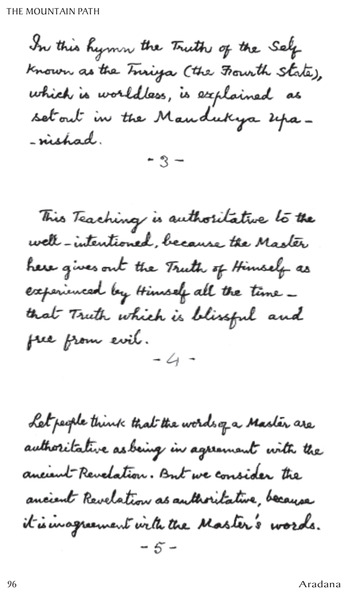
First we have some writings of Sri Ramana Maharshi on Turiya, see here for verses written in English by Sri Ramana Maharshi himself, see this post here for more information on the context of these writing and for more teachings written by Sri Ramana Maharshi in English:

In the photo above we can see Sri Ramana Maharshi has written in English handwriting the following, in which is he saying Turiya is worldless, that is, without objective phenomena present, and this is taught in the Mandukya Upanishad:

‘In this hymn of Truth of the Self known as Turiya (the Fourth State), which is worldless, is explained as set out in the Mandukya Upanishad’

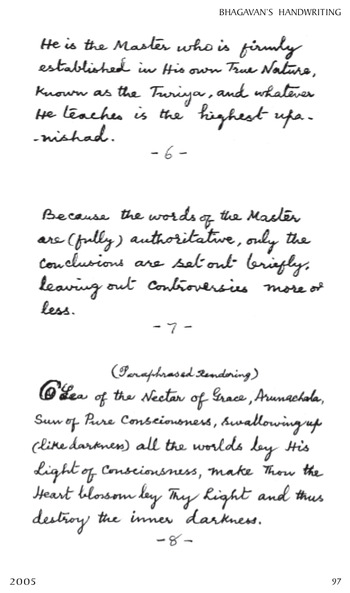
In this image above can see that Sri Ramana writes the following:

‘He is the master who is firmly established in his own True Nature, known as Turiya, and whatever he teaches is the highest upanishad’

We can see Sri Ramana is writing that Turiya is one’s own true nature, and that the sage is firmly established in this Turiya. He then states whatever the sage teaches is the highest Upanishad.

For more teachings written in English by Sri Ramana Maharshi see this post here and be sure to download the PDFs on that page for even more.

Sri Ramana Maharshi on Turiyamiscellaneous quotes:

Here are some other miscellaneous quote from Sri Ramana:

Turiya is only another name for the Self. Aware of the waking, dream and sleep states, we remain unaware of our own Self
~Sri Ramana Maharshi: Talks 353

It is the state of jivanmukti [Tom: liberation in this life] that is referred to as the attributeless Brahman and as the Turiya
~Sri Ramana Maharshi – Vichara Sangraham

Questioner: Why is the Self described both as the fourth state (turiya) and beyond the fourth state (turiyatita)?

Sri Ramana Maharshi: Turiya means that which is the fourth. The experiencers (jivas) of the three states of waking, dreaming and deep sleep, known as visva, taijasa and prajna, who wander successively in these three states, are not the Self. It is with the object of making this clear, namely that the Self is that which is different from them and which is the witness of these states, that it is called the fourth (turiya). When this is known, the three experiencers disappear and the idea that the Self is a witness, that it is the fourth, also disappears. That is why the Self is described as beyond the fourth (turiyatita).

~Sri Ramana Maharshi, Spritual Instruction 4.8

32. For one who seeks waking, dreaming or sleep there is a state beyond these three, a wakeful sleep, a fourth state called the turiya. But because this turiya state alone is real and the three apparent states are illusory, the ‘fourth’ state is indeed the transcendental state.

-Sri Ramana Maharshi, Supplement to 40 verses on reality

In the last verse Sri Ramana Maharshi equates Turiya with ‘wakeful sleep’ or ‘conscious sleep’, in Sanskrit, ‘Jagrat Sushupti’. Sri Ramana many times gave this teaching, which can help us better understand what Self-Enquiry actually is and how to realise the Self – see these articles for more on this topic:

Ramana Maharshi: the method of wakeful sleep (Jagrat Sushupti) to attain liberation
Conscious sleep (Jagrat Sushupti) is Self-knowledge
The point of Self-Enquiry is to go into Sleep Consciously

Sri Ramana Maharshi’s teaching on Turiya as recorded in Sri Ramana Paravidyopanishad:

The following teachings of Sri Ramana Maharshi were recorded in the text Sri Ramana Paravidyopanishad by Lakshmana Sarma (LS), a direct devotee who spend about 20 years with Sri Ramana. LS was one of only 2 people who received private tutelage from Sri Ramana on the deeper meaning of his teachings, the other being Sri Muruganar. LS was also a fluent English speaker and the translations below were made by LS himself, so we can be assured of their accuracy. LS has also provided his own commentary on the teachings, some of which I have provided below:

28. Since that state is changeless, worldless and calm, beyond the states of waking and the rest, it is called the fourth state. Such is the teaching of the Mandukya Upanishad.

Commentary from Lakshmana Sarma (LS): This is why there is no peace in the realm of ignorance. Peace prevails only in the transcendental state, which is the true state of the Self. Among the three states there is a distinction, which is stated next

30. The whole of this world is contained within this trinity of states. The reality of the fourth state, which is worldless, transcends these three states.

LS: Thus it is stated that, because of the underlying sleep of ignorance, the so-called waking is really a state of dream. This will be elaborated later, when the question of the reality of the world is discussed. The fourth state is in perfect contrast with the other three, being sleepless, dreamless and therefore worldless. It is the abode of freedom. Freedom cannot be had in any of the three states. This is one of the fundamentals of the transcendental metaphysics as taught by the sages.

34 Thus, every creature is asleep: none in this world of souls is awake. Only the sage, who, being firmly established in the fourth state, having transcended the three states, and who is free from ignorance, is awake.

LS: Being awake here means being aware of the real Self as it really is. Because of this awakening, he [the sage] is no more troubled by the dream called the world. This uniqueness of the sage is explained in the next two verses.

35 The sage is wide-awake, having become established in the true state of the Self, which is free from the darkness of ignorance. In respect of the dream-world that is being seen by those drowsy with ignorance of the Self, he is asleep.

36 Hence it is said that this world is as night to the sage, whereas to the ignorant the real Self is as night. For this reason the natural state, the fourth state is described by the sages as a state of waking sleep.

LS: This distinction between the sage and the ignorant finds a place in the following verse of the Gita: ‘The sage is awake in what is night to all creatures. That in which the creatures are awake is night to the sage, though he is, in fact, awake.’ This implies that from the standpoint of the sage, the world is unreal. This verse suggests a question: how the sage, whose body is still alive, can carry on his mission as a teacher of supreme wisdom. The solution to this riddle lies in the fact that the natural state of a sage does not interfere with the sage’s work as a teacher. That activity goes on in a mysterious way, which is explained to the extent possible in a later context. From all this it might appear that sagehood is something anomalous. What is anomalous is the worldly outlook, which is blind to the real and attentive to the unreal dream, the world-appearance. The worldly ones are just like intoxicated or mad people. It is the sage who is both sober and sane. Up to now the supreme state of the sage has been called the fourth state. But this name is only a concession to novices, as is shown presently.

37 For those to whom the three states, waking and the rest, are real, that [supreme] state is mentioned as ‘the fourth state’. But since that so-called fourth state alone is real, and these three are unreal, the term ‘fourth state’ is not rightly applicable to it.

LS: The supreme state is therefore just the transcendental state. When compared to this state, the three worldly states cannot be considered to be real. Their seeming reality is no more authentic than the reality that is ascribed to a dream while it lasts. This point will be further elaborated later. The cause of the difference between the three states and the supreme state is explained next.

38 In dream and waking, the mind, being active, itself creates the world. In deep sleep it goes into seed form; on awaking it again creates the world.

LS: In deep sleep the mind is not completely lost; it goes into a latent state, out of which it can emerge and become active again as before. This is the reason for the continuance of bondage. Thus, these three states form a vicious circle that can be broken only by finally extinguishing the mind so that it cannot revive on awaking. To reach this goal the mind-free state must be attained in the waking state itself since the other two states are useless for this purpose.

39 Unless and until the mind becomes utterly extinct, these three states will continue to prevail. When the mind becomes extinguished, the supreme state, in which this world once and for all ceases to appear [as real], is won.

LS: During the prevalence of ignorance the three states conceal the supreme state. The latter cannot be experienced because of these. To be able to experience that state the mind must be destroyed so that the world-creation will also cease. To this end, the quest must be taken up and pursued until the mind-free state is established. This is often styled the state of knowledge. But this description is misleading for the reason stated presently.

40 Though that state of being the real Self is called the state of knowledge, it is one in which there is none of the three: the knower, the object known, and the act of knowing. That being the case, what does one know there, by what means, and who is there to know? It must be understood that knowledge is just a name for the state of being the Self.

LS: That state is different from anything else because it is a state of non-duality (advaita). There is no object to be known, nor is there a knower – the soul – and hence there is no knowing. So ‘knowledge’ or ‘awareness’ are just arbitrary names for this state.

Sri Ramana Maharshi’s teachings on Turiya as recorded in Guru Vachaka Kovai:

The text Guru Vachaka Kovai, or Garland of Guru’s Sayings, is widely recognised and the most authoritative recording of Sri Ramana Maharshi’s verbal teachings, which fully and systematically explain the method and nature of Self Realisation, as much is possible in words. You can read the full text for free here. Here are some verses from that text on Turiya:

17. To those who look within, the highest
Good gained by the Master’s grace
Is wakeful sleep, the turiya state,
The undying flame, the sweet, uncloying
Fruit forever fresh.

80. Jivas suffer in the hot dry
Desert of the world, the dream
Born out of the whirling vasanas old.
Shady refuge from the triple
Fire of desire raging here,
They find beneath the spreading
Bodhi tree, turiya, Self-Awareness.

937. The sage whose ego is extinct
Is freed from the three seeming states
Of waking, dreaming and deep sleep.
All that remains for such a sage
Is turiya
, the most noble state,
First, last and all-transcendent.

940. This true and laudable awareness,
Turiya, may be aptly named
Grand Sleep that knows no waking,
Or Eternal Wakefulness untouched
By slippery sleep

1009. The last, eternal resting place
For those who are tired of seeking bliss
Here, there, everywhere
, what is it
But the marvellous turiya space
Revealed by sages who with Siva’s own
Bright, flawless Being-Awareness shine.

1123.He who has seen himself as Being
As Awareness sees the eternal Siva,
He has seen the death of terrible
Duality. He has seen his own
Natural state of turiya pure.
Birth is what this great one sees not.

Turiya and Turiyatita

See the following post for more on this topic:

Understanding Turiya (the 4th state) and Turiyatita (the state beyond the 4th state)