Tom: Here in Shankara’s introduction to his commentary on the Mandukya Upanishad and his commentary on Sri Gaudapada’s Karika (ie. Sri Gaudapadas commentary on the same Mandukya Upanishad), Shankara explains some fundamental teachings of vedanta which may (or may not) suprise you!
Throughout, Shankara’s writings are in black whilst my comments are in italicised red.
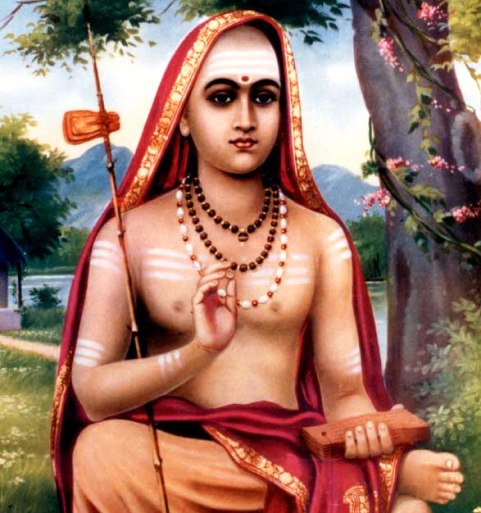
Shankara gives these same teachings throughout his commentaries, eg. in the Brihadaranyaka Upanishad but also in many other places too. However these teachings are often missed, glossed over or re-interpreted by many current so-called traditional teachers of Vedanta.
The following translation is my own, and I have simplified the language to aid understanding. Below I have also provided the PDF of a more literal translation of this commentary by Shankara on the Mandukya Upanishad from Swami Gambhirananda of Advaita Ashrama (this is the translation that I recommend as it is the most literal of the available translations in English, and so has the smallest amount of distortion and re-interpretation according to the prior beliefs and prejudices of the translator) which you can also read, which states the same as my translation but perhaps using more complex and at times archaic language.
Shankara’s Introduction to his commentary on Mandukya Upanishad
Translated by Tom Das
Invocatory Mantra
Om! O gods, may we hear auspicious words with
the ears; while engaged in sacrifices, may we see
auspicious things with the eyes; while praising the
gods with steady limbs, may we enjoy a life that is
beneficial to the gods.
May Indra of ancient fame be auspicious to us;
may the supremely rich and all-knowing Pisa, god
of the earth, be propitious to us; may Garuda, the
destroyer of evil, be well disposed towards us; may
Brihashpati ensure our welfare.
Om! Shanti! Shanti! Shanti!
(Om! May there be peace! May there be peace! May there be peace!)
Tom: Some say that the Mandukya Upanishad, which is the smallest of the Upanishads consisting only of 12 verses, has no mention of God within it. They clearly have not read the invocatory verses above! Devotion and worship has always been a part of the nondual tradition of Vedanta. Below Shankara will provide 2 more invocatory verses that he has written:
Invocation by Shankara
I bow to that Brahman,
which after having enjoyed the gross objects [in the waking state],
by pervading all the worldly objects through a diffusion of Its rays of unchanging consciousness that embraces all that moves or does not move;
Which after having ‘drunk’ [during the dream state] all the variety of objects, produced by desire and lighted up by the intellect,
And sleeps [in the deep sleep state] while enjoying bliss
and making us enjoy through Maya;
and which is [in liberation] counted as the Fourth from the point of view of Maya,
and is supreme, immortal, and birthless.
Tom: Shankara in his first invocatory verses states that liberation, or Turiya, is called the Fourth state, but that this is only from the point of view of Maya (or ignorance), which admits of the 3 states. In true liberation, the 3 states, which are superimpositions on the Self, do not exist in any way shape or form, so Turiya is actually the Singular Reality and not the Forth state at all. This is explained in more detail later in the text by both Shankara and Gaudapada, and Shankara also explains this in more detail here in the text he wrote called Upadesa Sahasri.
The structure of Shankara’s invocatory verses also mimics the structure of the actual Mandukya Upanishad, which first explains the nature of the 3 states of waking, dream and deep dreamless sleep, before lastly explaining the nature of liberation (see verse 7 of the Mandukya Upanishad here), also known as the Self or Turiya, Turiya literally meaning ‘the fourth’ in Sanskrit. Let us continue with Shankara’s second invocatory verse:
May that Fourth one protect us which,
after having [in the waking state] identified Itself with the universe,
enjoys the gross objects created by the merits (and demerits) of past deeds;
After having [in the dream state] experienced through its own light the subtle objects of enjoyment that are called up by its own intellect;
Which [in deep sleep] withdraws promptly all these into Itself;
and which lastly [in liberation] becomes free from all attributes,
by discarding every distinction and difference [ie. by discarding all phenomenal appearances/objects].
Tom: the implication is that in liberation, there are no appearances of any objects, for these have been cast out, and that the appearance of any objects is tantamount to duality. This is further explained below. Let us read Shankara’s introduction to both the Mandukya Upanishad and to Gaudapada’s Karika:
Introduction to the text by Shankara
The word [or letter] Om is everything [idam sarvam, literally meaning ‘all this’ or ‘all things’]. This will all be explained in the rest of this following text.
The four chapters of Sri Gaudapada’s commentary on the Mandukya Upanishad, that sum up the quintessence of Vedanta, starts with the phrase ‘The word Om is everything…’. Because Gaudapada starts with this phrase, the stated aim and purpose of this text, which we would usually state at the start of any text on Vedanta, should be obvious and need not be stated here. Clearly the aim and purpose of the text is the unfolding of Vedanta.
However, as I am giving a commentary here, I should briefly state the purpose of the text. The text, as it explains the spiritual disciplines that lead to a desired goal, will naturally have an aim and subject matter.
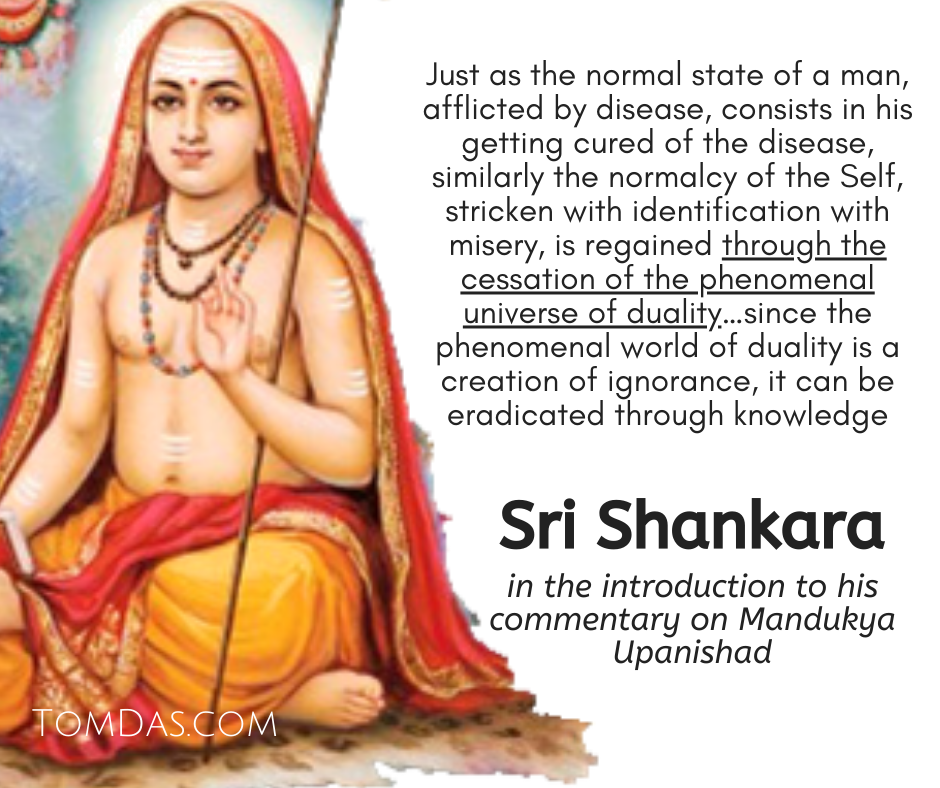
What is the aim of the text? Let me explain: just as a healthy person afflicted by disease will seek a cure for the disease in order to regain the natural state of health, the natural state of being the Self, when afflicted by suffering, will be returned to its ‘natural state of health’ through the cessation of the phenomenal universe of duality.
The aim therefore is the realisation of non-duality. Since the phenomenal world of duality is a creation of ignorance, it can be eradicated through knowledge.
Hence this text aims to reveal the knowledge of Brahman.
Tom: Shankara here is stating that the entire phenomenal world is a creation of ignorance, and that it needs to be eradicated for liberation to occur. This eradication of the phenomenal world can be attained through knowledge of Brahman, which is the same as liberation. The exact nature of knowledge of Brahman is explained later in this commentary here and how to attain this knowledge is explained by Gaudapada here and here.
Compare to Sri Ramana Maharshi when he says in the text Guru Vachaka Kovai in the following verses:
23. The Realised, who do not know anything as being other than Self, which is absolute Consciousness, will not say that the world, which has no existence in the view of the Supreme Brahman, is real.
28. O aspirants who hide yourselves away fearing this world, nothing such as a world exists! Fearing this false world which appears to exist, is like fearing the false snake which appears in a rope.
35. Since this world of dyads [knower-known] and triads [perceiver-perceiving-perceived] appears only in the mind, like the illusory ring of fire formed [in darkness] by whirling the single point of a glowing rope-end, it is false, and it does not exist in the clear sight of Self.
[Tom: The illusory ring of fire is a metaphor that Gaudapada himself uses throughout Chapter 4 of Gaudapada’s Karika].
87. Self appearing as the world is just like a rope seeing itself as a snake; just as the snake is, on scrutiny, found to be ever non-existent, so is the world found to be ever non-existent, even as an appearance.
Also compare also to Sri Ramana Maharshi when he writes in the beginning few paragraphs of his work entitled ‘Who Am I?’:
Q. When will the realization of the Self be gained?
A. When the world which is what-is-seen has been removed, there will be realization of the Self which is the seer.
Q. Will there not be realization of the Self even while the world is there?
A. There will not be.
Shankara will now justify his assertions by quoting from the highest scriptural authority in Vedanta, the Upanishads, let us see:
This fact is established by such Vedic texts as:
‘Because when there is duality, as it were, then one-smells something, one sees something…’ and so on (Brihadaranyaka Upanishad II. iv. 14);
‘When there is something else, as it were, then one can see something, on can know something’ (Brihadaranyaka Upanishad IV. iii. 31);
‘But when to the knower of Brahman everything has become the Self, then what should one see and through what? What should one know and through what?” (Brihadaranyaka Upanishad II. iv. 14).
Tom: we can see that Shankara is providing 3 quotes from the Brihadaranyaka Upanishad to back up this assertion, namely that appearances in the world, or perceiving things (apparently) through the senses, is the same as duality, and that all perceptions of the sense organs and all knowledge in the mind ceases with liberation. Now Shankara will summarise the contents of the 4 chapters of Gaudapa’s Karika (commentary) on the Mandukya Upanishad:
That being so, the first chapter explains the meaning of Om based on the traditional teachings [of Vedanta] and helps us to attain the reality that is the Self.
The second chapter aims to rationally prove the unreality of that phenomenal world of duality, on the cessation of which non-duality is attained, just as the reality of the rope is known on the elimination of the illusion of a snake imagined on it.
Tom: Shankara is again stating that non-duality or liberation is attained upon the cessation of the phenomenal world, which is duality, and Shankara gives the example of the rope and snake to justify his claim. We will only see the rope when the wrong-seeing or illusion of the snake (which causes fear and suffering) goes. Compare with Sri Ramana Maharshi when he writes in ‘Who Am I?’:
‘Just as the knowledge of the rope, which is the base, will not be obtained unless the knowledge of the snake, the superimposition, goes, so the realization of Self, which is the base, will not be obtained unless the perception of the world, which is a superimposition, ceases.’
Shankara continues to summarise the contents of the last 2 chapters of Gaudapa’s Karika, and thus ends Shankara’s introduction to the Mandukya Upanishad. If you wish, you can compare my translation of Shankara’s introduction to this wonderful text to the more scholarly translation below by Swami Gambhirananda:
The third chapter aims to rationally establish the truth of non-duality, and to prevent it too from being negated by a similar process of argument.
The fourth chapter seeks to logically refute all the non-Vedic points of view, which are counterproductive to attaining of the truth of non-duality, and which remain concerned with this unreal duality.
Tom: we can see that in the last sentence of his introduction, Shankara is stating that the false teachings, ie. the teachings that do not lead to liberation, keep on coming back to the unreal duality, ie. false teachings keep on wanting to come back to the world of names and form, also known as maya. There is no Maya in the Self, and in truth there never was. This is the doctrine of ajata vada (no creation or no birth) that is famously explained in Gaudapada’s commentary on this Mandukya Upanishad.
The two main ways that the truly liberating teaching is distorted is firstly by stating that we do not need to turn within in order to realise the self, and secondly by stating that once the self has been realised we must turn back towards the world and integrate our newly-found non-dual understanding/ knowledge/ realisation with the world of phenomenal appearances.
 Tom Das
Namaste Tom, thank you very much for the mail from today, greetings bert from Holland…
LikeLiked by 2 people
You say that Ṥaṅkara summarizes Ch.2 of his kārikā-s with the words: “The second chapter aims to rationally prove the unreality of that phenomenal world of duality, on the cessation of which non-duality is attained, just as the reality of the rope is known on the elimination of the illusion of a snake imagined on it.”
This is indeed how Swami Gambhirananda translates it, but it is misleading. The snake never existed, does not exist now and never will. What happens when we see the rope is that the snake-illusion is sublated, not eliminated. But the metaphor is a bit misleading. The difference is that, whereas the snake is entirely a figment of our overactive imagination, the world was, is and will continue to be name and form of Brahman. It is not an illusion; nor is it ‘unreal’; it is mithyā. Accordingly, it does not disappear; it is simply realized not to be an independently existing entity.
LikeLike
Thank you for your comment.
Many Vedanta teachers agree with what you say, and while it is a nice theory, the problem you have is that is not what Shankara actually says in his commentaries, as you can see from the post above. I personally think Shankara specifically chose this metaphor to make his point – he was perfectly capable of finding a different metaphor if he wanted to make the point you are making, but he doesn’t.
Sri Ramana also confirms this interpretation in his text he wrote called ‘Who Am I?’, as follows:
‘Just as the knowledge of the rope, which is the base, will not be obtained unless the knowledge of the snake, the superimposition, goes, so the realization of Self, which is the base, will not be obtained unless the perception of the world, which is a superimposition, ceases.’
Namaste
LikeLike
Hi Tom,
I will respond to your reply after I have looked at the actual words used by Ṥaṅkara. But Gaudapada himself actually explains this himself. Here is what I said in my book ‘A-U-M: Awakening to Reality’ (which is a complete commentary on the Māṇḍūkya and kārikā-s):
“As to whether or not the world then disappears, Gaudapada effectively asks: how can it disappear when it didn’t exist to begin with? “If the visible world actually existed, there is no doubt that it might stop (i.e. disappear) (as soon as jñāna was gained). (But) this (apparent) duality is merely māyā (and) the absolute truth is non-dual.” (K1.17)
“The world does not disappear because it never existed in the first place! What actually goes away is the mistaken belief that there was a world. Shankara begins his commentary with a supposed objection. The previous verse states that the jīva realizes Advaita when he ‘wakes up’ from ‘sleep’, i.e. dispels self-ignorance. If one can only realize Advaita when duality has gone, then how can there be non-duality while the world still exists?
“Shankara answers this by pointing out that this would only be a problem if the world actually exists to begin with. And he refers to the inevitable rope-snake metaphor: To speak of the snake disappearing when knowledge of the rope is gained is incorrect. Since the snake never existed in the first place, it cannot go away. Similarly, the world never existed, so to speak of it going away upon enlightenment is wrong. A non-existent thing neither comes nor goes away. (The world is, of course, mithyā, being neither real nor unreal but having brahman as its substratum.) So, what actually goes away upon obtaining jñāna is not the perceived dualistic universe but the error (bhrama) that we made in thinking that there was a dualistic world.”
Best wishes,
Dennis
LikeLike
Hi Dennis,
Thanks for your response. Here is the verse you are citing:
‘If the visible world actually existed, there is no doubt that it might stop (i.e. disappear) (as soon as jñāna was gained). (But) this (apparent) duality is merely māyā (and) the absolute truth is non-dual.’ ~ Gaudapada Karika 1.17
Isn’t it clear that Gaudapada is saying that IF you say the world exists, then it DOES cease to exist in liberation. But in truth the world never came into being at all, as it is maya (illusion) – i.e. in liberation it is not that the world disappears, but it was seen never to have come into being in the first place, not even as an appearance.
Shankara, in his commentary on this same verse, says this, again, quite clearly. eg. At the end of his commentary he writes:
‘Therefore the purport [or idea converyed by this verse] is that there is no such thing as the world which appears or disappears.’
This is Shankara and Gaudapada explaining the ajata theory, please see my article here where I explain this further:
Best wishes to you too
Tom
LikeLike
Hi Tom,
You seem to be repeating what I said at the beginning of the extract from ‘A-U-M’: “The world does not disappear because it never existed in the first place! What actually goes away is the mistaken belief that there was a world.” Except that you then add “… not even as an appearance”. But I don’t believe those words appear. Indeed, Ṥaṅkara actually points out in Brahmasūtra Bhāṣya 2.2.28 “(External objects are) not non-existent, for they are perceived.”) that the appearance cannot be denied.
This is saying that the object is not an impression only existing in the mind but an actual external appearance. Of course, there is no real ‘object’. Hence the metaphor of the mirage. It is the mind that superimposes (adhyāsa) the name and form. But the mind does not disappear after enlightenment either. Enlightenment is an event in the mind! The mind still continues to perceive the objects even though the intellect now appreciates what is happening and recognizes that all is Brahman.
To get back to your original post, I have now looked at Ṥaṅkara’s actual words in the Māṇḍūkya introduction. You quoted the translation by Swami Gambhirananda: “The second chapter aims to rationally prove the unreality of that phenomenal world of duality, on the cessation of which non-duality is attained, just as the reality of the rope is known on the elimination of the illusion of a snake imagined on it.”
First of all, the title of the second chapter is ‘Vaitathya Prakaraṇa’. The word ‘vaitathya’ means ‘falseness’, not ‘unreality’ or ‘illusion’. It is a synonym for mithyā. Presumably you do not dispute that the world is mithyā? In which case, you also acknowledge that its adhiṣṭhāna is Brahman which, of course, can never disappear. And, since the world has never been created, it can never be destroyed.
As regards the specific quotation to which you refer, the key words are:
विकल्प – vikalpa – imagined (false notion). We have the ‘false notion’ that the world is satyam. Enlightenment is the realization that it is mithyā. That is then nirvikalpa – without any false notions.
उपशमे – upaśame. The verb upaśam means ‘to become quiet or calm; to appease or pacify. For upaśame, Monier-Williams gives: ‘becoming quiet, assuagement, alleviation, relaxation’ and even ‘intermission’, as well as ‘stopping, cessation’. It does not give ‘elimination’. To my mind, this means that, although the problems created by it are relieved or suppressed, the cause is still there! Also, as far as enlightenment is concerned, the disappearance of the world could never give us that; it is the realization that ‘I am Brahman’ that we want and that is attained only through Self-knowledge, not from any ‘elimination’ of the world, ego or mind. (So please do not extend the discussion to manonāśa, which I have extensively refuted elsewhere!)
You should also always remember that the fact that some (even if it is ‘many’) authors translate a word in a particular way is no guarantee that it is an accurate translation of what was meant by the original author, as I illustrated several times in Volume 1 of ‘Confusions in Advaita Vedanta: Knowledge, Experience and Enlightenment’.
The difficulty for the seeker is in trying to rationalize two apparently contradictory aspects: 1) that the world never existed and 2) that one still sees it post-enlightenment. But one must be very clear about what is meant by ajāti vāda. It means that the world never existed as world; there has not been any creation. But the world is never ‘imaginary’ in the sense of the child of the barren woman. It is always Brahman. We superimpose form and give separate names to those perceptions.
(Some of this material is from the second volume of ‘Confusions in Advaita Vedanta: The Removal of Ignorance’, which is in the process of publication but probably won’t be available until the end of 2024.)
Best wishes,
Dennis
LikeLike
Hi Dennis
Please can you explain what you mean when you say:
‘the world never existed as world; there has not been any creation. But the world is never ‘imaginary’ in the sense of the child of the barren woman.’
Do you mean that the world never existed as separate from Brahman/Consciousness, but it DOES exist as Brahman/Consciousness?
If that is the case, then Maya and Mithya and Vaitathya for you all refer to mistaking the world to be an outright entity separate from Brahman, and the ‘cessation of the world’ (you admit the word upasame can mean cessation or stopping) does not actually mean cessation of the world, but cessation of the world as imagined as being separate from Brahman/Consciousness (which is NOT what is written, by the way).
In the same way, creation for you means creating something (the world) that is other or apart from Brahman/Consciousness, and in this sense there has never been any creation, but an appearance of the world/creation in consciousness and as consciousness continues after liberation. So for you ‘no-creation’ means creation DOES appear, but just not separate from Consciousness/Brahman/Self?
I’m guessing that for you ‘manonasa’ (which literally means destruction of the mind and is a traditional synonym for liberation/self-knowledge), does NOT actually mean destruction of mind, but instead means destruction of seeing things as separate from Brahman/Consciousness, mind here referring to the power of seeing things separate from Consciousness/Brahman, and that the thinking mind actually does survive after manonasa and so in Manonasa, destruction of mind, the mind is not destroyed after all.
Does this accurately represent your view?
You also write:
‘The difficulty for the seeker is in trying to rationalize two apparently contradictory aspects: 1) that the world never existed and 2) that one still sees it post-enlightenment.’
But I’m guessing what you actually mean when you say ‘(1) the world never existed’ is that the world DOES exist (ie. the opposite of what you write), but the world does not exist separate from Brahman.
So for you liberation, and the entirely of vedanta, is just a mere adjustment of seeing everything as consciousness rather than actually believing things as being separate from Self/Consciousness/Brahman?
Is this your view?
With thanks
Tom
ps.
1) I agree with your statement about the meaning of words, but I suspect we will disagree about the specifics.
2) you admit the word upasame can mean cessation or stopping, so the meaning is essentially the same as I translated it
3) a small point but you say the title of the second chapter is ‘Vaitathya Prakaraṇa’, but actually there is no formal title in the original sanskrit
4) You write ‘Also, as far as enlightenment is concerned, the disappearance of the world could never give us that; it is the realization that ‘I am Brahman’ that we want and that is attained only through Self-knowledge, not from any ‘elimination’ of the world, ego or mind. ‘
but
Disappearance of the world (or maya/mithya), through self-enquiry, IS self-knowledge. It is explained multiple times throughout the vedanta scriptures as being like this:
eg. The famous Shankacharya, Vidyaranya Swami quotes from Amritabindu Upanishad in his text Jivanmukti Viveka to make this very point too, here is the verse he himself quotes (ie. I am not cherry-picking a verse here, rather Swami V is quoting this verse, see here for more quotes like this):
The mind severed from all connection with sensual objects, and prevented from functioning out, awakes into the light of the heart, and finds the highest condition. The mind should be prevented from functioning, until it dissolves itself in the heart. This is Jnana [self-knowledge], this is Dhyana, the rest is all mere concoction of untruth.
~ Amritabindu Upanishad
In his commentary on Katha Upanishad 2.1.1, Shankara writes:
‘…the perceiver sees the external objects which are not-Self/not the Atman, such as sound, etc., and not the Self within. Though this is the nature of the world, some (rare) discerning man, like turning back/ reversing the current of a river, sees the Self within…The group of sense organs, beginning with the ear, should be turned away from all sense-objects.
Such a one, who is purified thus, sees the indwelling self. For it is not possible for the same person to be engaged in the thought of sense-objects and to have the vision of the Self as well.‘
We see the same teaching in Adhyatma Upanishad 1.21:
By expelling (from the mind) without any remainder all objects which are superimposed on one’s Atma, one becomes himself Parabrahman the full, the secondless and the actionless
Similarly, in his commentary on Katha Upanishad verse 1.2.20 Sri Shankara writes:
‘…One whose intellect has been withdrawn from all objects, gross and subtle, when this takes place, this is known as ‘inactivity of the sense organs’. Though this ‘inactivity of the sense organs’ one sees that glory of the Self. ‘Sees’ means he directly realises the Self as ‘I am the Self’ as thereby becomes free from suffering’
Sri Ramana Maharshi also gives these teachings in the text he wrote called ‘Who am I?‘:
Q. When will the realization of the Self be gained?
A. When the world which is what-is-seen has been removed, there will be realization of the Self which is the seer.
Q. Will there not be realization of the Self even while the world is there?
A. There will not be.
5) Briefly, re manonasa, Gaudapada writes in verse 3.38 of his Mandukya Karika:
There can be no acceptance or rejection where all mentation stops. Then knowledge is established in the Self and is unborn, and it becomes homogenous
Shankara’s commentary on this verse 3.38 is as follows:
…therefore there is no rejection or acceptance in It, where thought does not exist. That is to say, how can there be rejection or acceptance where no mentation is possible in the absence of the mind? As soon as there comes the realisation of the Truth that is the Self, then, in the absence of any object, knowledge (Jnanam) is established in the Self, like the heat of fire in fire. It is then birthless (ajati) and becomes homogenous.
I know I have put forward lots of quotes your way – there are just so many many more too like these. Please don’t feel you have to respond to each one of course.
Namaste
Tom
LikeLike
Hi Tom,
A mithyā entity is not non-existent. But neither does it exist in its own right, so to speak. The world ‘borrows’ its existence from Brahman, in the analogous way that the ring and bangle ‘borrow’ their existence from gold. The ring does not exist in its own right; it is name and form of gold, which is the actually existent substance. Similarly, the world does not exist as a separate ‘substance’; it is name and form of Brahman.
So yes, your assertion that I am saying that “the world never existed as separate from Brahman/Consciousness, but it DOES exist as Brahman/Consciousness” is correct.
And you are right that we mistake the world as a separate entity. References to the world disappearing in the scriptures mean that we realize this. Nothing actually happens (after all, there is only ever Brahman, so how could it).
You say that this is “NOT what is written” (by Ṥaṅkara, summarizing Ch. 2 of kārikā-s).
The actual words used by Ṥaṅkara are:
यस्य द्वैतप्रपञ्चस्योपशमे अद्वैतप्रतिपत्तिः रज्ज्वामिव सर्पादिविकल्पोपशमे रज्जुतत्त्वप्रतिपत्तिः, तस्य द्वैतस्य हेतुतो वैतथ्यप्रतिपादनाय द्वितीयं प्रकरणम् ।
Could you please indicate why the interpretation I have given is wrong and yours is correct.
In reality, there has never been any creation of any sort. Brahman does not ‘do’ anything and there is never anything other than Brahman. But, as I noted earlier, Ṥaṅkara confirms that “(External objects are) not non-existent, for they are perceived.” What we see exists (taking its existence from Brahman) in a manifest form during what we call ‘creation’ and in an unmanifest form in pralaya.
You seem to be trying to interpret what I said as ‘The world DOES exist (but as Brahman)’. As I’m sure you know, you have to be extremely careful with words when talking about practically anything in Advaita. To put it in completely unambiguous way (hopefully! 😉), the apparent ‘existence – sat’ of the world does not belong to the world; it ‘belongs’ to Brahman. C.f. the gold-ring metaphor.
As I indicated, I have written around 20,000 words on this topic for Vol. 2 of ‘Confusions in Advaita Vedanta’, so it is not realistic to attempt to present all the arguments for and against here. I concede that there are many more quotations (than the one you have quoted) in the scriptures that can be construed as meaning that the world actually disappears on enlightenment. But, except for the ones that are simply mistranslations, the rest are either misunderstandings or are taken out of context.
I have addressed all the plausible ones in the book. These were raised by ‘opponents’ during the year-long (plus) discussions on the topic that we had at my website. Some appear at first sight to be far more damning than the one you have chosen (which, funnily enough, no one else picked up). I have rationalized and shown why they have been wrongly understood, and I have provided many quotations from scriptures, Ṥaṅkara and Sureśvara to support my own understanding.
As I said, I do not want to open this discussion up into manonāśa. You can read my views on this at https://www.advaita-vision.org/manonasha-not-the-literal-death-of-the-mind/.
Incidentally, you presumably realize that your position entails the belief in eka-jīva-vāda (solipsism), to which Ṥaṅkara did not subscribe and which renders the entire Advaita teaching nonsensical (and Ṥaṅkara unenlightened). I have also refuted this in a number of places, e.g. https://www.advaita-vision.org/the-devils-teaching-part-1/.
So yes: end of world, end of mind, end of ego (on enlightenment) are all not true literally. They are simply figurative ideas used by some teachers in order to convey particular aspects of the teaching. Unfortunately, many seekers take them literally and end up being very confused!
Enlightenment is an intellectual reconfiguration, as a result of which it is realized as a certainty that ‘I am Brahman’, ‘all there is is Brahman’. It is NOT any sort of ‘experience’. We are already Brahman so nothing can actually ‘happen’. And I will not enter into a discussion of the meaning of anubhava – please wait for Vol. 2 of Confusions!
Regarding your P.S’s, briefly:
2) What ‘ceases’ or ‘stops’ can start again; i.e. is not actually ‘destroyed’ or ‘eliminated’.
3) As is common throughout Advaita, verses/chapters/topics are often named after the first-occurring Sanskrit word. Chapter 2 of the kārikā-s begins “Vaitathyaṃ sarvabhāvānāṃ…”.
4) Your statement “Disappearance of the world through Self-enquiry IS Self-knowledge” is not true. This is just another version of the quotation I was originally refuting. I’m afraid I do not accept Vidyaranya or Vivekananda as authorities, for reasons that I amply justify in Vol. 1 of ‘Confusions’. (Neither do I accept any modern teachers such as Ramana or Nisargadatta for different reasons.) If you want to substantiate such an assertion, please quote only prasthāna traya, Ṥaṅkara or Sureśvara.
Amritabindu Upaniṣad is, in any case, a Yoga Upaniṣad. Yoga (which is a dualistic philosophy) inserts all sorts of wrong ideas into Advaita (e.g. value of samādhi).
Kaṭha 2.1.1 – I don’t see anything about world disappearing here.
I don’t know the Adhyātma Upaniṣad but I suspect a translation problem there. One cannot ‘become’ Brahman. One is already Brahman, since there is only Brahman!
Again, there is no problem with Kaṭha 1.2.20. ‘Withdrawing’ from sense objects is akin to upaṣame. One becomes ‘free from suffering’ after realizing that the world and its apparent problems are only an appearance and one is not really affected by any of it. Enjoyment and pain still take place but no associated ‘suffering’.
K 3.38 is talking about turīya so doesn’t really apply to this discussion.
You say that “there are just so many many more (quotations) too like these. In my writing about this topic for Vol. 2 of ‘Confusions’, I collected 129 quotations altogether (and addressed them all to my satisfaction). Do you have more than this?
Best wishes,
Dennis
LikeLike
Hi Dennis
Thanks for your response.
Mithya actually does mean that which doesn’t exist, or that which is illusion, as does Maya, which literally means ‘that which is not’.
The idea of mithya meaning ‘dependent upon’ Brahman or not existing apart from Brahman is only meant to be an explanation from the point of view of Maya. This is similar to Turiya being said to be the ‘fourth’ state, which Shankara explains is only from the point of view of Maya, as in Truth there is only the singular ‘state’ of Self, to which Turiya refers.
My point is that Shankara never says what you have written. As you quote Shankara:
यस्य द्वैतप्रपञ्चस्योपशमे अद्वैतप्रतिपत्तिः रज्ज्वामिव सर्पादिविकल्पोपशमे रज्जुतत्त्वप्रतिपत्तिः, तस्य द्वैतस्य हेतुतो वैतथ्यप्रतिपादनाय द्वितीयं प्रकरणम् ।
A near-literal translation of this is:
‘The second chapter establishes the unreality of the phenomenal world of duality, on the cessation of which non-duality is attained, just as the truth of the rope is known with cessation of the appearance of the snake.’
Shankara clearly DOES say non-duality is attained on the cessation of the world, and that the world is not real. Shankara does NOT say that the world does not really cease, but it continues to appear, but just that it is non-separate from Brahman, which is what you say.
He says this multiple times just in this part that I have translated in the main post above.
He does not say what you say at all.
Further points:
2) Good point, I hadn’t thought of it that way
3) Can you give other examples where Advaita chapters are named after the first word?
4) I have not quoted Vivekananda, so not sure why you mention him, but Sri Vidyaranya was a Shankacharya in the 1300s, tasked with upholding Shankara’s traditional teaching lineage. The traditional advaita vedanta teaching for centuries is as I have explained above in the main post, as documented by a lineage of shankacharyas. What you are writing is a departure from the teaching tradition.
You mention Sureswara, but he essentially agrees with what I write – in his text Naiskarmya Siddhi (NS), eg. in the introduction he states that the world arises due to ignorance, and in verse 1 he uses the same metaphor of the snake and rope as Shankara has here. He later goes on to say in verse 1.66 how there is no action (karma) in jnana, ie. no world, the world being karma. This is also implied in NS verse 2.6
In his introduction to chapter 3 of NS, Suresvara writes that the self has no phenomena that arise in it.
(See here for the text of NS: https://tomdas.com/2021/10/09/sri-suresvara-advaita-vedanta-summarised-naishkarmya-siddhi/ )
We see the same teaching recorded in Sri Ramana Paravidyopanishad (Sri Ramana Maharshi’s teachings) – here Sri Ramana teaches us about this very Mandukya Upanishad in verse 28:
28. Since that state is changeless, worldless and calm, beyond the states of waking and the rest, it is called the fourth state. Such is the teaching of the Mandukya Upanishad.
39. Unless and until the mind becomes utterly extinct, these three states will continue to prevail. When the mind becomes extinguished the supreme state is won, wherein this world once and for all ceases to appear.
87 This universe [we see] shines in the dense darkness of ignorance, but does not shine in the great splendour of the light of Self-awareness. If this universe were real, why does it not shine in the supreme state, lit as it is by the conscious, effulgent light of the real Self?
88 That which survives in the experience of the real Self is the supreme state. [That] alone is real. All else is only unreal. This is the distinction between the real and the unreal, revealed to us by the teachings of all the sages.
91 As the dream world is known to be unreal for the reason that it vanishes upon waking, so this waking world is also proved to be unreal by its vanishing in the light of the real Self.
147 Creation is not other than seeing; seeing and creating are one and the same process.
578 The sage in his worldly activities may appear to be aware of worldly differences, but he is really no more aware of them than a sleepwalker who moves about, performing actions.
Dennis, you write:
‘Enlightenment is an intellectual reconfiguration, as a result of which it is realized as a certainty that ‘I am Brahman’, ‘all there is is Brahman’. It is NOT any sort of ‘experience’. ‘
Whilst I agree that enlightenment is not any sort of experience, it is also not intellectual knowledge or intellectual reconfiguration, which itself is a subtype of experience. Yes, intellectual reconfiguration is also a type of experience, a type of karma. This is why Shankara refutes your view, and in fact Suresvara also refutes this view, writing a few verses on this very point in NS, and criticising Sankhya philosophy for making this very mistake, ie. thinking enlightenment is merely an intellectual reconfiguration is also not correct, eg in NS verses 3.5 and 3.6
Suresvara, like Shankara, also emphasises how the body and mind have no connection with the Self at all, eg. NS 2.21, and so are not appearances that are one with Brahman as you contend. They are maya, non-existent. Due to ignorance they appear to exist, but in truth they do not. This is why Brahman is said to be homogenous, ie. without any variance or change, (not even an appearance of change, which is ignorance or maya or mithya)
Re the Upanishads, traditionally all 108 upanishads are considered to be authoritative, the categorisation into types such as ‘yoga’, etc, coming much later. These catergorisations were meant to be helpful guides to the contents of the Upanishads, and not to be used to exclude certain upanishads from being authoritative Sruti for vedantins. This is why Shankacharyas traditionally quoted from all the various types of the 108 traditional Upanishads.
Also many Upanishads write of ‘becoming’ Brahman or ‘becoming’ immortal. This is just a common turn of phrase – of course it is truer to say we are already that, but that is how these texts are often written, as I’m sure you must have seen if you have read the Upanishads and Advaita literature.
Namaste
Tom
LikeLike
Hi Tom,
I am bound to say that you seem to be taking the same actions as happened with those arguing your position at my website a year or two ago, namely instead of responding to specific points and keeping the discussion focused, you bring in new points as though they resolve the earlier ones. They don’t. I am not going to address your new points. I am happy that all could be resolved but I wish to get back to writing my books!
I began by simply querying your translation of Ṥaṅkara’s commentary at the introduction to kārikā chapter 2. I highlighted the meaning of the three key words in the sentence. Vaitathya does not mean ‘unreality’. If the world was unreal, how could we perceive it in the first place? I pointed out Brahmasūtra 2.2.28 “(External objects are) not non-existent, for they are perceived.”)
You say that “The idea of mithya meaning ‘dependent upon’ Brahman or not existing apart from Brahman is only meant to be an explanation from the point of view of Maya.” I presume you mean from the standpoint of vyavahāra. But everything in Advaita is vyāvahārika isn’t it? Nothing could ever be said from the standpoint of absolute reality, since it is non-dual!
And you say that “Mithya actually does mean that which doesn’t exist, or that which is illusion.” Could you give some Ṥaṅkara reference for this claim, please. A dictionary reference is not acceptable. Sanskrit words frequently have multiple meanings, which may diverge widely. It is how Ṥaṅkara uses a word that matters.
You give what you claim to be a “near-literal translation” of the Ṥaṅkara quotations as:
“The second chapter establishes the unreality of the phenomenal world of duality, on the cessation of which non-duality is attained, just as the truth of the rope is known with cessation of the appearance of the snake.”
I would say that the literal translation is:
“pratipādanāya dvitīyaṃ prakaraṇam – the second chapter (is discussed) in order to establish – hetuta – with reasoning – vaitathya – the mithyātva – yasya dvaita prapañcasya – of that phenomenal world of duality, (which is) advaitapratipattiḥ – realized as non-dual – vikalpa upaśame – on the suppression of the false notion – tasya dvaitasya – of that duality, (just as) rajjutattva – the truth of the rope – pratipattiḥ – is ascertained – sarpa ādi – (i.e.) of the snake etc.”
Accordingly, your assertion that “Shankara clearly DOES say non-duality is attained on the cessation of the world, and that the world is not real. Shankara does NOT say that the world does not really cease, but it continues to appear, but just that it is non-separate from Brahman, which is what you say.” is not correct.
He DOESN’T say that “nonduality is attained” – he says that the world is ‘realized as non-dual’. How could it be ‘attained’ when it is always non-dual?? And, by the same argument, the world (which is mithyā) cannot ‘cease’ since no world has ever been created – it is always Brahman in reality.
I agree that he does NOT say here that the world continues to appear, but neither does he say that it disappears! We realize the mithyātva of the mirage, or the bent pencil in water, or the sunrise but they all continue to present themselves!
There are quotations to support this. E.g. Ṥaṅkara’s bhāṣya on Muṇḍaka 2.2.12:
“Whatever is obtaining in front of you (yat purastāt) is seen as abrahman due to ignorance (avidyā dṛṣtinām), but the truth is, it is nothing else but Brahman… In short, on all sides whatever appears as the kārya prapañca different (anyat) from Brahman, is in fact Brahman alone, which pervades or appears (prasṛtam) everywhere in the form of name and form (nāma-rūpa-s).”
Or Brahmasūtra 2.1.14 is tadananyatvamārambhaṇaśabdādibhyaḥ. meaning that the world, which is an effect, is non-different from Brahman, the cause. (There is) ananyatvam – identity, non-difference; (between) tat – Brahman (and the world); (on account of) śabda – the texts about; ārambhaṇa – beginning, undertaking, commencement (i.e. origin of the world); ādi – etc.
The belief that the world is an illusion belongs to Buddhism, not Advaita!
Finally, one of the things you say is that “Suresvara, like Shankara, also emphasises how the body and mind have no connection with the Self at all.” This comes back to the point I made earlier, which you did not address: “you presumably realize that your position entails the belief in eka-jīva-vāda (solipsism), to which Ṥaṅkara did not subscribe and which renders the entire Advaita teaching nonsensical (and Ṥaṅkara unenlightened).”
The supreme advantage of the teaching of Advaita, once correctly understood, is that it explains everything reasonably. As soon as you start to make assertions that contradict experience or reason, that advantage disappears and you are left with ideas that just seem silly on close analysis.
Best wishes,
Dennis
LikeLike
Hi Dennis,
Similarly, I will confine my response to the key points:
You write:
‘I would say that the literal translation is:
“pratipādanāya dvitīyaṃ prakaraṇam – the second chapter (is discussed) in order to establish – hetuta – with reasoning – vaitathya – the mithyātva – yasya dvaita prapañcasya – of that phenomenal world of duality, (which is) advaitapratipattiḥ – realized as non-dual – vikalpa upaśame – on the suppression of the false notion – tasya dvaitasya – of that duality, (just as) rajjutattva – the truth of the rope – pratipattiḥ – is ascertained – sarpa ādi – (i.e.) of the snake etc.”’
Your use of the ‘etc’ misses out the important part of the sentence which allows us to understand what ‘upasame’ actually means. Shankara says the world needs to ‘upasame’ for liberation to occur just as the illusion of the snake needs to ‘upasame’ for the rope to be seen.
Isn’t it clear ‘upasame’, the usual literal meaning of which is ‘cease’ or ‘stop’, here also means ‘cease’? It doesn’t mean ‘supress’ unless by supress you mean supression until the point of cessation. A mere supression of the snake would not suffice unless the supression led to cessation of the snake, for that is what is required for the rope to be seen.
This is also Sri Ramana’s view in ‘Who Am I?’ when he himself writes on this exact same topic:
‘Just as the knowledge of the rope, which is the base, will not be obtained unless the knowledge of the snake, the superimposition, goes, so the realization of Self, which is the base, will not be obtained unless the perception of the world, which is a superimposition, ceases.’
You write:
‘He DOESN’T say that “nonduality is attained” – he says that the world is ‘realized as non-dual’.’
No, this is not correct. Shankara writes ‘Yasya dvaitaprapancasyopassame advaitapratipattih’, which literally means ‘when the dualistic-world ceases, non-duality is recognised’. Notice how the words are compounded: ‘dvaitaprapancasyopassame’ = cessation of the dualistic world and ‘advaitapratipattih’ which means recognition of non-duality.
You write:
‘I agree that he does NOT say here that the world continues to appear, but neither does he say that it disappears!’
As I have explained above, Shankara literally says the world ceases.
You write:
‘And you say that “Mithya actually does mean that which doesn’t exist, or that which is illusion.” Could you give some Ṥaṅkara reference for this claim, please. A dictionary reference is not acceptable. Sanskrit words frequently have multiple meanings, which may diverge widely. It is how Ṥaṅkara uses a word that matters.’
You yourself have resorted to the dictionary definition when it suits you to (inaccurately in this context) define ‘upasame’ as meaning ‘supression’ as opposed to ‘cessation’. If you want to depart from both the literal definition and traditionally accepted definition of a word such as Mithya (my translation is the traditional line taken by successive Shankacharyas such as Swami Vidyaranya with whom you disagree, and also with modern Advaitins such as Sri Ramana Maharshi, and it is also the literal meaning of the word), then I say it is you who should provide the evidence.
eg. If I were to say ‘green’ usually means ‘green’ and has always meant ‘green’, but in this context actually means ‘red’, then the burden of proof rests with me. This is what you are doing with the word ‘mithya’, which literally means illusory or false, and this is also the traditional meaning. Only more recently, mainly in 20th century, have scholars attempted to redefine mithya to mean ‘dependent upon Brahman’ or ‘non-separate from Brahman’ or something similar to what you write. This was never the traditional meaning of the word.
You write:
‘The supreme advantage of the teaching of Advaita, once correctly understood, is that it explains everything reasonably. As soon as you start to make assertions that contradict experience or reason, that advantage disappears and you are left with ideas that just seem silly on close analysis.’
I presume when you say ‘ideas that just seem silly’ you are referring to my view here 🙂 This is not quite true. Advaita scriptures are a revelation from Source/Guru that invite us to see a truth and also give us a method to discover this for ourself. The truth stated may not initially seem to be reasonable from the point of view of an ordinary way of thinking, and may even seem ‘silly’ and seem to contradict our experience, but we can discover this truth for ourself if we follow the clues given to us. What may initially seem ‘silly’ may well later be discovered to be fact/true with investigation and sadhana according to the scriptures.
In fact I am very familiar with your viewpoint – I used to agree with your point of view when I was much younger and more intellectually inclined, as this made more sense to my intellect/mind. However this view doesn’t actually end suffering once and for all. I am fully aware, for example, of the scolarship of both Swami Dayananda and also that of Swami Satchidanandendra Saraswati, both of whom actually disagree with each other.
It was only when I gained a deeper understanding and, for want of a better word, ‘experience’ of the the teachings that I was able to see the truth of this deeper (and more radical and apparently ‘silly’) explanation of Advaita, which actually has the advantage of ending duality and all suffering once and for all, rather than actually getting to have our cake (ego) and eat it (remain in ego-duality consciousness and suffer accordingly).
I discovered this through the Grace of Sri Ramana Maharshi, who has made the teachings simple and clear, and whose teachings and Being-Presence lead us to true liberation. I was told by some that Sri Ramana did not teach the true Vedanta, but I have found that he actually does teach the true vedanta, as found in the scriptures, and also found in his writings, in his translations of the scriptures and through his Presence.
Let us (perhaps) listen to him as he teaches us in Guru Vachaka Kovai:
599. The innocent girl-bride thinking that
Betrothal is full conjugal union
Is filled with joy. Even so the learned
Who have yet to turn within and taste true bliss
Claim that the verbal wisdom which they prattle
Is advaita jnana.
600. Those who from books have learnt about
The truth supreme esteem themselves
Supreme in wisdom, and fail to seek
The Knower and taste the bliss of Self,
But test and measure the silent sage.
What folly this!
Namaste
Tom
LikeLike
Hi Tom,
You say that “Your use of the ‘etc’ misses out the important part of the sentence”.
It is not ‘my’ use of the word ‘etc.’! That is Ṥaṅkara’s word – ‘ādi’ means ‘etc.’!
By all means use the word ‘cease’ if you want. As I pointed out, what ceases can start again later. C.f. all of the rain we have been having recently! It is just more likely to cause this sort of confusion.
As I also pointed out, I am not interested in what Ramana says about it. I have great respect for him – I maintained the UK Ramana website for many years – but he cannot be relied upon for a traditional-according-to-Ṥaṅkara view because he was not a sampradāya teacher.
The word pratipatti means ‘ascertained’, ‘acknowledged’, i.e. as a result of knowledge gained. Hence, ‘realized’ is a very reasonable translation. ‘Recognized’ implies perception and, since one is clearly seeing duality, it is not an appropriate translation.
As I have explained, Ṥaṅkara does NOT literally say that the world ceases! Your saying so does not make it so!
You ask that I provide evidence for ‘my’ understanding of the word ‘mithyā’ as NOT Meaning ‘illusory’ or ‘unreal’. Fine – I have written a fairly long article on this at https://www.advaita-vision.org/origin-and-meaning-of-the-word-mithya/.
Traditional Advaita teaching requires that a seeker attain sādhana catuṣṭaya sampatti and then go to a qualified teacher to be taught. I suggest that the idea of ‘discovering the truth for ourselves’ is a new one propagated by modern ‘teachers’ who, because they are not sampradāya taught, are unable to unfold scriptures using proven sampradāya techniques.
And you have still not answered the question about how any teaching could ‘end duality’. What would happen to the ‘person’ for whom duality had ended?? What would happen to the ‘rest of humanity’? I would be very interested in hearing your explanations in this regard.
Best wishes,
Dennis
LikeLike
Hi Dennis,
Keeping to the key point (as you advise), does that mean that you approve of the following tranlsation of the verse in question:
‘The second chapter establishes the unreality of the phenomenal world of duality, on the cessation of which non-duality is realised, just as the truth of the rope is known with cessation of the illusory appearance of the snake.’
I have used the word ‘ceases’, which you have said you are happy to accept as a translation for ‘upasame’, and the word ‘realised’ instead of ‘recognised’, which again you have said you are also happy to accept.
With thanks
Tom
LikeLike
Hi Tom,
Why would you choose to give a translation that could confuse seekers, when you can ‘fine tune’ it so as to explain it clearly?
Again (I think this is where I came in!), vaitathya does not mean ‘unreality’. It is another name for mithyātva, which means that the world is effectively ‘real’ with its ‘existence’ actually ‘belonging’ to Brahman.
You still haven’t explained how your interpretation can be reconciled, given its logical consequence. Please respond to my last sentence. (What would happen to the ‘person’ for whom duality had ended?? What would happen to the ‘rest of humanity’?) And add to that: how could there ever be any enlightened teachers of Advaita?
Best wishes,
Dennis
LikeLike
Hi Dennis
Re the sanskrit word ‘vaitathya’, the literal translation is unreal: ‘tathya’ means real or true, vaitathya means unreal, untrue (or false). I agree vaitathya is a synonym for mithya, which also literally means unreal or illusionary or false.
So I hope we can agree that my translation is an accurate one. You may prefer a different translation, but what I am writing is actually wholly representative of what is written by Shankara (and it is also the traditional way the text has been understood too, and is also in agreement with great sages such as Sri Ramana Maharshi).
Regarding the logical consequences of this, that is a different point, and your questions are of course valid. I have summarised this in the following posts which you are welcome to take a look at:
This post contains links to many other posts that explore the consequences of Shankara’s and Ramana’s teaching (which are essentially the same teaching):
Namaste
Tom
LikeLike
Hi Tom,
There are other nondual systems of philosophy, such as Zen, Taoism and Kabbalah, not to mention the Christian ‘Gospel of St. Thomas’. All of them may lead one to the final understanding, even though ‘route’ and ‘waymarks’ differ. Sureśvara says that “By whichever [method] people can develop understanding of the inner-Self, that method should certainly be known as good and as consistent [with the main teaching].” (Br. Up. Bhāṣ. vārttika 1.4.102)
So, if you want to stick with the idea that the world disappears on enlightenment and you believe that Ṥaṅkara actually claimed this, and it ‘works’ for you and others, then that is fine. But the fact remains that, for the reasons I have already given (and more), it does not stand the test of reason and Gauḍapāda, for example, says that “That which is supported by śruti and corroborated by reason, is alone true and not the other.” (Kārikā 3.23)
Those that teach that we have to kill the ego, destroy the mind, make the world disappear, etc. may be able to bring enlightenment to some seekers but they are not teaching traditional Advaita. Similarly, any who teach that enlightenment is an experience or that one has to go into nirvikalpa samādhi. There are many misunderstandings out there. (And I am afraid that Ramana’s and Ṥaṅkara’s teachings differ quite a bit!)
I don’t know how you explain all of the scriptural and Ṥaṅkara statements to the effect that the world is Brahman if it then disappears. Or how you contradict Ṥaṅkara, who says that:
“Thus, it is said that though all things are non-different from the supreme cause, Brahman, still there can be such a distinction as the experiencer and the things experienced on the analogy of the sea and its waves etc.… The experiencer and the things experienced never get identified with each other, nor do they differ from the supreme Brahman.” (B.S.B. 2.1.13
So yes, we agree that vaitathya is a synonym for mithyā, but we definitely do not agree that mithyā means ‘unreal or illusionary or false’. The definition usually given is sadasadvilakṣaṇa – neither sat nor asat and that’s the one I am sticking to!
Thank you for the discussion. It has been interesting, even if it has taken up quite a bit of time 😉. I hope it proves helpful to your readers.
Best wishes,
Dennis
LikeLike
Thank you Dennis
Appreciate your comments and your view here, as well as the discussion.
I can see we do not agree on what Mithya means – there are many Advaitins of course who agree with me whom have also extensively studied the scriptures and can explain the other quotes you raise, and I can also explain all of these other quotes you raise too. Of course there are plenty who agree with you too and can quote scriptures to back up your view too, as I am sure you can.
But of course everytime you quote from another Upanishad/text to back up your view, this opens up a whole other discussion on the context and meaning and translation of this new quote , etc, (and vice versa for when I do the same), so these discussions often become very protracted.
The scriptures can be interpreted in a variety of ways. It is all well and good saying you need a guru to guide you, but guru’s also differ in their interpretations, many agreeing with me, some agreeing with you too, so this doesn’t help.
In my view, you have wrongly understood the Advaita scriptures, and perhaps you are not familiar enough with Sri Ramana’s teachings, and this is why you think Shankara and Sri Ramana teach something different. I know many think this. In fact, the teachings are exactly the same, if we correctly interpret the scriptures, which means we take the words to mean what they actually and ordinarily mean and do not change the meaning of words such as mithya, which literally means illusion or unreal, to mean something they do not, such as ‘dependent reality’.
Sri Ramana himself explains all the points you have raised about Brahman and the world himself in his teachings. Please see a text called Guru Ramana Vachana Mala, which contains Ramana’s teachings and was composed with Sri Ramana’s help, where this is all explained further, you can read a copy here:
A Devotee of Sri Ramana Maharshi also wrote a text called Maha Yoga which attempts to show how Sri Ramana’a teachings are entirely consistent with the Upanishads and Advaita Vedanta, see here to view the text:
Many people who are not deeply familiar with Sri Ramana Maharshi’s teachings do not realise that Sri Ramana Maharshi:
1) had an in depth knowledge of the Advaita Scriptures – he even translated many of them from Sanskrit to Tamil for the benefit of those local to him who could not read/understand Sanskrit.
2) who also had realised the Self (most Advaitins accept this),
3) who understood the vedanta methodology (prakriyas) – if you read his teachings you will see that he often describes the various traditional prakriyas in great detail, quoting from scriptures as he does so.
I therefore say that Sri Ramana Maharshi provides us with the clarity in which the scriptures are seemingly lacking at times (if they are wrongly interpreted). Hence I have provided quotes from his teachings which are unambiguous and not open to misinterpretation.
Thank you for the discussion, I hope it has been helpful or at least interesting to you too, and I wish you well
Namaste
Tom
LikeLike