Also see:
Ramana Maharshi – the 3 levels of the teaching
“The scriptures talk about prarabdha karma only for the purpose of easy understanding of the ignorant“.
~Sri Shankara, Aparokshanubhuti verse 97
“The statement that the jnani retains prarabdha while free from sanchita and agami is only a formal answer to the questions of the ignorant. Of several wives none escapes widowhood when the husband dies; even so, when the doer goes, all three karmas vanish.“
~ Supplement to the 40 verses on reality, written by Sri Ramana Maharshi
462-3:… it is to convince those fools who entertain a doubt like this, that the Shrutis, from a relative standpoint, hypothesise Prarabdha karma [as existing for the Jnani]
~Sri Shankara, Vivekachudamani
Traditionally it is said that when one attains liberation, all of that person’s karma is wiped out and so they will not be born again into a future rebirth, thus ending the cycle of samsara (the cycle of birth, experience, suffering, death and rebirth). Here the word karma, which literally means action or doing, refers to the momentum of cause and effect that causes things to happen in our life and in the future, including in future lives (for those who believe in reincarnation).
The question naturally arises, if there is no karma for the jnani (knower of truth or self, ie. one who has realised the Self and thereby attained liberation), how does their body continue to function? And surely there is some karma for the Jnani, for we see some Jnanis experience both good and bad fortunes. Why is this?
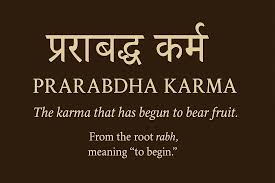
For a lower grade of seeker, the explanation is given that while all karmas* are destroyed for the jnani, prarabdha karma* remains. This prarabdha karma is the portion of karma needed to live out the current body’s life, and accounts for the good and bad things that the jnani experiences after self-realisation.
(*In Vedic traditions there are three karmas for the body: Sanchita karma (the total storehouse of past actions; sanchita means ‘heaped together’ or ‘collected together’), Prarabdha karma (the specific portion of Sanchita karma currently being experienced by this body in this life; prarabdha means ‘that which has begun’ or ‘that which has already commenced’, more commonly translated as ‘destiny’), and Agami karma (new actions being currently created now that shape your future; agami means ‘that which is coming’ or ‘that which is approaching’ or ‘future’)
The lower grade seeker is naturally satisfied with this answer and (perhaps because they are a lower grade seeker, or perhaps because they have faith in the teacher or teaching), they ask no further questions. They do not ask, how does this come about? How does some principle know to end sanchita and agami karma but continue prarabdha karma? And what is the mechanism by which this occurs? What principle governs this occurrence? Why does this prarabdha continue at all? Isn’t this dualistic, that some karmas are destroyed whilst others are not? And so on. The lower grade seeker simply accepts the teachings, as it gives their mind an explanation which makes sense to them, and the simple mind is often satisfied by mere explanations.
However, to earnest seekers who truly thirst for liberation, the great sages such as Sri Ramana Maharshi and Sri Shankara have said that this is just an explanation for the ignorant who consider the Jnani to be a body-mind entity, and that in truth, there is also no Prarabdha for the Jnani, for the Jnani has no body and sees no body.
We will look at some quotes from both Sri Ramana Maharshi and Sri Shankara that explain this, and also some commentary from Swami Chinmayananda that states the same, as well as teachings from Sri Nisargadatta Maharaj on this topic too.
We will see that the teaching there is no prarabdha karma for the Jnani and that there is no world for the jnani is in fact the traditional teaching of Advaita Vedanta that has been taught for centuries as per Shankara’s writings, and as per the writings of various others down the ages, and that it is only relatively recently, perhaps in the last 40-50 years or so, that a newer intellectualised form of Vedanta (that claims to be Traditional Advaita) has become more popular – Neo-Advaita it could be called.
First let us look at the answer to a question I was given here, which summarises the higher teaching, making it clear without additional complexity: https://tomdas.com/2022/01/15/does-prarabdha-karma-persist-after-realisation-liberation/
Questioner: I have a question, if Ajnanam (ignorance) is removed* that means the whole source of Samsara is removed. In such a case why should the Jnani (realised sage) even have Prarabdha Karma*. That also should not be present right?
Tom: In Truth, there is not even any such thing as a Jnani (meaning a person or body-mind that is ‘realised’) – there is only That Objectless Subject-Self-Brahman. So there is no karma whatsoever for ‘a Jnani’ (a Jnani here meaning the Self). The self has no duality, and no karma. Karma is born of ignorance and is maya, unreal. They are one and the same – karma and ignorance – or one comes from the other. This is also what is taught in the Upanishads (eg. Adhyatma Upanishad) and by Shankara, both in his commentaries and in texts such as Vivekachudamani.
*Removal of ignorance is the same as Self-Realisation, so say the Upanishads, so says Shankara.
**Prarabdha Karma is the portion of karma that, according to the Vedas, gives rise to the body in the present birth and will play out and determine the specifics of the present life. A simple translation could be ‘destiny’ or ‘what is destined for this life’. The idea of this question is that, for example, if you have ‘been bad’ in the past and have accumulated negative karma as a result, even though you have realised the Self, this negative karma may continue and cause suffering for you even after Self-Realisation. The Upanishads are clear that all karmas and all suffering end upon Self-Realisation, so one need not even fear the negative results of one’s past actions if one realises the Self.
We can see that even the notion of a body-mind entity, such as a ‘great sage’, is itself a fiction, for there is only the bodiless self, in which no body, mind or world ever appeared or ever could appear. All appearances are only due to ignorance, also known as ego or mind. In self-realisation, ignorance was seen to never have actually ever occurred, and the subsequent projection of the body mind and world was similarly never seen to have occurred. This is the doctrine of ajata vada, or the doctrine of no-creation, meaning nothing ever happened, or appeared to happen.
For the mind, this teaching makes no sense, for there is no worldly analogy that can explain non-duality or the Self, but this is what the higher teachings in the scriptures try to convey.
Sri Ramana Maharshi
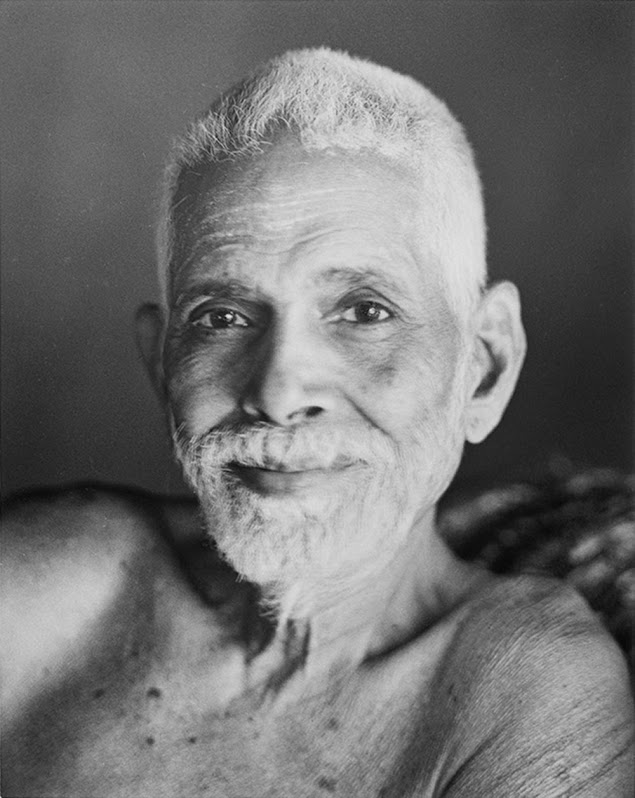
Sri Ramana himself writes, in the supplement to 40 verses on reality the following:
The statement that the jnani retains prarabdha while free from sanchita and agami is only a formal answer to the questions of the ignorant. Of several wives none escapes widowhood when the husband dies; even so, when the doer goes, all three karmas vanish.
~ Supplement to the 40 verses on reality, written by Sri Ramana Maharshi
We can clearly see that Sri Ramana is stating that all three karmas go for the jnani, and that the idea that prarabdha continues is a ‘formal answer to questions of the ignorant’, meaning it is a lower teaching for the masses who are either not genuinely seeking liberation, or in whom an intense conscious desire for liberation has not yet arisen.
But doesn’t the jnani see the world, but see it as illusion?
However some argue that the jnani still perceives the body, mind and world, but the prarabdha karma does not affect them, and this is what is meant by ‘there is no prarabdha for the sage’. Or they say that the body mind and world, together with its prarabdha, continue, but the Jnani sees them as being illusory. Sri Ramana writes the following to discount this view. Later we will also see that Sri Shankara makes the same point:
The Self-Realised Sage knows not whether the transient body comes and stays, or dies and leaves, even as a senseless drunkard knows not what happens to his clothes.
~ Guru Vachaka Kovai, Sri Bhagavan 24 (a verse written by Sri Ramana Maharshi)
We can see here that Sri Ramana is refuting the idea that the jnani even knows what is happening to the body.
Are we not just confusing levels here?
Some further argue that whilst on the absolute level (paramarthika or the level of the highest truth) the body mind and world do not exist, but relatively speaking (vyavaharika, or on the transactional relative level) they, together with prarabdha karma, continue.
This would mean there are 2 levels of the self and that the Self is non-dualistic. Sri Ramana clears up all of these in his teachings however, stating that for the jnani, there is only the one level – the truth ie. paramarthika – vyvaharika only being apparently existent for the ajnani.
The following verses are from Sri Ramana’s teachings in the text Guru Vachaka Kovai:
21. There is no mind, nor body, nor world, nor any one called a soul; the One pure Reality alone exists, without a second, unborn and unchanging, abiding in utter Peace.
313. As one that is profoundly alseep in a carriage in unaware of the varying states of the carriage – (its running, stoppages and unyoking of horses [Tom: – ie. the 3 states of waking, dream and deep sleep]) – so the one in the Transcendental State is unaware of the varying states of the body.
We see the same teachings of Sri Ramana recorded in the text Paravidyopanishad:
39. Unless and until the mind becomes utterly extinct, these three states will continue to prevail. When the mind becomes extinguished the supreme state is won, wherein this world once and for all ceases to appear.
The state of liberation is often called ‘sahaja samadhi’. Sahaja means natural or easy, so this refers to the effortless state of self-realisation. In Talks with Sri Ramana Maharshi, talk 82, Sri Ramana is recorded as saying the following:
Just as a passenger when asleep in a carriage is unaware of the motion, the halting or the unharnessing of the horses, so also a Jnani in sahaja samadhi is unaware of the happenings, waking, dream and deep sleep.
…In sahaja samadhi the activities, vital and mental, and the three states are destroyed, never to reappear. However, others notice the Jnani active e.g., eating, talking, moving etc. He is not himself aware of these activities, whereas others are aware of his activities. They pertain to his body and not to his Real Self, swarupa. For himself, he is like the sleeping passenger – or like a child interrupted from sound sleep and fed, being unaware of it
Sri Ramana himself also writes in ‘Who Am I?’:
Just as the knowledge of the rope, which is the base, will not be obtained unless the knowledge of the snake, the superimposition, goes, so the realization of Self, which is the base, will not be obtained unless the perception of the world which is a superimposition, ceases.
And also from Sri Ramana’s ‘Who Am I?’:
Therefore, when the world appears, Self will not appear; and when Self appears, the world will not appear
There are dozens more quotes like this from the writings and teachings of Sri Ramana Maharshi, and I have collected some more together here: https://tomdas.com/2023/01/07/does-the-sage-jnani-see-the-world-does-the-world-exist-after-liberation-lakshmana-sarma-explains-verse-18-of-ramana-maharshis-ulladu-narpadu/
What about ‘Sahaja Samadhi’?
But doesn’t Sri Ramana Maharshi say that the jnani is in the state of Sahaja Samadhi, the natural state of liberation in which the sage is naturally and effortlessly unattached to the phenomenal world of objects (‘sahaja’ means ‘natural’ or ‘easy’)? Yes, he does, but this too is a lower teaching. See what he says in his higher teachings:
‘So also a Jnani in sahaja samadhi is unaware of the happenings, waking, dream and deep sleep…In sahaja samadhi the activities, vital and mental, and the three states are destroyed, never to reappear.
However, others notice the Jnani active e.g., eating, talking, moving etc. He is not himself aware of these activities, whereas others are aware of his activities. They pertain to his body and not to his Real Self, swarupa. For himself, he is like the sleeping passenger – or like a child interrupted from sound sleep and fed, being unaware of it. The child says the next day that he did not take milk at all and that he went to sleep without it. Even when reminded he cannot be convinced. So also in sahaja samadhi.’
~ Talks with Sri Ramana Maharshi, Talk 82
Nirvikalpa Samadhi
What is called Sahaja Samadhi, the natural state of the jnani, is also called Sahaja Nirvikalpa Samadhi or just Nirvikalpa Samadhi. These are synonyms for self-knowledge or self-realisation or liberation. Sri Ramana Maharshi wrote in his translation of the classical advaita text Drig Drishya Viveka:
‘being completely absorbed in the Bliss experienced by the realization of the Self is nirvikalpa samadhi‘
Sri Ramana Maharshi wrote a summary of Shankara’s teachings in an essay he wrote which you can find here, in which he wrote the following:
…the natural and changeless state of Nirvikalpa samadhi is produced by unswerving vigilant concentration on the Self, ceaseless like the unbroken flow of oil. This readily and spontaneously yields that direct, immediate, unobstructed, and Universal perception of Brahman, which is at once knowledge and experience and which transcends time and space. This perception is Self-realisation. Achieving It cuts the knot of the Heart. The false delusions of ignorance, the vicious and age-long tendencies of the mind which constitute this knot are destroyed. All doubts are dispelled and the bondage of karma is severed.
But don’t we see the Jnani/Sage eating, drinking, talking, walking, etc…?
Yes, the ignorant will see the sage as a body-mind entity (whereas the Sage is really just the objectless worldless Self, Pure consciousness), and this ‘sage’ or ‘jnani’ will continue to act in the world as before, participate in the world and ‘see’ the world, but this is the exerience of the ignorant, not the direct experience of the realised Jnani (who is not truly a body-mind entity at all, being just Pure Objectless Consciousness or Spirit, also known as Nirguna Brahman).
See here and here for more on this teaching. Also see the section from Nisargadatta Maharaj below as he explains this too.
Sri Shankara
Now let us see what Sri Shankara says about this – of course we will see that he says exactly the same. Let us first see what he says about prarabdha karma and the jnani. The following verses are taken from his text Aparokshanubhuti, which means ‘unmediated (or direct) experience’. This is an extremely popular and influential traditional Advaita Vedanta text, written by Sri Shankara, that has been used as a manual for teaching Vedanta for over 1400 years, and is a well established part of the Advaita Vedanta tradition:
90. Even when self-knowledge has arisen, prarabdha karma does not cease – so it is said in the scriptures – this [claim] is now being refuted
Shankara first acknowledges this teaching that prarabdha karma continues for the jnani is given in the scriptures. He will now, in the next few verses, refute this teaching, the implication being that it is a lower teaching for the ignorant one, something that is explicitly stated later on in verse 97.
91. Upon the arising of true self-knowledge, prarabdha karma does not exist at all, because the body and all associated things [ie. all other phenomena] do not exist, just as a dream upon waking [no longer appears or exists]
We can see that Shankara is explaining that as the body and all associated things do not exist in genuine self-realisation, how can prarabdha karma exist? Prarabdha needs a body, and if there is no body or any other phenomena, how can there be prarabdha? He then gives the similie of a dream disappearing upon waking, which means that just as a dream ends upon waking, the body-mind-world end upon waking up to Self-Realisation.
In verses 92 and 93 Shankara gives further reasons or arguments why there is no prarabdha karma for the jnani:
92. Karma performed in a previous birth is called prarabdha, but since there is no other birth for the [self-realised] person, that prarabdha does not exist at any time.
Shankara’s argument here is that prarabdha karma comes from previous births. However, for a self-realised person, there have never been any births, ie. ajata (which means no birth or no creation), so how can there be prarabdha karma at any time for a jnani? In fact, there is no time or space for the jnani at all, so how can there be any karma for karma depends on space and time?
93. Just as the dream-body is a superimposition [false projection or illusion], so indeed is this body [physical body in the waking state] too. For something that is superimposed [ie. Illusory or unreal], how can there be birth? And in the absence of birth, how can that [prarabdha karma] exist?
Shankara is here stating in verse 93 of Aparokshanubhuti that the body in the waking state is an illusory projection or superimposition (adhyasa). This implication is that the body is ultimately unreal, having never really been born, and so there can be no prarabdha karma for the unreal.
Now we should be careful here as others interpret this verse slightly differently. They say that this verse merely states that the body continues to appear like a dream for the jnani, but the jnani knows the body, which continues to appear, to be an unreal superimposition on the self. They go on to say that ‘no prarabdha karma’ simply means that the jnani is unaffected by the prarabdha karma which continues to appear but just doesn’t touch the jnani or self. This is clearly a wrong interpretation, for it discounts the previous verse which states the world disappear for the jnani ‘like a dream upon waking’, and the next few verses make it very clear what Shankara’s intended meaning is.
As always, it is important not to cherry pick selected verses but to read the verses in context to understand their true meaning. Let us see the next few verses that make the teaching and intended meaning very clear:
94. Vedanta declares ignorance to be the material cause of the phenomenal world, just as clay is [the material cause] of a pot. When that ignorance is destroyed, where can the world be?
Shankara here is definitively and clearly stating, in classical rhetorical language, that (1) ignorance is the material cause of the world and (2) therefore when ignorance goes, so does the world. In the next two verses Shankara will emphasise this very point so that the meaning cannot be misunderstood:
95. Just as one, by ignoring the rope, one sees a snake due to delusion [ignorance], so too, not knowing the truth, the deluded [ignorant] one perceives the world.
Here we have another definitive statement from Shankara that the world is seen due to delusion, which is a synonym for ignorance. Note that the rope is equated with the worldless self, and the rope is equated with the world, projected and perceived through ignorance.
Doesn’t the jnani still perceive the world, but they perceive the world as self?
Some say that this means that the ignorant one perceives the world as world, whereas the jnani perceives the world as self. However it should be clear that this is not the intended meaning of these verses. If it were, Shankara would clearly say so, but instead he makes it clear that the metaphor to be used here is that of the rope and the snake, and that just as the snake disappears on apprehension of the rope, the world disappears (or, more accurately, the world was seen to have never appeared in the first place); see here in the next verse, verse 96:
96. When the rope is correctly known as the rope, the delusion of the snake does not remain; likewise, when the substratum [ie. self] is known, the phenomenal world vanishes into nothingness
Here we have Shankara stating what he has already stated rhetorically in verse 94.
Now Shankara will explain that the teaching that prarabdha karma continues for the Jnani is merely a lower teaching for the ignorant mind to more easily understand the jnani:
97. Since the body itself belongs to the phenomenal world [which disappears upon self-knowledge], how can prarabdha persist [with self-realisation]? Sruti [the revealed scriptures, ie. Vedas and Upanishads] talks about prarabdha only for the purpose of easy understanding of the ignorant.
Shankara repeatedly states that the relative world only appears due to ignorance
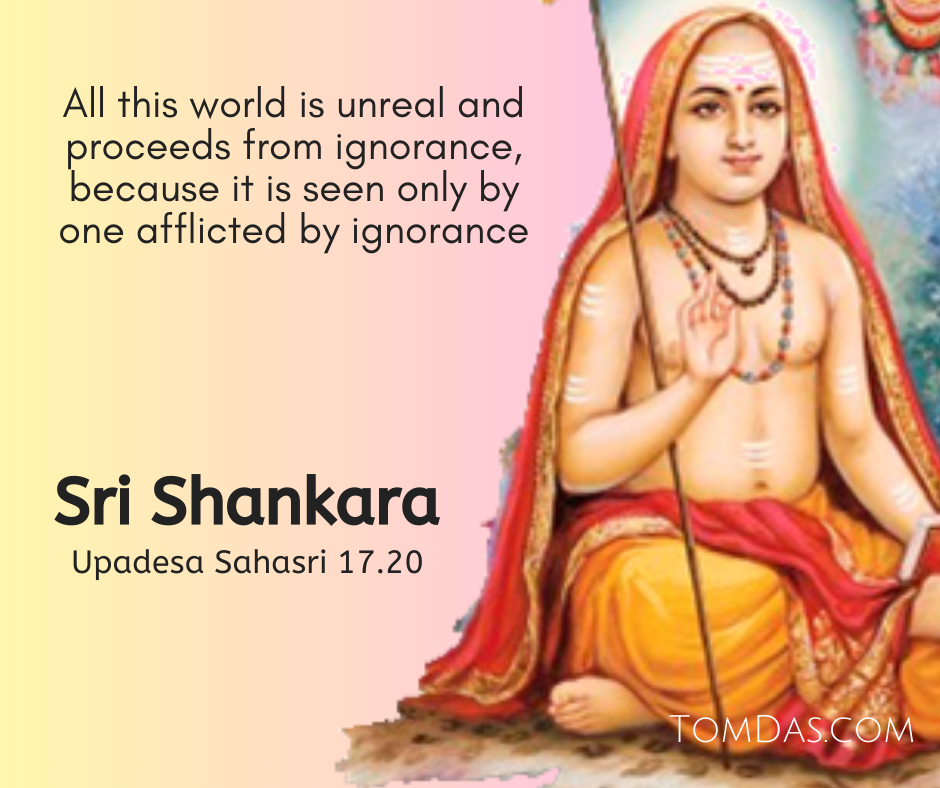
All this world is unreal and proceeds from ignorance, because it is seen only by one afflicted by ignorance
~Sri Shankara, Upadesa Sahasri 17.20
Having thus effaced the triad consisting of dreamless sleep, dream and waking experience, one crosses over the great sea of ignorance. For he is then established in his own Self, void of all attributes of the empirical world, pure, enlightened, and by his very nature liberated.
~Sri Shankara, Upadesa Sahasri 17.58
Because I am without an eye, I have no sight*. As I have no ear either, how could I have hearing*? As I have no voice I can have no speech. As I have no mind, how could I have thought? There cannot be action on the part of that which does not have life force (prana). There cannot be knowership on the part of that which has no mind. Neither can there be knowledge or ignorance on the part of me who am the Light of Pure Consciousness
~Sri Shankara, Upadesa Sahasri 13.1, 13.2
*(Shankara is quoting from Brihadaranyaka Upanishad 3.8.8)
Just as a dream is [apparently] real and valid until one awakens from it, so are the experiences of the waking state, such as identity with the body and the authoritativeness of perception and the other means of knowledge, real and valid until knowledge of the Self
~Sri Shankara, Upadesa Sahasri 11.5
Of me who am ever-liberated, pure, rock-firm and changeless, not subject to modification, immortal, indestructible and so without a body, there is no hunger or thirst or grief or delusion or old age or death. For I am bodiless…
~Sri Shankara, Upadesa Sahasri 13.3-13.4
Shankara’s Vivekachudamani
We also see this same teaching in Shankara’s Vivekachudamani, another extremely important text in Traditional Advaita Vedanta. It is arguably the single most important text historically and traditionally speaking in terms of its influence on Advaita Vedanta tradition for the last 1400 years, and it has been used as a manual of Advaita by countless sages who have also commended its teachings. Sri Ramana translated the entire work (click on link to view the translation) and also wrote an introduction to it which summarises the Advaita Vedanta teachings of Shankara, which you can view here:
460. Prarabdha work can be maintained only so long as one lives identified with the body. But no one admits that the man of realisation ever identifies himself with the body. Hence Prarabdha work should be rejected in his case.
And again, Shankara in his text Vivekachudamani maintains that the notion that the notion of prarabda karma is only taught in the scriptures to ‘convince fools’ who, erroneously thinking the Jnani to be a body-mind entity, ask questions like ‘how does the body of the jnani live?’:
462-3. “If the effects of ignorance are destroyed with their root by knowledge, then how does the body live?” – it is to convince those fools who entertain a doubt like this, that the Shrutis, from a relative standpoint, hypothesise Prarabdha karma, but not for proving the reality of the body etc., of the man of realisation.
ie. Shankara is stating the notion of prarabdha karma is only to satisfy the minds of ‘fools’ and not to show that the jnani actually has a body or sees a world.
This verse is actually very telling, as Shankara’s first point is that ‘the effects of ignorance are destroyed with their root by knowledge’. The effects of ignorance refer to all arising phenomena, including the body and mind and world, also known as duality. The next logical question for a ‘fool’ is ‘how therefore does the body live if there is no perception of a body or a world?’. It is a question for a ‘fool’ as one with a sharper intellect will realise that the teaching is saying that the body and mind are mere projections of ignorance and were never real or existent in the first instance, so this is not something that needs to be worried about or explained.
The ‘fool’, however, attached to the notion that bodies and minds and the world are all real and existent, not realising the import of the teaching, asks the question ‘how does the body live?’.
Now, if Shankara meant by’ the effects of ignorance are destroyed’ that the perception of the world continues for the jnani but the jnani is no longer attached to these perceptions, then the question ‘how does the body live’ does not arise, for the body would just carry on living according to its prarabdha.
So here in this verse, if we analyse it properly, we can see, yet again, what Shankara’s intended teaching is and what it is not.
No duality in non-duality
After these above verses, the text Vivekachudamani by Sri Shankara then goes on to say that there is only the non-dual Brahman, in which there is no duality whatsoever. Repetition is used to drum this point home, ensuring the reader understands there is no change, no activity (karma), it is homogenous (with no variation), it has no parts or aspects to it, etc, etc:
464. There is only Brahman, the One without a second, infinite, without beginning or end, transcendent and changeless; there is no duality whatsoever in It.
465. There is only Brahman, the One without a second, the Essence of Existence, Knowledge and Eternal Bliss, and devoid of activity; there is no duality whatsoever in It.
466. There is only Brahman, the One without a second, which is within all, homogeneous, infinite, endless, and all-pervading; there is no duality whatsoever in It.
467. There is only Brahman, the One without a second, which is neither to be shunned nor taken up nor accepted, and which is without any support, there is no duality whatsoever in It.
468. There is only Brahman, the One without a second, beyond attributes, without parts, subtle, absolute and taintless; there is no duality whatsoever in It.
469. There is only Brahman, the One without a second, whose real nature is incomprehensible, and which is beyond the range of mind and speech; there is no duality whatsoever in It.
470. There is only Brahman, the One without a second, the Reality, the One without a second, the Reality, effulgent, self-existent, pure, intelligent, and unlike anything finite; there is no duality whatsoever in It.
The ego-mind projects the entire world
In Vivekachudamani, Shankara explains that the entire phenomenal world is a projection of the ego-mind or ignorance:
169. There is no Ignorance (Avidya) outside the mind. The mind alone is Avidya (ignorance), the cause of the bondage of transmigration. When that is destroyed, all else is destroyed, and when it is manifested, everything else is manifested.
170. In dreams, when there is no actual contact with the external world, the mind alone creates the whole universe consisting of the experiencer etc. Similarly in the waking state also; there is no difference. Therefore all this (phenomenal universe) is the projection of the mind.
180. Hence sages who have fathomed its secret have designated the mind as Avidya or ignorance, by which alone the universe is moved to and fro, like masses of clouds by the wind.
Some modern readers may think that Shankara is merely speaking of the conceptual world, our ideas or the labelling of concepts and objects, but if you read his writings it becomes clear Shankara is actually stating the the mind literally creates the world. It would take too long to go into this here, but instead you can see this this article here where this is explained in depth – more quotes are given and you will also see teachings from Sri Gaudapada and Sri Suresvara (Shankara’s student) and otheres on this same topic
Swami Chinmayananda
In his commentary on the verse 97 of Shankara’s Aparokshanubhuti, Swami Chinmayananada writes the following:
The BMI, PFT and the OET* together constitute the prapanca [Tom: prapanca, this is the world often used in the scriptures to denote ‘the world’], the ever changing perishable phenomenal world. So where the Reality of the Atman is apprehended, how can the body which is a part of the phenomenal world come to exist? I the dusk you mistook the rope to be the snake and the post for the ghost. When you switch on the torch and then realise the post will you still say that you are seeing the smile of the welcoming ghost in the post, even though you accept that the ghost has disappeared? With the disappearance of the ghost, everything connected with the ghost totally completely comes to an end.
Similarly, as long as I was identifying myself with my body, mind and intellect I recognised my prarabdha and submitted to it. When I realise the Truth, ignorance gets ended and with it the BMI [body-mind-intellect] cease to exist and so how can there be any prarabdha? If this be the case why did the sastra say that prarabdha exists even for a Realised Soul? It is only for the popular understanding of the ignorant who have not got the scientific understanding of Vedanta, at the earlier stage of understanding, that the sastras introduce this in this way. But when the understanding that Truth alone remains, dawns, he will himself come to understand that there can be no prarabdha, for prarabdha is only at the plane of plurality in a concept of time. When a student does not know what a chair is, the teacher draws the picture of a chair and then explains its use and nature. It is only in the initial stages that he draws the picture of the chair and then explains its use to the understanding of the lesser intellects. Later when he refers to the chair he need not draw the picture. So too to the lesser intellects when the sastras explain the nature of realisation with reference to the actions they say there is prarabdha for the Man of Realisation. But, when once the student evolves and gains subtlety of understanding, the teacher points out the Truth in which there is admixture of no otherness.
*Swami Chinmayananda often used these abbreviations: BMI = body-mind-intellect, ie. what I call the body-mind; PFT = perceiver, feeler, thinger, ie. what I call the mind or ego, or what the scriptures call the ego or subtle body; OET = objects, emotions and thoughts, ie. what broadly corresponds to the notion of the world of gross and subtle objects.
I won’t repeat here, but is clear that Swami Chinmayananda is interpreting the text in the same way as I have elucidated above, which in turn is in line with Shankara’s own writings and that of Sri Ramana’s quoted above too.
The next 2 verses of Aparokshanubhuti, verses 98 and 99, continue along the same lines, again arguing against the existence of prarabdha karma for the jnani.
We see the same teaching in Swami Chinmayananda’s commentary on Shankara’s masterpiece Vivekachudamani. Swami Chinmayananda writes in his commentary on Vivekachanudamani verse 462, writing of the Jnani:
‘… For he, in his absolute state of realisation, does not perceive or recognise the existence of the physical body…Summing up his arguments, Shankara, with biting ridicule asks, “How can there be prarabdha for the unreal, which naturally is unborn and, consequently, non-existing?”‘
Notice how Swami Chinmayananda in his above commentary equates ‘unreal’ with ‘non-existing’ and also equates these with ‘non-perception’ and being ‘unborn’. Of course, these terms are synonymous in Vedanta teachings, but later more modern commentators try to twist the words of the scriptures by stating such things as ‘In Vedanta, real means temporary and unreal means permanent’ or other false notions such as ‘Mithya doesn’t mean unreal, it means dependent reality‘. Of course, no such teaching is ever given in Vedanta scriptures or teachings, these being distortions for the mind in order for the mind to make sense of a teaching – more on this in this video and this link here: https://tomdas.com/2024/09/30/the-meaning-of-real-in-advaita-vedanta/
And in his commentary on verse 463 of Shankara’s Vivekachudamani, which we have discussed above already – first here is Swami Chinmayananda’s translation of the verse:
463. If the effects of ignorance are destroyed, root and all, by knowledge, how does the body continue to live? Sruti, from a relative standpoint hypothesises the work of prarabdha for those fools who entertain such doubts
Now let us see the commentary on this verse 463 from Swami Chinmayananda:
In this verse the Acharya tries to explain why even the Upanishads discuss this great concept of prarabdha working upon all bodies including that of the man of Perfection. This is done only from a relative stand-point, to quieten the foolish doubt of an ignorant student.The student sees the body of the Master continuously functioning in the world and naturally, therefore, he feels that the Master continues living because of his prarabdha. Little does he understand that from the lofty panoramic vision of the Master, there is no body, that he is but the pure Self…thus the Upanishads compromise and condescend to accept the concept of prarabdha for the man of realisation only to help the dull ones who are still living in the realms of plurality.
Sri Nisaragadatta Maharaj
Here are some quotes from Sri Nisargadatta Maharaj on Ajata Vada teachings taken from this post here (see this post for even more quotes like this)
The body and mind are only symptoms of ignorance, of misapprehension.
——-
He who knows the state in which there is neither the world nor the thought of it, he is the Supreme Teacher.
——-
What do you know of me, when even my talk with you is in your world only?
——-
NM: The body appears in your mind; in my mind nothing is.
Q: Do you mean to say you are quite unconscious of having a body?
NM: On the contrary, I am conscious of not having a body.
Q: I see you smoking!
NM: Exactly so. You see me smoking. Find out for yourself how did you come to see me smoking, and you will easily realize that it is your ‘I am the body’ state of mind that is responsible for this ‘I see you smoking’ idea.
——-
Nothing dies. The body is just imagined. There is no such thing.
——-
In my world nothing happens
——-
NM: My world is real, while yours is made of dreams
Q: Yet we are talking.
NM: The talk is in your world. In mine – there is eternal silence. My silence sings, my emptiness is full, I lack nothing. You cannot know my world until you are there.
——-
In reality, nothing ever happens.
——-
No doubt imagination is richly creative. Universe within universe are built on it. Yet they are all in space and time, past and future, which just do not exist.
——-
In pure consciousness nothing ever happens
——-
Do understand that what you think to be the world is your own mind
——-
I take my stand where no difference exists, where things are not, nor the minds that create them. There I am at home.
——-
All thinking is in duality. In identity [Tom: ie. self realisation] no thought surives
——-
Now go within, into a state in which you may compare to a state of waking sleep, in which you are aware of yourself, but not of the world. In that state you will know, without the least trace of doubt, that at the root of your being you are free and happy.
——-
To know yourself, turn your attention away from the world and turn it within.
——-
Tom:
There are many other quotes I could give, but hopefully the above gives a flavor of the higher teachings of some of the great sages of the past
As always, all comments are welcome
Namaste
Also see the following posts:
Non-duality, Self-Realisation and the appearance of the world | Sri Sadhu Om
Ramana Maharshi – the 3 levels of the teaching
Sri Ramana Maharshi: Does the world appearance exist after liberation?
The entire path explained: the Path of Sri Ramana (Parts 1 and 2; PDF downloads)
Shankara: how to Realise the Self (commentary on the Brihadaranyaka Upanishad)
The nature of Liberation | Manonasa by Michael Langford
How can the Jnani (sage) function with NO THOUGHTS? Sri Ramana Maharshi
The nature of Self-Realisation according to Shankara and Gaudapada | Mandukya Upanishad and Karika
 Tom Das