Who Am I? (Nan Yar?) by Sri Ramana Maharshi

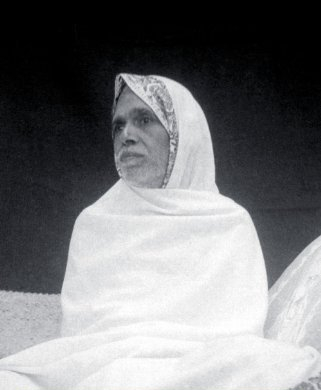
ramana umbrella

See also: Recommended Reading: Books for Enlightenment, Liberation and Self-Realisation

Many state that in this short text alone is contained all you need to attain liberation. And I would agree! Together with Upadesa Saram and Ulladu Narpadu (click on the links for downloadable PDF versions), a comprehensive set of teachings for liberation is given to us in concise form by Sri Ramana Maharshi. I also highly recommend reading The Path of Sri Ramana which explains in detail the entire path to liberation.

Ramana was not only genuinely self-realised, but he also had an in-depth knowledge of the traditional scriptures and their various methodologies. Here he has distilled their essence for us, enabling the serious seeker to find the direct path and not be side-tracked by various doctrinal intricacies and conceptual dead-ends.

How lucky are we to have these teachings given to us to keep us on the straight, narrow and true path!

There are many versions of this text titled ‘Who am I?’ (Nan Yar? in the original Tamil), all with subtle variations, but this one I have selected below is the essay version which is the only version I know of that was written by Bhagavan Sri Ramana Maharshi himself. The version I recommend you read is the essay version translated by Sri Sadhu Om which you can find as a PDF here. This is taken from the appendix of The Path of Sri Ramana Part 1 and is one of the most accurate of the available English translations. You can listen to the audiobook here:

There is also a more common Q&A version of which you can find the PDF version of Who Am I here.

The framework for this essay originated from a series of answers that a philosophy graduate Sivaprakasam Pillai wrote down in 1902 after asking Bhagavan a corresponding series of questions whilst at Virupaksha cave on Arunachala, and was first published by Sri Pillai 21 years later in 1923.

Sometime in the mid-1920s, Bhagavan removed the questions and fashioned the answers into an essay form and he also added an introductory paragraph on the nature of happiness. It is the English translation of this essay which is found below.

The resultant essay was on sale in pamphlet form at the ashram and served to provide an introduction and practical summary of instructions for self-enquiry or Bhagavan’s ‘direct path’ to liberation. Many times when people asked Bhagavan questions, he asked them to read this essay first, and only ask further questions if they still had any afterwards.

Om Namo Bhagavate Sri Ramanaya Om

Sri Ramana Maharshi 1902

Who Am I?

by

Sri Ramana Maharshi

Every living being longs always to be happy, untainted by sorrow; and everyone has the greatest love for himself, which is solely due to the fact that happiness is his real nature. Hence, in order to realize that inherent and untainted happiness, which indeed he daily experiences when the mind is subdued in deep sleep, it is essential that he should know himself. For obtaining such knowledge the inquiry ‘Who am I?’ in quest of the Self is the best means.

‘Who am I?’ I am not this physical body, nor am I the five organs of sense perception; I am not the five organs of external activity, nor am I the five vital forces, nor am I even the thinking mind. Neither am I that unconscious state of nescience which retains merely the subtle vasanas (latencies of the mind), while being free from the functional activity of the sense-organs and of the mind, and being unaware of the existence of the objects of sense-perception.

Therefore, summarily rejecting all the above-mentioned physical adjuncts and their functions, saying ‘I am not this; no, nor am I this, nor this’ — that which then remains separate and alone by itself, that pure Awareness is what I am. This Awareness is by its very nature Sat-Chit-Ananda (Existence-Consciousness-Bliss).

If the mind, which is the instrument of knowledge and is the basis of all activity, subsides, the perception of the world as an objective reality ceases. Unless the illusory perception of the serpent in the rope ceases, the rope on which the illusion is formed is not perceived as such. Similarly, unless the illusory nature of the perception of the world as a objective reality ceases, the Vision of the true nature of the Self, on which the illusion is formed, is not obtained.

The mind is a unique power (sakti) in the Atman, whereby thoughts occur to one. On scrutiny as to what remains after eliminating all thoughts, it will be found that there is no such thing as mind apart from thought. So then, thoughts themselves constitute the mind. Nor is there any such thing as the physical world apart from and independent of thought. In deep sleep there are no thoughts: nor is there the world. In the wakeful and dream state thoughts are present, and there is also the world. Just as the spider draws out the thread of the cobweb from within itself and withdraws it again into itself, in the same way the mind projects the world out of itself and absorbs it back into itself.

The world is perceived as an apparent objective reality when the mind is externalized, thereby forsaking its identity with the Self. When the world is thus perceived, the true nature of the Self is not revealed: conversely, when the Self is realized the world ceases to appear as an objective reality.

By a steady and continuous investigation into the nature of the mind, the mind is transformed into That to which ‘I’ refers; and that is in fact the Self. Mind has necessarily to depend for its existence on something gross; it never subsists by itself. It is this mind that is otherwise called the subtle body, ego, jiva, or soul.

That which arises in the physical body as ‘I’ is the mind. If one inquires whence the ‘I’-thought in the body arises in the first instance, it will be found that it is from hrdayam (literally ‘I am the Heart), or the Heart. That is the source and stay of the mind. Or again, even if one merely continuously repeats to oneself inwardly ‘I-I’ with the entire mind fixed thereon, that also leads one to the same source.

The first and foremost of all thoughts that arise in the mind is the primal ‘I’-thought. It is only after the rise or origin of the ‘I’-thought that innumerable other thoughts arise. In other words, only after the first personal pronoun, ‘I’, has arisen, do the second and third personal pronouns (‘you, he’ etc.) occur to the mind; and they cannot subsist without the former.

Since every other thought can occur only after the rise of the ‘I’-thought and since the mind is nothing but a bundle of thoughts, it is only through the inquiry ‘Who am I?’ that the mind subsides. Moreover, the integral ‘I’-thought, implicit in such enquiry, having destroyed all other thoughts, gets itself destroyed or consumed, just as the stick used for stirring the burning funeral pyre gets consumed.

Even when extraneous thoughts sprout up during such enquiry, do not seek to complete the rising thought, but instead, deeply enquire within, ‘To who has this thought occurred?’ No matter how many thoughts thus occur to you, if you would with acute vigilance enquire immediately as and when each individual thought arises to whom it has occurred, you would find it is to ‘me’. If then you enquire ‘Who am I?’ the mind gets introverted and the rising thought also subsides. In this manner as you persevere more and more in the practice of Self-enquiry, the mind acquires increasing strength and power to abide in its Source.

It is only when the subtle mind is externalized through the activity of the intellect and the sense-organs that gross name and form constituting the world appear. When, on the other hand, the mind stays firmly in the Heart, they recede and disappear. Restraint of the outgoing mind, and its absorption in the Heart, is known as introversion (antarmukha-drishti). The release of the mind, and its emergence from the Heart is known as bahirmukha-drishti (objectiveness).

If in this manner the mind becomes absorbed in the Heart, the ego or ‘I’, which is the center of the multitude of thoughts, finally vanishes and pure Consciousness or Self, which subsists during all the states of the mind, alone remains resplendent. It is this state, where there is not the slightest trace of the ‘I’-thought, that is the true Being of oneself. And that is called Quiescence or Mouna (silence).

This state of mere inherence in pure Being is known as the Vision of Wisdom. Such inherence means and implies the entire subsidence of the mind in the Self. Nothing other than this, and no psychic powers of the mind such as thought-reading, telepathy, and clairvoyance, can be Wisdom.

Atman alone exists and is real. The threefold reality of world, individual soul, and God is, like the illusory appearance of silver in the mother of pearl, an imaginary creation in the Atman. They appear and disappear simultaneously. The Self alone is the world, the ‘I’ and God. All that exists is but the manifestation of the Supreme.

For the subsidence of mind there is no other means more effective and adequate than Self-enquiry. Even though by other means the mind subsides, that is only apparently so; it will rise again.

For instance, the mind subsides by the practice of pranayama (restraint and control of breath and vital forces); yet such subsidence lasts only as long as the control of breath and vital forces continues; and when they are released, the mind also gets released and immediately, becoming externalized, it continues to wander through the force of its subtle tendencies.

The source of the mind is the same as that of breath and vital forces. It is really the multitude of thoughts that constitutes the mind; and the ‘I’-thought is the primal thought of the mind, and is itself the ego. But breath too has its origin at the same place whence the ego rises. Therefore, when the mind subsides, breath and vital forces also subside; and conversely, when the latter subside, the former also subsides.

Breath and vital forces are also described as the gross manifestation of the mind. Till the hour of death the mind sustains and supports these forces in the physical body; and when life becomes extinct the mind envelops them and carries them away. During sleep, however, the vital forces continue to function, although the mind is not manifest. This is according to the divine law and is intended to protect the body and to remove any possible doubt as to whether it is dead or alive while one is asleep. Without such arrangement by nature, sleeping bodies would often be cremated alive. The vitality apparent in breathing is left behind by the mind as a ‘watchman’. But in the wakeful state and in samadhi, when the mind subsides, breath also subsides. For this reason (because the mind has the sustaining and controlling power over breath and vital forces and is therefore ulterior to both of them), the practice of breath control is merely helpful in subduing the mind, but cannot bring about its final extinction.

Like breath control, meditation on form, incantations, invocations, and regulation of diet are only aids to control of the mind. Through the practice of meditation or invocation the mind becomes one-pointed. Just as the elephant’s truck, which is otherwise restless, will become steady if it is made to hold an iron chain, so that the elephant goes its way without reaching out for any other object, so the ever-restless mind, which is trained and accustomed to a name or form through meditation or invocation, will steadily hold on to that alone.

When the mind is split up and dissipated into countless varying thoughts, each individual thought becomes extremely weak and inefficient. When, on the contrary, such thoughts subside more and more till they finally get destroyed, the mind becomes one-pointed and, thereby acquiring strength and power of endurance, easily reaches perfection in the method of enquiry in quest of the Self.

Regulation of diet, restricting it to satvic food taken in moderate quantity, is of all the rules of conduct the best; and it is most conducive to the development of the satvic qualities of the mind. These, in their turn, assist one in the practice of Atma vichara or enquiry in quest of the Self.

Countless vishaya-vasanas (subtle tendencies of the mind in relation to objects of sense gratification), coming one after the other in quick succession like the waves of the ocean, agitate the mind. Nevertheless, they too subside and finally get destroyed with progressive practice of Atma dhyana or meditation on the Self. Without giving room even to the thought which occurs in the form of doubt, whether it is possible to stay merely as the very Self, whether all the vasanas can be destroyed, one should firmly and unceasingly carry on meditation on the Self.

However sinful a person may be, if he would stop wailing inconsolably: ‘Alas! I am a sinner, how shall I attain Liberation?’ and, casting away even the thought that he is a sinner, if he would zealously carry on meditation on the Self, he would most assuredly get reformed.

So long as subtle tendencies continue to inhere in the mind, it is necessary to carry on the enquiry: ‘Who am I?’. As and when thoughts occur, they should one and all be annihilated then and there, at the very place of their origin, by the method of enquiry in quest of the Self.

Not to desire anything extraneous to oneself constitutes vairagya (dispassion) or nirasa (desirelessness). Not to give up one’s hold on the Self constitutes jnana (knowledge). But really vairagya and jnana are one and the same. Just as the pearl diver, tying stones to his waist, dives down into the depths and gets the pearl from the sea bed, so every aspirant pledged to vairagya can dive deep into himself and realize the precious Atman. If the earnest seeker would only cultivate the constant and deep contemplative ‘remembrance’ (smrti) of the true nature of the Self till he has realized it, that alone would suffice. Distracting thoughts are like the enemy in the fortress. As long as they are in possession of it, they will certainly sally forth. But if, as and when they come out, you put them to the sword the fortress will finally be captured.

God and the Guru are not really different: they are identical. He that has earned the Grace of the Guru shall undoubtedly be saved and never forsaken, just as the prey that has fallen into the tiger’s jaws will never be allowed to escape. But the disciple, for his part, should unswervingly follow the path shown by the Master.

Firm and disciplined inherence in the Atman, without giving the least scope for the rise of any thought other than the deep contemplative thought of the Self, constitutes self-surrender to the Supreme Lord. Let any amount of burden be laid on Him, He will bear it all. It is, in fact, the indefinable power of the Lord that ordains, sustains, and controls everything that happens. Why then should we worry, tormented by vexatious thoughts, saying: ‘Shall we act this way? No, that way,’ instead of meekly but happily submitting to that Power? Knowing that the train carries all the weight, why indeed should we, the passengers travelling in it, carry our small individual articles of luggage on our laps to our great discomfort, instead of putting them aside and sitting at perfect ease?

That which is Bliss is also the Self. Bliss and the Self are not distinct and separate but are one and the same. And That alone is real. In no single one of the countless objects of the mundane world is there anything that can be called happiness. It is through sheer ignorance and unwisdom that we fancy that happiness is obtained from them. On the contrary, when the mind is externalized, it suffers pain and anguish. The truth is that every time our desires get fulfilled, the mind, turning to its source, experiences only that happiness which is natural to the Self. Similarly in deep sleep, in spiritual trance (samadhi), when fainting, when a desired object is obtained, or when evil befalls an object considered undesirable, the mind turns inwards and enjoys that Bliss of Atman. Thus wandering astray, forsaking the Self, and returning to it again and again is the interminable and wearisome lot of the mind.

It is pleasant under the shade of a tree, and scorching in the heat of the sun outside. A person toiling in the sun seeks the cool shade of the tree and is happy under it. After staying there for a while, he moves out again but, unable to bear the merciless heat of the sun, he again seeks the shade. In this way he keeps on moving from shade to sun and sun to shade.

It is an unwise person who acts thus, whereas the wise man never leaves the shade: in the same way the mind of the Enlightened Sage (Jnani) never exists apart from Brahman, the Absolute. The mind of the ignorant, on the other hand, entering into the phenomenal world, suffers pain and anguish; and then, turning for a short while towards Brahman, it experiences happiness. Such is the mind of the ignorant.

This phenomenal world, however, is nothing but thought. When the world recedes from one’s view — that is when one is free from thought — the mind enjoys the Bliss of the Self. Conversely, when the world appears — that is when thought occurs — the mind experiences pain and anguish.

Not from any desire, resolve, or effort on the part of the rising sun, but merely due to the presence of his rays, the lens emits heat, the lotus blossoms, water evaporates, and people attend to their various duties in life. In the proximity of the magnet the needle moves. Similarly the soul or jiva, subjected to the threefold activity of creation, preservation, and destruction which take place merely due to the unique Presence of the Lord, performs acts in accordance with its karma (fruits of past actions, in the present life), and subsides to rest after such activity. But the Lord Himself has no resolve; no act or event touches even the fringe of His Being. This state of immaculate aloofness can be likened to that of the sun, which is untouched by the activities of life, or to that of the all-pervasive ether, which is not affected by the interaction of the complex qualities of the other four elements.

All scriptures without any exception proclaim that for attaining Salvation the mind should be subdued; and once one knows that control of the mind is their final aim it is futile to make an interminable study of them. What is required for such control is actual enquiry into oneself by self-interrogation: ‘Who am I?’ How can this enquiry in quest of the Self be made merely by means of a study of the scriptures?

One should realize the Self by the Eye of Wisdom. Does Rama need a mirror to recognize himself as Rama? That to which the ‘I’ refers is within the five sheaths (physical, vital, mental, knowledge-experience, and bliss), whereas the scriptures are outside them. Therefore, it is futile to seek by means of the study of scriptures the Self that has to be realized by summarily rejecting even the five sheaths.

To enquire ‘Who am I that is in bondage?’ and to know one’s real nature is alone Liberation. To keep the mind constantly turned within, and to abide thus in the Self is alone Atma-vichara (Self enquiry), whereas dhyana (meditation) consists in fervent contemplation of the Self as Sat-Chit-Ananda (Being-Consciousness-Bliss). Indeed, at some time, one will have to forget everything that has been learnt.

Just as it is futile to examine the rubbish that has to be swept up only to be thrown away, so it is futile for him who seeks to know the Self to set to work enumerating the tattvas (classifications of the elements of existence) that envelop the Self and examining them, instead of casting them away. He should consider the phenomenal world with reference to himself as merely a dream.

Except that the wakeful state is long and the dream state is short there is no difference between the two. All the activities of the dream state appear, for the time being, just as real as the activities of the wakeful state seem to be while awake. Only, during the dream state, the mind assumes another form or a different bodily sheath. For thoughts on the one hand, and name and form on the other, occur simultaneously during both the wakeful and dream states.

There are not two minds, one good and the other evil. It is only the vasanas or tendencies of the mind that are of two kinds, good and favorable, evil and unfavorable. When the mind is associated with the former it is called good, and when associated with the latter it is called evil. However evil-minded other people may appear to you, it is not proper to hate or despise them. Likes and dislikes, love and hatred, are equally to be eschewed. It is also not proper to let the mind often rest on objects or affairs of mundane life. As far as possible one should not interfere in the affairs of others. Everything offered to others is really an offering to oneself; and if only this truth were realized, who is there that would refuse anything to others?

If the ego rises, all else will also rise; if it subsides all else will also subside. The deeper the humility with which we conduct ourselves, the better it is for us. If only the mind is kept under control, what matters it where one may happen to be?


Shankara: characteristics of a perfected sage or Jnani

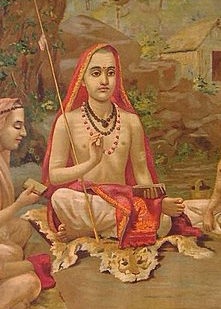
Shankara shankaracharya

Om!

Praise to Sri Shankara!

Praise to those custodians of this wonderful knowledge and teaching!

Praise to the Self,

One and supreme in all its effulgent glory!

May we all be happy and free!

May we all realise the Self!

Om!

In his text Vivekachudamani Shankara writes 18 verses describing the Jnani (literally ‘knower’ or ‘one who knows’) or perfected sage, starting at verse 535. My comments are in blue throughout.

Unattached and self-satisfied:

In these first few of these verses, the theme is a lack of attachment to the phenomenal world. Shankara uses phrases such as ‘he is neither grieved nor elated by sense objects’…’neither attached nor adverse to them [sense objects]… ‘without anxiety or humiliation’…’without fear’…’unattached to external things’…’experiences all sorts of sense objects as they come’. We can see that while the sage is (naturally) unattached, there is also no attempt to be detached either (which would actually be a form of attachment or striving).

Often detachment from sense-objects is emphasised at the level of a seeker engaging in sadhana (spiritual practice), but now there is no ignorance, there is no need to emphasise either detachment or attachment. A natural state of balance has been naturally achieved now the distorting/unbalancing effect of ignorance is no longer at play:

535. Satisfied with undiluted, constant Bliss, he is neither grieved nor elated by sense-objects, is neither attached nor averse to them, but always disports with the Self and takes pleasure therein.

536. A child plays with its toys forgetting hunger and bodily pains; exactly so does the man of realisation take pleasure in the Reality, without ideas of “I” or “mine”, and is happy.

In these above 2 verses, it is interesting to note that the flip-side of natural detachment is a natural resting in the ‘undiluted, constant Bliss’ of the Self. The Sage, completely satisfied by the self, does not notice or mind the suffering of the body. The resultant natural side effect of this is lack of both attachment and aversion to sense objects. Note that this means there is no need for supression of emotions or feelings or fear of any other phenomena.

The next 2 verses comment on the free-living aspect of the Jnani. The jnani is without self-image and finds the earth to be their home. Being without self-image, they do not necessarily dress or look a certain way (‘wears no outward mark’), and they allow what comes to come, and what goes to go. This last point is the same as stating there is no attachment or aversion to sense objects, and in verse 538 it is compared to the innocence of a child:

537. Men of realisation have their food without anxiety or humiliation by begging, and their drink from the water of rivers; they live freely and independently, and sleep without fear in cremation grounds or forests; their clothing may be the quarters themselves, which need no washing and drying, or any bark etc., the earth is their bed; they roam in the avenue of the Vedanta; while their pastime is in the Supreme Brahman.

538. The knower of the Atman, who wears no outward mark and is unattached to external things, rests on this body without identification, and experiences all sorts of sense-objects as they come, through others’ wish, like a child.

You can’t tell a jnani by clothes, behaviour, sex or age:

539. Established in the ethereal plane of Absolute Knowledge, he wanders in the world, sometimes like a madman, sometimes like a child and at other times like a ghoul, having no other clothes on his person except the quarters, or sometimes wearing clothes, or perhaps skins at other times.

The sage can enjoy sense objects, but fundamentally cares not for them:

540. The sage, living alone, enjoys the sense-objects, being the very embodiment of desirelessness – always satisfied with his own Self, and himself present at the All.

The many appearances of a Jnani:

Not caring one iota for self-image, the Jnani may appear in multiple forms, but cares not about whether they are a king or a pauper, well revered or despised:

541. Sometimes a fool, sometimes a sage, sometimes possessed of regal splendour; sometimes wandering, sometimes behaving like a motionless python, sometimes wearing a benignant expression; sometimes honoured, sometimes insulted, sometimes unknown – thus lives the man of realisation, ever happy with Supreme Bliss.

542. Though without riches, yet ever content; though helpless, yet very powerful, though not enjoying the sense-objects, yet eternally satisfied; though without an exemplar, yet looking upon all with an eye of equality.

The ‘eye of equality’ naturally arises when one does not prefer one set of sense-objects (ie. experiences) over another set. This lack of preference naturally occurs when one realises the Self and is satisfied as the Self.

The next verse juxtaposes the relative (doing, experiencing, possessing a body, limited)  with the absolute (inactive, untouched, unidentified, omnipresent), indicating that we can speak of reality using either set of langauge:

543. Though doing, yet inactive; though experiencing fruits of past actions, yet untouched by them; though possessed of a body, yet without identification with it; though limited, yet omnipresent is he.

The next verse goes one step further, showing that in truth the Jnani is nothing but the absolute in which there is not even the idea of a body, despite the appearance of one appearing:

544. Neither pleasure nor pain, nor good nor evil, ever touches this knower of Brahman, who always lives without the body-idea.

545. Pleasure or pain, or good or evil, affects only him who has connections with the gross body etc., and identifies himself with these. How can good or evil, or their effects, touch the sage who has identified himself with the Reality and thereby shattered his bondage ?

Just as the sun appears to be ‘swallowed’ and destroyed when it sets, a jnani appears to have a body and act. In reality, just as the sun is not ‘swallowed’ or destroyed at sunset, the jnani is ever-bodiless, as are all of us. It is only ignorance that makes us believe otherwise:

546. The sun which appears to be, but is not actually, swallowed by Rahu, is said to be swallowed, on account of delusion, by people, not knowing the real nature of the sun.

547. Similarly, ignorant people look upon the perfect knower of Brahman, who is wholly rid of bondages of the body etc., as possessed of the body, seeing but an appearance of it.

549. As a piece of wood is borne by the current to a high or low ground, so is his body carried on by the momentum of past actions to the varied experience of their fruits, as these present themselves in due course.

This next verse employs the beautiful imagery of comparing the Self to a pivot on a potter’s wheel. Whilst the pedal on moved, the pivot remains stationary, just as the two ends of a sea-saw move, but the pivot remains still amidst the movement. Similarly, whilst this world-appearance seems to be full of motion, the Self/Jnani is eternally still, at peace and free:

550. The man of realisation, bereft of the body-idea, moves amid sense-enjoyments like a man subject to transmigration, through desires engendered by the Prarabdha work. He himself, however, lives unmoved in the body, like a witness, free from mental oscillations, like the pivot of the potter’s wheel.

Next the imagery of a passive witness or ‘unconcerned spectator’ is utilised.  This is to convey the point that the jnani is without egoic or volitional desire (‘unconcerned’, without ‘the least regard’) but is aware (‘spectator’):

551. He neither directs the sense-organs to their objects nor detaches them from these, but stays like an unconcerned spectator. And he has not the least regard for the fruits of actions, his mind being thoroughly inebriated with drinking the undiluted elixir of the Bliss of the Atman.

The Jnani cares not about meditation or any other sadhana. The Jnani has transcended ignorance, meditation and sadhana only being required as a remedy for ignorance. When ignorance is no longer present (ie. seen to never have been real), and when the egoic tendencies (vasanas) to identify as a ‘me’ or body-mind have gone, then what need is there for meditation? Just as what need is there to prepare and implement a cure when the disease has now gone?

552. He who, giving up all considerations of the fitness or otherwise of objects of meditation, lives as the Absolute Atman, is verily Shiva Himself, and he is the best among the knowers of Brahman.

The Jnani is only ever Brahman (there is only Brahman), regardless of appearances that may suggest otherwise:

553. As an actor, when he puts on the dress of his role, or when he does not, is always a man, so the perfect knower of Brahman is always Brahman and nothing else.

For the entire text of Vivekachudamani click here.

Om!

Praise to Sri Shankara!

Praise to those custodians of this wonderful knowledge and teaching!

Praise to the Self,

One and supreme in all its effulgent glory!

May we all be happy and free!

May we all realise the Self!

Om!

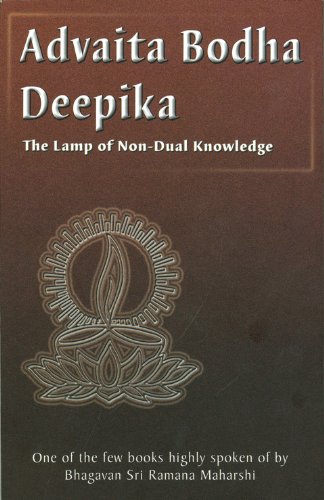
Advaita Bodha Deepika – vital teachings for Self-Realisation that are often missing in modern non-dual and Advaita Vedanta teachings

Here are some very potent nondual teachings that are well worth taking the time and making the effort to read. The teachings here tend not to be found in many other places. I have found that even many so-called teachers of Advaita Vedanta seem to teach something else, especially in the West, so it pays to read the traditional teachings for yourself and learn the true path to liberation directly from the source texts.

Advaita Bodha Deepika was one of Ramana Maharshi’s favourite scriptures and he often recommended it for seekers to read. It is one of the few traditional scriptures that comprises a structured and comprehensive explanation of the various methods of Advaita Vedanta. All chapters of this work are great, but this following chapter on ‘Sakshatkara’ or ‘Realisation’ has some key teachings that are often lost in some contemporaneous renditions of Advaita Vedanta and nondual teachings in general.

Without the  vital understanding presented in this chapter, true liberation is unlikely to result. The opposite is also true – putting the words of this chapter into practice sets one off on the direct path to liberation.

This particular teaching starts at Chapter 7. Thus far in the text, the Self or Awareness has already been pointed out and described to the student, and the student, being open to the teachings, has gained a first-hand understanding of this. The student now feels that liberation has been gained, but then the teaching continues…the teacher points out the egotism-ignorance is still at play and then explains how to remove it…

Please let us make obeisance to the Lord-our-Self, and without further ado – enjoy;

The chapter starts with a recap of what has been discussed thus far in preceding chapters, and I have added bold type for emphasis of what I felt are some key points:

Advaita Bodha Deepika

Chapter 7 – Sakshatkara or Realisation

1. In the foregoing chapter it was said that direct knowledge must first be gained and then the latent tendencies of the mind wiped out so that Brahman may be realised. Now Realisation is dealt with. The master says: Wise son, now that you have gained direct knowledge by enquiry into the Self, you should proceed with meditation.

2. DISCIPLE: Master, now that I have gained direct knowledge by enquiry and my task is finished why should I meditate further and to what end?

3-4. MASTER: Though by reflection, direct knowledge of the Self has been gained, Brahman cannot be realised without meditation. In order to experience `I am Brahman’ you must practise meditation.

5-6.: D.: You ask me to pursue meditation for realising Brahman. I have already gained direct knowledge by enquiry into the sacred text. Why should I now practise meditation?

M.: If you mean to say that enquiry into the sacred text results in realising Brahman, who can deny it? No one. Truly this enquiry must end in the realisation of Brahman. Let us now enquire into the meaning of the text. Whose identity with whom is implied in it? It must be of the consciousness witnessing the five sheaths of the individual, the implied meaning of `thou’ with Brahman, the implied meaning of `That’; it cannot be of the Jiva, i.e., the personal soul with Brahman. By enquiry the identity of the witnessing consciousness with Brahman has certainly been found. Of what use can this identity of the witness with Brahman be to you?

7. D.: On enquiry into the meaning of the sacred text, when one has realised that the witness is Brahman and vice versa, how can you raise the question `Of what use can it be to the person?’ Its use is evident. Formerly the seeker was ignorant of the identity and now by enquiry he is aware of it.

M.: By enquiry you have certainly known that the witness is Brahman and that the unbroken, all-perfect Brahman is the witness. Still this knowledge is not the end and cannot serve your purpose. Suppose a poor beggar who was ignorant of the fact that a king residing in a fort was the emperor of the world, later knew it. How does this newly acquired knowledge improve his position? It cannot serve any useful purpose for him.

  1. D.: Before enquiry, ignorance prevails. After enquiry, knowledge is gained that the witness is Brahman. Now knowledge has taken the place of ignorance. This is the use.

M.: How does this affect the fact? Whether you have known it or not, the witness ever remains Brahman. Your knowledge of the fact has not made Brahman, the witness. Whether the poor beggar knew it or not, the king in the fort was the emperor. His knowledge did not make an emperor of the king in the fort. Now that you have known the witness to be Brahman, what has happened to you? Tell me. There can be no change in you.

  1. D.: Why not? There is a difference. The sacred text teaches `That thou art’. On enquiring into its significance I have found that the witness of the five sheaths in me is the same as Brahman. From this I have known that I am Brahman, which forms another sacred text. To me who was ignorant of the witness being the same as Brahman, this knowledge has dawned, with the result that I have realised Brahman.

M.: How can you claim to have realised Brahman? If by the text `I am Brahman’ you understand yourself to be Brahman, who is this `I’ but the Jiva, the individual soul or the ego? How can the ego be Brahman? Just as even with his knowledge of the king, the beggar cannot himself be the king, so also the changeful ego can never be identical with the changeless Brahman.

10-14. D.: Certainly so. But on enquiring `Who am I?’ it becomes plain that by non-enquiry the unchanging witness had mistaken the changing ego for himself. Now he knows `I am not the changing ego but remain its unchanging conscious witness’. Now it is but right that the witness should say, `I am Brahman’. What can be discordant in this?

M.: How can you hold that the witness says `I am Brahman?’ Does the unchanging witness or the changing ego say so? If you say that it is the witness, you are wrong. For the witness remains unchanging as the witness of the `false-I’. He is not the conceit itself. Otherwise he cannot have the quality of being the witness for he will himself be changing. Being unchanging the witness is free from the least trace of any notion such as `I’ or Brahman and cannot therefore know `I am Brahman’. There is no ground for your contention that the witness says so.

D.: Then who knows `I am Brahman’?

M.: From what has been said before, it must follow that the individual soul, the jiva, or the `false-I’ must have this knowledge.

D.: How does this follow?

M.: In order to be free from the repeated cycle of births and deaths, the ignorant man is obliged to practise the knowledge `I am Brahman’. There is no ignorance for the witness. When there is no ignorance, there can be no knowledge either. Only the ignorant must seek knowledge. Who but the `false-I’ can be the subject of ignorance or of knowledge? It is self-evident that the witnessing Self being the substratum on which knowledge or ignorance appears, must itself be free from them. On the contrary the `false-I’ is known to possess knowledge or ignorance. If you ask him `Do you know the Self witnessing you?’ And he will answer `Who is that witness? I do not know him’. Here the ignorance of the `false-I’ is obvious. On hearing the vedanta that there is an inner witness to him, indirectly he knows that the Self is his witness. Then enquiring into the Self, the veil of Ignorance that It does not shine forth, is drawn off and directly he knows the witnessing Self. Here again the knowledge of the `false-I’ is also clear. It is only the jiva and not the witness who has the knowledge or ignorance that there is, or is not, the inner witness. You must now admit that the jiva has the knowledge that `I am Brahman’. Now for the reason that the changing Jiva has become aware of the unchanging witness, he cannot be the same as the witness. Because he had seen him, the poor beggar cannot be the king. So also the changing Jiva cannot be the witness. Without being the witnessing Self, the changing entity cannot be Brahman. So this experience `I am Brahman’ is impossible.

  1. D.: How can you say that merely seeing the witness, I cannot know that I am the witness? Ignorant of his true being as the substratum or the witnessing consciousness, the Jiva moves about as the `false-I’. However on a careful enquiry into his true nature he knows the witness and identifies himself as the witness who is well-known to be the unbroken, all perfect Brahman. Thus the experience, `I am Brahman’, is real.

M.: What you say is true provided that the jiva can identify himself as the witness. The witness is undoubtedly Brahman. But how can the mere sight of the witness help the jiva merge himself into the witness? Unless the jiva remains the witness, he cannot know himself as the witness. Merely by seeing the king, a poor beggar cannot know himself to be the king. But when he becomes the king, he can know himself as the king. Similarly the jiva, remaining changeful and without becoming the unchanging witness, cannot know himself as the witness. If he cannot be the witness, how can he be the unbroken, all-perfect Brahman? He cannot be. Just as at the sight of the king in a fort, a poor beggar cannot become king and much less sovereign of the universe, so also only at the sight of the witness who is much finer than ether and free from traffic with triads, such as the knower, knowledge and the known, eternal, pure, aware, free, real, supreme and blissful, the jiva cannot become the witness, much less the unbroken, all-perfect Brahman, and cannot know `I am Brahman’.

  1. D.: If so, how is it that the two words of the same case ending (samanadhikarana) — `I’ and `Brahman’ — are placed in apposition in the sacred text `I am Brahman’? According to grammatical rules the sruti clearly proclaims the same rank to the jiva and Brahman. How is this to be explained?

17-18. M.: The common agreement between two words in apposition is of two kinds: mukhya and badha i.e., unconditional and conditional. Here the sruti does not convey the unconditional meaning.

D.: What is this unconditional meaning?

M.: The ether in a jar has the same characteristics as that in another jar, or in a room, or in the open. Therefore the one ether is the same as the other. Similarly with air, fire, water, earth, sunlight etc. Again the god in one image is the same as that in another and the witnessing consciousness in one being is the same as that in another. The sruti does not mean this kind of identity between the jiva and Brahman, but means the other, the conditional meaning.

D.: What is it?

M.: Discarding all appearances, the sameness of the substratum in all.

D.: Please explain this.

M.: `I am Brahman’ means that, after discarding the `false-I’, only the residual being or the pure consciousness that is left over can be Brahman — It is absurd to say that, without discarding but retaining the individuality, the jiva, on seeing Brahman but not becoming Brahman, can know himself as Brahman. A poor beggar must first cease to be beggar and rule over a state in order to know himself as king; a man desirous of god-hood first drowns himself in the Ganges and leaving this body, becomes himself a celestial being; by his extraordinary one-pointed devotion a devotee leaves off his body and merges into god, before he can know himself to be god. In all these cases when the beggar knows himself to be king, or the man to be celestial being, or the devotee to be god, they cannot retain their former individualities and also identify themselves as the superior beings. In the same way, the seeker of Liberation must first cease to be an individual before he can rightly say `I am Brahman’. This is the significance of the sacred text. Without completely losing one’s individuality one cannot be Brahman. Therefore to realise Brahman, the loss of the individuality is a sine qua non.

D.: The changeful individual soul cannot be Brahman. Even though he rids himself of the individuality, how can he become Brahman?

  1. M.: Just as a maggot losing its nature, becomes a wasp.A maggot is brought by a wasp and kept in its hive. From time to time the wasp visits the hive and stings the maggot so that it always remains in dread of its tormentor. The constant thought of the wasp transforms the maggot into a wasp. Similarly, constantly meditating on Brahman, the seeker loses his original nature and becomes himself Brahman. This is the realisation of Brahman.
  2. D.: This cannot illustrate the point, for the jiva is changing and falsely presented on the pure Being, Brahman, which is the Reality. When a false thing has lost its falsity, the whole entity is gone; how can it become the Reality?
  3. M.: Your doubt, how a superimposed falsity turns out to be its substratum, the Reality, is easily cleared. See how the nacre-silverceases to be silver and remains as nacre, or a rope-snake ceasing to be snake remains ever as rope. Similarly, with the jiva superimposed on the Reality, Brahman.

D.: These are illusions which are not conditioned (nirupadhika bhrama) whereas the appearance of the jiva is conditioned (sopadhika bhrama) and appears as a superimposition only on the internal faculty, the mind. So long as there is the mind, there will also be the jiva or the individual, and the mind is the result of past karma. As long as this remains unexhausted, the jiva must also be present. Just as the reflection of one’s face is contingent upon the mirror or water in front, so is individuality, on the mind, the effect of one’s past karma. How can this individuality be done away with?

M.: Undoubtedly individuality lasts as long as the mind exists. Just as the reflected image disappears with the removal of the mirror in front, so also individuality can be effaced by stilling the mind by meditation.

[Tom: this ‘stilling of mind’ means the stilling or removal of all thoughts, and is also known as Nirvikalpa Samadhi]

D.: The individuality being thus lost, the jiva becomes void. Having become void, how can he become Brahman?

M.: The jiva is only a false appearance not apart from its substratum. It is conditional on ignorance, or the mind, on whose removal the jiva is left as the substratum as in the case of a dream person.

22-23. D.: How?

M.: The waking man functions as the dreamer (taijasa) in his dreams. The dreamer is neither identical with nor separate from the waking man (visva). For the man sleeping happy on his bed has not moved out whereas as the dreamer he had wandered about in other places, busy with many things. The wanderer of the dream cannot be the man resting in his bed. Can he then be different? Not so either. For on waking from sleep, he says `In my dream I went to so many places, did so many things and was happy or otherwise’. Clearly he identifies himself with the experiencer of the dream. Moreover no other experiencer can be seen.

D.: Not different from nor identical with the waking experiencer, who is this dream-experiencer?

M.: Being a creation of the illusory power of sleep the dream experiencer is only an illusion like the snake on a rope. With the finish of the illusory power of dream, the dreamer vanishes only to wake up as the real substratum, the original individual self of the waking state. Similarly the empirical self, the jiva is neither the unchanging Brahman nor other than It. In the internal faculty, the mind, fancied by ignorance, the Self is reflected and the reflection presents itself as the empirical, changing and individual self. This is a superimposed false appearance. Since the superimposition cannot remain apart from its substratum, this empirical self cannot be other than the absolute Self.

D.: Who is this?

M.: Successively appearing in the ignorance-created mind and disappearing in deep sleep, swoon etc., this empirical self is inferred to be only a phantom. Simultaneously with the disappearance of the medium or the limiting adjunct (upadhi), the mind, the jiva becomes the substratum, the True Being or Brahman. Destroying the mind, the jiva can know himself as Brahman.

  1. D.: With the destruction of the limiting adjunct, the jiva being lost, how can he say `I am Brahman’?

M.: When the limiting ignorance of dream vanishes, the dreamer is not lost, but emerges as the waking experiencer. So also when the mind is lost, the jiva emerges as his true Being — Brahman. Therefore as soon as the mind is annihilated leaving no trace behind, the jiva will surely realise `I am the Being-Knowledge-Bliss, non-dual Brahman; Brahman is I, the Self ‘.

D.: In that case the state must be without any mode like that of deep sleep. How can there be the experience `I am Brahman’?

M.: Just as at the end of a dream, the dreamer rising up as the waking experiencer says `All along I was dreaming that I wandered in strange places, etc., but I am only lying down on the bed,’ or a madman cured of his madness remains pleased with himself, or a patient cured of his illness wonders at his past sufferings, or a poor man on becoming a king, forgets or laughs at his past penurious state, or a man on becoming a celestial being enjoys the new bliss, or a devotee on uniting with the Lord of his devotion remains blissful, so also the jiva on emerging as Brahman wonders how all along being only Brahman he was moving about as a helpless being imagining a world, god and individuals, asks himself what became of all those fancies and how he now remaining all alone as Being-Knowledge-Bliss free from any differentiation, internal or external, certainly experiences the Supreme Bliss of Brahman. Thus realisation is possible for the jiva only on the complete destruction of the mind and not otherwise.

  1. D.: Experience can be of the mind only. When it is destroyed,who can have the experience `I am Brahman’?

M.: You are right. The destruction of the mind is of two kinds: (rupa and arupa) i.e., in its form-aspect and in its formless aspect. All this while I have been speaking of destroying the former mind. Only when it ceases to be in its formless aspect, experience will be impossible, as you say.

D.: Please explain those two forms of the mind and their destruction.

M.: The latent impressions (vasanas) manifesting as modes (vrittis) constitute the form-aspect of the mind. Their effacement is the destruction of this aspect of mind. On the other hand, on the latencies perishing, the supervening state of samadhi in which there is no stupor of sleep, no vision of the world, but only the Being-Knowledge-Bliss is the formless aspect of mind. The loss of this amounts to the loss of the formless aspect of mind. Should this also be lost, there can be no experience — not even of the realisation of Supreme Bliss.

D.: When does this destruction take place?

M.: In the disembodiment of the liberated being. It cannot happen so long as he is alive in the body. The mind is lost in its form-aspect but not in its formless one of Brahman. Hence the experience of Bliss for the sage, liberated while alive.

26-27. D.: In brief what is Realisation?

M.: To destroy the mind in its form-aspect functioning as the limiting adjunct to the individual, to recover the pure mind in its formless aspect whose nature is only Being-Knowledge-Bliss and to experience `I am Brahman’ is Realisation.

D.: Is this view supported by others as well?

M.: Yes. Sri Sankaracharya has said: `Just as in the ignorant state, unmindful of the identity of the Self with Brahman, one truly believes oneself to be the body, so also after knowing to be free from the illusion of the body being the Self, and becoming unaware of the body, undoubtingly and unmistakably always to experience the Self as the Being-Knowledge-Bliss identical with Brahman is called Realisation’. `To be fixed as the Real Self is Realisation’, say the sages.

  1. D.: Who says it and where?
  2. M.: Vasishta has said in Yoga Vasishta: ‘Just as the mind in a stone remains quiet and without any mode, so also like the interior of the stone to remain without any mode and thought free, but not in slumber nor aware of duality, is to be fixed as the Real Self’.

[Tom: again, this ‘the mind…remains quiet and without any mode…not in slumber [sleep] nor aware of any duality’ clearly refers to nirvikalpa samadhi, also known as the state of wakeful sleep (jagrat sushupti)]

30-31. Therefore without effacing the form-aspect of the mind and remaining fixed as the true Self, how can anyone realise `I am Brahman’? It cannot be. Briefly put, one should still the mind to destroy one’s individuality and thus remain fixed as the Real Self of Being-Knowledge-Bliss, so that in accordance with the text `I am Brahman’ one can realise Brahman. On the other hand, on the strength of the direct knowledge of Brahman to say `I am Brahman’ is as silly as a poor beggar on seeing the king declaring himself to be the king. Not to claim by words but to be fixed as the Real Self and know `I am Brahman’ is Realisation of Brahman.

  1. D.: How will the sage be, who has undoubtingly, unmistakably and steadily realised Brahman?

M.: Always remaining as the Being-Knowledge-Bliss, nondual, all perfect, all-alone, unitary Brahman, he will be unshaken even while experiencing the results of the past karma now in fruition. (prarabdha).

33-35. D.: Being only Brahman, how can he be subject to the experiences and activities resulting from past karma?

M.: For the sage undoubtingly and unmistakably fixed as the real Self, there can remain no past karma. In its absence there can be no fruition, consequently no experience nor any activity. Being only without mode Brahman, there can be no experiencer, no experiences and no objects of experience. Therefore no past karma can be said to remain for him.

D.: Why should we not say that his past karma is now working itself out?

M.: Who is the questioner? He must be a deluded being and not a sage.

D.: Why?

M.: Experience implies delusion; without the one, the other cannot be. Unless there is an object, no experience is possible. All objective knowledge is delusion. There is no duality in Brahman. Certainly all names and forms are by ignorance superimposed on Brahman. Therefore the experiencer must be ignorant only and not a sage. Having already enquired into the nature of things and known them to be illusory names and forms born of ignorance, the sage remains fixed as Brahman and knows all to be only Brahman. Who is to enjoy what? No one and nothing. Therefore there is no past karma left nor present enjoyments nor any activity for the wise one.

36-37. D.: However we do not see him free from the experience of past karma; on the other hand he goes through them like an ordinary ignorant man. How is this to be explained?

M.: In his view there is nothing like past karma, enjoyments or activities.

D.: What is his view?

M.: For him there is nothing but the pure, untainted Ether of Absolute Knowledge.

D.: But how is he seen to pass through experiences?

M.: Only the others see him so. He is not aware of it.

38-39. D.: Is this view confirmed by other authorities?

M.: In Vivekachudamani, Sri Acharya [Shankara] has said `Simultaneous with the dawn of knowledge, ignorance with all its effects flees away from the sage and so he cannot be an enjoyer. However, the ignorant wonder how the sage continues to live in the body and act like others. From the ignorant point of view, the scriptures have admitted the momentum of past karma, but not from the point of view of the sage himself ‘.

  1. D.: If truly he is no enjoyer, why should he appear to others to be so?

M.: Owing to their ignorance, the others regard him as an enjoyer.

41-43. D.: Can this be so?

M.: Yes. To the ignorant only the non-dual, pure Ether of Absolute Knowledge manifests Itself as various beings, the world, God, different names and forms, I, you, he, it, this and that. Like the illusion of a man on a post, silver on nacre, snake on rope, utensils in clay, or ornaments in gold, different names and forms on the Ether of Knowledge delude the ignorant. The sage who, by practice of knowledge, has destroyed ignorance and gained true knowledge, will always remain only as the Ether of Absolute Knowledge, unaware of enjoyments of fruits of actions or of worldly activities. Being That, he can be aware as the Ether of Knowledge only. Nevertheless, owing to their ignorance others see him otherwise, i.e., as an embodied being acting like themselves. But he remains only pure, untainted ether, without any activity.

44-46. D.: Can it be illustrated how the sage remaining himself inactive, appears active to others?

M.: Two friends sleep side by side. One of them reposes in dreamless sleep whereas the other dreams that he is wandering about with his friend. Though in complete repose, this man appears active to the dreamer. Similarly although the sage remains inactive as the blissful Ether of Absolute Knowledge, he appears to be active to those who in ignorance remain always caught up in names and forms.

It must now be clear that the realised sage being the pure Self is not involved in action but only appears to be so.

47-48. D.: Not that there are no experiences whatever for the realised sage, but they are only illusory. For Knowledge can destroy the karma already stored and the future karma (sanchita and agamya) but not the karma which having already begun to bear fruit (prarabdha) must exhaust itself. As long as it is there, even from his own point of view, activities will persist, though illusory.

M.: This cannot be. In which state do these three kinds of karma exist — knowledge or ignorance? Owing to delusion; it must be said `they are operative only in ignorance.’ But in knowledge there being no delusion, there is no prarabdha. Always remaining undeluded as the transcendental Self, how can the delusion of the fruition of karma occur to one? Can the delusion of dream-experience return to him who has awakened from it? To the disillusioned sage there can be no experience of karma. Always he remains unaware of the world but aware of the Self as the non-dual, unbroken, unitary, solid, without any mode Ether of Absolute Knowledge, and of nothing besides.

  1. D.: The Upanishad admits past karma in the Text `As long as his past karma is not exhausted the sage cannot be disembodied, and there will be illusory activities for him’.

M.: You are not right. The activities and experiences of the fruits of action and the world seem illusory to the practiser of Knowledge and they completely vanish to the accomplished sage. The practiser practises as follows: `I am the witness; the objects and activities are seen by and known to me. I remain conscious and these are insentient. Only Brahman is real; all else is unreal.’ The practice ends with the realisation that all these are insentient consisting of names and forms and cannot exist in the past, present or future, therefore they vanish. There being nothing to witness, witnessing ends by merging into Brahman. Only the Self is now left over as Brahman. For the sage aware of the Self only, there can remain only Brahman and no thought of karma, or worldly activities.

D.: Why then does the sruti mention past karma in this connection?

M.: It does not refer to the accomplished sage.

D.: Whom does it refer to?

M.: Only to the ignorant.

D.: Why?

M.: Although from his own point of view, the sage has no enjoyment of the fruits of actions, yet the ignorant are deluded on seeing his activities. Even if told there is no enjoyment for him, the ignorant will not accept it but continue to doubt how the sage remains active. To remove such doubt, the sruti says to the ignorant that prarabdha still remains for the sage. But it does not say to the sage `You have prarabdha’. Therefore the sruti which speaks of residual prarabdha, for the sage, really does not speak of it from his point of view.

50-51. D.: Realisation can result only after complete annihilation of individuality. But who will agree to sacrifice his individuality?

M.: Being eager to cross over the ocean of the misery of repeated births and deaths and realise the pure, eternal Brahman, one will readily sacrifice one’s individuality. Just as the man desirous of becoming a celestial being, willingly consigns himself to the fire or the Ganges in order to end this human life and emerge as a god, so also the seeker of Liberation will by practice of sravana, manana, and nidhidhyasana, (i.e., hearing, reflection and meditation) sacrifice his individuality to become the Supreme Brahman.

  1. Here ends the Chapter on Realisation. Diligently studying and understanding this, the seeker will kill the mind which is the limiting adjunct that causes individuality to manifest and ever live as Brahman only.

See here for how the teachings in this chapter lead to Silence or the Ultimate Means to Liberation

Also see here for Shankara’s writing on this: Shankara on the Mind, Samadhi, Manonasa (destruction of mind), and Liberation

Q. Could you name some spiritual teachers you respect? Can only a jnani tell if someone else is a true jnani?

lying buddha


Q. Hi Tom, who do you think is the best spiritual teacher, or could you name some teachers you respect?

A. There is only One Teacher.

——-

Q. Hi Tom, it’s been said that only a jnani* can tell if someone else is a true jnani. Is this true in your experience?

A. There are no jnanis, only jnana*

——-

*Jnani refers to an enlightened person – the word literally means ‘one who knows’. Jnana literally means knowledge, and in this context means spiritual enlightenment or liberation.

Swami Chinmayananda and Shankara: the need for Samadhi

Below is verse 357 from Shankara’s Vivekachudamani together with Swami Chinmayananda’s brief commentary on the verse, stating the need for Samadhi, and how without this experience the whole of written and verbal vedanta is just empty talk (this is paraphrasing the teachings given in the Amritabindu Upanishad in verse 5). BMI is Swami Chinmayananada’s shorthand for Body-Mind-Intellect:

Here we can clearly see both Sri Shankara and Swami Chinmayananda stating Samadhi is a pre-requisite for liberation.

Here are several other articles explaining the need for Nirvikalpa Samadhi according to Advaita Vedanta for liberation:

The need for nirvikalpa samadhi according to Advaita Vedanta – Swami Advayananda | Swami Chinmayananada

Shankara, Gaudapada and Ramana Maharshi all say Samadhi leads to liberation, as do the Upanishads. But what is this Samadhi exactly?

Does Swami Sarvapriyananda teach the same as Swami Vivekananda and Sri Ramakrishna? | Swami Dayananda | Swami Satchidanendra Saraswati

Do we need to turn away from the world of objects to realise the Self? | The need to turn within according to Advaita Vedanta

Also see:

What is Vedantic Meditation (Nididhyasana)?

The Union of Meditation and Self-Enquiry – The two paths of Vedanta – Panchadasi by Vidyaranya Swami

Advaita Bodha Deepika – vital teachings for Self-Realisation that are often missing in modern non-dual and advaitic teachings

Ramana Maharshi: the path to self-realisation (Padamalai)

Shankara on the Mind, Samadhi (stillness of mind), Manonasa (destruction of mind), and Liberation

Advaita vedanta scholars and false teachers

51m5pnpvk0l

The following taken from a traditional vedanta text called Advaita Bodha Deepika (The Lamp of Nondual Knowledge). This text was one of Ramana Maharshi’s favourites and was often recommended by him. This is taken from Chapter 3 which is entitled ‘Sadhana’, or Spiritual Practice, and the bold has been added by myself for emphasis:

Verses 50-51:

Disciple: How is it that even scholars in Vedanta have not succeeded in the pursuit of enquiry?

Master: Though they always study Vedanta and give lessons to others yet in the absence of desirelessness they do not practise what they have learnt.

D.: And what do they do otherwise?

M.: Like a parrot they reproduce the Vedantic jargon but do not put the teachings into practice.

D.: What does Vedanta teach?

M.: The Vedanta teaches a man to know that all but the non-dual Brahman is laden with misery, therefore to leave off all desires for enjoyment, to be free from love or hate, thoroughly to cut the knot of the ego appearing as `I’, you, he, this, that, mine and yours, to rid himself of the notion of `I’ and `mine’, to live unconcerned with the pairs of opposites as heat and cold, pain and pleasure, etc., to remain fixed in the perfect knowledge of the equality of all and making no distinction of any kind, never to be aware of anything but Brahman, and always to be experiencing the Bliss of the nondual Self.

Though Vedanta is read and well understood, if dispassion is not practised, the desire for pleasures will not fade away. There is no dislike for pleasing things and the desire for them cannot leave the person. Because desire is not checked, love, anger, etc., the ego or the `false-I’ in the obnoxious body, the sense of possession represented by `I’ or `mine’ of things agreeable to the body, the pairs of opposites like pleasure and pain, and false values, will not disappear.

However well read one may be, unless the teachings are put into practice, one is not really learned. Only like a parrot the man will be repeating that Brahman alone is real and all else is false.

D.: Why should he be so?

M.: The knowers say that like a dog delighting in offal, this man also delights in external pleasures. Though always busy with Vedanta, reading and teaching it, he is no better than a mean dog.