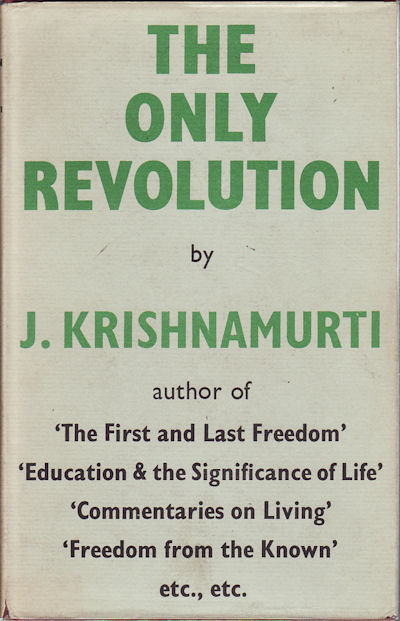
Krishnamurti: meditation, Indian temples, Vedanta

154552

The following is an excerpt from ‘The Only Revolution’ by Jiddu Krishnamurti:

Meditation is not an escape from the world; it is not an isolating self-enclosing activity, but rather the comprehension of the world and its ways. The world has little to offer apart from food, clothes and shelter, and pleasure with its great sorrows.

Meditation is wandering away from this world; one has to be a total outsider. Then the world has a meaning, and the beauty of the heavens and the earth is constant. Then love is not pleasure. From this all action begins that is not the outcome of tension, contradiction, the search for self-fulfillment or the conceit of power.


The room overlooked a garden, and thirty or forty feet below was the wide, expansive river, sacred to some, but to others a beautiful stretch of water open to the skies and to the glory of the morning. You could always see the other bank with its village and spreading trees, and the newly planted winter wheat. From this room you could see the morning star, and the sun rising gently over the trees; and the river became the golden path for the sun.

At night the room was very dark and the wide window showed the whole southern sky, and into this room one night came – with a great deal of fluttering – a bird. Turning on the light and getting out of bed one saw it under the bed. It was an owl. It was about a foot-and-a-half high with extremely wide big eyes and a fearsome beak. We gazed at each other quite close, a few feet apart. It was frightened by the light and the closeness of a human being. We looked at each other without blinking for quite a while, and it never lost its height and its fierce dignity. You could see the cruel claws the light feathers and the wings tightly held against the body. One would have liked to touch it, stroke it, but it would not have allowed that. So presently the light was turned out and for some time there was quietness in the room. Soon there was a fluttering of the wings – you could feel the air against your face – and the owl had gone out of the window. It never came again.


It was a very old temple; they said it might be over three thousand years old, but you know how people exaggerate. It certainly was old; it had been a Buddhist temple and about seven centuries ago it became a Hindu temple and in place of the Buddha they had put a Hindu idol. It was very dark inside and it had a strange atmosphere. There were pillared halls, long corridors carved most beautifully, and there was the smell of bats and of incense.

The worshipers were straggling in, recently bathed, with folded hands, and they walked around these corridors, prostrating each time they passed the image, which was clothed in bright silks. A priest in the innermost shrine was chanting and it was nice to hear well-pronounced Sanskrit. He wasn’t in a hurry, and the words came out easily and gracefully from the depths of the temple. There were children there, old ladies, young men. The professional people had put away their European trousers and coats and put on dhotis, and with folded hands and bare shoulders they were, with great devotion, sitting or standing.

And there was a pool full of water – a sacred pool – with many steps leading down to it and pillars of carved rock around it. You came into the temple from the dusty road full of noise and bright, sharp sunshine, and in here it was very shady, dark and peaceful. There were no candles, no kneeling people about, but only those who made their pilgrimage around the shrine, silently moving their lips in some prayer.


A man came to see us that afternoon. He said he was a believer in Vedanta. He spoke English very well for he had been educated in one of the universities and had a bright, sharp intellect. He was a lawyer, earning a great deal of money, and his keen eyes looked at you speculatively, weighing, and somewhat anxious. He appeared to have read a great deal, including something of western theology. He was a middle-aged man, rather thin and tall, with the dignity of a lawyer who had won many cases.

He said: “I have heard you talk and what you are saying is pure Vedanta, brought up to date but of the ancient tradition.” We asked him what he meant by Vedanta. He replied: “Sir, we postulate that there is only Brahman who 5 creates the world and the illusion of it, and the Atman – which is in every human being – is of that Brahman. Man has to awaken from this everyday consciousness of plurality and the manifest world, much as he would awaken from a dream. Just as this dreamer creates the totality of his dream so the individual consciousness creates the totality of the manifest world and other people. You, sir, don’t say all this but surely you mean all this for you have been born and bred in this country and, though you have been abroad most of your life, you are part of this ancient tradition. India has produced you, whether you like it or not; you are the product of India and you have an Indian mind. Your gestures, your statue-like stillness when you talk, and your very looks are part of this ancient heritage. Your teaching is surely the continuation of what our ancients have taught since time immemorial.”

Let us brush aside whether the speaker is an Indian brought up in this tradition, conditioned in this culture, and whether he is the summation of this ancient teaching. First of all he is not an Indian, that is to say, he does not belong to this nation or to the community of Brahmins, though he was born in it. He denies the very tradition with which you invest him. He denies that his teaching is the continuity of the ancient teachings. He has not read any of the sacred books of India or of the West because they are unnecessary for a man who is aware of what is going on in the world – of the behaviour of human beings with their endless theories, with the accepted propaganda of two thousand or five thousand years which has become the tradition, the truth, the revelation.

To such a man who denies totally and completely the acceptance of the word, the symbol with its conditioning, to him truth is not a secondhand affair. If you had listened to him, sir, he has from the very beginning said that any acceptance of authority is the very denial of truth, and he has insisted that one must be outside all culture, tradition and social morality. If you had listened, then you would not say that he is an Indian or that he is continuing the ancient tradition in modern language. He totally denies the past, its teachers, its interpreters, its theories and its formulas.

Truth is never in the past. The truth of the past is the ashes of memory; memory is of time, and in the dead ashes of yesterday there is no truth. Truth is a living thing, not within the field of time.

So, having brushed all that aside, we can now take up the central issue of Brahman, which you postulate. Surely, sir, the very assertion is a theory invented by an imaginative mind – whether it be Shankara or the modern scholarly theologian. You can experience a theory and say that it is so, but that is like a man who has been brought up and conditioned in the Catholic world having visions of Christ. Obviously such visions are the projection of his own conditioning; and those who have been brought up in the tradition of Krishna have experiences and visions born of their culture. So experience does not prove a thing. To recognise the vision as Krishna or Christ is the outcome of conditioned knowledge; therefore it is not real at all but a fancy, a myth, strengthened through experience and utterly invalid. Why do you want a theory at all, and why do you postulate any belief? This constant assertion of belief is an indication of fear – fear of everyday life, fear of sorrow, fear of death and of the utter meaninglessness of life. Seeing all this you invent a theory and the more cunning and erudite the theory the more weight it has. And after two thousand or ten thousand years of propaganda that theory invariably and foolishly becomes “the truth”.

But if you do not postulate any dogma, then you are face to face with what actually is. The “what is”, is thought, pleasure, sorrow and the fear of death. When you understand the structure of your daily living – with its competition, greed, ambition and the search for power – then you will see not only the absurdity of theories, saviours and gurus, but you may find an ending to sorrow, an ending to the whole structure which thought has put together.

The penetration into and the understanding of this structure is meditation. Then you will see that the world is not an illusion but a terrible reality which man, in his relationship with his fellow man, has constructed. It is this which has to be understood and not your theories of Vedanta, with the rituals and all the paraphernalia of organized religion. 7

When man is free, without any motive of fear, of envy or of sorrow, then only is the mind naturally peaceful and still. Then it can see not only the truth in daily life from moment to moment but also go beyond all perception; and therefore there is the ending of the observer and the observed, and duality ceases.

But beyond all this, and not related to this struggle, this vanity and despair, there is – and this is not a theory – a stream that has no beginning and no end; a measureless movement that the mind can never capture.

When you hear this, sir, obviously you are going to make a theory of it, and if you like this new theory you will propagate it. But what you propagate is not the truth. The truth is only when you are free from the ache, anxiety and aggression which now fill your heart and mind. When you see all this and when you come upon that benediction called love, then you will know the truth of what is being said.

Karma Yoga

hummingbird moon.jpg

Karma means action in Sanskrit, and Karma Yoga is the Yoga of Action.

There are a few ways karma yoga can be performed according to the traditional scriptures, but one of them is to set up the concept of a personal God, an all-powerful entity that is responsible for everything and every action in the universe. The Karma yogi is taught to realise that it is this God (sometimes known as ‘Ishvara’, which literally means the owner, ruler or controller in Sanskrit) that ultimately has control and not the limited body-mind that it thinks itself to be.

The karma yogi therefore practices gladly accepting everything that comes his or her way as a gift from God, working to the best of their ability, but not being attached to the results of their actions.

As the Karma yogi starts to learn to be happy regardless of what is happening, this has the direct result of eroding away compulsive desires, converting them into non-compulsive desires, and so eventually the yogi becomes peaceful and pure (sattvic)

Thereafter, over time, the sense of identification with the body-mind entity loosens and is seen through. It can become apparent to the Karma yogi that actions happen by themselves: thoughts happen by themselves, but there is no thinker, just a spontaneous thought occurring, one by one, in quick succession. Similarly actions happen by themselves: limbs move, lips speak in the same way that dogs bark, leaves rustle and clouds float by – all happens spontaneously, and there is no doer. Here Knowledge arises.

Now the yoga has completed its aims: Freedom has been realised and we are seen to be free from suffering – we are seen to have always been free from suffering and the world. Now we no longer have to worry about concept of an infinite all-powerful personal God that is ultimately unknowable and unverifiable.

Again, the concept of the infinite God, as with the concept of the Unchanging Indestructible Brahman for Jnana yoga, can be seen to have been a useful tool, aiding the seeker to attain Liberation, but now no longer needs to be believed in.

This above article is an extract from: How yoga works

Non-duality meetings in London

A GENUINE REALISATION OF FREEDOM IN ORDINARY EVERYDAY LIFE

ND London

The course of structured teachings I’ve been teaching recently are due to restart this Thursday 7pm in Kingston, London, and the following week online.

As both a parent and a working doctor, my teachings are geared towards a genuine realisation of Freedom in everyday ordinary life.

It seems there are lots of conflicting teachings out there which can add to the confusion for a seeker of truth: are practices required? Is there anything you can do to help ‘get this’? Does the ego disappear? What happens when we die? Is there really ‘nobody here’? What about self-inquiry? The structured teachings, over the next few weeks, aim to address all these apparently contradictory points and more…

While this really can’t be put into words, concepts and practices can apparently help us along the way. Sometimes. It seems that some teachings are more effective than others, depending on ‘where the seeker is’.

The result? Seeing the Freedom that already is.

For more details see http://meetu.ps/e/.nwhrrlywdbmb/1GbHK/d or tomdas.com/events

Krishnamurti: meditation is not an escape from the world

154552.jpg

Meditation is not an escape from the world; it is not an isolating self-enclosing activity, but rather the comprehension of the world and its ways. The world has little to offer apart from food, clothes and shelter, and pleasure with its great sorrows.

Meditation is wandering away from this world; one has to be a total outsider. Then the world has a meaning, and the beauty of the heavens and the earth is constant. Then love is not pleasure. From this all action begins that is not the outcome of tension, contradiction, the search for self-fulfillment or the conceit of power.

Jiddu Krishnamurti, taken from his book ‘The Only Revolution’

Q: Who sees there is no doer? (Self-Enquiry, Ramana, Who am I?)

Q: You say there is no doer, and that this is a key point in your teaching, but who or what sees there is no doer? 

Tom: Why do you ask? What do you hope to gain from that question? Do you think that knowing the answer to this question will set you free? Do you think the answer to this question can be found in words? Contemplate on these questions.

It’s easy to say that ‘I see’, or that ‘awareness sees’, but does this really get us anywhere? What is the concept of awareness but another way of verbalising that something is being perceived. When we say ‘awareness sees’ or ‘I am aware’, all we are really saying is that ‘something is seen’. It’s tautology, just a different way of saying the same thing.

wp-1474790287732.png

Q: So why do so many non-dual teachers prescribe self-inquiry as a method?

Tom: The real point of asking ‘who or what sees’ (ie. self enquiry) is to notice that what we commonly take ourselves to be is actually something that is seen, and is not the seer/doer at all.  What we, in ignorance or misapprehension, commonly take to be the subject is actually experienced as an object(s). This is also the point of the awareness teachings, to see through the doer – not to get caught up and identified with a concept of awareness.

We commonly take ourself to be the body-mind apparatus, but it can be seen that the body and mind are both objects that are perceived. The body and mind, as far as our direct experience goes, are parts of our experience, they are parts of ‘the perceived’. There is no evidence that they are perceivers of the experience. (That is not to say that they are not representations of the subject/perceiver within our consciousness, but just that there is no evidence either way).

Q: OK… (pause)

Tom: So, back to your question: what is it that sees?

Here’s the shorter answer: that which sees is that which sees. Why name it? Does naming it mean we know it any better? Are we any the wiser for naming it or calling it ‘awareness’ or ‘consciousness’ or ‘me’ or ‘I’?

Why settle for verbal explanations or spiritual-sounding slogans? Instead question these statements. Don’t get rid of one dogma and replace it with another. Be true to yourself, be true to what you know and your own experience:

Things are seen – that much I know. What sees? – I do not know…

wp-1474790287732.pngQ: But don’t we need to know exactly what it is that sees?

Tom: No. Not only do we not need to know what sees, we cannot know what sees (as an object). We only know that we see, and not what sees. That is enough. And that’s our actual experience, right? We don’t need to take on a new belief such as the belief that we are awareness. Sure, we are aware. or you could say awareness is here, but we don’t have to go further and say ‘I am awareness’. Let’s just stick to our experience and not pretend to know something that we don’t. As Ramana Maharshi says:

‘The state we call realization is simply being one’s self, not knowing anything or becoming anything.’

There are a few other aspects to the teachings too, which I’ll quickly summarise for you. I go into more detail on the group meetings, but briefly:

1. We need to stop mistaking certain objects (ie. the appearance of the body-mind organism) for being the subject. That is a key purpose of what I call the ‘awareness teachings’ that are found in Shankara’s Advaita Vedanta and in many schools of Mahayana Buddhism.

2. We need to notice and understand deeply that all objects are transient – they all come and go, and that no object brings lasting satisfaction. As this realisation deepens and takes root, this leads us to naturally turn away from depending on objects as a source of happiness. This leads to our addictive and suffering-causing desires (vasanas) to naturally fall away. Suffering dissolves away and joy naturally rises in its place, rearing its head from time to time as it pleases.

3. We need to see that all objects comes and go spontaneously, including thoughts and actions, and so realise that there is no doer-entity controlling it all. What we call the mind is just a spontaneous succession of thoughts, with no evidence of any entity controlling it. This is the real point of self-enquiry.

As Ramana Maharshi said when a questioner asked him about self-enquiry:

‘Reality is simply the loss of ego. Destroy the ego by seeking its identity.  Because the ego is no entity it will automatically vanish and reality will shine forth by itself.
This is the direct method. All other methods retain the ego. In those paths so many doubts arise, and the eternal question remains to be tackled. But in this method the final question is the only one and is raised from the very beginning.’

When we see the false to be false, meaning when we see the doer (ego) is an illusion, whatever remains is reality. It just is whatever is. It doesn’t have to be named, known or understood – it’s just what is.

A complete teaching: Relax. Listen to the beat of the drum.

water-drop

Relax.

Listen to the beat of the drum.

There’s no-one here!

Tom Das

This pithy statement actually encapsulates the entire teaching. How? Let me explain:

Relax…

This refers to generating peace, and relaxation primarily of the mind. Like a dense fog clearing in the heat of the morning sun, allowing the mind to calm and thoughts to lessen gives rise to the conditions in which clarity of seeing-understanding can arise.

As we practice being peaceful, we naturally become happier: a warmth in our heart naturally blossoms as our addictive pleasure-seeking desires weaken and fade. We learn to be happy where we are, and then we pass beyond the need for the body-mind to even be happy or at peace. Gradually compulsive desires fall away and we no longer suffer if we do not receive what we want. Our compulsive desires fade, and only preferences remain.

Listen…

This refers to the insight part of the teaching, the essence of the teaching. It is clear seeing-understanding. As the morning fog clears, things can be seen for what they are, as they are, brightly illuminated by the sun of knowledge/insight/understanding.

…to the beat of the drum.

What do we listen to? What are we looking at? The drum can represent the body-mind entity, an object in the world, or just a simple drum. The point is to see things as they are. As the drum beats, we can watch it, hear it, follow its mechanism.

We can see how there is nobody inside the drum making a noise. We can see how the sound is an automatic  reflexive response when the skin is struck with the striking implement. We can see how the drum is empty, and the resonance within the empty space (full of air) creates the reverberating sound.

We can see how this is true of all things, how all things act and function without there being a separate doer-entity that initiates and creates its actions. Rather there is a natural spontaneously self-expressing interdependence and non-separation.

There’s no-one here!

Like the drum, we are essentially empty, meaning there is no trace whatsoever of a separate individual doer/self. This is the essential realisation of freedom.

It is not that the appearance of the body-mind goes or changes, or that you lose the experiential perspective of being a particular body-mind. No. Perception from the apparent perspective of the body-mind remains.

The term ‘no-one’ refers specifically to no-doer. It is the seeing that there never was a separate doer-entity. It is seeing that this doer was created by thought, it was imagined by thought and believed to exist by thought.

A summary

Through generating peace (Relax…) the grip of thought was loosened, through observing (Listen…) things were examined with the intention of seeing things (…the drum…) as they are. Comparing what is seen against the content of our thoughts, it is revealed that the concept of doership does not accurately reflect the reality of what is perceived: there is no doer.

The concept of doership has been operating for so long within most of us. It is this concept that causes our suffering. The understanding that there is no-doer can then act to root out the concept of doership and remove suffering.

What we are left with is what was always here: this. It doesn’t have to be named, you don’t have to put it in words, you don’t have to carve it up using the knife of concepts (although you can if you want). It’s just whatever’s happening, spontaneously arising, however it arises.

This.


Can you know something is infinite?

the_center_galaxy_of_cats_eye

How can you know something is infinitely powerful or that it will last forever (ie. an infinite amount of time)? Just because it is very very powerful or has lasted a very very long time, doesn’t mean it is infinite in those dimensions. Similarly, just because something has been around for a very very long time or just because you can’t remember something beginning, doesn’t mean it was never born. Maybe it is very very old, but you have no way of knowing if it was infinitely old.

If you think something is infinite in some way, then I would say that’s a belief. Infinity is a concept, and we have no way of knowing if anything infinite actually exists at all.

This is an except from a larger article:  Can you know something is infinite, limitless, indestructible, eternal or unborn?

Ranjit Maharaj: use a thorn to remove a thorn, then throw them both away

Ranjit Maharaj

This passage below is taken from ‘Illusion vs. Reality’ (page 6) by Shri Ranjit Maharaj. Shri Ranjit’s guru (Shri Siddharameshwar Maharaj) was also the Guru of Nisardagatta Maharaj, making Ranjit and Nisargadatta ‘guru-brothers’, ie. contempories in the same teaching lineage.

The address is false but when you reach the goal, it is Reality. In the same way, all the scriptures and the philosophical books are meant only to indicate that point, and when you reach it they become non-existent, empty.

…For example, to remove a thorn in your finger you use another thorn; then you throw both of them away. But if you keep the second thorn which was used to remove the first one, you’ll surely be stuck again.

To remove ignorance, knowledge is necessary, but finally both must dissolve into Reality. Your Self is without ignorance, without knowledge.

…If you keep the second thorn, which means knowledge, even if it is a golden thorn, you’ll be stuck [by the second thorn].

…Knowledge is a great thing but it must be only a remedy. When the fever goes off thanks to the medicine you take, you must stop taking it. Don’t prolong the treatment or you will create more problems.

Knowledge is necessary only to remove the disease of ignorance. The doctor will always prescribe a limited dosage!

Also see here for more

Buddha: How to approach the teachings

buddha

Going back to the Pali suttas, the Buddha also repeatedly warned against being attached to any particular teaching or teaching tradition:

‘Do not go by oral tradition, by lineage of teaching, by hearsay, by a collection of texts, by logic, by inferential reasoning, by reasoned cogitation, by the acceptance of a view after pondering it, by the seeming competence of a speaker, or because you think, ‘This ascetic is our teacher.’
AN 3.65 Kesaputti [Kālāma] Sutta

This really is quite a stark warning, and we could see this as a very ‘modern’ and scientific way of approaching this search for freedom from suffering.

The above text is an except taken from a larger article: Buddhism: How enlightenment happens