Here are some films that I have enjoyed that relate to Spirituality, Non-Duality and Advaita. The films may not be for everyone, but hopefully the themes will become fairly apparent as you watch them.
I haven’t made too much comment on them as you can always look them up for yourself should you wish to!
In no particular order:
Revolver (directed by Guy Ritchie) – a treatise on the ego
The Matrix – well it’s The Matrix!What more needs to be said?! So, do you want to take the blue pill or the red pill…
The Truman Show – hmmm…wait a second…is THIS the Truman Show?
V for Vendetta – go beyond your fears
American Beauty – ‘look closer’…things are not as they seem
Inception – Illusions, dreamscapes and creating reality
Bliss (directed by Mike Cahil) – Illusion vs reality
Ok, a rather meagre post, but let me know your thoughts!
The following is excerpted from The Sutra of Hui Neng (also known as the Platform Sutra), Chapter 5 entitled ‘On Dhyana’. My comments are interspersed in italicised red:
Learned Audience, what are Dhyana and Samadhi? Dhyana means to be free from attachment to all outer objects, and Samadhi means to attain inner peace. If we are attached to outer objects, our inner mind will be perturbed.
Tom: we can see Hui Neng has succinctly defined both Dhyana and Samadhi. In the next line he is essentially saying that these two are one and the same, in that when there is no attachment (ie. Dhyana), there will also be peace (ie. Samadhi):
When we are free from attachment to all outer objects, the mind will be in peace.
Tom: See if you can see the parallel with Sri Ramana Maharshi stating in ‘Who Am I?’:
‘Not to desire anything extraneous to oneself constitutes vairagya (dispassion) or nirasa (desirelessness). Not to give up one’s hold on the Self constitutes jnana (knowledge). But really vairagya and jnana are one and the same.’
Our Essence of Mind is intrinsically pure, and the reason why we are perturbed is because we allow ourselves to be carried away by the circumstances we are in.
He who is able to keep his mind unperturbed, irrespective of circumstances, has attained Samadhi.
Tom: Sri Ramana Maharshi states in ‘Who Am I?’:‘If only the mind is kept under control, what matters it where one may happen to be?’
In the above two lines Hui Neng hints that your True Nature, or what Hui Neng refers to as Essence of Mind, is already ‘unperturbed’, and essentially is always undisturbed and ‘pure’. Realisation of this naturally leads to Freedom:
To be free from attachment to all outer objects is Dhyana, and to attain inner peace is Samadhi. When we are in a position to deal with Dhyana and to keep our inner mind in Samadhi, then we are said to have attained Dhyana and Samadhi. The Bodhisattva Sila Sutra says, “Our Essence of Mind is intrinsically pure.” Learned Audience, let us realize this for ourselves at all times. Let us train ourselves, practice it by ourselves, and attain Buddhahood by our own effort.
The following is taken from The Sutra of Hui Neng (also known as the Platform Sutra), Chapter 2 entitled ‘On Prajna’. My comments are interspersed in italicised red:
The wisdom of Buddhas, past, present and future, as well as the teachings of the twelve sections of the canon are immanent in the mind, but in case we fail to enlighten ourselves, we have to seek the guidance of the pious and learned.
Tom: the essential teaching is within ourselves or ‘immanent in the mind’. Only if we do not enlighten ourselves with our own inner wisdom do we need the external teacher (‘the pious and the learned’)
On the other hand those who enlighten themselves need no extraneous help. It is wrong to insist upon the idea that we cannot obtain liberation without the assistance of the pious and learned. It is by our innate wisdom that we enlighten ourselves, and even the extraneous help and instruction of a pious and learned friend would be of no use so long as one is deluded by false doctrines and erroneous views.
Tom: ie. it is possible for illumination to occur without an outer teacher as the true wisdom of enlightenment is our very nature. How can this be done? All we have to do is realise our true nature, what Hui Neng here calls ‘Essence of Mind’, and we will certainly and immediately be Buddhas, let us see:
As we introspect our minds with Prajñā, all erroneous views will disappear of themselves, and just as soon as we realise Essence of Mind we will immediately arrive at the Buddha stage.
Tom: Hui Neng states that if we look within at our true nature or ‘minds’ with Prajna, all erroneous views or ignorance will disappear spontaneously, and this is realisation of Essence of Mind or True Nature, and this is also the same a Buddhahood or enlightenment. So, how ‘introspect with prajna’? Hui Neng will explain. Prajna means wisdom or insight:
When we use Prajñā for introspection we are illuminated within and without and are in position to know our own nature. To realise our own nature is to obtain fundamental liberation. To obtain liberation is to attain the Samadhi of Prajñā, which is ‘thoughtlessness’.
Tom: Hui Neng explains that realising our true nature is liberation. This is also known as ‘thoughtlessness’. What is this ‘thoughtlessness’? Let us see:
What is ‘thoughtlessness? ‘Thoughtlessness’ is to see and to realise all dharmas (things) with a mind free from attachment. In action Prajñā is everywhere present yet it “sticks” nowhere. What we have to do is to so purify the mind that the six vijnanas (aspects of consciousness sight, sound, smell, taste, touch, mentation) in passing through their six sense-gates will neither be defiled by nor attached to their six sense-objects. When our mind works freely without any hindrance and is at liberty “to come” or “to go, “then we have attained the intuitive insight of Prajñā, which is emancipation. To enable one to attain such a mental state of freedom is the function of intuitive insight.
Tom: In summary Hui Neng is stating that when the mind functions free from attachment to both gross and subtle objects, that is liberation. This non-attachment is also known as ‘thoughtlessness’. We can see this is in keeping with the Buddha’s more classical teachings which essentially state the same. We can also see this is in keeping with the Vedanta teachings in which lack of identification with and attachment to the body, mind and world is the same as Self-Realisation.
Sri Ramana Maharshi states the following in Maharshi’s Gospel, Chapter 3 entitled ‘Mind Control‘:
Questioner: Does Bhagavan condemn dvaita Philosophy?
Sri Ramana Maharshi :Dvaita can subsist only when you identify the Self with the not-Self. Advaita is non-identification.
Now Hui Neng will tell us what not to do:
To refrain from thinking of anything, in the sense that all mental activity is suppressed, is to be Dharma-ridden; this is an extremely erroneous view. (Discriminative thought which leads to desire and attachment, or to aversion and defilement, is to be controlled in the interests of intuitive thought which leads to self-realisation and freedom.)
Those who understand the way of ‘thoughtlessness’ will know everything; they will have the experience that all the Buddhas have had, and they will attain Buddhahood.
Tom: later on in the same chapter Hui Neng quotes a long verse that he composed himself for the benefit of those listening to him – here are a couple of excerpts I have chosen to quote here:
To illumine our gloomy tabernacle, which is stained by defilement,
We should constantly set up the Light of Wisdom.
Erroneous views keep us in defilement
While right views remove us from it,
But when we are in a position to discard both of them
In Advaita Vedanta it is said that the Ultimate Truth is that Maya never existed, and that there never was a world (Jagat), individual person (Jiva), or a God (Isvara). This is known as Ajata Vada – see here for an example of this teaching. Here in Guru Vachaka Kovai we have Sri Muruganar stating the same:
‘…I have known that in truth there is never in the least any attainment of bondage, liberation, and so on, which are fabricated when one imagines one is separate from reality’ Guru Vachaka Kovai, verse 1241
Someone recently made a comment to me that this sounds remarkably like Neo-Advaita, to which my response was as follows:
They sound remarkably similar because on the verbal level both traditional and neo-Advaita talk about Ajata Vada (the view that there is no maya, no objects truly exist, and therefore no true meaning, no seeker, no teaching, no teacher, etc) as being the ultimate truth, but traditional advaita also talks about teachings from vivarta vada (world is a projected illusion) and shristi dristi vada (world is real) viewpoints and prescribes self-enquiry as a (paradoxically) valid method for this to be realised on these latter 2 levels for those who cannot fathom ajata vada. Upon this realisation it is ‘realised’ there was never a seeker and no real realisation either. Sri Ramana Maharshi explains it more fully hereif you are interested.
‘I am that. I am the source of all that is, and so are you’
Tony Parsons, from Invitation to Awaken, page 117.
Generally speaking I do not comment much on other teachers as everyone has their own path and different teachings can be helpful at different times (apparently!). If you have found a teaching or communication useful, who am I to say otherwise? I am not interested in trying to take you away from something you resonate with, enjoy or agree with – quite the contrary in fact. However occasionally I find myself writing posts such as these in order to shine some light and clarity on aspects of certain teachings (or ‘non-teachings’!) and give my view for those who are interested.
Last year I wrote a post called ‘The evolution of Tony Parsons’ in which I noted how Tony’s expression has changed over time, becoming more and more radical or ‘neo-advaitic’ and less traditional as the years have progressed. Conversely, in previous years gone by his expression was much more in line with the traditional type teachings that he now states are dualistic, confusing and misleading. I also noted how in my view some important absences in the teaching limit its effectiveness, and how the evolution of his teaching is actually in line with the teaching methodology of traditional Advaita.
Nowadays all references to ‘I am That’ or ‘awaken to your true nature’ and references to awareness are all dismissed as being incorrect, ‘dualistic’ and ‘for the me’ by Tony Parsons, but several years ago he was speaking in this very way that he now says is dualistic.
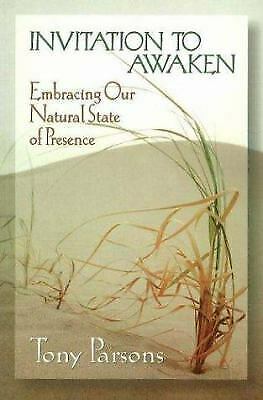
Since writing ‘The Evolution of Tony Parsons’, I was encouraged to read another another book of Tony Parsons published in 2004, which is no longer on sale, called ‘Invitation to Awaken’. As his first book ‘The Open Secret’ was published in 1995, this represents at least the first 9 years of him sharing these teachings. I obtained a copy about six months ago but for some reason today I was moved to actually pick it up, take a look at it, and write this post. Having flicked through it, I can only presume that it is no longer on sale as it contains teachings which now Tony Parsons says are dualistic and inaccurate. In fact I would guess that most of the following quotes would now likely be thought of as being incorrect and dualistic by those who advocate radical non-duality (or neo-advaita) style communications.
The subheading ‘Embracing Our Natural State of Presence’ is exactly the type of teaching language that is now refuted by so-called radical non-duality, so it is particularly interesting that this was the phrase chosen to be put on to the book cover:
In this book called ‘Invitation to Awaken’, what I would call the savikalpa aspect of the traditional teaching is unfolded by Tony Parsons in a manner very similar to Sri Nisargadatta Maharaj’s teachings. This savikalpa (literally meaning ‘with objects’ or with arising phenomena present) teaching illumines the oneness between all arising phenomena and the space-like consciousness that we are, but by itself rarely leads to permanent end of (apparent) duality and suffering.
Please take the time to watch this video where I explain this important teaching, as it is the nirvikalpa aspect of the teaching that is actually liberating and ends suffering:
However, unlike Nisargadatta Maharaj’s teachings, in Tony’s teachings the nirvikalpa aspect of the Vedanta teaching is notably absent. This nirvikalpa (literally, without objects or arising phenomena) aspect of the teachings, in which one naturally turns away from objective phenomena towards the Subject/Self, is the actual part of the teaching which is liberating.
It is this aspect of the teaching that many never take up, for the ego doesn’t want to go there, and it is this part of the teaching that (for most) leads to liberation. It is this nirvikalpa aspect of the teaching which removes the habitual energetic tendency (vasana) to identify with the body-mind. eg. Nisargadatta Maharaj teaches the method of staying with the ‘I AM’, which leads one to this liberating nirvikalpa aspect of the teaching, but Tony Parsons advocates no such thing – in fact he even detracts from this kind of sadhana/practice, so allowing the ego-mind and duality to remain intact.
Please note that most of the quotes below are probably now refuted by those who have an affinity with radical non-duality, including Tony Parsons himself. Please also note that I have selectively taken quotes to highlight the similarity with more traditional vedanta expositions, at least the savikalpa aspect of the teachings. In the book there are still many neo-advaita style teachings present.
Please also note that I am not trying to criticise any teachings or teachers/speakers but my interest is only to share how these teachings may have evolved into their present form and I hope this article is useful to those seekers who are faced with an abundance of teachings and are trying to find their way through it all.
‘A meeting with Tony Parsons can be an invitation to rediscover your true nature. Reading a book like this may help you recognize your own doubts, hope and questions until they no longer come to the surface’
Quote from back cover of ‘Invitation to Awaken’ by Tony Parsons
‘Totally radical and uncompromising expression of absolute Non-dualism’
The preface to the 2004 book ‘Invitatation to Awaken’ by Tony Parsons states that:
‘this book is a totally radical and uncompromising expression of absolute Non-dualism’.
Tony Parsons also states in the same preface:
‘I am surprised at the number of teachings that are presented or thought of as nondualistic or Advaita teachings when they are anything but. As far as I can see, the radical, clear, and uncompromising expression of absoute nonduaism is still very rarely communicated’
Let us see some of these ‘totally radical and uncompromising expressions’ in this post.
Awareness and Consciousness
When reading this book, there are several phrases that seem reminiscent of the language used in Nisargadatta Maharaj’s book ‘I am That’. Tony here even speaks of the distinction between ‘awareness’ and ‘consciousness’, which is a fairly peculiar distinction made in the specific Advaita Vedanta teaching lineage from which Nisargadatta Maharaj comes from. In fact I have never heard of this kind of distinction made by anyone else in quite this way:
‘Anger, sadness and thoughts can still be present, but they all arise in what I am, which is awareness.’
Tony Parsons, from Invitation to Awaken, page 3
‘Awareness is the source of all. As the matrix of everything, it is completely still, silent and impersonal. It has no relationship with anything; it’s the singularity from which everything emanates. Consciousness for me is the soup, which contains everything that apparently happens, including the sense of separation….Awareness simply is and requires nothing; consciousness can only arise in awareness.’
Tony Parsons, from Invitation to Awaken, page 3
‘…you are That. That is it – simple awareness. Just know this awareness, which is watching the game of consciousness. You have always been That.’
Tony Parsons, from Invitation to Awaken, page 4
‘You are simply awareness, seeing whatever arises. It’s absolutely simple, and it’s absolutely what you are. Just let awareness see what arises. ‘
Tony Parsons, from Invitation to Awaken, page 21
Tony Parsons and Nisargadatta Maharaj
So when I read the above on the first few pages, I thought that this must have been a time during which Tony was reading Nisargadatta Maharaj. The influence of Nisargadatta seems to be fairly strong. But was Tony even aware of Nisargadatta Maharaj? I would find it difficult to believe that this distinction between ‘awareness’ and ‘consciousness’ would arise otherwise, as practically no other teacher uses this terminological difference as far as I am aware. Well, I found my answer on page 37 when Tony mentions Nisargadatta by name:
‘When Nisargadatta said ‘Nothing is happening’, this’s what he meant. Actually, nothing ever happens’
Tony Parsons, from Invitation to Awaken, page 37
Here we have Tony Parsons interpreting Nisargadatta Maharaj! For those familiar with radical non-duality/ neo-advaita as well as more traditional expositions, perhaps there is some humour in this!
Love and wisdom
Nisargadatta famously said in I Am That:
‘Love says ‘I am everything.’ Wisdom says ‘I am nothing.’ Between the two, my life flows.’
Nisargadatta Maharaj, I Am That
Here we have Tony saying something very similar on page 43:
‘Deep wisdom is knowing ‘I am awareness, I am nothing’, but unconditional love is knowing that ‘I am everything’.
Tony Parsons, from Invitation to Awaken, page 43
Later in the book Tony quotes Nisargadatta Maharaj, seemingly approving of this style of expression:
‘In the words of Sri Nisargadatta Maharaj, while absolute wisdom sees that ‘I am nothing’, absolute love sees that ‘I am everything’. Everything is generated from unconditional love’
Tony Parsons, from Invitation to Awaken, page 60
‘Neo-Advaita’
Contrast this with what Tony says nowadays, namely that the notion of awareness is itself dualistic and perpetuates the ego. The following quotes are taken from This Freedom by Tony Parsons, published in 2015:
‘Awareness is the fuel of separation…Awareness is that which helps to construct a subject-object world. It is the accomplice of separation. A subject is aware of an object.’
Tony Parsons, This Freedom, page 48
‘But awareness is a function that needs something apart for it to be aware of.’
Tony Parsons, This Freedom, page 9
‘Awareness simply feeds separation, and a state of detachment can arise and be mistaken for enlightenment.’
Tony Parsons, This Freedom, page 9
‘Consciousness, knowing and awareness are similar apparent functions within wholeness. Awareness is the function through which the apparently contracted energy of a separate identity arises. The function of awareness re-establishes and maintains the illusory sense of a self’
Tony Parsons, This Freedom, page 50
However, previously Tony said something quite different, namely he emphasised the subject, similar to traditional vedanta and Nisargadatta Maharaj’s teachings:
‘Some people teach that awakening is seeing that there is no ‘doer’, that consciousness is all there is. But there’s something that knows that consciousness is all there is. It is the lover, the ultimate, what you are.’
Tony Parsons, from Invitation to Awaken, page 61
I am that
Let us see again how Tony used to talk about non-dualty – all italics are present in the original text:
‘I am that. I am the source of all that is, and so are you’
Tony Parsons, from Invitation to Awaken, page 117.
‘You are That’
Tony Parsons, from Invitation to Awaken, page 111.
‘I don’t need to still my mind because I am stillness itself…I am the stillness, and the mind arises within it’
Tony Parsons, from Invitation to Awaken, page 122.
‘You are absolute awareness, and without absolute awareness nothing can be’
Tony Parsons, from Invitation to Awaken, page 94.
‘[talking about the Buddha] he ultimately gave it up and saw ‘I am That”
Tony Parsons, from Invitation to Awaken, page 96.
‘…the nearest I can get to is is absolute Being. When the state of unconditional love is total, it leads to the fnial realisation ‘I am absolute Being’ or ‘There’s just absolute Being.’
Tony Parsons, from Invitation to Awaken, page 43
‘While your perception of ‘I am That, I am the absolute, I am awareness, I am the light just as everyone else is’ remains constant, in certain circumstances you can still contract back into identification. This means that at times you can still be in relationship…’
Tony Parsons, from Invitation to Awaken, page 49
‘Let’s close our eyes and be open to the possibility that there’s no one there, that there’s simply awareness – silent, still, impersonal awareness – and whatever seem to be happening is arising in that. Just be the watcher…you are the stillness; you are the silence in which everything arises. Embrace that which never moves and is totally still’
Tony Parsons, from Invitation to Awaken, page 53
The ‘I Am’
Another phrase Nisargadatta Maharaj uses is ‘the I Am’. Here in this same book we have Tony using the same phrase:
‘You are the I Am, and so am I’
Tony Parsons, from Invitation to Awaken, page 58
The Subject
These days Tony states there is no subject, the subject being an illusion that perpetuates duality. Here is an example of this:
‘Question: But is there a perception of ‘what is’?
Tony: No, there is just ‘what is’…there is no perceiver that is real’
Tony Parsons, This Freedom, page 49
However previously Tony emphasised the subject – italics in the following quotes are not added by myself but are present in the book. The first quote is presumable referring to Ramesh Balsekar who used to teach the ‘no doer, all is consciousness’ teaching at that time:
‘Some people teach that awakening is seeing that there is no ‘doer’, that consciousness is all there is. But there’s something that knows that consciusness is all there is. It is the lover, the ultimate, what you are.’
Tony Parsons, from Invitation to Awaken, page 61
Here is another example of Tony emphasing the subject, again italics are present in the original text:
‘Question: How does one drop it [the veil], then?
Tony: One doesn’t drop it. It’s dropped by seeing that there is no individual, but only space in which things apparently happen. You get a sense of moving ‘behind’ the person that’s always been at the forefront of things. Just behind that apparent person is the one that knows the person standing there looking at me’
Tony Parsons, from Invitation to Awaken, page 64.
Integration after awakening
Imagine my suprise to hear Tony discussing the need for integration after awakening! Here is what he says:
‘After awakening, people need to integrate what’s happened to them. Very often they rush out and say ‘I’m giving Satsang on Friday’, even though there’s been no integration.’
Tony Parsons, from Invitation to Awaken, page 70
‘Although I experienced great clarity walking across the park, it took some time to integrate the vast seeing that ‘this is all there is’…a lot of people start teaching thinking that they can help others attain what they have, but if they haven’t integrated their awakening, their teachings may create some confusion.’
Tony Parsons, from Invitation to Awaken, page 71
Perhaps it is these kinds of statements which explains why this book is no longer being published?
Is this just linguistics or semantics?
But isn’t this just linguistics? The ‘old Tony’ and the ‘new Tony’ – are they not just saying the same thing using different words? I don’t think so. Our true nature, consciousness, is often traditionally said to know itself, just like Nisargadatta Maharaj’s teachings. Here is a questioner trying to get to this point, taken from the 2015 publication This Freedom, page 51:
Questioner: But surely the no thing that is and isn’t, knows itself?
Tony: It’s doesn’t need to know it is and is not. It is an illusion that consciousness knows consciousness…Where would it go to stand apart and know itself?
Questioner: I am not talking about a consciousness that is apart, I am talking about a consciousness that is in it.
Tony: So consciousness is another word for knowing or awareness, and these are all transient functions…they are in movement. They are actions that apparently happen within wholeness. Consciousness of a tree, consciousness of self, knowing the sky, knowing I am, awareness of a thought; it is wholeness appearing to be a separate knower.’
Tony Parsons, This Freedom, page 51
And again on page 52:
‘So as consciousness is an inconstant function within the everything, how can it be the everything?’
On page 61:
‘Awareness is the accomplice of separation. Awareness is a function which requires something for it to be aware of. When awareness arises there is a subject aware of an object. That is awareness.’
However, what did Tony say back in 2004?
‘…you are That. That is it – simple awareness. Just know this awareness, which is watching the game of consciousness. You have always been That.’
Tony Parsons, from Invitation to Awaken, page 4
‘I am that. I am the source of all that is, and so are you’
Tony Parsons, from Invitation to Awaken, page 117.
OK, that’s all from me on this for now. I hope you enjoyed reading the above and found it interesting and perhaps even useful. Again, the idea of this post is not to criticise or condemn, but to share and give insight into how such teachings can change and evolve over (apparent) time. Please feel free to check out Tony Parsons’s current teachings on YouTube and see what you think for yourself!
First we hear the teachings (sravana), then we think about the teachings (manana), then we realise what they are pointing to (*paroksha jnana or understanding primarily on the level of the mind, ie. indirect knowledge;).
This naturally leads to abiding as the Self (nididhyasana), which leads to deeper and deeper silence (mouna or samadhi).
Eventually all of the egoic tendencies (vasanas) are removed (vasana kshaya) resulting in destruction of ignorance (manonasa or destruction of egoic mind) which is the same as liberation (moksha) or direct knowledge (*aparoksha jnana – direct knowledge) or self-realisation (atma sakshatkara)
This entire path is then seen to have been illusory (maya)!
Where is there to go? Who/what entity is there to go anywhere? What is there to do?
In the meantime suffering will continue until the Self is realised as your own very Being, and it is Abidance in that Being as that Being that fructifies as Moksha.
*Think of ‘paroksha’ as meaning ‘mediated’, so paroksha jnana means knowledge that is mediated by something, ie. it is indirect knowledge. Conversely think of aparoksha as meaning unmediated, so aporoksha jnana refers to unmediated or direct knowledge.




 Tom Das