Jnana
Self-Enquiry is not a ‘doing’, it is a ‘being’ | Sri Ramana Maharshi | Sri Sadhu Om
Traditionally in Vedanta teachings it is said that no actions (karma) can lead to liberation (moksha). But doesn’t Bhagavan Ramana Maharshi say that self-enquiry is the sure way to liberation? And doesn’t he even say that self-inquiry is the only way to liberation? And is not self-inquiry a karma (action)?
Here in this post the answer to this question is explained, and the nature of self-inquiry is further explained too.
The following is an excerpt from ‘The Path of Sri Ramana’ Chapter 7. You can find out more about and download the entire text for free here.
Also see: What does it really mean to ‘be still’? Summa Irru | Sri Ramana Maharshi
Therefore, while practising Self-enquiry, instead of taking anyone of the five sheaths as the object of our attention, we should fix our attention only on the ‘I’-consciousness, which exists and shines as oneself, as the singular, and as a witness to and aloof from these sheaths.
Instead of being directed towards any second or third person, is not our power of attention, which was hitherto called mind or intellect, thus now directed only towards the first person? Although we formally refer to it as ‘directed’, in truth it is not of the nature of a ‘doing’ (kriya-rupam) in the form of directing or being directed; it is of the nature of ‘being’ or ‘existing’ (sat-rupam). Because the second and third persons (including thoughts) are alien or external to us, our attention paid to them was of the nature of a ‘doing’ (krlya). But this very attention, when fixed on the non-alien first person feeling, ‘I’, loses the nature of ‘paying’ and remains in the form of ‘being’, and therefore it is of the nature of non-doing (akriya) or inaction (nishkriya). So long as our power of attention was dwelling upon second and third persons, it was called ‘the mind’ or ‘the intellect’, and its attending was called a doing (kriya) or an action (karma). Only that which is done by the mind is an action. But on the other hand, as soon as the attention is fixed on the first person (or Self), it loses its mean names such as mind, intellect or ego sense. Moreover, that attention is no longer even an action, but inaction (akarma) or the state of ‘being still’ (summa iruttal).
Therefore, the mind which attends to Self is no more the mind; it is the consciousness aspect of Self (atma-chit-rupam)! Likewise, so long as it attends to the second and third persons (the world), it is not the consciousness aspect of Self; It is the mind, the reflected form of consciousness (chit-abhasa-rupam)! Hence, since Self-attention is not a doing (kriya), it is not an action (karma).
That is, Self alone realizes Self; the ego does not ! The mind which has obtained a burning desire for Self-attention, which is Self-enquiry, is said to be the fully mature one (pakva manas). Since it is not at all now inclined to attend to any second or third parson, it can be said that it has reached the pinnacle of desirelessness (vairagya). For, do not all sorts of desires and attachments pertain only to second and third persons? Since this mind, which has very well understood that (as already seen in earlier chapters) the consciousness which shines as ‘I’ alone is the source of full and real happiness, now seeks Self because of its natural craving for happiness, this intense desire to attend to Self is indeed the highest form of devotion (bhakti).
It is exactly this Self-attention of the mind which is thus fully mature through such devotion and desirelessness (bhakti-vairagya) that is to be called the enquiry ‘Who am I ?’ taught by Bhagavan Sri Ramana! Well, will not at least such a mature mind which has come to the path of Sri Ramana, willingly agreeing to engage in Self-attention, realize Self ? No, no, it has started for its doom ! Agreeing to commit suicide, it places its neck (through Self-attention) on the scaffold where it is to be sacrificed !! How ? Only so long as it was attending to second and third persons did it have the name ‘mind’, but as soon as Self-attention is begun, its name and form (its name as mind and its form as thoughts) are lost. So we can no longer say that Self-attention or Self-enquiry is performed by the mind, Neither is it the mind that attends to Self, nor is the natural spontaneous Self-attention of the consciousness aspect of Self (atma-chit-rupam), which is not the mind, an activity!
“A naked lie then it would be
If any man were to say that he
Realized the Self, diving within
Through proper enquiry set in,
Not for knowing but for death
The good-for-nothing ego’s worth!
’This Arunachala alone,
The Self, by which the Self is known!”
‘Sri Arunachala Venba’ verse 39
Guided Self-Enquiry Meditation With Bhakti (Devotion) & Jnana (Knowledge) | May 2nd 2024 | Sri Ramana Maharshi
Aham Sphurana – Scintillations of Jnana from Sri Ramana Maharshi – PDF download of the complete unedited text
This is one of several recommended reading texts (click on the link to see the others). You will also find a list of introductory articles on the homepage of this website which share and clarify the essential teachings.
Aham Sphurana [‘I Shining’ or ‘I vibration’ or ‘I Am shining’ or ‘Shining of the I AM’], an unedited text of over 1000 pages, claims to contain a collection of previously unpublished talks with Sri Ramana Maharshi as apparently recorded by a visitor to Sri Ramana Ashrama, Sri Gajapathi Aiyyer, in 1936.

This is a controversial text and the authenticity of the teachings as being genuinely from Sri Ramana Maharshi cannot be confirmed, a fact acknowledged in the manuscript preamble itself, but I share these teachings here in case they are of interest to you. Whilst I have not read the entire text, I have found the teachings I have read so far to be wonderfully clear and unusually deep. Note that the essential teachings presented here are no different to the teachings from Sri Ramana Maharshi you will find elsewhere, but the way they are presented may be helpful to many.
At the time of writing this post, there is also a 280 page version of this text which is available from Open Sky Press – this is a beautifully arranged set of teachings collated from Aham Sphurana – but the teachings have been edited and therefore subtly changed. Sometimes this makes the teachings easier to access, but sometimes the meaning of the text may inadvertently be altered.
For example, this post, which I have presented in unedited form, is also present in the Open Sky Press version but the word ‘solipsism’ was removed from the edited version of the text on page 57 and for some reason replaced with the word ‘egoism’; the reference to Berkeley was also removed and the Latin phrase was (slightly) wrongly translated. For some this may make it easier to access, as the word solipsism is a philosophical term that some may not be familiar with, but for others reading Sri Ramana’s alleged view on solipsism may be fascinating and useful, and the removal of this term could take away from the depth of the teaching; similarly with the reference to the philosopher Berkeley.
Having read many spiritual texts, my personal preference is to read as near to the source material as possible (and where possible to go to primary sources themselves), as this gives the most accurate presentation of the teachings. I have read many texts that try to be helpful through editing but many end up inadvertently distorting the teachings. This is also why when I make comments on texts, I try to make it very clear what is added by me as opposed to what is present in the original, so the reader has an opportunity to assess my comments in light of the actual source material. To this end I am sharing the unedited PDF here for those who find it useful.
Best wishes & Namaste
Tom
Shankara: Absolute separation from the body is liberation | Bliss (Ananda) and the Self | Advaita Vedanta | Commentary on Upanishads
Tom: Shankara writes the following in his commentary of Brihadaranyaka Upanishad 3.9.29.7. My comments are interspersed in italicised red with Shankara’s writings in black.
Here Shankara is making the point that strictly speaking there is no knowing or knowledge in Self-Knowledge/Self-Realisation/The Self, meaning there is no existence of or involvement of the mind in Self. He gives the analogy of water being thrown into a larger tank of water – that initial water does not retain its separateness by which it can know the larger body of water into which it was thrown. Self-knowledge is just a phrase used to point to That which cannot be put into words.
If there was an entity that could know Brahman or know of Brahman, then that would imply 2 entities, Brahman and and knower of Brahman. Or it would imply differentiation of Brahman. Either of these would contradict shruti (revealed scripture/revealed knowledge).
Similarly, Shankara states that bliss is not cognised in Self-Realisation for the same reasons. Rather Bliss is the nature of Self, not something experienced by the Self or by some self-realised entity or person (which is another illusion).
Incidentally, Shankara also reveals just how radical liberation is, stating that in liberation there is no body, no organs, no mind, no knowledge:
Also see: What exactly is Jnana (knowledge) according to Shankara and Gaudapada and the scriptures?
[Shankara:] Absolute separation from the body is liberation, and when there is no body there can be no organs, for they will have no support . Hence too there will be no knowledge, there being no body and organs. If knowledge could arise even in the absence of the body and organs, there would be no necessity for any one to possess them. Moreover (if Brahman as Knowledge Absolute cognises the bliss in liberation), it will contradict the oneness of Brahman.
Tom: Shankara clearly states in liberation there is total or absolute separation from Body, and then says there is no body in liberation. Without a body, there can be no mind and without a mind there can be no cognition or knowledge (in the ordinary sense of these words).
We see similar teachings from Sri Ramana Maharshi: in Ulladu Narpadu verse 12, Sri Ramana Maharshi writes:
True Knowledge is Being, devoid of knowledge as well as ignorance of objects. Knowledge of objects is not true knowledge. Since the Self shines self-luminous, with nothing else for It to know, with nothing else to know It, the Self is Knowledge. Nescience [ignorance] It is not.
In Upadesa Saram verse 27, Sri Ramana Maharshi writes:
That is true knowledge which transcends
Both knowledge and ignorance,
For in pure knowledge
Is no object to be known.
OBJECTION: Suppose we say that the Supreme Brahman, being eternal Knowledge, ever knows Itself as Bliss Absolute?
REPLY: No, (this has just been answered). Even the person under bondage, when freed from relative existence, would regain one’s real nature (Brahman). (So the same argument would apply also) .
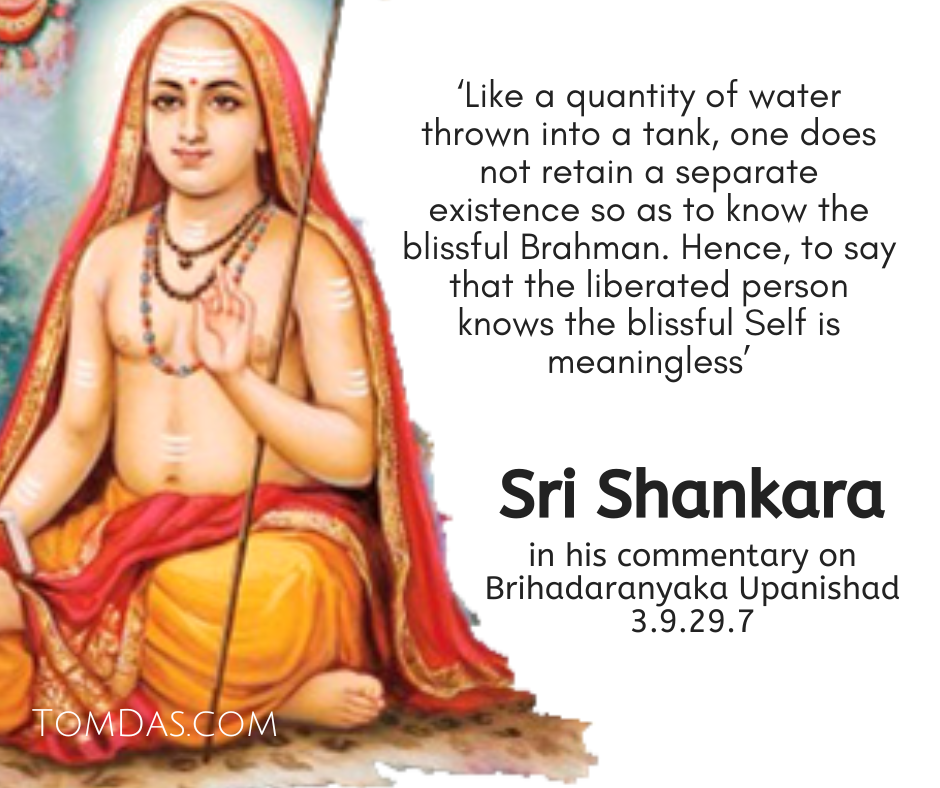
Like a quantity of water thrown into a tank, one does not retain a separate existence so as to know the blissful Brahman. Hence, to say that the liberated person knows the blissful Self is meaningless. If, on the other hand, the liberated one, being different from Brahman, knows the bliss of Brahman and the individual self as, “I am the Bliss Absolute”, then the oneness of Brahman is contradicted, which would be against all Srutis; and there is no third alternative.
Tom: See my explanation in the introduction above
Moreover, if Brahman ever knows Its own bliss, it is superfluous to distinguish between awareness and unawareness. If It is constantly aware of this bliss, then that is Its nature; hence there is no sense in maintaining that It cognises Its own bliss.
Tom: the point here is that if Brahman is ‘constantly aware of it’s own bliss’, then this bliss is simply the nature of the Self, as Self is One, and it doesn’t make sense to think of an entity that cognises or perceives bliss in some way in Self-Realisation.
Such a view would be tenable if ever there was the possibility of Its not knowing that bliss, as for instance one knows oneself and another (by an act of will). There is certainly no sense in distinguishing between a state of awareness and one of unawareness in the case of one whose mind is uninterruptedly absorbed in making an arrow, for instance.
Tom: Shankara’s argument here is saying that to speak of ‘constantly knowing bliss’ during self-realisation would only make sense if there would be a possibility of not knowing bliss during self-realisation, which is not possible, so again, bliss is the nature of Self and not a cognised object.
If, on the other hand, Brahman or the Self is supposed to be knowing Its bliss interruptedly, then in the intervals when It does not cognise Itself, It must know something else; and the Self would become changeful, which would make It non-permanent.
Tom: If the bliss of Brahman came and went, or increased and decreased, then that would mean the Self is subject to change (which it isn’t) and is therefore impermanent (which it isn’t).
Hence the text, ” Knowledge , Bliss “, etc, must be interpreted as setting forth the nature of Brahman, and not signifying that the bliss of the Self is cognised.
Tom: Regarding the initial statement of Shankara’s above, namely that there is no body in Liberation, here are some quotes of Sri Ramana Maharshi’s that say the same, taken from Guru Vachaka Kovai:
86 Don’t ask, “How did this error rise,
Why this ignorance that the Self
Itself is as the world transformed?”
Seek rather and find out to whom
This happened, and the error [Tom: of the world appearance] will
Persist no more.
87 What is the Self’s self-transformation
As the world? A coil of straw
Appearing as a snake? Look hard,
You see no snake at all. There is
No transformation, no creation, none,
No world at all. [Tom: ie. ajata vada]
97 Only the mind, by maya’s might
Deluded, and looking outward sees
The body. The true Self knows no body.
To call the Self of Pure Awareness
The body’s owner or indweller
Is an error.
[Tom: This is reference to Chapter 13 of the Bhagavad Gita where Krishna states the Self is the knower of the body, and various other scriptures which advise that the Self is somewhere deep within the body, dwelling in each and everyone’s body, here Bhagavan Ramana is saying even this is not true, pointing us to a deeper teaching]
1230 The things you think of as existing
Do not exist. But That of which
You know not if it does exist
Or does not [Tom: ie. the supreme birthless deathless unchanging ever-pure blissful Self], That alone exists.
First know who you are. This requires no sastras (scripture) or scholarship | Sri Ramana Maharshi
First know who you are. This requires no sastras (scripture) or scholarship. This is simple experience. The state of being is now and here all along. You have lost hold of yourself and are asking others for guidance. The purpose of philosophy is to turn the mind inward. “If you know yourself, no evil can come to you. Because you asked me I have told you this” (see Kaivalya Navaneeta). The ego comes up only by holding you (the Self). Hold yourself and the ego will vanish. Until then the sage will be happy saying, ‘There is’, and the ignorant will be asking, ‘Where?’
Regulation of life, such as getting up at a fixed hour, bathing, doing mantra-japa, etc., all this is for people who do not feel drawn to Self-enquiry, or are not capable of it. But for those who can practise this method all rules and disciplines are unnecessary.
Undoubtedly it is said in some books, that one should go on cultivating one good quality after another and thus prepare for moksha; but for those who follow the jnana or vichara marga, their sadhana is itself quite enough for acquiring all daivic (divine) qualities; they need not do anything else.
What is Gayatri? It really means ‘Let me concentrate on That which illumines all’.
~ Gems from Sri Ramana Maharishi, Chapter 4
Who can conceive of the state of the Jnani? Sri Sadhu Om | The true nature of the Jnani. The true nature of Jnana | Advaita Vedanta | Sri Ramana Maharshi

The following verse is taken from Guru Vachaka Kovai verse 1105 followed by commentary by Sri Sadhu Om, a direct devotee of Sri Ramana Maharshi’s who spent several years with him. Guru Vachaka Kovai is recognised as being the most authoritative exposition of Sri Ramana Maharshi’s verbal teachings, and can be downloaded in full here. For this particular verse, Sri Ramana Maharshi has also re-written the verse so we have 2 forms of the same verse:
1105. The Jnani, the unchanging one, who is sleeping naturally within the body, does not know His activities [vyavahara] in the world, His absorption [nishtha] and His sleep, just as one who is sleeping in the cart does not know the moving of the cart, its standing still and its lying [with the bullocks unyoked].
The above verse was rewritten by Bhagavan Sri Ramana Maharshi in the form of the following verse, which is also included in Ulladu Narpadu – Anubandham (Supplement to 40 verses on reality) as verse 31:
B21. To the knower of the reality [mey-jnani], who is asleep within the fleshy body, which is [like] a cart, His activities [in waking and in dream], His absorption [nishtha] and His sleep are similar to the moving of the cart, its standing still and the cart being unyoked, to one who is sleeping in the cart
Commentary by Sri Sadhu Om: The bodily life of a Jnani appears to be real only from the perspective of others. So ignorant people [ajnanis] think, “This Jnani is performing activities here in the waking state.”
But since the Jnani is verily bodiless, He does not know those activities; to Him the body and its activities are completely non-existent.
Just as the traveler who is sleeping in a bullock cart does not know the movement of the cart, and just as a sleeping child does not know that he is taking food, so also the Jnani does not know the state in which the body, the senses and the mind are active.
When the body, the senses and the mind of a Jnani remain without activities, people think, “This Jnani is in samadhi.” This is similar to the state where the oxen remain yoked to the cart but are motionless. Even this state of samadhi or nishtha is not known to the Jnani; for Him it is completely non-existent. When people think, “This Jnani is sleeping,” this state of apparent deep sleep in which his body, his senses and his mind seem to be unconscious, is similar to the cart that is with the unyoked oxen.
Just as the fact that the car is undone is not known to the traveler who sleeps in the car, so also the state of deep sleep is not known to the Jnani; for him this state it is completely non-existent.
Therefore, these three different states in the life of a Jnani seem to exist only under the erroneous perspective of the ajnanis, who see the bodiless Jnani as a body.
For the Jnani, the state of activity [wakefulness and sleep], the state of samadhi and the state of deep sleep do not really exist.
That is why Sri Bhagavan says in verse 31 of Ulladu Narpadu:
“Who can conceive and how what his [the Jnani’s] state is?”
~ above text is by Sri Sadhu Om in his commentary on Guru Vachaka Kovai verses 1105 and B21
For more on the same topic, please also see here:
For those attached to the world, the world is considered to be a divine manifestation. For the advanced seeker, the world is considered to be an illusion
What exactly is Jnana (self-knowledge) according to Shankara and Gaudapada and the scriptures?
How can the Jnani (sage) function with NO THOUGHTS? Sri Ramana Maharshi
Ramana Maharshi: how to abide as the Self, the world is not real, attend to yourself
Does the Sage (Jnani) see the world? Does the world appearance exist after liberation?
Multiplicity, plurality and polarity ARE duality | Non-duality | Sri Ramana Maharshi
The nature of liberation | Manonasa by Michael Langford | Ramana Maharshi | PDF download
Does the liberated Jnani or Sage see the body, the mind, the world or the 3 states of deep sleep, waking and dream according to Sri Ramana Maharshi and Sri Adi Shankara?
Does Jnana (or Self-Enquiry) lead to Bhakti (or Self-Surrender) or the other way round? Sri Ramana Maharshi
This is one of a series of introductory articles – please see the homepage of tomdas.com for more introductory articles.
Some say that self-enquiry eventually culminates in surrender, and others say the opposite. Which is true? By the way, Self-Enquiry can also be referred to the path of Jnana (Knowledge or Wisdom) and Self-Surrender is also known as the path of Bhakti (love or devotion).
Ramana Maharshi has sometimes said it one way, and other times another, and other times said they are the same path. Again, which of these is true?
Let us see definitively what Sri Ramana says about this (surrender = Bhakti; Self-enquiry = jnana) in Guru Vachaka Kovai*, a text that is widely considered to be the most authoritative, reliable and comprehensive collection of the verbal teachings of Sri Ramana Maharshi:
722. When scanned, bhakti supreme and jnana
Shine as in their essence one.
Saying that one of them is but
A means to the other is only due
To understanding neither.
723. Even those who know may sometimes seem
To honour this saying and so prefer
One or the other of these paths.
This is in order to prevent
Some seeker half-way on one path
From giving it up and choosing the other.
724. When one adopting self-enquiry
Reaches the journey’s end and gains
Samadhi’s bliss, it is solely due
To the grace of God, one’s inmost Self,
Life of one’s life.
725. Unless the Self, the God within,
By power of grace pulls in the mind,
Who has the strength through his own effort
To stop the rogue mind’s outward drift
And merge it in the Heart and so
Gain peace?
728 To tell the truth, God’s grace supreme
And the keen quest “Who am I?”,
Which means abidance in the Heart,
Will work together as mutual aids
And bring one to the state of oneness
With the Self supreme.
729 This maya world-dream will not end
Unless the Self within speaks out.
The enquiry, “Who is the dreamer
Of this dream?” is prayer addressed
To Him to speak and wake us up.
730. It is said that meditation
On one’s own being [Tom: ie. Self-enquiry] is supreme
Devotion to all-transcending God,
Because, though spoken of as two,
They are in substance one.
731. The way of knowledge and the way of love
Are interwoven close. Don’t tear
Asunder these inseparables.
But practise both together holding
In the heart the two as one.
Meditation on the Self
Is devotion to the Lord
Supreme, since He abides as this,
Our very Self.
– SRI BHAGAVAN 13
*Guru Vachaka Kovai, or The Garland of Guru’s sayings, is widely considered to be the most authoritative, reliable and comprehensive collection of the verbal teachings of Sri Ramana Maharshi. Here is what Ramana Ashram states about the Guru Vachaka Kovai in the foreword of their publication of it:
‘[Guru Vachaka Kovai] provides the most precise, systematic and authoritative exposition of Sri Bhagavan’s teaching, explaining step by step the theory, the practice and the experience of jnana, the Truth supreme which is Being as Life Eternal, Pure Awareness, Perfect Bliss. Thus, the most comprehensive collection of the Maharshi’s sayings is Guru Vachaka Kovai.’
The paths of knowledge and love are more fully explained in the text The Path of Sri Ramana which you can download for free here. This is one of the few texts that goes into detail into both the paths of knowledge and love.
Also see:
Non-dual devotion, worship and prayer
Ramana Maharshi on those who ridicule idol-worship or image-worship
The paths of Devotion and Knowledge – Bhakti vs Jnana | Advaita Vedanta
Bhakti Yoga as a complete path to Final Liberation
Sri Ramana Maharshi: the necessity of Meditation
Is the Self a witness? Or is it everything? Or both? How to realise the Self? Advaita Vedanta | Atman | Self-Realisation

This is one of a series of introductory articles – please see the homepage of tomdas.com for more introductory articles. Also see:
Recommended Reading: Books for Enlightenment, Liberation and Self-Realisation
Question: Hi Tom, it is often said that the Self is the Witness, meaning that which sees or perceives all objects. In other places it is said the Self is everything. I’m not sure what to make of this. Can you give me some clarity please?
Tom: Hi, yes, this can cause lots of confusion for many. Even many Vedanta teachers do not really understand this point. As ever, Bhagavan Sri Ramana Maharshi points us to the true vedanta, the truly liberating way, in his teachings.
In truth the Self is not a witness (Sanskrit: sakshi) at all, but as long as we think we are a body-mind entity, and as long as we see a world outside of or apart from our self, the Self is indicated or pointed out as being the Subject or the Witness.
When in Self-Enquiry (the path of Knowledge) we turn our attention away from the objects, which means the various gross and suble phenomena that are perceived, and towards the Subject or Self (‘Witness’), eventually the ego-mind which takes itself to be a body-mind entity dissolves or dies and all that is left is the Subject-Witness-Self. This Self can no longer truly be said to be either a Subject (for there are no objects present), nor can it be said to be a Witness, as there is nothing to witness. It is All, it is the Sole Reality, ‘One without a second’, as it is often described as being in the Upanishads.
Sri Ramana Maharshi has taught us in Guru Vachaka Kovai verse 98 (Guru Vachaka Kovai is the most authoritative record of Sri Ramana Maharshi’s verbal teachings according to Sri Ramana Ashram):
98. Unless the body is taken to be ‘I’, otherness – the world of moving and unmoving objects – cannot be seen. Hence, because otherness – the creatures and their Creator – does not exist, it is wrong to call Self the Witness.
Sri Sadhu Om, a direct devotee of Sri Ramana Maharshi, writes in his commentary on this verse:
Descriptions of self as the ‘witness of the individual soul’ (jiva sakshi) or the ‘witness of everything’ (sarva sakshi), which can be found in some sacred texts, are not true but are only figurative (upacara), because only when other things are known would the one who knows them be a ‘witness’ of them. Since self does not know anything in the state of absolute oneness, which is devoid of any other thing, to what can it be a witness? Therefore describing self as a ‘witness’ is incorrect.
What both Sri Ramana Maharshi and Sri Sadhu Om are saying is that objects only appear when the ego/ignorance is present. In Self-realisation, there are no objects, only the Self, so in truth the Self cannot be said to be a witness.
In verse 869 of Guru Vachaka Kovai Sri Ramana teaches us:
869. ’Tis a foolish fancy to ascribe the role of ‘witness’ to the Self, the luminous Sun, the mighty sky of Pure Awareness. In the Self Immutable there is no room for maya’s darkness void. The Self is one sole whole without a second.
Here is an alternative translation of the same verse, with Sri Sadhu Om’s commentary, which essentially states in truth, ie. in realisation, there is no Maya in the Self. It is only for ajnani’s, ie. the ignorant, that consider the Self to be a witness of phenomena/maya:
869. The role [dharma] of seeing is ascribed to Self – the space of consciousness, the sun – only in the imagination of ajnanis, [because] maya, the empty ignorance [of seeing otherness], never exists in Self, the support [sthanu], [and also because] Self is without a second.
Sri Sadhu Om’s comments: Since Self is in truth that which transcends all roles and all qualities, and since It exists as one without a second, to glorify It as the ‘witness of all’ [sarva-sakshi] or as the ‘knower of all’ [sarvajna] is merely the folly of ignorant people.
This teaching is explained in detail in The Path of Sri Ramana and Sadhanai Saram (the essence of spiritual practice)
Q. Why then is the Self said to be a witness at all?
Tom: it is only to point out where to direct your attention towards. That apparent Subject, the I AM is what we truly are and all there truly is. All else is illusion, maya. The problem is that we think that we are the body-mind, which is actually a part of maya. Only through Self-Knowledge can we realise what we truly are, and to that end the Self is pointed out as being a Witness or being the Subject. Why? So we can turn towards it and thereby realise our/the Self.
Q. Why then is the Self said to be everything?
Tom: When we are under the spell of illusion, meaning when we take ourself to be a body-mind entity living in an apparently external world, we can say that everything is the Self, that all comes from the Self, and the Self pervades all. What can be apart from the Self? Nothing! However, at this point, we are still under the spell of illusion or maya or ignorance (all are synonyms). When, through self-enquiry, we discover the Reality, our Self, as it truly is, there is no Maya/ignorance/illusion at all and we realise there never was ever any illusion/ignorance at any point in time ever (actually we also realise there was never any time either, which is simply a part of the illusion). This is the Self. This is self-realisation.
There is actually no realisation of anything in self-realisation, for realisation implies a mind that realises something, and neither the ‘mind’ nor ‘something’ are in the self, both being aspects of Maya (illusion). There is only the Self.
Q. So does the Self pervade everything, all objects?
Tom: Why worry about objects, maya? The ego-mind is always concerned about maya. Discover the Self and find out! You will no longer be interested in maya (ie. there is/will be no maya in realisation). To discover the self, consider all objects to be maya and turn your attention lovingly towards the Subject, the I AM, what you actually are
Renouncing this phenomenal world
Which seems to, but does not, exist
We gain (the great ones say) the Self,
The Awareness shining all unseen.
Sri Ramana Maharshi, Guru Vachaka Kovai, Verse 835
Q. Why in some places does it say objects are not-Self and in other places it says objects are Self?
Tom: Contrary to what many think it is the lower teachings that say all is Self, to convince the seeker that there is only the Self. The higher teachings say that objects are not-Self, ie. maya or illusion, thus encouraging the sincere seeker to turn away from objects towards the Subject, whose true nature is Eternal Love and Bliss. The Eternal and Blissful nature of the Self is seemingly lost due to pre-occupation with the dream-like maya. Therefore the only way out is to attend to the Eternal and discover what you truly are!
Note that in both cases, whether you consider objects to be the Self or non-Self, that is a conceptual position for the mind. And liberation has nothing to do with the mind, the mind itself being ignorance.
Q. Don’t the scriptures state that the mind leads the way to liberation? Isn’t the way to liberation through knowledge, as isn’t knowledge to do with the mind?
Tom: It is true that some scriptures say that through the mind we can reach liberation. That means that it is the mind that hears the teachings (sravana), reflects upon them (manana), and then this naturally leads to meditation upon the Self (Self Enquiry or Nididhyasana) which in turn leads to manonasa (destruction of mind, or destruction of ignorance) which is the same as liberation (Mukti or Moksha), which is also the same as Jnana (knowledge) or Atma Jnana (Self-knowledge).
In Self knowledge, there is only the Self. There is no mental knowledge in Jnana at all, Jnana or Knolwedge just being another name for the Self. See here for more on this:
What is true Wisdom? What is Jnana? Sri Ramana Maharshi (Upadesa Saram)
Q. So in that case does that mean that all we have to do for realisation is to remain as the witness, watching phenomena as they come and go?
Tom: No, that is not correct at all. Whilst remaining as the witness is a lovely teaching in many ways that can be a wonderful practice for some people at some points on their journey, merely remaining a witness is (1) not liberating and (2) is also not possible for most, as the mind keeps on getting drawn back into thoughts of body, mind or world. Merely remaining as the witness to objective phenomena as they come and go is merely attending to maya, as all objective phenomena are maya, and so the ego-illusion and suffering continue. For realisation, we must attend to the Subject-Self, the I Am, until the ego-mind (which is duality) is no more, ie. until self-realisation, ie. until be discover what we truly are.
For more see here: In Brief: how to attain Liberation and HOW TO END EGO-SUFFERING (and why other spiritual paths tend not to ultimately work
If you refrain from looking at this
Or that or any other object
Then by that overpowering look
Into absolute Being you become
Yourself the boundless space of pure
Awareness which alone is Real Being.
Sri Ramana Maharshi, Guru Vachaka Kovai, Verse 647
Question: What is it that discovers the Self?
Tom: There is no entity that discovers the Self. It is only the Self that ‘discovers’ the Self. It is the total absolute removal or total absense of ignorance. It is merely the Self being the Self, One without and second (maya), no more, no less.
!Om Namo Bhagavate Sri Ramanaya Om!
The paths of Devotion and Knowledge – Bhakti vs Jnana | Advaita Vedanta
The following is taken from the wonderful text Sadhanai Saram (The Essence of Spiritual Practice) written by Sri Sadhu Om, a direct devotee of Sri Ramana’s. This text not only gives us the essence of Sri Ramana Maharshi’s teaching, but also directs us to the true Vedanta teachings. The notes are written by Sri Sadhu Om himself. You can download the full text as a PDF using the above link.
The paths of knowledge and devotion are more fully explained in the text The Path of Sri Ramana which you can download for free here. This is one of the few texts that goes into detail into both the paths of knowledge and love.
Also see Recommended Reading: Books for Enlightenment, Liberation and Self-Realisation
The Paths of Devotion (Bhakti) and Knowledge (Jnana)
79. To the extent to which love for God arises in one’s heart, to that extent will one acquire knowledge about Him. And to the extent to which one knows the nature of God, to that extent will the mind gain steadfast love for Him. Thus, knowledge (jnana) will be increased by devotion (bhakti), and devotion (bhakti) will be increased by knowledge (jnana).
80. By means of our love for God, He will give us more knowledge of Him, and by means of our knowledge of Him, He will give us more love for Him. Therefore, of these two paths, bhakti and jnana, follow that one for which you first gain a liking, because that one path will lead you to follow the other one into the heart.
81. In the life of an aspirant who is seeking liberation, bhakti and jnana will be experienced as inseparable, like the two sides of one sheet of paper. Hence, each one is equal to the other. They are not two different things, for the true nature of both of them is one and the same; know that bhakti and jnana are merely two names for that one thing. (Garland of Guru’s Sayings (Guru Vachaka Kovai) verses 722, 731)
82. The state of abiding firmly in Self-alone is wisdom (jnana). Would it be possible to abide thus in Self if one did not have love for Self? Love for Self-alone is bhakti; abiding firmly in Self on account of that love alone is jnana. What difference is there between these two? Discriminate and know this truth. (Maharshi’s Gospel p.24)
83. If there did not exist the power of gravity, which attracts and pulls everything towards the earth, would anything remain stable on earth? On scrutiny, devotion (bhakti) is found to be similar to the gravitational power of attraction, while the state of wisdom (jnana) is found to be similar to the state of objects remaining stable on earth as a result of that attraction. If either one of these two, the power of attraction or bhakti and the state of abidance or jnana, were absent, the other one would not exist.
84. An aspirant who practices Self-inquiry, which is the path of jnana, denies his own individuality by knowing, “I, this insignificant ego, am not the doer of any action”; while a devotee denies his own individuality by knowing, “God alone is the doer of all actions.” Thus, since an aspirant who follows either of these two paths refrains from assuming the sense of doership, understand that these two paths are not different even during the time of practice, and follow either of them.
85. We should not allow our minds to become bewildered and confused by trying to deliberate and decide, “Which of these two, the practice of bhakti or the practice of jnana is the best means for attaining liberation?” For whichever path a liking arises in the heart of a person, for that person that path alone is the best.
86. According to the strength of habit continuing from former lives, in this life the mind will acquire a liking either for the path of devotion or the direct and unfailing path of Self-inquiry, and will feel that particular path to be the best and most suited to itself. Therefore, follow at least one of these two paths to its very end.
Inquiry Becoming Easy Due to Devotion
87. When, having wept and wept with intense yearning for a long time, unceasingly thinking of and adoring the Gracious Feet (of the Lord), the mind which rises (as “I am so-and-so”) dissolves and becomes pure, the blemishless Self-inquiry (jnanatmavichara) will become firmly settled (in the heart) and the experience of Self (swarupa-anubhava) will of its own accord arise very easily indeed. (Sri Muruganar, Sri Ramana Jnana Bodham v.1286)
88. O, you who say, “We have never seen you closing your eyes and practicing Self-abidance (nishtha); tell us, how did you attain the state of inner silence (mauna)?” Understanding the above verse, know the secret of (how to attain the true experience of) God, who is not seen even though one waits closing one’s eyes (for a long time in expectation of seeing His true vision).
Note: the previous verse is the answer to the above question
Tom: The paths of knowledge and love are more fully explained in the text The Path of Sri Ramana which you can download for free here. This is one of the few texts that goes into detail into both the paths of knowledge and love.
Also see:
Non-dual devotion, worship and prayer
Ramana Maharshi on those who ridicule idol-worship or image-worship
 Tom Das