One of the best books ever written on the subject of Self-Realisation/Liberation is the Seven Steps to Awakening, compiled by Michael Langford. It contains wonderful, clear and rare teachings for those who are able to truly take in what is presented here:
One of the best books ever written on the subject of Self-Realisation/Liberation is the Seven Steps to Awakening, compiled by Michael Langford. It contains wonderful, clear and rare teachings for those who are able to truly take in what is presented here:
One of the best books ever written on the subject of Self-Realisation/Liberation is the Seven Steps to Awakening, compiled by Michael Langford. It contains wonderful, clear and rare teachings for those who are able to truly take in what is presented here:
One of the best books ever written on the subject of Self-Realisation/Liberation is the Seven Steps to Awakening, compiled by Michael Langford. It contains wonderful, clear and rare teachings for those who are able to truly take in what is presented here:
One of the best books ever written on the subject of Self-Realisation/Liberation is the Seven Steps to Awakening, compiled by Michael Langford. It contains wonderful, clear and rare teachings for those who are able to truly take in what is presented here:
One of the best books ever written on the subject of Self-Realisation/Liberation is the Seven Steps to Awakening, compiled by Michael Langford. It contains wonderful, clear and rare teachings for those who are able to truly take in what is presented here:
This post is only for those who are deeply interested in liberation, and it was originally posted here on Facebook
There is a teaching that says that after liberation, the liberated sage’s ego becomes dead, like a burnt rope, in that it continues to exist in superficial appearance, in name and form, but doesn’t actually have any robust structure or power.
Similarly, the same teaching says that the liberated sage’s body & mind continues after liberation, but there is no longer any individual will at play, and it is just the destiny of the body mind (known as prarabdha karma in Sanskrit) that plays out. An analogy is given of how a fan continues to rotate even when the power has been turned off, the idea being that in a similar way the sage’s body continues to act in the world according to its pre-existing energy and destiny but without anybody’s individual will or ego being present any longer..
Sri Ramana often gave this teaching himself, but he also said this was a lower teaching for those who were unable to accept the higher teachings. In his writings, and to his closest devotees, he often explained that in truth, in liberation there is no karma (action or activity) whatsoever, and there is no body or mind or world for the Jnani. It only appears this way due to the ignorant view of the ignorant onlooker.
33. The statement that the jnani retains prarabdha while free from sanchita and agami is only a formal answer to the questions of the ignorant. Of several wives none escapes widowhood when the husband dies; even so, when the doer goes, all three karmas vanish. ~ Supplement to the 40 verses on reality, written by Sri Ramana Maharshi
and
The Self-Realised Sage knows not whether the transient body comes and stays, or dies and leaves, even as a senseless drunkard knows not what happens to his clothes. ~ Guru Vachaka Kovai, Sri Bhagavan 24 (a verse written by Sri Ramana Maharshi)
AJATA
This teaching is known as Ajata, which is the teaching that the appearance of the body mind and world only appear due to ignorance or ego, and that the world, including the body and mind, never really appeared or existed in the first place. Ignorance never really came about at all. Duality, meaning the appearance of any rising phenomena whatsoever, never actually occurred.
SHANKARA & UPANISHADS
This is why the scriptures describe the truth, the true self, as being homogeneous, without multiplicity or variety, devoid of appearances, objects, forms and imagination. The scriptures say in Brahman there are no hands or feet or eyes or ears or thoughts, etc etc, and this is the meaning of those verses, as Shankara has also explained in his commentaries.
eg. Shankara writes the following:
‘Because I am without an eye*, I have no sight. As I have no ear either*, how could I have hearing? As I have no voice I can have no speech. As I have no mind, how could I have thought? There cannot be action on the part of that which does not have life force (prana). There cannot be knowership on the part of that which has no mind. Neither can there be knowledge or ignorance on the part of me who am the Light of Pure Consciousness ~Sri Shankara, Upadesa Sahasri 13.1, 13.2
*Shankara is quoting from Brihadaranyaka Upanishad 3.8.8
BUT HOW CAN THERE BE DIFFERENT LEVELS OF A NON-DUAL TEACHING?
Here is how Lakshmana Sarma (LS), a direct devotee of Sri Ramana’s, describes this in Maha Yoga pages 59-60; here LS speaks of 2 levels of the teaching, the higher (true) and lower (ultimately untrue); note that LS uses the English word ‘revelation’ to refer to Shruti (the revealed scriptures consisting primarily of the Vedas and Upanishads):
‘The ancient lore is twofold. One part of it is addressed to those who are not conscious of being in ignorance, and therefore have no use for a teaching intended to dispel that ignorance. The other part of the ancient lore is addressed to those that are conscious of the ignorance and are in earnest to escape from it. These two parts are quite distinct. But this feature of the ancient Revelation is not known to these believers. Besides they are offended by the inevitable corollary that theirs is a lower position; they also feel it a grievance that the world, which they believe to be real, should be dismissed as unreal, and often want to quarrel with us who are followers of the Sages; we however have no quarrel with them, as the Sages have pointed out, because we realise that for them it is all right to believe as they do, and, so believing, to make the best of the world while it lasts. They are like dreamers who are persuaded that their dreams are real, and do not want to awake. We have begun to see that this worldly life is only a dream, because the Sages tell us so; and we want to awake.’
See this post below for more on this topic – I share more quotes from Sri Ramana and Sri Shankara which further explains the above in more detail:
You are free to download and share these pictures quotes which contain some key teachings of Advaita Vedanta courtesy of Adi Shankara, taken from the text Upadesa Sahasri (A Thousand Teachings):
You are welcome to download and share any of the following picture quotes – many more can be found on my Facebook page here in the photo albums.
There was a particular conceptual world-view that great sages such as Sri Ramana Maharshi encouraged us to take on, if we are able to, in order to facilitate our spritual practice and thereby attain self-realisation or liberation.
For lower seekers of liberation, meaning for those whose minds were unable to be open to the higher teachings, Sri Ramana Maharshi and the great sages often did not give the teachings we will outline below, but for those whose minds were ready and ripe, he would often encourage this following view of creation and the world, as it is this conceptual view that most readily allows the seeker’s mind to properly do self-enquiry and thereby realise the Self.
However, rest assured, that regardless of how one conceives of the world, meaning that even if you do NOT agree with the teachings below, if one makes an earnest attempt to understand and carry out Self-Enquiry, liberation will be assured irrespective of your conceptual view on liberation and the world. Then you will discover the truth for yourself.
A warning/disclaimer
The teachings that are given below, whilst they are open to anyone, they are very radical in their nature. It is not recommended that you read them if you are not an earnest seeker of liberation or if your mind is likely to be destabilised by a more radical notion of the nature of the universe or what liberation looks like.
We will see that these same exact teachings have been given for many centuries, but traditionally these teachings would only be given to a prepared mind, a mind prepared by devotion, faith and loving surrender. This infuses the mind and heart with an energy of peace, calm and loving kindness and happiness. It is this stable peaceful mind that is most able to receive these teachings, although it is possible there can be some exceptions to this.
Some people can find these teachings quite distressing and destablising and the author of this post takes no responsibility for providing this information to you that has been traditionally written about and taught for many centuries and is already in the public domain.
Be open minded to receive these teachings
Similarly, the ego-mind will often reject these teachings when it first hears them. Often a person’s ego will only be able to come to these teachings once it has suffered enough. The more insight the ego has into suffering, and the more it is able to contemplate the causes of suffering, then the more likely it is able to appreciate the truth of these teachings.
Usually only a sharp intellect is usually able to discern these teachings. Many people read these types of spiritual teachings and immediately project their own preconceived ideas onto them, and so distort the teachings from the very beginning. If we keep an open mind and read the range of quotes given, we will inevitably see what they are truly pointing too. If we cling to our own preconceived notions then we are less likely to receive these teachings in the way they were intended.
These teachings are rare and often misunderstood
Many prominent spiritual teachers, including prominent teachers of advaita and non-duality, give out distorted versions of these teaching, so it is important to be able to temporarily put aside all you have learnt whilst reading or listening to these teachings if you really want to understand what the intended communication actually is.
It is also important to not assume that all spiritual teachers are teaching their own versions of the Same One Teaching, and be open to the fact that they may be teaching very different things; just because a teaching is helpful, doesn’t mean it is liberating; and just because a teaching isn’t liberating, it doesn’t mean it will not be helpful to you.
My recommendation is that you listen to what Sri Ramana Maharshi has to say, and the best way to do that now that his body has passed is to read his own writings themselves.
The Jnani does not see the world
Sri Ramana often said that the Jnani (self-realised or liberate Sage) is totally unaware of the body, the mind and the world, and that the liberated sage also has no awareness of the 3 states of dream, deep sleep or waking, all of which are a projection of ignorance (aka the mind). We will see below that Sri Shankara says the same, as does his guru’s guru, Sri Gaudapada, as well as his student, Sri Suresvara. The quotes given in the later part of this post will concentrate on demonstrating that this was indeed the teachings of these great teachers.
The Conceptual Teaching Framework for the Teachings
The following conceptual teaching framework is consistently given from the Vedas, the Upanishads, Sri Ramana Maharshi, Sri Gaudapada, Sri Shankara, and Sri Suresvara as well as others such as Ramakrishna, Vasistha and Ashtavakra, and it is this larger framework that the quotes that will be given later fit into. It is essentially a combination of the Ajata Vada and Dristi Sristi Vada views. The reason for different views on how the world is created in explained by Sri Ramana Maharshi in his answer to question 10 in his text Self-Enquiry (click here to download the text) as follows:
Question: If the entire universe is of the form of mind, then does it not follow that the universe is an illusion? If that be the case, why is the creation of the universe mentioned in the Veda?
Sri Ramana Maharshi: There is no doubt whatsoever that the universe is the merest illusion. The principal purport of the Veda is to make known the true Brahman, after showing the apparent universe to be false. It is for this purpose that the Vedas admit the creation of the world and not for any other reason. Moreover, for the less qualified persons creation is taught, that is the phased evolution of prakriti (primal nature), mahat-tattva (the great intellect), tanmatras (the subtle essences), bhutas (the gross elements), the world, the body, etc., from Brahman [Tom: ie. the lower seeker is taught a traditional creation model of the world in which the subtle elements progressively evolve into more complex structures, etc], while for the more qualified simultaneous creation is taught, that is, that this world arose like a dream on account of one’s own thoughts induced by the defect of not knowing oneself as the Self [Tom: ie. the defect of not knowing oneself is ignorance, and this creates thoughts, and these project the world akin to a dream, so the world is a creation of ignorance or delusion]. Thus, from the fact that the creation of the world has been described in different ways it is clear that the purport of the Vedas rests only in teaching the true nature of Brahman after showing somehow or other the illusory nature of the universe. That the world is illusory, every one can directly know in the state of realization which is in the form of experience of one’s bliss-nature
Without understanding the creation framework that the teachings are operating in, the teachings are much more difficult to follow. The opposite is also true, in that understanding this framework may greatly aid our journey to liberation. Please note that all of the following points have strong scriptural support and form the clearest most consistent interpretation of the scriptures according to the great sages who have proclaimed them – see the recommended reading list for books that explain these teachings more thoroughly and in greater detail:
1. There is only the Self and you are That. Self-realisation and liberation are synonyms and they represent the highest possible ‘attainment’ in which duality, suffering and any sense of individuality are competely destroyed never to return again. See a summary of Sri Ramana Maharshi’s teachings here for more on this and how to realise this for yourself.
2. In the Self there are no objects or arisings or appearances at all (this is the doctrine of ajata vada – no phenomena are created or born in it, not even as an appearance, see link for more). It is:
‘one without a second’
homogenous (the same throughout, without any variation whatsoever)
unchanging (without possibility of change arising within or being projected upon it)
formless (ie. without form and without the possibility of any form arising in it)
without karma (without action or movement, also known as ‘silence’ or ‘stillness’) or the possibility of karma/action (karma literally means action or change, more commonly refering to the chain of cause and effect)
without thoughts or the possibility of thoughts
non-dual (without duaity)
devoid of time and space and therefore devoid of samara (the cycle of birth and death)
blissful – it is heaven, the culmination of all desires, everything you have ever wanted and more, devoid of suffering and without any problems or questions or doubts.
Peace, Silence and Stillness. See herefor what it really means to be still according to Sri Ramana Maharshi.
Infinte unconditional Love – the Self is the only infinite unconditional love, infinite unconditional love not being possible in the realtive realm of objects, people and things, all of which are conditional, under the sway of cause and effect and temporary.
Divine, heavenly, godly
devoid of the appearances or arising of the 3 states (waking, dream and deep sleep)
devoid of body and mind, even as an appearance
without ignorance or the possibility of ignorance or any arisings ever arising in it
without describable characteristics; although it is often said to be Sat Chit Ananda, this is a metaphorical description, all descriptions of the Self ultimately fall short and can only be metaphorical at best
unable to be conceived, understood or thought about. All metaphors ultimately fall short when trying to describe or explain the Self, even though they may be provisionally be used as a pedagogical device (teaching aid).
The Self is also known as Turiya (the fourth), Samadhi, Nirvilkalpa Samadhi, Pure consciousness (the word ‘pure’ refers to the absense of arisings), Pure Being, Truth, Reality, True Nature, Jagrat-Susupti (waking sleep), God, Heaven, the Abosolute, Brahman, etc.
3. The self is both the only ‘thing’ that is real and the only ‘thing’ that exists, although it is not actually ‘a thing’ at all. To know the Self is to know all, and there is no real ‘knowing’ of the self, the word ‘knowledge’ being a metaphor for the removal of ignorance or another word for the Self. To know the Self is just to be the Self devoid of any phenomenal arisings. See here for more on this teaching which explains the true nature of Jnana, or self-knowledge, according to Shankara, Ramana and the scriptures. Reality and Existence are in fact synonyms and the idea that something can be both unreal but still appear or arise is fallacious (a false teaching) and not a teaching found anywhere in the Vedanta scriptures or the Upanishads – see here for more on this teaching. Also see this article here: The Meaning of Real and Unreal in Advaita Vedanta
4. It is due to ignorance that the range of phenomenal appearances appear to arise – ie. the appearance of one’s apparent body-mind, apparent other people and living beings, and apparent things such as tables, chairs, cars, trees, plants, planets, celestial bodies and stars,etc – all of these are a mere projection of ignorance, as explained by Sri Ramana Maharshi in his answer to question 10 in his text Self-Enquiry which you can read here. This projection is known as ‘duality’. In the Self or in non-duality, there is no duality. We will see Shankara and others clearly give this teaching below many times. It is also explained in this video here:
5. This root ignorance also goes by other names such as ego, mind, maya(illusion), imagination, hallucination, nescience, delusion, the I-thought and the I am the body-mind idea. (See the text Self-Enquiry by Sri Ramana Maharshi where this is explained in the answer to question 3) Therefore it could equally just as well be said that the world (ie. body, mind and world) are a projection of any of the above words.
In some teachings it is said that there are 2 forms of ignorance, the macro-form called maya which projects the body mind and world, and the micro-form called ignorance which gives rise to the individual sense of being a person, and that vedanta teachings removes only ignorance, the limited sense of being a jiva, but not maya, and so the body-mind world continues after liberation. Please note this is not the teaching given in the Upanishads or by Shankara at all and is a later development by later commentators who were not able to understand the radical nature of the original true and liberating teachings, and changing the teachings in this way renders a potentially liberating teaching potentially non-liberating. We repeatedly see how the terms ignorance and maya are used interchangably throughout the scriptures.
6. It is also explained that ignorance creates the subtle sense of being identified as a seperate entity (ego), and then this subtle entity (ego) itself projects the body and mind and identifies with this, which is called being a jiva (a living embodied entity). Subsequently, or simultaneously, depending on how it is expounded, the ego also projects the appearance of an environment for the body-mind entity which we call the world, and within this world the body-mind entity roams and experiences various sense objects via the body and subtle objects via the mind (thoughts, feelings, emotions, imaginings). This is explained succinctly in the text ‘Who Am I?’ by Sri Ramana Maharshi – I recommend the Sri Sadhu Om version which is the more accurate of the main translations.
7. In this same way the ego or ignorance projects the 3 states which it then experiences in turn. This is all the realm of ignorance. When objects arise, it is called either the dream or waking state, and when objects temporarily cease, that is called deep sleep. In fact the scriptures go on to explain here that we could say there are only 2 states, one called dream, when object appear, and another called sleep, when there are no objects, and that what we call the waking state is merely another form of dream. These refer to ignorance and reality respectively, or maya (illusion) and satya (truth or reality) – see here for this rare teaching.
8. This ignorance or ego or maya is itself not a real entity and in truth (ie. in self-realisation) it is ‘seen’ to have never actually occurred at all. Nothing (phenomenal) ever really happened at all. This is the ajata teaching, that nothing was ever created or arose at all. There was never any ignorance/maya or even any appearance of ignorance.
9. Within the waking dream, there is a specific way for the apparent ego to apparently remove ignorance (self-enquiry, also known as surrender; these are analgous to the paths of knowledge, jnana, and devotion, bhakti), and when ignorance is removed, the entire effects of ignorance, namely all phenomenal arisings, also cease, the effects no longer having a cause to sustain them. Karma or action refers to movement which can only occur. This specific method is clearly explained in the The Path of Sri Ramana – part 1 and in the book The Most Direct Means to Eternal Bliss by Michael Langford, which you can download for free from the links given. The method specifially involves discovering who or what you really are – this is done by allowing the mind to quieten, allowing the attention to no longer go towards gross and subtle objects, and with attention inward turned discovering the true nature of the ‘I’ or ‘I Am’. Importantly no objects/ phenomena arise at the time of the discovery – it is Pure Self alone, devoid of duality/objects. The method is also explained in brief here and supporting quotes from Shankara and others can be found here.
Just because the waking dream is ultimately an illusion, it doesn’t mean there is not a specific method to escape it. Effort on this specific path is required for liberation.
It is important to listen not only to our own hearts and inner knowing, but to also listen to the words and teachings of the Guru who has already crossed over to the other shore of liberation. Why? Because even though the same teaching the True Guru (Sat Guru) gives is already shining and being sung in our hearts, due to ignorance our minds are turned outwards and emeshed with thoughts, we are often not able to truly listen to our Hearts (the True Guru Within) and instead our ego distorts the teachings. Therefore the Guru’s words are supremely important in aiding us who are genuinely interested in liberation and this is why tradition exaults the value of the Guru on the path to Self-Realisation.
There is no other newer or quicker way that can be discovered to know or realise the Self. This is not a dogmatic assertion, but should become clear once you start to understand the teachings and why Self-Enquiry is the only way to liberation, although the same process can go by other names. Similarly there is no different way for men versus women, for this, like any other science, is universal and is applicable for all.
10. This removal of ignorance is not a real thing at all, ignorance itself being unreal, the whole thing being an imagination that never happened. This paradoxical teaching only appears paradoxical to the mind, which is unable to understand it, the mind being a product or the nature of ignorance. In truth there was only the Self, which cannot even be said to be called the self, as it is beyond all words and concepts, but it is called the Self or witness (the self is not truly a witness) for the purpose of the teaching only – see here for more on this teaching.
11. In self-realisation only the real remains, and the false or unreal no longer appears or exists; only the Self remains and what was previously called non-self, ie. all objects, these no longer remain or appear/arise. When the scriptures say that the jnani sees all phenomenal arisings and objects as being unreal or being illusory, this is a lower teaching for those whose minds are unable to fathom that the jnani is (and themselves are) not a body-mind entity at all. In truth the illusory appearances no longer appear at all and the jnani is not a person.
12. Similarly, the self cannot be known by a body-mind entity or by the mind or the ego. There is no such thing as a ‘person who is self-realised’, although it may appear that way to a person (the ignorant onlooker). There is only the Self and you are that. This also means that, relatively speaking, a jnani cannot be identified by the way they act or behave in the world – what is important is the teaching they give – are they giving a liberating teaching either verbally or non-verbally?
13. Is is the ego or ignorance that creates or projects the world, so the ego is also known as Brahma (the creator deity) or Hiranyagarbha (the cosmic womb or cosmic egg that gives rise to the world) or Isvara (the creator and ruler of the world) or Maya (the magical power that creates the appearance of the world). Sometimes it is said that all creation proceeds from the Self, but this is a simpler or lower teaching for those who consider the world to be real. See here for more on levels of the teaching and how they are taught.
14. Whilst all phenomenal arisings are ultimately illusory, as long as the body mind and world appears, ‘you’ (ego) will think yourself to be a person (a body-mind entity, ie. a jiva) living in a world of people places and things (the world or jagat in Sanskrit). This world is governed by apparent rules and forces which can be personified as a ruler deity (Isvara, which means ruler or Lord). These three, jiva, jagat and isvara, are all illusory.
15. As long as the body mind and world appear, we will consider ourselves to be a jiva (person) living in a jagat (world), we will suffer accordingly, as these appearances are downstream from the root ignorance. Whilst this is the case, there is a clear method, often called Self-Enquiry, also known as the Path of Knowledge, that can be followed to attain liberation – this involves effort and application of the mind (as explained in the video above at point 12). Note that this means it is therefore not possible for appearances to arise and be experienced and simultaneously not indentify as a person/jiva or identify with what is arising. It is not possible for objects to arise in our consciousness and for ignorance to not be fully present. This is explained further in this video here:
16. The self only has to be realised once, and can only be realised once, and then that is the end of the spiritual journey. Then illusion and ignorance ends once and for all. Then all duality and suffering end once and for all, duality being another term for the arising of phenomena. There is no possibility of sadhana after realisation or integration after realisation, for there is no action or entities that exist after realisation. There is also no possibility of falling back into duality again – if that occurs, then it means the self was never truly realised to being with. The self can only be ‘experienced’ once, it can only be ‘abided’ in once, it can only be ‘known’ once (it cannot be truly experienced or known or abided in as it is not an object or container and no words truly apply, all words just being metaphors or pedagogical devices), and then the entire house of cards that is duality and maya and ignorance ends.
Expositions that advise repeated abidance or resting in the Self are just teaching devices to encourage repeated efforts in sadhana, for if we ‘rest’ in the Self just once, then Self is known in its entirely, that is all that is needed. Then there will be no question, no doubts, nor will there be possibility of questions or doubts. Whilst there can be degrees of ignorance and delusion, there are no degrees of liberation or self-knolwedge, which is one. Similarly ideas of different forms of liberation such as jivanmukti (liberation in the body whilst alive) and videhamukti (liberation after the body has died) are ultimately false view given as lower teachings for those requiring explanations on the level of ignorance – this is explained in Sri Ramana Maharshi’s answer to Question 40 in the text Self-Enquiry.
17. The idea that the sage is a person living in the world is only from the view of the ignorant ‘onlooker’ who considers themselves to be a peron, and so projects their own jivahood onto that of the ‘sage’. What we call the body-mind of a sage is in fact a projection of our own self/ignorance. The true Jnani is the self, devoid of thoughts or arisings. See here for more on this teaching. Ideas such as the ego of a Jnani being like a burnt rope or some kinds of karma persisting in liberation are lower teachings, as Sri Ramana Maharshi has explained here.
Relatively speaking, this also means that we are unable to tell who a True Jnani or Sat Guru is by outward signs such as the behaviour of their body-mind; the apparent Jnani can appear and manifest to us in a multitude of ways, according to what suits our own needs and our own ideas.
18. The parts of Maya (the appearance or waking dream) that lead us towards bhakti and self-enquiry and therefore self-realisation or liberation are called the teaching and the teacher. The teaching and the apparent teacher are themselves projections of ego, manifested by our desire for liberation, hence when the student is ready the teacher will appear. See here for more on this teaching.
19. Just as there is in truth only One Self, there is actually (if we concede to the existance of ignorance, which is truly non-existent, like the snake in the rope – see the quotes below for more on this) only one ignorance or one ego. There is only one jiva, just like in a dream. This is called Ek Jiva Vada (the doctrine of one jiva) – see here for more. Similarly, just as there is One Self and one ignorance, there is only One Teacher in truth (and you are That).
20. Note that whilst it is often said that it is the Self that witnesses or perceives the world, the Self, as we will see from the quotes below, is not a perceiver or a witness at all. To be technically correct, it is the ego or mind that sees the world. The self never sees any objects or any things, these objects and things being duality, and the self never admits of any duality or ignorance or multiplicity whatsoever. The self cannot see, hear, feel, think, etc, these all being unreal effects of ignorance only. Even to say the Self knows itself is mere poetic sentiment – the most we can say about the Self is that it IS.
Much of this teaching is given in the book Sadhanai Saram by Sri Sadhu Om, which bears repeated reading and study for those who need it, as well as in the book The Path of Sri Ramana which also explains much of the above but in less detail and can be found on the same link as Sadhanai Saram above.
This teaching is also given in Ribhu Gita, Yoga Vasista and many other places too – please click on the links for texts which concicely summarise these teachings in a wonderful way. See the recommended reading list for more.
Now, in the following quotes we will concentrate on the nature of the world, and how the Jnani doesn’t see the body mind or world because they are all non-existant in truth, as explained by Sri Ramana Maharshi, Sri Shankara, Sri Gaudapada (the Guru of Shankara’s Guru) and Sri Suresvara (Shankara’s student).
In the text Guru Vachaka Kovai (Garland of Guru’s Sayings) – a highly authoritative collection of Sri Ramana’s teachings recorded by Sri Muruganar, there are several verses that were written by Sri Ramana Maharshi himself, often highlighting key or especially important teachings. These verses were called ‘Sri Bhagavan’ – here is the 24th such verse from that text, which Sri Ramana himself wrote:
The Self-Realised Sage knows not whether the transient body comes and stays, or dies and leaves, even as a senseless drunkard knows not what happens to his clothes.
Guru Vachaka Kovai, Sri Bhagavan 24
We can see that Sri Ramana is saying that in truth the Jnani is not aware of the body at all.
This next quote is from Maharshi’s Gospel:
To him who is one with that Reality, there is neither the mind nor its three states, and therefore, neither introversion nor extroversion.
Maharshi’s Gospel (Chapter 6)
We can see here Sri Ramana is implying that it is the mind that gives rise to the 3 states (waking, dreaming, deep sleep) and for the Jnani there is no mind, nor the 3 states, therefore the Jnani’s (non-existent) mind cannot be said to be introverted nor extroverted (both of which are in relation to the body and the world of objects, of which the Jnani is unaware).
Taking about a different triad, the triad of jiva, jagat and iswara (individual person, the world, and the power that animates these – the prior verse specifies that this is the triad he is speaking of), Sri Ramana states that none of these remain in Self Realisation in the text Guru Ramana Vachana Mala:
Though these* (three) are unreal, they are not different from the Supreme Reality (Brahman); but the Supreme Reality is different (from these), because It exists without these* in the State of Self -Realisation
*the triad of jiva, jagat and Isvara; ie. the individual person, the world, and the personal God; these 3 do not exist in Self-Realisation
Guru Ramana Vachana Mala, verse 290
But doesn’t Sri Ramana teach us that for the Jnani they see the names and forms and body and mind AS THE SELF and not apart from the SELF? Yes, he does teach this, but this is a lower teaching, as he has also explained. See Sri Ramana’s own writing in Ulladu Narpadu verse 18:
18. To those who do not know and to those who do, the world is real. But to those who do not know, Reality is bounded by the world; while to those who know, Reality shines formless as the ground of the world. Such is the difference between them.
Careful readers will realised that Bhagavan Sri Ramana is saying that for the Jnani, only the substratum is real, and that the ‘world’ of the Jnani is the Pure consciousness only devoid of name and form, as he has already explained above.
Lakshmana Sarma (LS) was a close devotee of Sri Ramana Maharshi’s for over 20 years, and he was one of only 2 people to have private tuition with Sri Ramana Maharshi on the true meaning of Sri Ramana’s teachings. LS was unhappy about how Sri Ramana’s teachings had been misrepresented even by other devotees, so after consulting with Sri Ramana Maharshi he wrote several texts aimed at correcting these distorting teachings. In this post I have included some of what he said about this aspect of Sri Ramana Maharshi’s teachings, and also given LS’s comments and explanation on verse 18 above, which Sri Ramana Maharshi allegedly said was the correct interpretation.
Here are some more teachings of Sri Ramana’s in a similar vein. When read separately they are clear. When read together they surely give a definitive teaching (please also scroll past the pictures for teachings from Shankara on this same topic further below):
Sri Shankara
So Bhagavan Sri Ramana has given these types of teachings to us many times – see the introductory articles on the homepage of this website which explore many of these teachings even further – but so has Sri Shankara given us these same teachings in various places. Here are some quotes from Upadesa Sahasri (‘A Thousand Teachings’), the only non-commentarial work attributed to Adi Shankara that is universally agreed as being a genuine work of his:
All this world is unreal and proceeds from ignorance, because it is seen only by one afflicted by ignorance
Sri Shankara, Upadesa Sahasri 17.20
Having thus effaced the triad consisting of dreamless sleep, dream and waking experience, one crosses over the great sea of ignorance. For he is then established in his own Self, void of all attributes of the empirical world, pure, enlightened, and by his very nature liberated.
Sri Shankara, Upadesa Sahasri 17.58
Because I am without an eye*, I have no sight. As I have no ear either*, how could I have hearing?As I have no voice I can have no speech. As I have no mind, how could I have thought?
There cannot be action on the part of that which does not have life force (prana). There cannot be knowership on the part of that which has no mind. Neither can there be knowledge or ignorance on the part of me who am the Light of Pure Consciousness
*Shankara is quoting from Brihadaranyaka Upanishad 3.8.8
Sri Shankara, Upadesa Sahasri 13.1, 13.2
Just as a dream is [apparently] real and valid until one awakens from it, so are the experiences of the waking state, such as identity with the body and the authoritativeness of perception and the other means of knowledge, real and valid until knowledge of the Self
Sri Shankara, Upadesa Sahasri 11.5
Of me who am ever-liberated, pure, rock-firm and changeless, not subject to modification, immortal, indestructible and so without a body, there is no hunger or thirst or grief or delusion or old age or death. For I am bodiless…
Sri Shankara, Upadesa Sahasri 13.3-13.4
There are many other places Shankara has given this same teaching, such as in his introduction to his commentary on the Mandukya Upanishad which you can view here and if you explore this website you will find many such similar teachings.
Below I have put together some picture quotes of Shankara’s teachings which I previously shared on Facebook (there are dozens more on Facebook!)- you are also welcome to share any picture quotes I have created:
Sri Ramana Maharshi’s translation of Shankara’s writings
And here are some verses of Sri Shankara’s that Sri Ramana Maharshi himself has translated (into Tamil – these are the English translations of his translations):
Sri Gaudapada’s Mandukya Karira and Shankara’s commentary on this
Gaudapada, who was the guru of Shankara’s guru, also makes these teachings (ie. that the body mind and world no longer appear in liberation, ie. Ajata Vada) very clear repeatedly throughout his writings, and Shankara makes these same points in several of his other commentaries too. If you read discerningly you can see Gaudapada makes the following points in the quotes below (as Shankara has already made these points above), and that Shankara brings these very points out in his own commentary on Gaudapada’s verses:
The term ‘duality’ refers to the appearance of objects
Similarly the term ‘non-duality’ refers to that which remains when no objects whatsoever arise
In non-duality there is no duality whatsoever, not even as an appearance (some people are of the impression that the non-dual acts as a ‘container’ for the apparently dual)
The entire world (of phenomenal arisings), which is duality, is projected or created by ignorance and is also known as ‘the effects of ignorance’.
Ignorance is also known as the mind, and every thing (object) we perceive, from the subtle to the gross, is actually a manifestion of thought or mind
When the mind stops, that is the cessation of ignorance; then there are no thoughts, no duality and therefore no effects of ignorance (ie. no appearance of body, thoughts/feelings or the world) as their cause (ignorance) has been removed.
This is akin to the rope and the snake, wherein the snake disappears when the truth of the rope is seen; similarly the arising phenomena, which are illusory like the rope, all cease when the truth of Self is realised.
It is spoken as if there are two levels or aspects of reality – (1) conventional or relative reality consisting of the body mind and world ie. all objects or duality, and (2) the Ultimate or the Absolute, which is the non-dual Brahman/Atman. However, although it is spoken of as two levels, in truth, only one of these actually exists, and in self-realisation it is seen that the relative never existed at all, not even as an appearance. The notion of there being two aspects of reality is a fictional concesession merely used as a teaching device for the ignorant who are presently unable to fathom the unreality and non-existence of the phenomenal world. See herefor more.
If we read discerningly and carefully, we will see that several other notions or theories are refuted by the quotes below and therefore not compatible with them:
the notion that in self-realisation all phenomena continue to arise but are seen as illusion (for it is only the ego or ignorance that sees phenomena or could know phenomena as being real or illusory)
the notion that self-realiation all phenomena continue to arise but are seen as one with Self (for to admit to phenomena arising would be to admit to multiplicity or duality as somehow existing or apparently existing in the self, and this is not permissable according to the scriptures)
the notion that for the realised sage the body-mind continues according to its remaining (prarabdha) karma – this is a lower teaching for those who are unable to accept the radical ajata teachings explained above.
the notion that when Gaudapada or Shankara deny objects, they are not really denying the objects, but just the notion they are separate from the Self. It is important to note in the quotes below that (1) this view is denied by Shankara and (2) nowhere in the scriptures is this view given, apart from as a lower view.
because the world is an illusion, there is no need to do a practice or have a teacher, as these too are part of the illusion. No, rather the teaching and teacher, whilst ultimately being part of the illusion, they are part of the illusion that help us get out of the illusion, like dreaming of a lion that scares us and wakes us up from that dream. There is a specific teaching and practice that is necessary to undergo whilst the illusion/ignorance appears to exist, and whilst we consider ourself to be a person living in a world and thereby suffering accordingly.
Before we get to verses from Gaudapada, let us read Shankara’s introduction to his commentary on Mandukya Upanishad and Karika, where he explains the purpose of the text:
‘What is the aim of the text? Let me explain: just as a healthy person afflicted by disease will seek a cure for the disease in order to regain the natural state of health, the natural state of being the Self, when afflicted by suffering, will be returned to its ‘natural state of health’ through the cessation of the phenomenal universe of duality.
The aim therefore is the realisation of non-duality. Since the phenomenal world of duality is a creation of ignorance, it can be eradicated through knowledge.’
~ Sri Shankara, introduction to his commentary on Mandukya Upanishad and Mandukya Karika
We can see right that the outset Sri Shankara is summarising the teachings. Let us now see what Gaudapda says in his writings. If we read carefully and discerningly, we will see he is giving a very clear teaching. As usual, unless we read with a clear and discerning mind, the true teaching may ellude us:
‘This duality, which consists of the moving [ie. living beings/creatures] and the unmoving [ie. inert or non-living things], is a projection seen by the mind. Indeed, when there is the state of no-mind, this duality is not perceived/experienced at all.’
Gaudapada states that duality, which consists of all living and non-living things – ie. all objects – is merely a projection of the mind, and when the mind no longer exists, this duality is not experienced/perceived at all. Note how Guadapada specifically refers to and thereby defines duality as the objective realm of living and non-living things, and note how Gaudapada is clear there is no duality in non-duality. Shankara, in his commentary on this verse, states the following:
This duality as a whole, that is perceived by the mind, is nothing but the mind, which itself is imagined – this is the proposition. For duality endures so long as the mind does, and disappears with the disappearance of the mind.
~ Sri Shankara, commentary on Mandukya Karika 3.31
See here how Shankara repeats that duality is a projection of the mind, which itself is a projection/imagination – ie. the mind itself is not a real entity. Note how Shankara also asserts that all phenomenal arising are themselves nothing but mind.
Shankara also writes the same in his wonderful masterpiece of a text, Vivekachudamani, in many verses, some of which I have included below. Verse 170 in particular was highlighted by Sri Ramana Maharshi as containing a most essential teaching of Vedanta – (see here for verses Sri Ramana Maharshi thought were most important in Vivekachudamani, and see here for more verses like these from Vivekachudamani, as there are many more – this last link also explains the method by which liberation is attained which is not explored so much in this post, and is perhaps the more important topic!):
169. There is no Ignorance (Avidya) outside the mind. The mind alone is Avidya, the cause of the bondage of transmigration. When that is destroyed, all else is destroyed, and when it is manifested, everything else is manifested.
170. In dreams, when there is no actual contact with the external world, the mind alone creates the whole universe consisting of the experiencer etc. Similarly in the waking state also; there is no difference. Therefore all this (phenomenal universe) is the projection of the mind.
179. Man’s transmigration is due to the evil of superimposition, and the bondage of superimposition is created by the mind alone.
180. Hence sages who have fathomed its secret have designated the mind as Avidya or ignorance, by which alone the universe is moved to and fro, like masses of clouds by the wind.
407. This apparent universe has its root in the mind, and never persists after the mind is annihilated. Therefore dissolve the mind by concentrating it on the Supreme Self, which is thy inmost Essence.
~ Sri Shankara, Vivekachudamani
See also how Shankara insists duality ends when the mind ends and equates duality with the appearance of objects or phenomenal arisings. You can also see Shankara is equating ignorance with maya (the power the projects the illusory world) repeatedly. Shankara goes on to say the following in his commentary on the same verse:
For, when the mind ceases to be mind, like the disappearance of the illusory snake in the rope, the mind’s activity stops through the practice of wisdom and detachment, or when the mind gets absorbed in the state of deep sleep, duality is not perceived.
~ Sri Shankara, commentary on Mandukya Karika 3.31
Shankara is likening the illusory projection of objects onto the self to the illusory projection of the snake onto the rope: just like the snake disappears when the truth of the rope is seen, the objects disappear when the truth of the Self is seen/known/realised. Sri Ramana Maharshi explains this same exact teaching in his text ‘Who Am I?’ as follows:
If the mind, which is the cause of all [objective] knowledge and all action, subsides, the perception of the world (jagat-drishti) will cease. Just as the knowledge of the rope, which is the base, will not be obtained unless the knowledge of the snake, the superimposition, goes, so the realization of Self, which is the base, will not be obtained unless the perception of the world which is a superimposition, ceases.
~ Sri Ramana Maharshi, ‘Who Am I?’
Note that Shankara states that objects cease to appear both in deep sleep (when no objects are perceived) and in Self-realisation, making clearer the intended meaning that ‘duality’ refers to the presence or perception or appearance of objects, and that these are absent in self-realisation. Shankara in his commentary then asks how to attain this state of ‘no-mind’ and says this will be explained in Gaudapada’s next verse. In the next verse Gaudapada explains that this no-mind state is attained through self-realisation, and that the mind no longer exists in Self-realisation due to there being no thoughts present:
‘The mind ceases to think as a consequence of the realisation of the Truth that is the Self (Atmasatya), then the mind attains the state of no-mind; in the absense of objects to be perceived, it ceases that perception.’
Ātma-satya-anubodhenā na saṅkalpayate yadā | Amanastāṃ tadā yāti grāhy-ābhāve tad-grahaṃ
~ Sri Gaudapada, Mandukya Karika 3.32
We can see here in verse 3.32 Gaudapada is stating that in Self-Realisation, all thoughts cease, and when all thoughts cease, there is no mind. Verse 3.31 has already stated that the mind is the cause of the appearance of all objects. In 3.32 Gaudapada states in the state of no-mind, there are no objects to be perceived and therefore no perception of objects remains. Shankara write the following in his commentary on this verse:
The mind does not think, as fire does not burn in the absense of fuel, then at that time it attains the state of no-mind. In the absense of objects to be perceived, that mind becomes free from the entire illusion of perception.
~ Sri Shankara, commentary on Mandukya Karika 3.32
Notice how Shankara is comparing the mind to fire and objects to fuel – he is saying just as there can be no fire without fuel, there can be no mind without objects appearing/being present. This is the state of no-mind, or self-realisation, in which freedom from all of Maya or phenomenal arising occurs. Again we see the same teaching from Sri Ramana Maharshi in his text ‘Who Am I?’:
What is called mind (manam) is a wondrous power existing in Self. It projects all thoughts. If we set aside all thoughts and see, there will be no such thing as mind remaining separate; therefore, thought itself is the nature (or form) of the mind. Other than thoughts, there is no such thing as the world. In deep sleep there are no thoughts, (and hence) there is no world; in waking and dream there are thoughts, (and hence) there is the world also, Just as the spider spins out the thread from within itself and again withdraws it into itself, so the mind projects the world from within itself and again absorbs it into itself. When the mind comes out (rises) from Self, the world appears. Therefore, when the world appears, Self will not appear; and when Self appears (shines), the world will not appear…The mind can exist only by always depending upon something gross [ie. objects]; by itself it cannot stand’
~ Sri Ramana Maharshi, ‘Who Am I?’
We can see how Sri Ramana also concurs with Shankara and Gaudapada stating that the entire world is merely a projection of the mind, comparing this to a spider projecting a web (a traditional metaphor also used by Shankara in his commentaries) – an apt comparison before the days of computer simulation and wide use of projecting devices. Sri Ramana also states that when the world appears, the Self will not be realised and vice verse – when the Self is realised, the world will not appear. This is made even clearer in the question and answer version of ‘Who Am I?’:
Question 4. When will the realisation of the Self be gained? Sri Ramana: When the world, which is what-is-seen, has been removed, there will be realisation of the Self, which is the seer
Question 5. Will there not be realisation of the Self even while the world is there? Sri Ramana: There will not be
~ Sri Ramana Maharshi, ‘Who Am I?’ (Question and Answer version)
Also note how Sri Ramana uses an analogy similar to Shankara’s fuel/fire analogy when he writes ‘The mind can exist only by always depending upon something gross [ie. objects]; by itself it cannot stand‘, meaning that devoid of objects, the mind cannot survive, just as fire cannot survive without fuel.
Shankara and Ramana are both stating that in self realisation, objects or duality no longer exist or even appear to exist, and therefore, as the mind mind cannot exist without objects, it too can no longer exist. This causality can also be stated the other way round, as causality itself is an illusion, so we can also say that as objects (all living and non-living things as Gaudapada and Shankara put it) are projection of the mind, when the mind becomes no-mind, ie. when there are no thoughts and when therefore there is no mind, the objects can no longer appear. Shankara makes this point repeatedly in his commentaries on other Upanishads and in his various other writings such as Upadesa Saharsri, eg:
All this world is unreal and proceeds from ignorance, because it is seen only by one afflicted by ignorance
~ Sri Shankara, Upadesa Sahasri 17.20
‘For it is not possible for the same person to be engaged in thoughts of sense-objects and to have the vision of the Self as well.’
~Sri Shankara, commentary on Katha Upanishad 2.1.1
‘The highest truth is that in Brahman, which is Truth by nature, nothing whatsoever, not even a jot or a tittle, is born [ie. no phenomenal appearances arise whatsoever]‘
~ Sri Shankara, commentary on Mandukya Karika 3.48
Shankara makes it clear that in Self-Realisation objects do not even arise as an appearance
These teachings are usually only discernable by people of sharp intellect (or intuitively by those who dive deep within and realise the Self or who experience revelation through Grace of God). Despite the above verses, which make the teachings very clear, some people say that Shankara and Gaudapada are not really saying there are no objects that appear in the Self, but they instead are saying that objects do appear and arise in the Self but are either seen to be the Self, or they are seen to be unreal/illusory arisings and in this sense they do not exist: objects arise and appear, but they are not real, like a dream may arise and appear, but is ultimately not real. This view is known as Dristi-Sristi Vada (DSV), and this view is different from Ajata Vada as expounded by Shankara and Gaudapada – see this article here where this is more clearly explained.
Both Shankara and Gaudapada in various places explicity refute this notion of DSV. Towards the end of Chapter 4 of his Mandukya Karika, Gaudapada makes this very point. He states that in order to explain for purposes of teaching we talk about 2 levels of reality:
1) Vyavaharika – firstly there is the vyvaharika or realm of objects, also called conventional reality, transactional reality (because you can transact objects here), the empirical outlook, the phenomenal realm, the relative world of (living and non-living) things, or maya. We can see from the earlier verses cited above that this is also known as duality or the mind.
2) Paramarthika – and secondly there is paramartikha or the ultimate truth, also known as the Self/Atman, the Absolute reality, Brahman. This is no-mind or non-duality where no duality whatsoever is present.
Both Shankara and Gaudapada state that for purposes of teaching usually these 2 levels are acknowledged, but in reality only one of them, Atman, truly exists, and the first one appears to exist only due to maya or ignorance or the mind. This is akin to saying that for teaching purposes we temporarily or provisionally admit of duality or ignorance as actually existing: we talk as if objects, people and things are real and existent, but in truth these things do not exist whatsoever, not even as an appearance, ie. there is no duality in non-duality, or put differently, there are no objects that arise (or are ‘born’) in the self, nothing ever happened and ignorance or maya never existed at all in any way shape or form. This is the meaning of ajata vada, as explained by Shankara and Gaudapada.
Logically, it should be obvious that there cannot really be two points of view if reality is truly non-dual, for two points of view denotes duality.
This teaching comes to a crescendo in Chapter 4 of Gaudapada’s Karika and Shankara makes clear and highlights this teaching even further. For example starting in verse 4.61 through to 4.70 Gaudapada and Shankara explain the (lower and ultimately false) teaching of Dristi-Sristi Vada, namely that all objects arise in consciousness as consciousness and all objective arisings are one with that consciousness. In verse 4.68 Gaudapda states this conventional reality of objects appearing is like a dream, in which all dream phenomena are a projection of mind and one with the mind-consciousness in which they appear, and in verses 4.69 and 4.70 they state it could also be likened to an illusion created by a magician (4.69) or a hallucination created by drugs, etc (4.70). In both these cases the objects come and go, but the consciousness onto which they are projected or superimposed is constant and unchanging.
But then in verse 4.71 Gaudapada states in the highest truth, ie. in self-realisation, no living being is ever born, as there is no source or cause for it (the cause or source for birth would be ignorance, also known as maya or mind):
‘No creature whatsoever has birth, there is no source for it. This is the highest truth where nothing whatsoever is born’
~ Sri Gaudapada, Mandukya Karika 4.71
Shakara then makes this teaching even clearer in his commentary on this verse:
‘It has been said that birth, death, etc of creatures within the range of empirical existence are like those of the creatures in a dream etc, but the highest truth is that where no creature undergoes birth. The remaining portion was explained before [in his commentary on verse 3.48 cited above]’
~ Sri Shankara, commentary on Mandukya Karika 4.71
We can see in this commentary Shankara is clearly refuting the idea that objects continue to appear, like in a dream, in Self-realisation, as in actuality no objects appear (no objects are ‘born’). Shankara refers to his previous comments on verse 3.48 where he writes ‘The highest truth is that in Brahman, which is Truth by nature, nothing whatsoever, not even a jot or a tittle, is born [ie. no phenomenal appearances arise whatsoever]‘.
In the next verse the same teaching is given in a different way: here it is said that objects arise from a vibration of the self, which is the mind or ignorance:
‘The duality of the perceiver and the perceived is the vibration or movement of consciousness or mind (citta-spandikam); yet consciousness itself is always without an object, eternal, and unattached — therefore, it is so described or proclaimed.
cittaspandikamevedaṃ grāhyagrāhakavaddvayam cittaṃ nirviṣayaṃ nityamasaṃgaṃ tena kīrtitam
~ Sri Gaudapada, Mandukya Karika 4.72
Shankara writes in his commentary on this verse:
All duality, which consists of a subject and object, is a vibration of mind/consciousness. But from the Ultimate point of view, consciousness is nothing but the Self, and accordingly it is nirvasayam, without objects…as consciousness is without objects, it is unattached, this is the meaning [of the verse].
~ Sri Shankara, commentary on Mandukya Karika 4.72
We can see that Shankara is clearly stating that unlike a dream or magic show or a drug-induced or otherwise-induced hallucination, in (Ultimate) Reality, appearances or objects no longer arise. In the next verse Gaudapada makes this even clearer:
‘That which exists because of a fancied empirical outlook, does not do so from the standpoint of the absolute Reality. Anything that may exist on the strength of the empirical outlook, taught by various other schools of thought, does not really exist‘
Gaudapada is clearly stating that that which appears to exist from a relative point of view is actually non-existent in self-realisation. In his commentary on this verse Shankara emphasises this same point stating that the empirical outlook is an imagined illusion that certainly has no actual existence.
All of this has already been stated earlier in Chapter 2 of the same Mandukya Karika, eg. 2.17:
As a rope whose nature has not been well ascertained is imagined in the dark to be vaious thinkgs like a snake, a line of water, etc, so also is the Self imagined variously’
~ Sri Gaudapada, Mandukya Karika 2.17
On his commentary on this verse Shankara states the following:
‘..this is the illustration – similarly the Self is imagined to be such countless diverse objects as an individual creature or the vital force, etc, just because It has not been ascertained in its true nature to be pure intelligence, existence and non-duality, and different from such evils as cause and effects that are characteristics of the world. This is the conclusion of all Upanishads’
~ Sri Shankara, commentary on Mandukya Karika 2.17
Some may argue that unlike the rope and snake in which the snake disappears when the rope is seen, when the Highest Truth (of Self) is seen the appearance of the world does not disappear but it continues, but Gaudapada and Shankara both refute this view in the next verse:
‘As illusion (eg. of the snake) ceases and the rope alone remains when the rope is ascertained to be nothing but the rope, so also is the ascertainment about the Self’
~Sri Gaudapada, Mandukya Karika 2.18
Shankara makes it explicitly clear what exactly this means in his commentary on this verse:
‘As on certainly realising that the rope is nothing but a rope all imaginations disappear and there remains rope alone without anything else, so also from the scriptural text ‘neti, neti’ [Brihadaranyaka Upanishad 4.4.22] establishing the Self as devoid of all wordly attributes, there dawn, as a result of the light of the sun of realisation certainty about the Self.’
~ Sri Shankara, commentary on Mandukya Karika 2.18
We can clearly see the analogy between the rope and the imaginary appearance of the illusory snake, is analogous to the Self and the imaginary appearance of objects, and Shankara is clearly stating that the appearances no longer arise in self-realisation. We have already seen that Sri Ramana wrote the same in his text ‘Who am I?’:
If the mind, which is the cause of all [objective] knowledge and all action, subsides, the perception of the world (jagat-drishti) will cease. Just as the knowledge of the rope, which is the base, will not be obtained unless the knowledge of the snake, the superimposition, goes, so the realization of Self, which is the base, will not be obtained unless the perception of the world which is a superimposition, ceases.
~ Sri Ramana Maharshi, ‘Who Am I?’
But perhaps Shankara says it best in his own introduction to the Mandukya Upanishad where he writes:
‘Since the phenomenal world of duality is a creation of ignorance, it can be eradicated through knowledge, and hence this book is begun in order to reveal the knowledge of Brahman’
~ Shankara, introduction to his commentary on Mandukya Upanishad and Gaudapada’s Karika
Shankara also makes the following remark in his introduction, this time summarising chapter 2 of Mandukya Karika:
‘The second chapter is concerned with rationally proving the unreality of the phenomenal world of duality, on the cessation of which is attained non-duality, just as the reality of the rope is know on the elimination of the illusion of the snake etc imagined upon it’
~ Shankara, introduction to his commentary on Mandukya Upanishadand Gaudapada’s Karika
Lastly I will leave you with a verse from Chandogya Upanishad and Shankara’s commentary on this:
‘The infinite is that where one does not see anything else, does not hear anything else, and does not understand anything else. Hence, the finite is that where one sees something else, hears something else, and understands something else. That which indeed is the Infinite is immortal. On the other hand, that which is finite is mortal’
~ Chandogya Upanishad 7.24.1
Shankara writes the following in his commentary on this verse – note he is making a statement about the entire text. Hopefully given all of the above the meaning is clear without my having to comment any further:
‘Therefore the meaning of the whole text is that phenomenal dealing does not exist in the Infinite…the idea is that this [phenomenal dealing] exists during the period of ignorance. It is like a thing seen in a dream, which only exists in that period, before waking’
~ Shankara’s commentary on Chandogya Upanishad 7.24.1
There are so many more quotes, both from Gaudapada and Shankara, on this same topic that give the same teaching. If we explore Shankara’s other commentaries we see these same teachings given again and again. For example, see this post here on Chapter 1 of Gaudapada’s Karika which explains many things including:
the True Self (Atman) is also known as Turiya
there are no phenomenal arisings in Turiya/Atman
no cause or effect or karma exists in Turiya/Atman
in Turiya/Atman there is no consciousness of the waking, dream or deep sleep state
in truth we cannot even say the the phenomenal world disappears in liberation, as when truth (self) is realised, it is ‘known’ that the phenomenal world never even arose or appeared in the first place (ie. the radical ajata doctrine is being ellucidated here)
Suresvara was a devoted student of Shankara who wrote the treatise Naishkarmya Siddhi (NS, you can download the text for free in this link) as well as some commentaries on Shankara’s works. As expected, he explains exactly the same things as Gaudapada and Shankara do above. We will see that Suresvara explains the following key points in his writings:
That the world only appears due to ignorance
The world itself is a form of ignorance
The world refers to phenomenal arisings, also known as objects, and includes the body and the mind (thoughts, feelings, emotions, etc) and gross objects such as trees, stars, rivers, etc.
Ignorance itself is ultimately not a real thing that ever exists
When (apparent) ignorance is removed by self-knowledge, the world also no longer appears due to its cause (ignorance) being removed
This world therefore no longer arises or appears to the self-realised Jnani
If we read carefully, we will see that Suresvara is not saying that the Jnani continues to see the world but sees it to be an illusion, and he is also not saying the Jnani continues to see the world but sees the world as Self or being one with the Self
In truth, there is no connection between the Self on one hand, and ignorance/the world/the body on the other hand, the latter not really existing, and only appearing to exist due to ignorance
The world also refers to all movement or action (karma), and this action or karma only appears or arises due to ignorance.
Because karma or action is downstream from ignorance, in that ignorance is the cause of action, action cannot remove ignorance.
Like action, desire also arises from ignorance, and so in self-realisation there is no desire, as ignorance, which is the cause of all desire, no longer exists.
Similarly, all of time and space are products of ignorance and so time and space cease once ignorance has been removed (seen to have never existed)
Similarly, all of samsara, the cycle of birth, death and rebirth, is due to ignorance and this entire process starting from birth no longer appears when our true nature (Self) has been realised. This is ajata vada – that birth or creation never really ever occurred in the first place, not even as an appearance.
Let us see some quotes from the writings of Suresvara:
Therefore all this (world-appearance) comes forth from ignorance (ajnana) ~ Sri Suresvara, Naishkarmya Siddhi, preamble to 2.45
and that non-self is ignorance (or duality):
‘For the very nature of the not-self is ignorance‘ ~ Sri Suresvara, Naishkarmya Siddhi, preamble to 3.1
and again that the non-self is created by ignorance:
Further, the not-self is born of ignorance. ~ Sri Suresvara, Naishkarmya Siddhi, preamble to 3.1
and that ignorance is not actually a ‘thing’ at all:
…for ignorance is nothing but absence of knowledge, and since the latter is a non-entity (avastu) by nature… ~ Sri Suresvara, Naishkarmya Siddhi, preamble to 3.7
In NS, in his introduction to Chapter 3 he writes the following:
‘We have shown at some length that all this [world] from the Creator [Brahma] to a clump of grass, consisting of the empirical [relatie] knower, his instruments of knowledge, his knowledge and its objects, is but a false [unreal or untrue] superimposition. And it has been made clear that the Self is the changeless rock-firm Consciousness, void of the six states of phenomenal existence beginning with birth – and is that [changeless consciusness void of objects] alone. And between the world (as false superimposition) and the rock-firm Self there is no connection except ignorance (ajnana) [which itself is unreal]…’
~ Sri Suresvara, Naishkarmya Siddhi, introduction to chapter 3
See how Suresvara gives the same teaching as his Guru, Shankara, by clearly stating that the Self is changeless and void of all phenomenal happenings. The phrase ‘beginning with birth’ emphasises that all phenomenal arisings right from their very outset are denied or non-arising in the Self.
Indeed, there is never any real contact between the Self and the body, far less between the Self and objects.
~ Sri Suresvara, Naishkarmya Siddhi 1.19
How can there be no contact between Self and objects? Only if the latter does not actually exist in any way, shape, arising or form! As he says in Chapter 2:
‘The Self is changeless consciousness, and therefore does not contain the factors of action.’
~ Sri Suresvara, Naishkarmya Siddhi 2.113
Suresvara is stating that the factors of action are not present in the Self – the factors of action are the doer/agent, the deed/action performed and the instrument through which it is performed. Everything we see/feel/perceive is in the field of action, of cause and effect. Suresvara is stating none of these exist in the Self. We see this same teaching here:
For Self-knowledge is based on the self-revealed reality alone, and its nature is to destroy ignorance and the whole complex of factors of action that arise from it as effects.
~ Sri Suresvara, Naishkarmya Siddhi 1.35
Here again we see the notion that ignorance is the cause of the body, mind and world, which are its effects. Both Shankara and Suresvara repeatedly state that when ignorance is destroyed by Self-Knowledge, the effects of ignorance, namely all phenomenal arisings, are also destroyed, just as the illusory snake is destroyed when the rope is clearly seen as rope. Suresvara continues in the same verse as follows restating that action depends on ignorance for both its existance and continuation once it has arisen:
But action depends on ignorance both for its rise and (for the production of its effects) after it has arisen. For action is but a means resorted to by some agent. It does not maintain itself independently after its own component factors (agent, instrument, object etc.) have all disappeared
~ Sri Suresvara, Naishkarmya Siddhi 1.35
Suresvara states this more succinctly here in his preamble to 1.40:
Action arises from ignorance, it ceases with the destruction of ignorance.
~ Sri Suresvara, Naishkarmya Siddhi, preamble to 1.40
Action itself arises from nescience, hence it cannot destroy it. But right knowledge can destroy nescience for it is the opposite of it, as the sun is the oppositeof darkness.
~ Sri Suresvara, Naishkarmya Siddhi 1.35
Here is it very directly stated that there is no action or movement when ignorance is destroyed, as action is a consequence or effect of ignorance. Next we will see Suresvara stating that the teacher, the texts and the seeker are all illusions that do not exist in self-realisation – the teacher and teaching are the part of the illusion that take us out of illusion, and, being unreal, they do not persist with self-realisation:
In the same way, one who was ignorant of the Self and who is awakened from this ignorance by the Vedic text (sruti) sees nothing other than his own Self. The Teacher (guru), the texts and he himself as deluded individual soul have all disappeared.
~ Sri Suresvara, Naishkarmya Siddhi 4.37
In verse 43 of the same chapter Suresvara introduces the idea that it is our desire that creates/causes what is calls the ocean of suffering in verse 1.37 and what is here referred to as samsara, the cycle of birth-death-rebirth-suffering (also called transmigration):
Sruti has also declared this [teaching] in order to demolish desire (kama). All samsara has desire for its root.The destruction of desire arises from the destruction of ignorance.
~ Sri Suresvara, Naishkarmya Siddhi 1.43
The implication is that ignorance causes desire, which in turn creates or manifests the phenomenal arisings, similar to what we read in the karma kanda portion of the Vedas as well as the ‘new age’ Law of Attraction teachings. Suresvara quotes from Sruti to back this statement up:
“When all the desires that lie in a man’s heart are resolved.” (then the mortal becomes immortal and attains Brahman): “thus (does the man who desires transmigrate; but the man who does not desire never transmigrates)”. So says the Brhadaranyaka Upanishad [in verses 4.4.6 and 4.4.7]. Vyasa also spoke of this, as in “this our bondage is verily bondage through desire”
~ Sri Suresvara, Naishkarmya Siddhi 1.44
We can see that that idea of samsara, or transmigration, which consists of (the illusion of) being born as a person, then living and experiencing the joys and pains of life, eventually dying, and then repeating the process by being born again – this entire samsara is the phenomenal arising that we see, also known as suffering, that appears to appear in ‘our’ consciousness – all of this samsara is due to desire -ie. our desires manifest or project or create phenomenal arisisings such as bodies, minds, creatures and things. Desire itself is a consequence of ignorance, and when ignorance ceases, all the effects of ignorance, namely all desire and samsara, which is to say the entire mind and all phenomenal arisings, also cease.
It seems that Suresvara was likely reading or referring to Shankara’s commentary on the Brihadaranyaka Upanishad when he wrote the above verse, as Shankara writes the following:
They do not also know the contradiction, based on incongruity, between the attainment of knowledge, which obliterates all action with its factors and results, and ignorance together with its effects. [ie. all objects, duality, actions and suffering are removed with liberation, so there is no possibility of either desire or an object to desire in liberation] Nor have they heard Vyāsa’s statement (on the subject). The contradiction rests on the opposite trends of the nature of rites and that of knowledge, which are related to ignorance and illumination respectively.
~ Sri Shankara, Commentary on Brihadaranyaka Upanishad, introduction to section 2.4
We see Shankara say the the following in his commentary on Brihadaranyaka Upanishad about desires not being present in the Jnani, that is actually just the Self devoid of all illusion/arisings/birth.
But there are some who hold that even a knower of Brahman has desires. They have certainly never heard the Bṛhadāraṇyaka Upaniṣad[which states the Jnani has no desires]
~ Sri Shankara, Commentary on Brihadaranyaka Upanishad, introduction to section 2.4
Here in this next verse Suresvara says the following:
The sphere of ignorance is the unreal; the sphere of knowledge is the highest reality : conjunction between the two is like conjunction between the sun and the night.
~ Sri Suresvara, Naishkarmya Siddhi 1.56
And again here:
We have shown that action is an effect of ignorance, and that therefore there can be no association, either simultaneous or even successive, between knowledge and action
~ Sri Suresvara, Naishkarmya Siddhi, peramble to verse 1.76
We can see here Suresvara is stating that, just as when the sun rises nighttime cannot exist in any way, similarly the unreal cannot exist in any way in self-realisation, which is the highest reality. Note that this is essentially the same as when Sri Ramana writes in ‘Who am I?’:
Therefore, when the world appears, Self will not appear; and when Self appears (shines), the world will not appear.
~ Sri Ramana Maharshi, ‘Who Am I?’
and
Question 4. When will the realisation of the Self be gained? Sri Ramana: When the world, which is what-is-seen, has been removed, there will be realisation of the Self, which is the seer
Question 5. Will there not be realisation of the Self even while the world is there? Sri Ramana: There will not be
~ Sri Ramana Maharshi, ‘Who Am I?’ (Question and Answer version)
Suresvara makes the point there can be no identification whatsoever with the body-mind for the self-realised one:
The Self-realized man cannot identify himself with the individual body and mind, since such identification is due to demoniac (Asuric) ignorance. If the latter had power to afflict even the man of Self-realization, knowledge of the Absolute would be useless.
~ Sri Suresvara, Naishkarmya Siddhi 1.75
This is because there is no body-mind and world for the self-realised one, who is nothing but the pure objectless formless self. The notion that the Jnani has a body, a mind, and engages in actvities, in birth and death, is only from the ignorant point of view of the ‘onlooker’, none of which exist in truth if we investigate who we are. Here are some more verses from Suresvara on this topic, all taken from Naishkarmya Siddhi:
Preamble to 2.30: When the ego-limitation is removed, nothing in the whole range of duality is left standing, since that is the sole root of our relation with duality. So we proceed:
2.30 When the ego-sense ceases, the sense of possession, too, departs; for the ego-sense is its only cause. Can there be (the appearance of) a false snake except when it is dark?
2.31 It is only he whose mind is afflicted by darkness who sees a snake in a rope through error. Therefore noone sees a snake in a garland except through error
2.32 If the ego-sense were really a property of the Self it would continue after liberation and in deep sleep. Since it does not do so, we conclude that it is a property of something else.
2.44 Thus we have shown that this duality is different from the Self – this duality which is false, which has no definable essence, whose cause is ignorance and whose nature is hard to understand by mere reasoning.
Preamble to 2.51: Nor does this whole illusory display (abhasa), consisting in action, its factors and results, touch the supreme reality in any way, since it is founded in mere delusion.
2.61 If the Self of man changes with the rise of every new idea in his intellect, that Self is non-eternal; but if the Self does not change, it cannot be the knower of that cognition.”
2.63 The notion that the changeless Self can be an experiencer is due to an error set up by the ego-sense; it is like the notion that mountains are moving due to the error set up by the motion of a boat.
Preamble to 2.69: Thus this pure consciousness, “firm as a mountain peak” (kutastha), has no contact with duality whatever
2.93 This formless non-dual Absolute (Brahman) is conceived in millions of ways by those of weak intellect, like the blind men guessing at the nature of the elephant.
2.119 So saying, he pronounces “OM” and becomes awake to the partless Self, beyond action and the factors of action. He acquires the solitary state, estranged as it were from the intellect, the body and the external objects.
Suresvara explains many other points in his text, such as the nature of ignorance and the method of self realisation, and he repeats these teachings that I have given above elsewhere in the text too, but I think the point is hopefully made that Suresvara’s view is very clear, and in accordance with his Guru, Sri Shankara, as well as with Gaudapada and the Upanishads, namely that there are no phenomenal arisings whatsoever in the Self, not even as an appearance. It is not that there is the Self, and there is the non-self, and these two never meet, for this would be highly dualistic – it is that there is only self, and in truth (which is ‘seen’ in self-realisation) there has never been non-self at any time. This is also explained in this article here with respect to the three levels of the teaching (sristi-dristi vada, dristi-sristi vada and ajata vada).
This is the true meaning of ajata vada, and this cannot be understood by the mind, which has completely perished (or ‘seen’ never to have arisen, a bit like the snake in the rope although that analogy too falls short as it appears that the snake did arise for a point in time, but actually ajata is even more radical and unfathomable than this!) in Self-Realisation. As suresvara states, ignorance has never really ever occurred:
When the Self is pure knowledge by nature, void of the factors of knower, knowing and known, how could there be the faintest possibility of the existence of ignorance therein?
~ Sri Suresvara, Naishkarmya Siddhi 3.112
Here is a different point that Suresvara makes, that reasoning and intellectual knowledge alone will not lead to eradication of ignorance (and the subsequent or simultaneous self-knowledge)
The knowledge that the intellect, etc are not-self may be attained through reasoning. But reasoning does not suffice to annihilate ignorance. ~ Sri Suresvara, Naishkarmya Siddhi 3.33
Here Suresvara states that Self-knowledge or removal of ignorance only can happen once, and when that happen, no time and space (and therefore no phenomenal arisings) and no samsara remain:
Through knowledge of reality he brings empirical being (samsara) to a complete end. Right-knowledge destroys the path of renunciation as surely as it destroys the path of action. ~ Sri Suresvara, Naishkarmya Siddhi 4.56
By merely rising once, this (knowledge) destroys all becoming, through negation of ignorance once and for all. There is no more wrong knowledge afterwards. ~ Sri Suresvara, Naishkarmya Siddhi 4.57
Time and space, etc., are the effects of delusion, and do not inhere in the Self. Once the Self is known, there is no more knowledge to gain and no ignorance left unconsumed. ~ Sri Suresvara, Naishkarmya Siddhi 4.58
Quotes from Yoga Vasistha – Ajata
The following are taken from the text Voga Vasistha Saram, which you can view and download here in its entirely. As with most Advaita texts, various teachings from different levels are given in this text. In Yoga Vasistha mainly Ajata Vada and Dristi Sristi Vada teachings are given, and below I will list some of the quotes pointing to Ajata Vada:
1.17 Even the slightest thought immerses a man in sorrow; when devoid of all thoughts he enjoys imperishable bliss.
1.23 Nothing whatever is born or dies anywhere at any time. It is Brahman alone appearing illusorily in the form of the world.
2.1 Just as the great ocean of milk became still when the Mandara Mountain (with which it was churned by the Devas and the Asuras) became still, even so the illusion of samsara comes to an end when the mind is stilled.
2.2 Samsara rises when the mind becomes active and ceases when it is still. Still the mind, therefore, by controlling the breath and the latent desires (vasanas).
2.3 This worthless (lit. burnt out) samsara is born of one’s imagination and vanishes in the absence of imagination. It is certain that it is absolutely unsubstantial.
2.5 This long-living ghost of a samsara which is the creation of the deluded mind of man [ie. ignorance] and the cause of his sufferings disappears when one ponders over it.
2.8 Whatever is seen does not truly exist. It is like the mythical city of Gandharvas (fata morgana) or a mirage.
2.11 This creation, which is a mere play of consciousness, rises up, like the delusion of a snake in a rope (when there is ignorance) and comes to an end when there is right knowledge.
2.19 The bliss of a man of discrimination, who has rejected samsara and discarded all mental concepts, constantly increases.
3.22 If, by perceiving that the objects of perception do not really exist, the mind is completely freed (from those objects) there ensues the supreme bliss of liberation.
3.23 Abandonment of all latent tendencies is said to be the best (i.e. real) liberation by the wise; that is also the faultless method (of attaining liberation).
3.24 Liberation is not on the other side of the sky, nor is it in the nether world, nor on the earth; the extinction of the mind resulting from the eradication of all desires is regarded as liberation.
3.25 O Rama, there is no intellect, no nescience, no mind and no individual soul (jiva). They are all imagined in Brahman.
3.26 To one who is established in what is infinite, pure consciousness, bliss and unqualified non-duality, where is the question of bondage or liberation, seeing that there is no second entity?
4.1 Consciousness which is undivided imagines to itself desirable objects and runs after them. It is then known as the mind.
4.9 The mind is the cause of (i.e. produces) the objects of perception. The three worlds depend upon it. When it is dissolved the world is also dissolved. It is to be cured (i.e. purified) with effort.
4.12 O Rama, he who, with in-turned mind, offers all the three worlds, like dried-grass, as an oblation in the fire of knowledge, becomes free from the illusions of the mind.
4.13 When one knows the real truth about acceptance and rejection and does not think of anything but abides in himself, abandoning everything, (his) mind does not come into existence.
4.14 The mind is terrible (ghoram) in the waking state, gentle (santam) in the dream state, dull (mudham) in deep sleep and dead when not in any of these three states [ie. when in the fourth state, Turiya, self-realisation].
4.16 The mind is samsara; the mind is also said to be bondage;
6.2 The mind, the intellect, the senses, etc. are all the play of Consciousness. They are unreal and seem to exist only due to lack of insight [ie. objects only appear due to lack or self-knowledge, which is also known as ignorance].
6.9 The world which has come into existence on account of my ignorance has dissolved likewise in me.
7.16 It is again strange that while the Supreme Brahman is forgotten by men, the idea ‘this is mine’ called avidya is firmly held by them (lit. strongly confronts them).
10.1 Supreme Bliss cannot be experienced through contact of the senses with their objects. The supreme state is that in which the mind is annihilated through one-pointed enquiry.
10.2 The bliss arising from the contact of the senses with their objects is inferior. Contact with the sense objects is bondage; freedom from it is liberation.
10.5 The belief in a knower and the known is called bondage. The knower is bound by the known; he is liberated when there is nothing to know.
10. 6 Abandoning the ideas of seer, seen and sight along with latent desires (vasanas) of the past, we meditate on that Self which is the primal light that is the basis of sight.
10.11 The rock-like state in which all thoughts are still and which is different from the waking and dream states, is one’s supreme state.
10.16 There is only the one waveless and profound ocean of pure nectar, sweet through and through (i.e. blissful) everywhere
Quotes from Ribhu Gita – Ajata
Here are quotes from The Esssence of Ribhu Gita (download the full text here) that contain the Ajata Vada doctrine. Of course the Ribhu Gita itself contains many more quotes that these, almost every chapter hammering home this most radically non-dual teaching:
5. The universe was neither born, nor maintained, nor dissolved; this is the plain truth. The basic screen of pure Being-Awareness-Stillness devoid of all the moving shadow pictures of name and form of the universe is the sole, eternal Existence. (Ch.2, v.33)
9. The universe of name and form, the embodied creatures and their creator, mind, desire, Karma (action), misery and everything other than the Self, are merely thought formations projected by the powers of the Self on its screen — Self. (Ch.5, v.25)
10. The state of firm abidance in that thought-free alert Awareness-Self, constitutes integral perfection, yoga, wisdom, Moksha, Sahaja Samadhi, the state of Siva and the state of Atman-Self, which scriptures proclaim by the title of Brahman. (Ch.5, v.26)
11. There never was a mind nor any of its countless forms like world, jivas, etc. There isn’t the least doubt that all these are the form of the eternally undifferentiable Supreme Brahman-Self. This is the Truth. The one who hears this great secret diligently and understands completely, abides as Brahman-Self (Ch.5, v.28)
14. …That Siva must be meditated upon and realised to be the Self, by making the restless mind stay still and alert after it has been adequately restrained, and completely prevented from the pursuit of sense objects, namely, the shadow pictures on the screen of the Self. All shadow pictures removed, what remains is pure Awareness, the spotlessly effulgent screen. Thus, Siva reveals Himself spontaneously as the sole eternal Sat-Chit-Ananda-Self, the very essence of the nature of the worshipper. (Ch.7, v.35)
24. The total discarding of the mind is alone victory, achievement, bliss, yoga, wisdom and liberation. The sacrifice of the mind is, in fact, the totality of all sacred sacrifices. (Ch.15, v.7)
35. Firmly established in the Self, undisturbed by the least ripple of thought, as still as an idol of stone or wood, dissolved completely in Brahman-Self, even as water is in milk, with awareness devoid of all impurities of thought and drowsiness, standing clear as the pure sky, the grandeur of the Jnani’s nishta (firm stance in the Self) defies thought and expression. (Ch.19, v.21)
40. Abidance in the state of thought-free alert Awareness, is the state of mukti beyond thought and expression. The emergence of thought is the bondage of untold suffering. Abidance in the Self is the true non-dual samadhi, and that alone leads one to the eternal bliss of mukti. (Ch.21, v.41)
43. There are no such things as achieved objectives and the efforts leading to them, association with the wise or the ignorant, efforts of learning and knowledge acquired, acts of enquiry and practice, the learner or the learned, and any goals achieved. What exists is only Brahman, the effulgent Awareness-Self. (Ch.23, v.10)
44. One should be firm in the conviction that there are no charitable acts, sacred waters and kshetras (pilgrim centres), no loss or gain and no loser or gainer, no karma, bhakti and wisdom, and no knower or known. All these thought-forms are bound to be dissolved and lost in the Brahman-Self, which is the sole existence. (Ch.23, v.11)
46. The illusion that one is the body and that the world is the basic reality has remained soaked over a long, long time, and cannot be got rid of by the casual reading and mere understanding of the truth. The basic illusion can be effaced only by a long and unremitting practice of the bhavana that all this is ‘I-am-Brahman-Self’. (Ch.24, v.28)
48. There is never such a thing as conception of names and forms, no such thing as the conceiving mind, no such thing as a person lost in samsara, and no such things as the world and its creator. Everything that is seen to exist must be realised to be no other than the sole, pure Awareness-Being-Brahman-Self. (Ch.25, v.8)
51. By abiding in the Self, the wandering mind is reduced to perfect stillness after being freed from all nescience and thought currents. It gets lost in the Sat-Chit-Ananda-Self in the same way that water is lost when mixed with milk. This unitary state of abidance in the Self is called Atma Nishta by the wise who have attained perfection. (Ch.26, v.2)
54. In that Self wherein there is neither conceiver nor conception of the world of names and forms, one should remain blissfully still, eschewing the least trace of thought. (Ch.26, v.8)
55. In that Self wherein desire, anger, covetousness, confusion, bigotry and envy are all absent; in that Self wherein there is no thought of bondage or release, one should abide blissfully still, eschewing the least ripple of thought. (Ch.26, v.13)
57. Mind merged completely in the Self, one becomes a lord without rival-steeped in bliss beyond compare. In that state one should abide still, free from the least trace of thought. (Ch.26, v.28)
58. I am that Self which is integral existence-awareness-bliss, the sole impartite Brahman-Self. Firm in the conviction born of this experience, one should abide still, free from the least trace of thought. (Ch.26, v.29)
59. In the conviction that ‘I am the Self’ in which no thought, ego, desire, mind or confusion can exist one should abide still, free from trace of thought. (Ch.26, v.31)
60. The firm faith of being the Self is sufficient to dispel all thought and establish one in Brahman-Self. In due course of this practice, even the thought involved in that faith fades away leading to the spontaneous effulgence of the Self. If a person hearkens to this teaching and practises the faith, even if he is a great sinner, he is washed clean of all his sins and is established in Brahman-Self. (Ch.26, v.42)
61. There is certainly no such thing as mind with its constituents of thought and thought forms of objects. In this conviction one should ever abide still and at peace, in the state of thought-free alert Awareness-Self which endures after all sadhanas and its rigours have exhausted themselves in Brahman-Self. (Ch.27, v.29)
62. Having gained the experience that there is no creator, no maya, no duality, and no objects at all, and that pure Awareness-Self alone exists, one should ever remain still and peaceful in that state of Selfhood. (Ch.27, v.34)
63. If a person gives heed to these teachings he would certainly gain the grace of Lord Siva and attain the state of Selfhood even though he is immersed in the dense darkness of nescience which could not be banished by the glare of a million suns. (Ch.27, v.43)
64. Why waste words? This is the truth in a nutshell. Only those who have earned the Grace of our Lord Siva by long devotional worship will get the rare opportunity of reading this scriptural text which leads to the bliss of peace everlasting in Brahman-Self. (Ch.27, v.44)
65. Only that Jnani who teaches ‘Thou art the thoughtfree, alertly aware, absolutely still, ever blissful, intensely peaceful, unqualified Brahman-Self’, is the true Sat Guru, and others are not. (Ch.28, v.28)
66. Unbroken abidance in the state of alert awareness, unruffled by thoughts, is Self-realization. That is at once the spotless jivan mukti and the magnificent videha mukti. This state is easily attainable only for those who have earned the divine Grace of Siva by deep devotion to Him, and not for others. What is stated here is the import in a nutshell of the message of that charming crest jewel of the Vedas known as the Upanishads. (Ch.29, v.37)
67. Those who give heed to this message and abide in accordance with it will forthwith attain mukti (liberation). They will not suffer from the least particle of affliction; they will enjoy a bliss far greater than the bliss attained from this and all other worlds; they and their environments will be filled with the plenitude of auspicious events. Totally free from all trace of fear, they will never again enter the cycle of births and deaths. They will become the immutable Brahman-Self. All this we swear is the truth beyond doubt. By our Lord Siva, again and again we swear that this is the fundamental truth. (Ch.29, v.40)
69. By the persistent and continued bhavana of ‘I am the Brahman-Self’ all thoughts and feelings of differentiation of Self and non-Self will drop off and permanent abidance in Brahman-Self will be achieved. This bhavana is possible only for those with a keen inquiring mind intent on knowing the Self and not for those who are indifferent about Self-knowledge. (Ch.32, v.18)
70. Ignorance and indifference in regard to the enquiry of the truth about one-self is the store house of nescience and trouble, blocking the view of the Self, and creating in a split second all sorts of illusions and harassment of mental worry. Non-enquiry renders bhavana impossible. (Ch.32, v.19)
71. In short, non-enquiry will steep one for ever in the ocean of samsara (earthly suffering). There is no greater enemy for one than non-enquiry. Therefore, this habit must be overcome in order to fix the mind in the bhavana which leads to abidance in the Self. (Ch.32, v.20)
73. Staying in the company of sadhus (those engaged in the pursuit and enjoyment of the bliss of the Sat-Self) and respectfully questioning the Sat-Guru-Jnani, one should first make oneself clear about the objective to be obtained. This is an important aspect of the enquiry. After thus making sure of the objective, one must firmly abide in that objective of sole Brahman-Self until the Self is unmistakably experienced. (Ch.32, v.22)
74. The conscious introspective concentration of Self enquiry (‘Who am I’?) kills all thoughts and destroys the dense darkness of nescience; it effaces all worry; it illuminates the intellect with the radiance of pure awareness; it wipes out all conceptual confusions; it fixes one in Siva-Self; it transforms a host of impending disasters into auspicious events; and lastly, it destroys the ego-mind utterly with all its afflictions. (Ch.32, v.24)
75. Only by those strong willed persons who make earnest and persistent Self-enquiry will the turbulent mind be controlled and fixed still in the practice of firm bhavana. In due course all thoughts and nescience will disappear, yielding place to the effulgent Awareness-Self of mukti. (Ch.32, v.26)
76. One should relentlessly pursue Self-enquiry until all conceptual forms of creature, world and creator merge and disappear in the pure thought-free, alert Awareness-Self, enabling one to abide in that bhavana of the experience, ‘I am the Brahman-Self’. (Ch.32, v.27)
103. I am verily the Sat-Chit-Ananda-Brahman-Self. I am the eternal undisturbed peace devoid of name and form. I am the flawless integral whole of all existence. Firmly I am settled in my sole Brahman-Self. (Ch.40, v.10)
May you attain liberation!
May you make contact with the Grace of God!
May you be lovingly ferried to the shore of liberation, which is just your own Self!
May your mind be turned inwards and thereby find Peace!

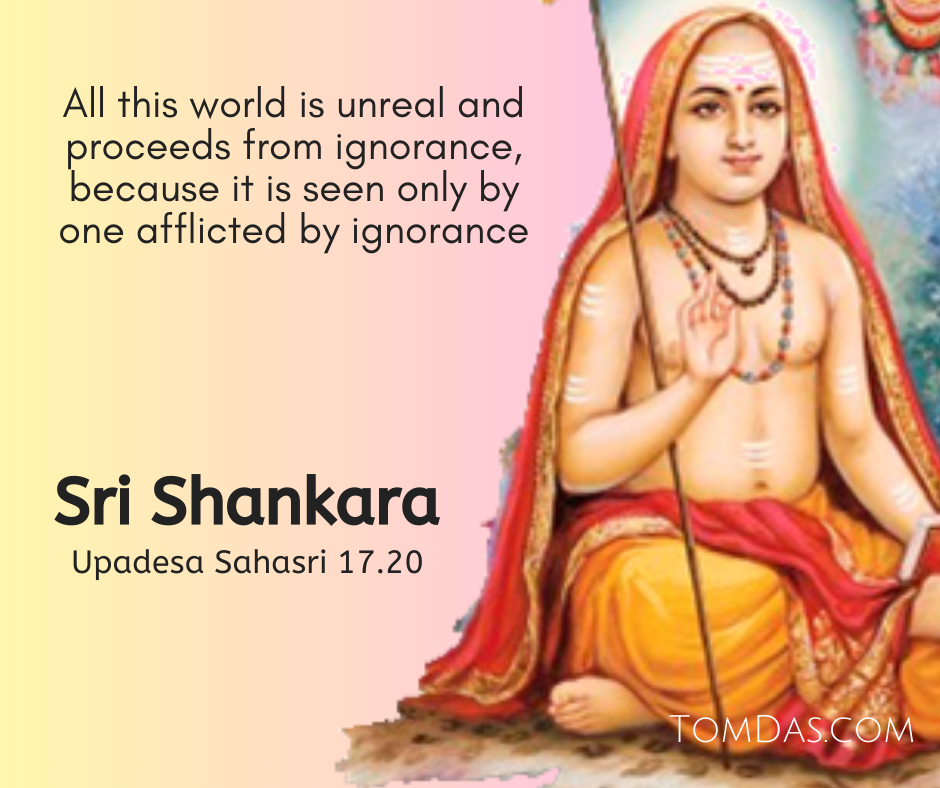
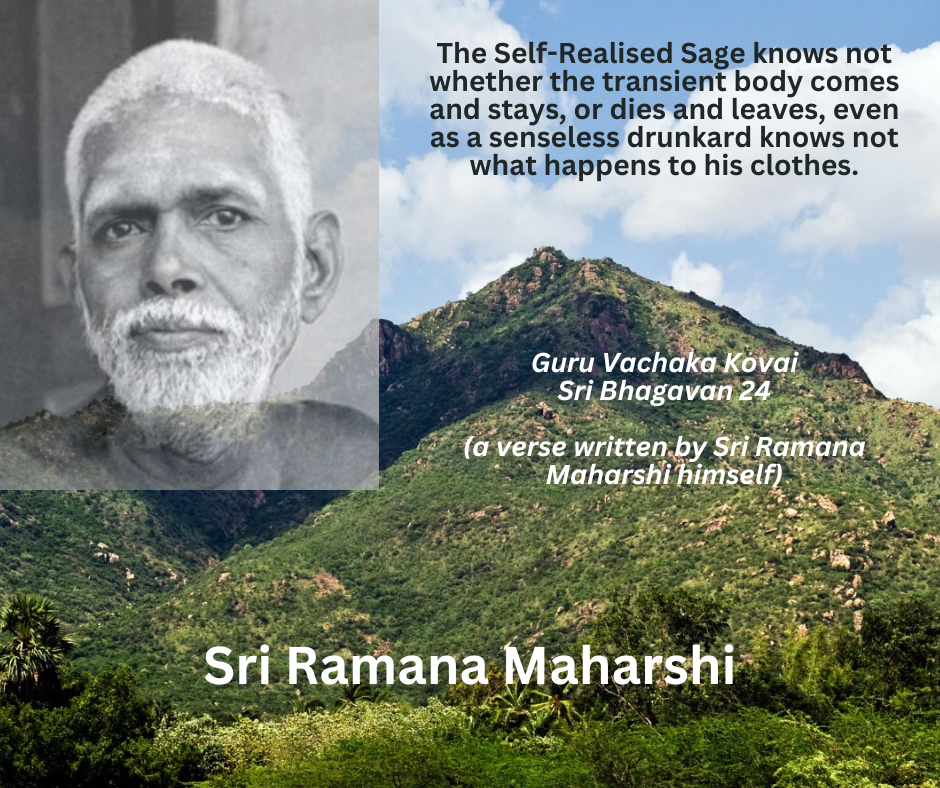
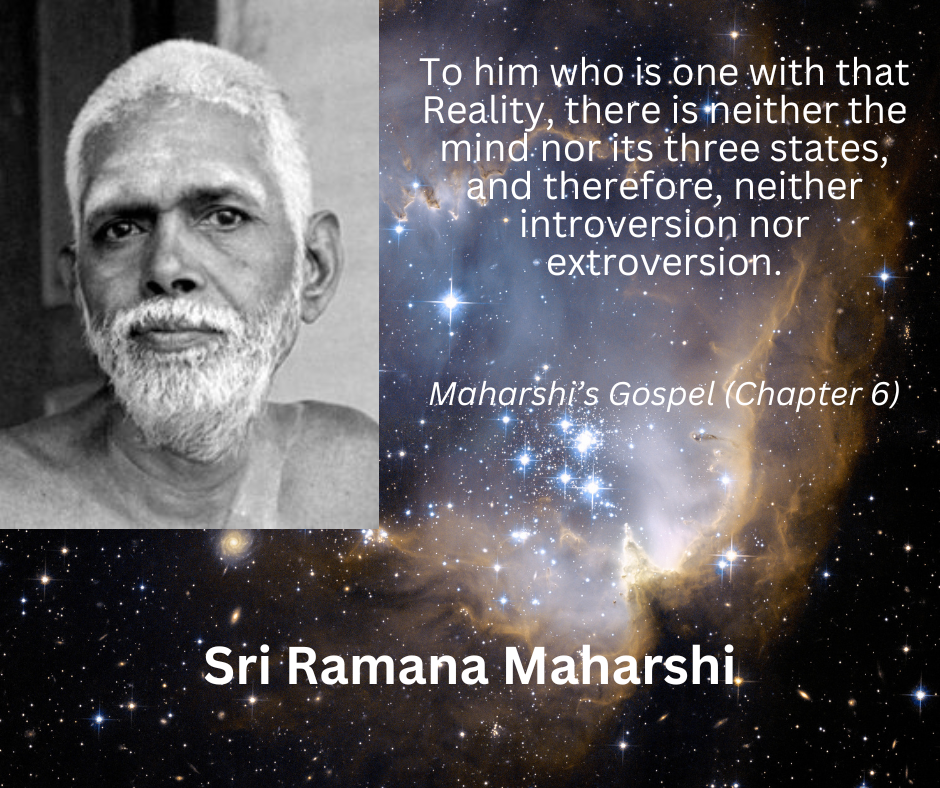
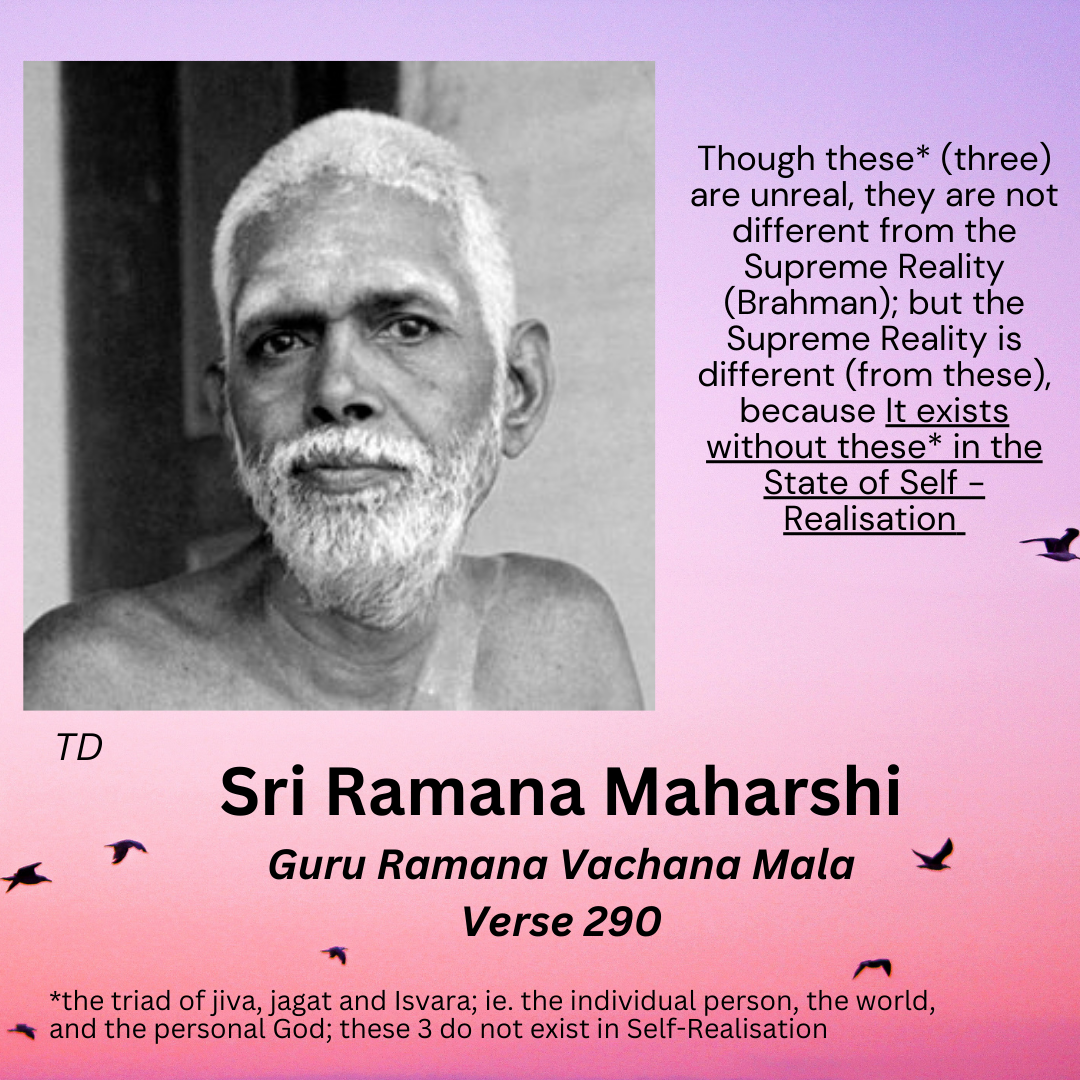
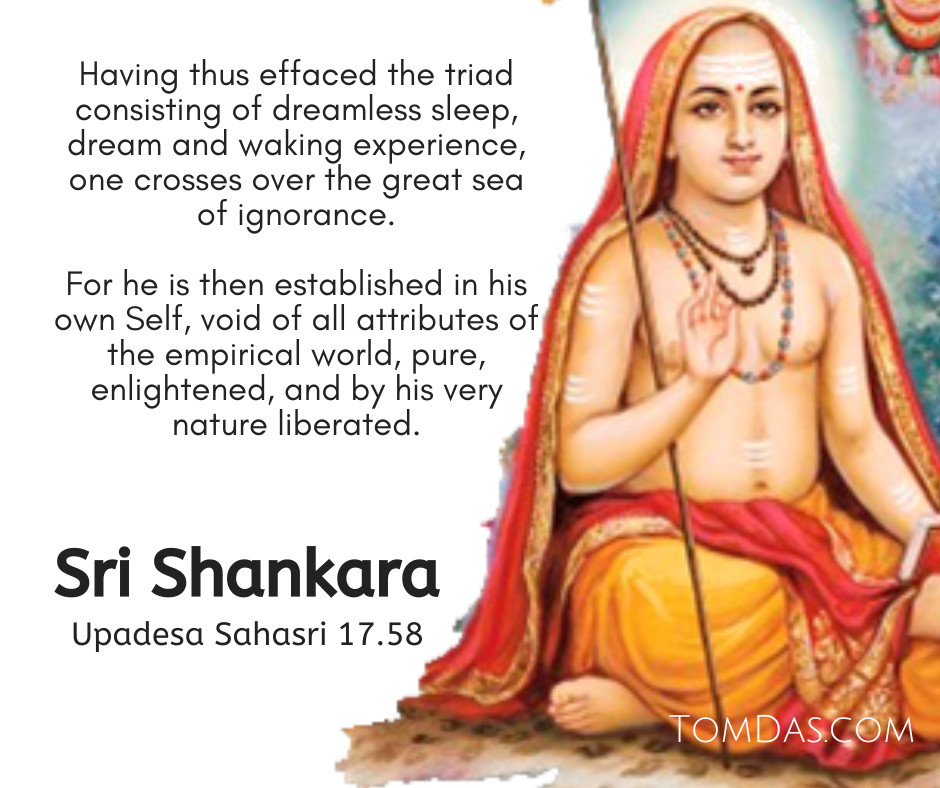
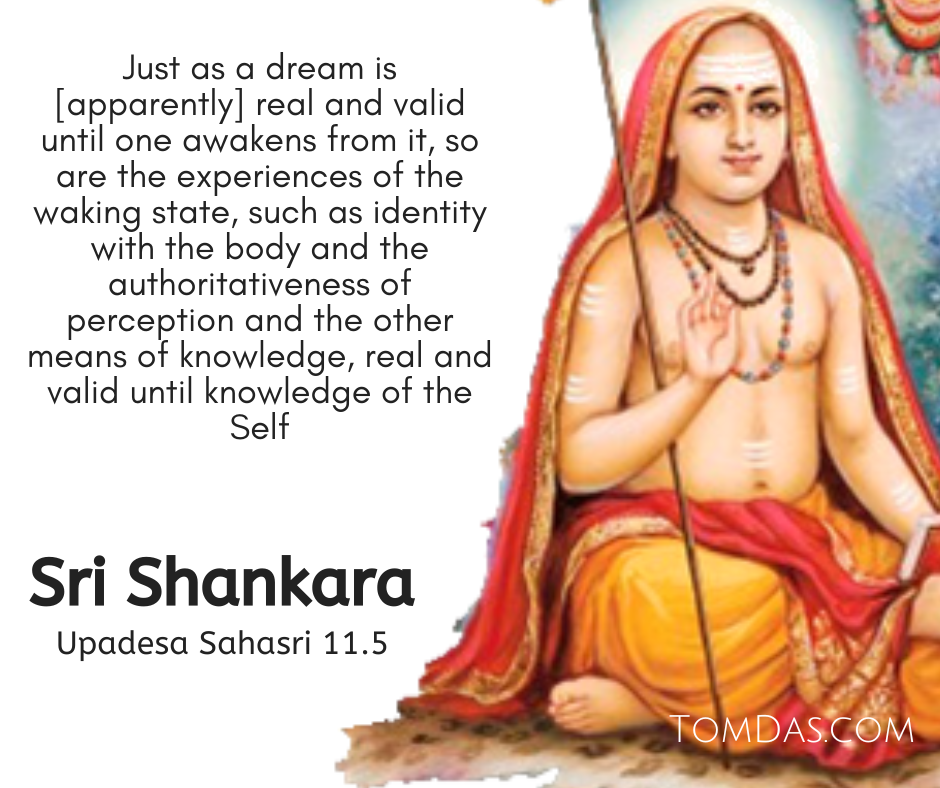
 Tom Das