Traditionally in Vedanta teachings it is said that no actions (karma) can lead to liberation (moksha). But doesn’t Bhagavan Ramana Maharshi say that self-enquiry is the sure way to liberation? And doesn’t he even say that self-inquiry is the only way to liberation? And is not self-inquiry a karma (action)?
Here in this post the answer to this question is explained, and the nature of self-inquiry is further explained too.
The following is an excerpt from ‘The Path of Sri Ramana’ Chapter 7. You can find out more about and download the entire text for free here.
Therefore, while practising Self-enquiry, instead of taking anyone of the five sheaths as the object of our attention, we should fix our attention only on the ‘I’-consciousness, which exists and shines as oneself, as the singular, and as a witness to and aloof from these sheaths.
Instead of being directed towards any second or third person, is not our power of attention, which was hitherto called mind or intellect, thus now directed only towards the first person? Although we formally refer to it as ‘directed’, in truth it is not of the nature of a ‘doing’ (kriya-rupam) in the form of directing or being directed; it is of the nature of ‘being’ or ‘existing’ (sat-rupam). Because the second and third persons (including thoughts) are alien or external to us, our attention paid to them was of the nature of a ‘doing’ (krlya). But this very attention, when fixed on the non-alien first person feeling, ‘I’, loses the nature of ‘paying’ and remains in the form of ‘being’, and therefore it is of the nature of non-doing (akriya) or inaction (nishkriya). So long as our power of attention was dwelling upon second and third persons, it was called ‘the mind’ or ‘the intellect’, and its attending was called a doing (kriya) or an action (karma). Only that which is done by the mind is an action. But on the other hand, as soon as the attention is fixed on the first person (or Self), it loses its mean names such as mind, intellect or ego sense. Moreover, that attention is no longer even an action, but inaction (akarma) or the state of ‘being still’ (summa iruttal).
Therefore, the mind which attends to Self is no more the mind; it is the consciousness aspect of Self (atma-chit-rupam)! Likewise, so long as it attends to the second and third persons (the world), it is not the consciousness aspect of Self; It is the mind, the reflected form of consciousness (chit-abhasa-rupam)! Hence, since Self-attention is not a doing (kriya), it is not an action (karma).
That is, Self alone realizes Self; the ego does not ! The mind which has obtained a burning desire for Self-attention, which is Self-enquiry, is said to be the fully mature one (pakva manas). Since it is not at all now inclined to attend to any second or third parson, it can be said that it has reached the pinnacle of desirelessness (vairagya). For, do not all sorts of desires and attachments pertain only to second and third persons? Since this mind, which has very well understood that (as already seen in earlier chapters) the consciousness which shines as ‘I’ alone is the source of full and real happiness, now seeks Self because of its natural craving for happiness, this intense desire to attend to Self is indeed the highest form of devotion (bhakti).
It is exactly this Self-attention of the mind which is thus fully mature through such devotion and desirelessness (bhakti-vairagya) that is to be called the enquiry ‘Who am I ?’ taught by Bhagavan Sri Ramana! Well, will not at least such a mature mind which has come to the path of Sri Ramana, willingly agreeing to engage in Self-attention, realize Self ? No, no, it has started for its doom ! Agreeing to commit suicide, it places its neck (through Self-attention) on the scaffold where it is to be sacrificed !! How ? Only so long as it was attending to second and third persons did it have the name ‘mind’, but as soon as Self-attention is begun, its name and form (its name as mind and its form as thoughts) are lost. So we can no longer say that Self-attention or Self-enquiry is performed by the mind, Neither is it the mind that attends to Self, nor is the natural spontaneous Self-attention of the consciousness aspect of Self (atma-chit-rupam), which is not the mind, an activity!
“A naked lie then it would be If any man were to say that he Realized the Self, diving within Through proper enquiry set in, Not for knowing but for death The good-for-nothing ego’s worth! ’This Arunachala alone, The Self, by which the Self is known!” ‘Sri Arunachala Venba’ verse 39
The following is written by Sri Sadhu Om, a direct devotee of Sri Ramana Maharshi’s, and is taken from the text ‘The Path of Sri Ramana – Part 1’, from one of the footnotes in Chapter 7. You can download the entire text for free here – it is a wonderful and rare text that explains the entire path to liberation. Please also see recommended reading for liberation here as well as the introductory articles on the homepage for more.
The practice of witnessing thoughts and events, which is much recommended nowadays by lecturers and writers, was never even in the least recommended by Sri Bhagavan, Indeed, whenever He was asked what should be done when thoughts rise (that is, when attention is diverted towards second or third persons) during sadhana, He always replied in the same manner as He had done to Sri Sivaprakasam Pillai in ‘Who am I?’, where He says:
“If other thoughts rise, one should, without attempting to complete them, enquire ‘To whom did they rise?’. What does it matter however many thoughts rise? At the very moment that each thought rises, if one vigilantly enquires ‘To whom did this rise ?’, it will be known ‘To me’. If one then enquires ‘Who am I?’, the mind (our power of attention) will turn back (from the thought) to its source (Self)”.
Moreover, when He says later in the same work, “Not attending to what-is-other (that is, to any second or third person) is non-attachment (vairagya) or desirelessness (nirasa)”, we should clearly understand that attending to (witnessing, watching, observing or seeing) anything other than Self is itself attachment, and when we understand thus we will realize how meaningless and impractical are such instructions as ‘Watch all thoughts and events with detachment’ or ‘Witness your thoughts, but be not attached to them’, which are taught by the so-called gurus of the present day.
————
Tom: The following excerpt is also taken from the same chapter, chapter 7, of The Path of Sri Ramana – Part 1:
Since, whether we know it or not, Self, which is now wrongly considered by us to be unknown, is verily our reality, the very nature of our (the Supreme Self’s) attention itself is Grace (anugraha). This means that whatever thing we attend to, witness*, observe or look at, that thing is nourished and will flourish, being blessed by Grace…
…Hence, when the power of attention of the mind is directed more and more towards second and third person objects, both the strength (kriya-bala) to attend to those objects and the ignorance – the five sense-knowledges in the form of thoughts about them – will grow more and more, and will never subside! Have we not already said that all our thoughts are nothing but attention paid to second and third person objects? Accordingly, the more we attend to the mind, the thoughts which are the forms (the second and third person objects) of the world, the more they will multiply and be nourished. This is indeed an obstacle. The more our attention – the glance of Grace (anugraha-drishti) – falls on it, the more the mind’s wavering nature and its ascendancy will increase. That is why it is impossible for the mind to negate anything by thinking ‘I am not this, I am not this’ (neti, neti). (Footnote to text here: This is why aspirants who, in order to destroy evil thoughts like lust, anger and so on, fight against them and thereby think about them fail in their attempts, while aspirants practising Self-enquiry, who pay their full attention to Self with an indifference towards their thoughts, bypass them easily)
On the other hand, if our (Self’s) attention is directed only towards ourself, our knowledge of our existence alone is nourished, and since the mind is not attended to, it is deprived of its strength, the support of our Grace. “Without use when left to stay, iron and mischief rust away” – in accordance with this Tamil proverb, since they are not attended to, all the ‘vasana-seeds, whose nature is to rise stealthily and mischievously, have to stay quiet, and thus they dry up like seeds deprived of water and become too weak to sprout out into thought-plants. Then, when the fire of Self-knowledge (jnana) blazes forth, these tendencies (vasanas), like well-dried firewood, become a prey to it.
This alone is how the total destruction of all tendencies (vasanakshaya) is effected.
The following is a teaching excerpt from a large unedited manuscript, well over 1000 pages long, called ‘Aham Sphurana’.
Aham Sphurana [‘I Shining’ or ‘I vibration’ or ‘I Am shining’ or ‘Shining of the I AM’] claims to contain a collection of previously unpublished talks with Sri Ramana Maharshi as apparently recorded by a visitor to Sri Ramana Ashrama, Sri Gajapathi Aiyyer, in 1936.
The authenticity of the teachings as being genuinely from Sri Ramana Maharshi cannot be confirmed, a fact acknowledged in the manuscript preamble itself, but I share these teachings here in case they are of interest to you.
17th July 1936
Questioner: Is it really true that I am not this body?
Sri Ramana Maharshi: Yes.
Questioner: If so, when some damage is suffered by the body, why do I feel pain? If, say, a piece of burning coal falls on somebody near me, I do not feel anything, but that person alone feels the pain. Likewise if a thorn pricks my foot I alone feel the pain, but not the one walking by my side.
Sri Ramana Maharshi: Does the body cry out, saying, ‘I am feeling pain!’? You associate yourself with your body and speak of it as your “I”. The body is only in the mind. All pain apparently suffered by the body is as imaginary as the body itself. The body cannot know anything. It is insentient flesh and bone. Notions of pain spring from our own imagination only. Thus, in deep slumber, the mind being inactive, there is no pain.
Questioner: Suppose I have a piece of metal wire in my hand. If I cut it into pieces, the metal cannot be aware that it is being cut, because it is insentient. Whereas, if a living body were to so much as be scratched, it explodes with agony. In what sense, therefore, does Bhagavan mean that the body is insentient?
Sri Ramana Maharshi: True, the body experiences the physical stimulus of pain if it is injured, but why should that fact create a thought in the mind, “I am feeling pain.”?
Physical pain creates mental agony because of the following reason – the mind assumes itself to be the body and appropriates to itself the bodily identity, because in the absence of such false self-objectification it cannot survive or thrive. If the idea “I am the body” is abandoned, everything, including pain suffered by the body, is only Bliss.
Questioner: But I am aware of the pain if the body is injured!
Sri Ramana Maharshi: When the body is injured, in the case of the unenlightened one, the following happens – his body feels the physical stimulus of pain, and his mind spontaneously manifests the thought, “I am injured”, causing him to become mentally agitated; the reason for the manifestation of such thought is the underlying erroneous idea “I am the body”. In one who is free from the mistaken idea of accepting the body for the Self, injury of the body causes no disturbance to his peace. Each one is indeed the Self, but absurdly confounds himself with the not-Self and so needlessly suffers on account of such dehatma-buddhi.
Questioner: The question still remains – if, as postulated by Sri Bhagawan, the body is insentient, how can it and why does it feel pain at all?
Sri Ramana Maharshi: The word “pain” is employed because there is a prejudice in the mind against such stimuli. When the mind is dissolved in Pure Consciousness, its prejudices also disappear. For the enlightened one, therefore, pain and pleasure are physical stimuli that stand on an equal footing. He does not covet the one and abhor the other; nor does he abhor the one and covet the other. Mind gone, there remains no yardstick by means of which one sensation is to be regarded as pain and another as pleasure.
Questioner: Sri Bhagavan seriously means to say he is unable to tell the difference between the sensation that ensues when an insect bites his leg and the one that ensues when someone is massaging it?
Sri Ramana Maharshi: That they are different sensations is self-evident; that the one is abhorrent and the other agreeable is mere mental judgement from which the Jnani is quite free. He himself seeks out neither pain nor pleasure, but accepts what comes his way without resisting; in Jnana only automatic acceptance remains.
Questioner: For Jnanis it is different; what of the common man?
Sri Ramana Maharshi: You also are a Jnani; only, you think otherwise!
Questioner: How could that be?
Sri Ramana Maharshi: The option of turning inwards and quietly allowing the mind to plunge and dissolve in the Self is equally available for all. It is not the fiefdom of a select few. All are verily only the Self.
Questioner: That does not satisfy me. I am unable to Realise it for myself.
Sri Ramana Maharshi: So long as worldly attachments are present the mind cannot be succesfully turned inwards.
Questioner: How to eliminate worldly attchment?
Sri Ramana Maharshi: By turning the mind inwards.
Questioner: Really!
Sri Ramana Maharshi: The more you hold on to the Self or retain the mind in its native state of subjective-awareness-sustained-effortlessly-and-volitionlessly, the more the mental tendancies and worldly attachments wither off; the lesser the mental tendancies and worldly attachments, the easier does become retention of the mind in its native state of subjective-awareness-sustained-effortlessly-andvolitionlessly.
Questioner: Which comes first?
Sri Ramana Maharshi: The sadhaka recognises and reflects upon the ephemeral nature of the objective world and the transient nature of his own body. He gets fed up with material pleasures, because they eventually lead only to sorrow, when their enjoyment becomes, for any reason, impossible. He asks himself if a more permanent experience of life might not be possible. Then he discovers the Ajata-advaita doctrine. Initially he is not convinced, and argues that if it were a dream there would be no possibility of corroboration, but that here his relatives and friends are able to confirm the evidence provided by his senses; he also asks why the same dream should be repeated everyday, were it all only a dream – according to him, here he sees the same sun, moon and earth everyday, whereas in his dreams he finds himself in new worlds moment to moment. Eventually it dawns upon him that everything he thinks he knows, including an understanding of the apparent permanency of the world he believes himself to live in, is only thought or imagination.
Then at the intellectual level he understands the truth – that the names and forms constituting the world are fictitious. This sparks a search for the substratum said to be underlying them, which alone is said to be Real by the wise.
He hears the teaching that the source of the mind, Beingness, is the gateway to the Real Self. Then he begins the practice of quietening the mind by vichara or any other method, tackling various distractions as and when they arise, by withdrawing attention from them and fixing it on Beingness or the Self. The beginning is only becoming fed-up with the evanescent nature of the world and the fugacious attractions it has to offer.
Questioner: The boubts Bhagavan mentioned – they are my doubts also. Why is everyone witnessing the same dream? The sun moon etc. are seen by all.
Sri Ramana Maharshi: In turn those “all” are seen by you only. In deep slumber when there is no mind, nothing is available to be seen, but your existence is a constant.
Questioner: Why do I dream the same dream everyday? For instance yesterday I came to the ashram and had darshan of Bhagawan; he was sitting on the same sofa in exactly the same manner. Today I am seeing Bhagawan and tomorrow also it is going to be the same Bhagawan.
Sri Ramana Maharshi: The future is a mere mental projection. The past is a mere memory. Have you not had dreams where the places you visit look extremely familiar?
Questioner: At least is the present real?
Sri Ramana Maharshi: Anything seen cannot be Real. What is seen is not Pratyaksha. It is not self-evident, because there is a subject-object relationship involved. It is merely sensory information that is fed into the mind by the strength of its own evil faculty of avidya maya. That alone is Real which shines by its own light.
You are asking about the objects of the world. Can such objects exist without a YOU, a perceiver? When there is no perceiver, as in swoon or deep slumber, is there anything to be perceived? No. What is the inference? The objects owe the appearance of their apparent existence to you only. They are merely mental creations. The appearance of this enormous cosmos around you is merely a mental information. The mind is fiction. Therefore the ‘objects’ manufactured by it are also fictitious. Have not the least doubt about it.
Questioner: If everything is unreal, can we conclude that bondage and liberation are also unreal?
Sri Ramana Maharshi: Yes.
Questioner: Then why should I try to obtain Liberation? Let me remain as I am.
Sri Ramana Maharshi: Exactly!
Questioner: I do not understand.
Sri Ramana Maharshi: Remaining as you are is the loftiest Sadhana.
Questioner: How can remaining in ignorance be sadhana?
Sri Ramana Maharshi: You think that you are in ignorance. When you do not think at all, what remains is only wisdom. Removal of the screen of thought is all that is required for Reality to be revealed. Since you want a sadhana by means of which you may reach this thought-free state, vichara is suggested. Actually there is no need for any sadhana for one who has mastered the art of remaining as he is – the art of Being. That is the import of the advice Summa Iru [Tom: ‘Be Still’]. People generally misunderstand it. It does not mean keeping the body idle. It means keeping the mind still or free from thought. Remain perpetually absorbed in the thought-free I-Current. This will automatically lead you to the Sahaja-stithi [Tom: the natural state, ie. liberation or self-realisation] without requirement for further effort.
Questioner: Is even desire for Liberation an obstacle to Liberation?
Aham Sphurana [‘I Shining’ or ‘I vibration’ or ‘I Am shining’ or ‘Shining of the I AM’], an unedited text of over 1000 pages, claims to contain a collection of previously unpublished talks with Sri Ramana Maharshi as apparently recorded by a visitor to Sri Ramana Ashrama, Sri Gajapathi Aiyyer, in 1936.
This is a controversial text and the authenticity of the teachings as being genuinely from Sri Ramana Maharshi cannot be confirmed, a fact acknowledged in the manuscript preamble itself, but I share these teachings here in case they are of interest to you.Note that the essential teachings presented here are no different to the teachings from Sri Ramana Maharshi you will find elsewhere, but the way they are presented may be helpful to many.
At the time of writing this post, there is also a 280 page version of this text which is available from Open Sky Press – this is a beautifully arranged set of teachings collated from Aham Sphurana – but the teachings have been edited and therefore subtly changed. Sometimes this makes the teachings easier to access, but sometimes the meaning of the text may inadvertently be altered.
For example, this post, which I have presented in unedited form, is also present in the Open Sky Press version but the word ‘solipsism’ was removed from the edited version of the text on page 57 and for some reason replaced with the word ‘egoism’; the reference to Berkeley was also removed and the Latin phrase was (slightly) wrongly translated. For some this may make it easier to access, as the word solipsism is a philosophical term that some may not be familiar with, but for others reading Sri Ramana’s alleged view on solipsism may be fascinating and useful, and the removal of this term could take away from the depth of the teaching; similarly with the reference to the philosopher Berkeley.
Having read many spiritual texts, my personal preference is to read as near to the source material as possible (and where possible to go to primary sources themselves), as this gives the most accurate presentation of the teachings. I have read many texts that try to be helpful through editing but many end up inadvertently distorting the teachings. This is also why when I make comments on texts, I try to make it very clear what is added by me as opposed to what is present in the original, so the reader has an opportunity to assess my comments in light of the actual source material. To this end I am sharing the unedited PDF here for those who find it useful.
The following is a teaching excerpt from a large unedited manuscript, well over 1000 pages long, called ‘Aham Sphurana’.You can find out more and download the entire text here.
Aham Sphurana [‘I Shining’ or ‘I vibration’ or ‘I Am shining’ or ‘Shining of the I AM’] claims to contain a collection of previously unpublished talks with Sri Ramana Maharshi as apparently recorded by a visitor to Sri Ramana Ashrama, Sri Gajapathi Aiyyer, in 1936.
The authenticity of the teachings as being genuinely from Sri Ramana Maharshi cannot be confirmed, a fact acknowledged in the manuscript preamble itself, but I share these teachings here in case they are of interest to you.Note that the essential teachings presented here are no different to the teachings from Sri Ramana Maharshi you will find elsewhere, but the way they are presented may be helpful to many.
11th July 1936
Sri Ramana Maharshi: When a man is told he is neither the body nor the mind, he is initially puzzled, because all along his life his experience of self has been confined to these two only. When he hears the words of the Jnana-guru for the first time, he learns to his shock that these two [Tom: ie. body and mind] are suddenly to be regarded as unreal, insignificant and immaterial, and Consciousness of Being alone is to be treated as Real and material.
To one whose understanding of the world is sustained by conceptual knowledge and whose life is ruled by subject-object relationships, this can be too much of a shock to bear. He either laughs off the Ajata-advaita doctrine as sheer nonsense developed by mischievous minds that have nothing better to do, or takes it seriously and is shocked by the implications – everything he has ever known and cherished in his life is now suddenly revealed to be meaningless, fungible, evanescent and mutable, and thus unreal and unworthy of consideration, whereas what he had never before paid attention to is revealed as the only permanent, abiding Reality.
To one who has up till that point in time been regarding himself as a subject, finite across time and space, occupying an objective world, this revelation comes as a great emotional and mental upheaval, because he is attached to the things of the world.
One whose past sadhanas [Tom: spiritual practices] have weakened all attachment takes naturally to the idea that the world is a dream – either way it is not going to matter to him because he is not interested in it. The idea that the world does not exist as a collection of independent objects, but rather depends upon perception for its apparent existence, shocks some people. The evidence of the 5 sensory organs is merely random ‘information’. It does not denote that any such object is actually ‘out there’; there is no ‘out there’.
The inlet of consciousness is only one; therefore, all perceived depends upon the perceiver only; this consciousness, turned outside, is the world and its perceiver; turned inside it finds that it is the Self. Jagrat-prama [Tom: Knowledge of the waking state; Jagrat means the waking state, prama means knowledge] is the prama of jagrat-pramata [Tom: knower of the world; pramata means knower] [Tom: This entire sentence means that the [knowledge] of the waking state is knowledge for the knower of the waking state, ie. It is the ego that knows the waking state]. Apart from the perceiver there is no such thing as the perceived. The pramata [Tom:knower] believes he knows so many things about the world; he is merely accessing the contents of his own mind.All thoughts and perceptions are intra-mental modifications. The light of the Self falls on the aham-vritti and its children, the other vrittis, and a jiva [Tom: the (apparent) individual person] is born. It is for the aspirant to destroy all the other vrittis. The Self takes care of the nude ahamvritti – that is, destroys it. Then it will remain without reflection.
Questioner: This is pure solipsism – Berkeley’s Esse est percipi aut percipere [Tom: ‘to be is to be perceived or to perceive’ as expressed by George Berkeley].
Sri Ramana Maharshi: The solipsist says the mind is real, that everything, including the world and thoughts, that proceed from it is a phantom or shadow. He does not question the reality of the mind itself. I am asking you to go even further. I say that the mind itself is a shadow or phantom proceeding from the Self.
You will discover this as a matter of direct experience – if only you will probe into the source of the mind.
You ask why some do not Realize. You wonder whether prarabdha [Tom: fate or destiny] might be the reason. No. Prarabdha has no power to pull back into the world a jiva that is adamantly determined to disappear in its source forever. Then what is the reason, you ask. This is the reason – clinging fast to objective knowledge [Tom: this is the reason why some do not realise the Self – because they cling to objects].
There are learned pandits who have written rich commentaries volume after volume – upon various Advaitic texts which directly propound the Ajata-advaita doctrine- Ashtavakra Gita, Ribhu Gita, Panchadasi, Kaivalya Navaneetam, Ozhivil Odukkam, etc, etc. Go to their houses when a loved one has died, and ask how they feel. You may be met with a hostile stare. If you sit down then and there and explain all this, you may count yourself lucky if permitted thereafter to leave with your life. Where does the problem lie? All the learning has been in vain, because it has stopped at the level of the intellect.
It is unable to crush the Ego, because there was no practice. The only effort made was to read more books, go on writing commentaries, and go on receiving accolades for being ‘an Expert in the field of Advaita’, thus making the ego grow bigger and bigger. Never was effort made to still the ceaseless waves of thought. Even some effort in that direction might have brought a reciprocal flow of Grace from the Self. But no. Read, write, receive shawls at book-launch festivals, imagine oneself to be acting in a highly intelligent manner in saying the words, “No, no, it is all God’s work… I am an instrument in his hands, that is all…” there, receive applause, and inflate the ego further and further.
The Sun and the Earth may one day decide to interchange their positions out of boredom, but such people, who are infatuated with the poisonous wine of love for book-learning, cannot obtain True Knowledge. Objective knowledge and book-learning are the most deadly enemies on the path to Self-Realistion, because they are expertly disguised as sweet friends, and the disguise runs deep indeed.
The following is a teaching excerpt from a large unedited manuscript, well over 1000 pages long, called ‘Aham Sphurana’.You can download the entire text here.
Aham Sphurana [‘I Shining’ or ‘I vibration’ or ‘I Am shining’ or ‘Shining of the I AM’] claims to contain a collection of previously unpublished talks with Sri Ramana Maharshi as apparently recorded by a visitor to Sri Ramana Ashrama, Sri Gajapathi Aiyyer, in 1936.
The authenticity of the teachings as being genuinely from Sri Ramana Maharshi cannot be confirmed, a fact acknowledged in the manuscript preamble itself, but I share these teachings here in case they are of interest to you.
5th July 1936
Questioner: Is it true that for complete beginners, meditation on an object is easier than attempting to practise vichara [Tom: self-enquiry]?
Sri Ramana Maharshi: Yes. As the aspirant gains one-pointedness (ekagrata) of mind, then he can commence with vichara.
Questioner: Should sadhakas [Tom: seekers] then be discouraged from taking up vichara whilst yet being neophytes?
Sri Ramana Maharshi: Leave each one to take up that method or path which appeals the most to him. All other methods, if persevered with long enough, eventually lead up to vichara only. Vichara begins to have significant effect after the aspirant is able to plainly distinguish between the inward-turned and outward-turned mind, and hastens to avoid the latter and inhere in the former as soon as he observes that his mind is wandering.
Questioner: How shall I get vairagya [Tom: dispassion, ie. turining away from objects or loss of interest in objects or objective phenomena]?
Sri Ramana Maharshi: A correct understanding of the actual nature of happiness will lead you to it. Now you seek happiness but think that happiness flows into you from the outside world, or that your mind absorbs happiness from the external, objective world. But what is the truth? Far from causing happiness, the appearance of manifestation is the cause for all our wretchedness. The pleasure that is got by interaction of the mind with objects of sensory perception also has the obverse side of pain. The desire for happiness is right but you have been deluded (by avidya maya) into imagining pain-associated and transient pleasures to be real happiness. Sensory perceptions yield short-lived pleasure which moreover causes pain in its wake. Pain and pleasure alternate with one another in the world. To ascertain the difference between fleeting, momentary, and pain-associated happinesses with the Supreme Happiness of the Self and confine oneself wisely to exclusively the latter is known as vairagya. Knowing that pursuit of sensory fascinations leads only to pain, why do you go in that direction? It is owing to the pull of the old habits of the mind. After these habits (vasanas) wear off, you will have abiding peace. The habits cannot suddenly be shaken off one day. They will go only by prolonged abhyasa [Tom: practice] and steady vairagya.
Questioner: What is the role of the Guru in making the mind steady?
Sri Ramana Maharshi: The Guru will only suggest that you surrender yourself unconditionally. He will not give you anything new which you have not got already.
Questioner: The mind is peaceful for a while, but after some time, again the old mischievous tendencies assume control over the mind and lead it astray. I don’t know what to do.
Sri Ramana Maharshi: By continuous practise you will succeed in retaining the mind in its source. The state of submergence of mind in its source is its natural state. If you want to regain the natural state, a tremendous fight is inevitable.
Questioner: What is the one thing which I should know properly so as to gain the upper hand in this fight?
Sri Ramana Maharshi: That you should never trust anything revealed into the field of your consciousness that may pull you away from the path leading into further and further introversion of mind.
Questioner: So visions are not necessarily a sign of spiritual progress?
Sri Ramana Maharshi: Do not be deceived by visions. Even if I appear before you, do not believe it. Only unintermittently attend to the task of keeping the mind incessantly submerged in the Heart. This is the only thing you need to do: Remain permanently submerged in the Heart.
Questioner: Guru’s Grace or God’s Grace is required for it. Please bless me with your Grace.
Sri Ramana Maharshi: Introversion of mind and Grace are the same thing. Why go searching outside for Grace? Is it not fruitless to do so? Is there anything outside you?
Questioner: So Grace is something I can win by my own efforts?
Sri Ramana Maharshi: Certainly. Grace is the same as the Self.
Questioner: I am not able to come here as often as I would like to. My work commitments prevent it.
Sri Ramana Maharshi: You regard the physical body as real and hence all your troubles. Whereas there are no limitations in the Self. Time and space are operative on the physical plane. Since we think that we are physical, we are enslaved by time and space. Realisation means not imagining that you are this and that, not thinking that you are conditioned by so-and-so circumstances. Are you in the world or is the world in you? In deep sleep did the world come and announce itself to you? Nevertheless, did you not exist in deep sleep? Are you different from the one that existed in deep sleep? Why then bother about time and space, which are merely concepts conjured up by the effervescent mind? Know that what you are in sleep is your true nature. That sleep continues even now; hold on to the state of sleepless sleep and see if these questions arise.
Questioner: How to sleep without sleeping?
Sri Ramana Maharshi: By always retaining the mind in its source and never allowing it to stray outwards. By practise, the state will gradually become spontaneous. That perfectly spontaneous state of continuous, volitionless and effortless thoughtlessness is the coveted state of sleepless sleep. That is the object of our efforts. It will come only by long practice.
Questioner: How to remind myself that I am not the body?
Sri Ramana Maharshi: Compare the present state with deep sleep. Were you with a body in sleep? Did you not exist all the same? The same ‘I’ which slept is now also present. Hold on to Him. The experience of bodilessness that was in deep sleep is also now. Even now you are bodiless. Only rein in the malefic force that asserts contrariwise: thought.
Questioner: How shall I get nirvikalpa samadhi?
Sri Ramana Maharshi: What is nirvikalpa samadhi? It is to remain permanently submerged in the Heart. In sleep, swoon, death and so on we merge into the Heart unconsciously. In samadhi we merge into the Heart consciously. Why remain apart from the source? Who is that one who wishes to remain apart from his source? Is his existence not mere pretension? The idea of your existence as an individual being is called moola avarana [Tom: root veiling, ie. root ignorance]. The idea is false, because as soon as he is steadily called upon to investigate himself and announce his existence the ego flies away. Then only Reality is left. This process is known as Realising the Self. But there is nothing to be newly gained. The one who dissipates the clouds does not create sky.
‘Who Am I?’ was originally composed by Sri Ramana Maharshi. It provides a summary of all the teachings one needs for liberation. This version is translated by Sri Sadhu Om and read by Anne, a devotee of Sri Ramana’s who attends Satsang meetings with Tom Das.
Many people are unable to fully understand the teachings given in ‘Who Am I?’. It is therefore recommended you read The Path of Sri Ramana by Sri Sadhu Om (free download here): which more fully explains the teachings and/or find yourself a teacher.
The following is the first teaching from a large unedited manuscript, well over 1000 pages long, called ‘Aham Sphurana’.You can download the entire text here.
Aham Sphurana [‘I Shining’ or ‘I vibration’ or ‘I Am shining’ or ‘Shining of the I AM’] claims to contain a collection of previously unpublished talks with Sri Ramana Maharshi as apparently recorded by a visitor to Sri Ramana Ashrama, Sri Gajapathi Aiyyer, in 1936.
The authenticity of the teachings as being genuinely from Sri Ramana Maharshi cannot be confirmed, a fact acknowledged in the manuscript preamble itself, but I share these teachings here in case they are of interest to you.
5th July 1936
Questioner: How to prevent falling asleep in meditation?
Sri Ramana Maharshi: If you think “I must not fall asleep; I am meditating now. Falling asleep would spoil my meditation”, your meditation will be spoilt, for thinking is the anti-thesis of meditation. If you try to consciously prevent sleep, therefore, it will lead to emergence of thought.
However, if you slip into sleep while meditating, the meditation will continue even during and just after sleep. Since thoughts about sleep are also distracting thoughts, such thoughts must also be got rid of, for the native thought-free state has to be obtained consciously in jagrat [Tom: jagrat means the waking state]. The resultant state of thought-free subjective consciousness sustained effortlessly and volitionlessly is known as jagrat-sushupthi [Tom: waking sleep or conscious sleep, see here for more], and it is the same as samadhi.
Never forget that dreaming, apparent wakefulness and sleeping are mere pictures upon the screen of the inherent, effortless thought-free state. Let them pass unnoticed.
You focus on Being the abiding Reality that serves as the permanent substratum underlying the 3 states, and let the 3 states, and what transpires in them, take care of themselves. Never worry about them.
The state of absence of thought and the state in which there are no ideas present is the primordial, natural state of mind for all; this is the original state of peace, which we subsequently spoil by bringing in thoughts.
Tom: Here in this post I have selected some key teachings from Zen Master Huang Po that outline his view of the ‘Path’ to Liberation. In addition to this, I have also selected some specific teachings in order to compare and contrast Huang Po’s teachings to that of Advaita Vedanta and of Sri Ramana Maharshi (see here for some essential teachings of Sri Ramana Maharshi).Whilst I make no claim that these teachings are all exactly the same, in this particular post I have emphasised commonalities rather than differences.
As usual my comments will be in italicised red. To gain the most from this post please explore the related posts that are hyperlinked throughout, such as the one above on the Essential Teachings of Sri Ramana Maharshi. So you can read Huang Po’s zen teachings in their full context, I have provided the complete translation of Huang Po’s teachings as a PDF file below from which the various quotes below are taken:
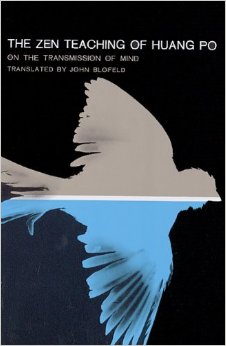
The first teaching I cite is in fact the entire first teaching given in the above book, The Zen Teaching of Huang Po, teaching 1 from the Chun Chou record. Here is Huang Po:
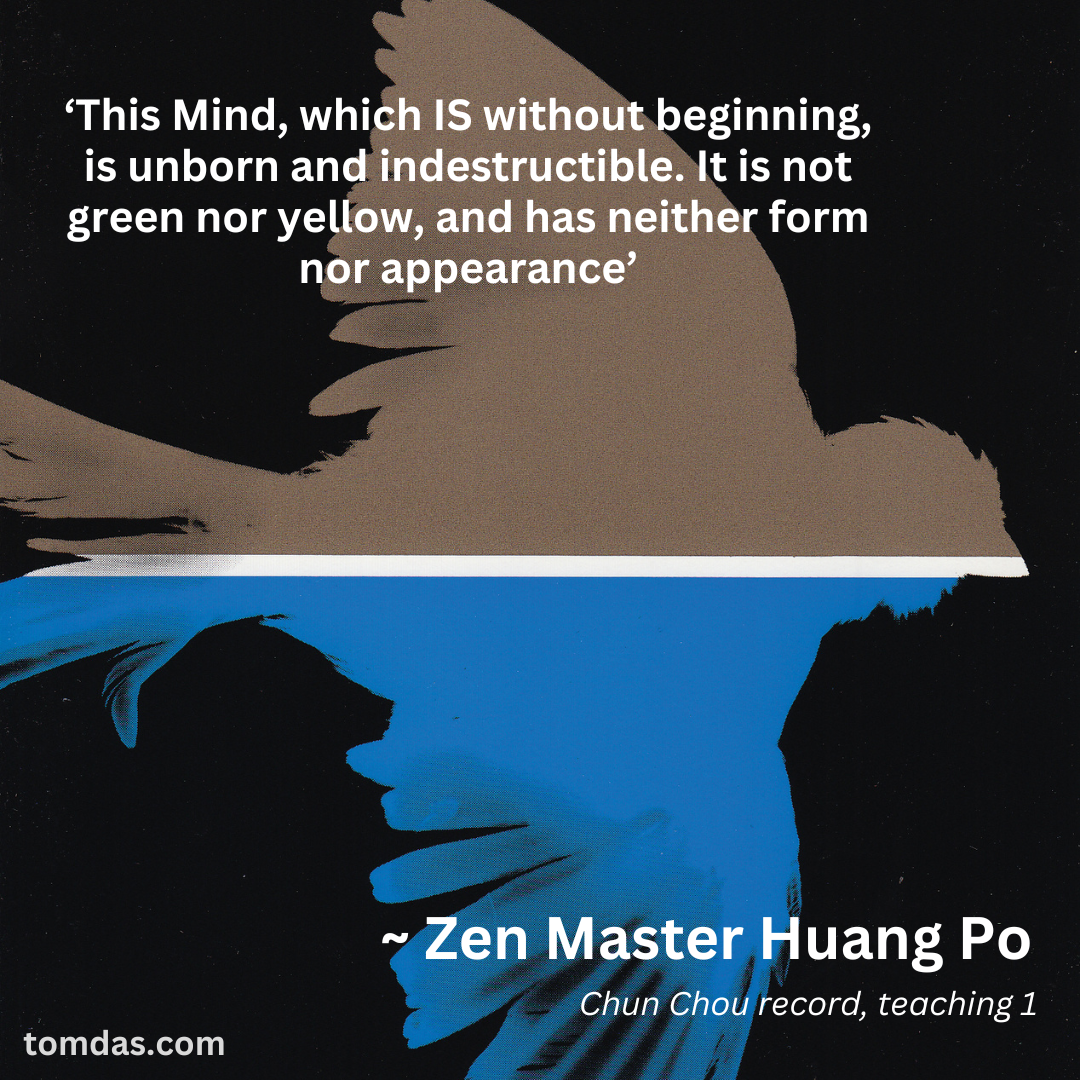
‘The Master [Huang Po] said to me: All the Buddhas and all sentient beings are nothing but the One Mind, beside which nothing exists. This Mind, which IS without beginning, is unborn (Unborn not in the sense of eternity, for this allows contrast with its opposite; but unborn in the sense that it belongs to no categories admitting of alteration or antithesis) and indestructible.
‘It is not green nor yellow, and has neither form nor appearance. It does not belong to the categories of things which exist or do not exist nor can it be thought of in terms of new or old. It is neither long nor short, big nor small, for it transcends all limits, measures, names, traces, and comparisons. It IS that which you see before you – begin to reason about it and you at once fall into error. It is like the boundless void which cannot be fathomed or measured.
‘The One Mind alone is the Buddha, and there is no distinction between the Buddha and sentient things, but that sentient beings are attached to forms and so seek externally for Buddhahood. By their very seeking they lose it, for that is using the Buddha to seek for the Buddha and using mind to grasp Mind. Even though they do their utmost for a full aeon, they will not be able to attain to it.
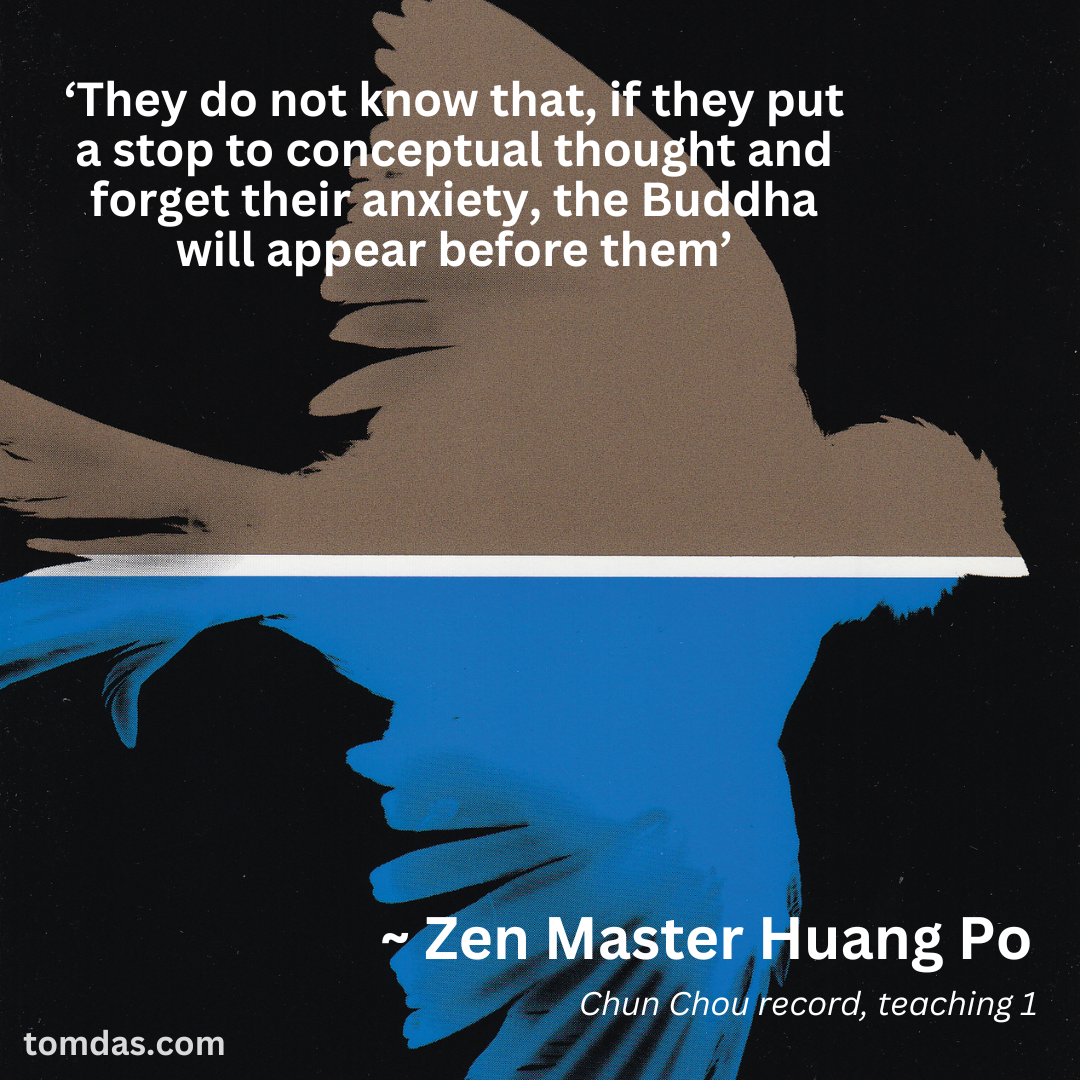
‘They do not know that, if they put a stop to conceptual thought and forget their anxiety, the Buddha will appear before them, for this Mind is the Buddha and the Buddha is all living beings. It is not the less for being manifested in ordinary beings, nor is it greater for being manifested in the Buddhas.’
~ the first teaching from The Chun Chou record of Zen Master Huang Po, translated by John Blofeld, as found in the book ‘The Zen Teaching of Huang Po’
Tom’s Comments
Tom comments:
(1) The nature of Mind. All is Mind. Mind is That which is unborn, devoid of objectivity and objective characteristics and is unending/indestructible. It has no form or appearance according to Huang Po, indicating its pure Subjectivity, form and appearance pertaining only to objects. It also cannot be understood. Mind here is equivalent to Sri Ramana Maharshi’s concept of the Self. The implication of this is that it is something you already ‘have’ and/or already ‘are’. Huang Po writes:
‘This Mind, which IS without beginning, is unbornand indestructible. It is not green nor yellow, and has neither form nor appearance‘
Compare this with Shankara writing in Vivekachudamani, a major text in the Advaita Vedanta tradition:
‘254. That which is beyond caste and creed, family and lineage; devoid of name and form, merit and demerit; transcending space, time and sense-object – that Brahman art thou.‘
In teaching number 8 from this same text, the Chun Chou record, Huang Po states the following, confirming the lack of objects in Buddha-Mind:
‘Our original Buddha-Nature is, in highest truth, devoid of any atom of objectivity. It is void, omnipresent, silent, pure; it is glorious and mysterious peaceful joy – and that is all’
In teaching number 6 Huang Po states that Mind has nothing to do with conceptual thought (ie. the intellect) and it has nothing to do with forms:
‘This Mind is no mind of conceptual thought and it is completely detached from form‘
We see this in echoed in Shankara’s Vivekachudamani here, where he describes the Absolute as being distinct from the Universe/Maya (Maya means the illusion of the world, also known as duality):
‘261. That which is free from duality; which is infinite and indestructible; distinct from the universe and Maya, supreme, eternal; which is undying Bliss; taintless – that Brahman art thou‘
And from teaching number 2 Huang Po says:
‘The Mind IS the Buddha, nor are there any other Buddhas or any other mind. It is bright and spotless as the void, having no form or appearance whatever.’
From teaching 18 Huang Po says:
‘the real Mind as formless and neither coming nor going; his nature as something neither commencing at his birth nor perishing at his death, but as whole and motionless in its very depths’
And from teaching 22 of Wan Ling record Huang Po says (capitalisation present in the original translation):
‘NO BODIES AND NO MINDS – that is the Way of the Buddhas!‘
(2) Mind vs sentient beings (Self vs jiva): All is Mind, BUT Huang Po points out a very important distinction: when Mind seeks externally in forms, ie. when the mind goes out towards objects/objective phenomena, that characterises ‘sentient beings’, meaning jivas or apparent individual people. So we can see that the term ‘sentient being’ roughly translates as ‘jiva’ (apparent individual people). Huang Po writes ‘sentient beings are attached to forms and so seek externally for Buddhahood‘, the implication being that Buddhahood cannot be attained in this way through seeking externally.
This is similar to Sri Ramana Maharshi stating In Day by Day with Bhagavan:
‘The mind turned inwards is the Self; turned outwards, it becomes the ego and all the world’
Similarly the great Advaita text Yoga Vasishta states:
‘Consciousness which is undivided imagines to itself desirable objects and runs after them. It is then known as the mind.’
and
‘After knowing that by which you know this (world) turn the mind inward and then you will see clearly (i.e. realize) the effulgence of the Self.’
and
‘O Rama, the mind has, by its own activity, bound itself; when it is calm it is free.’
Similarly Huang Po states in teaching 5:
‘You students of the Way who do not awake to this in your own minds, and who are attached to appearances or who seek for something objective outside your own minds, have all turned your backs on the Way’
Again, Huang Po admonishes seeking Buddhahood/liberation externally via objective phenomena.
(3) Ego cannot know Mind or Self: John Blofeld capitalises the ‘M’ in Mind in some places and leaves it uncapitalised when it is referring to ego-mind: Huang Po says ‘By their very seeking they lose it, for that is using the Buddha to seek for the Buddha and using mind to grasp Mind’, meaning Mind cannot be known by mind, or Self cannot be known by ego/mind/jiva (a person).
In the Wan Ling record, Huang Po states in teaching 18:
‘It cannot be reached with the body nor sought with the mind. All sentient beings ARE ALREADY of one form with Bodhi [Tom: Bodhi means Knowledge or liberation/enlightenment]‘
Similarly, Shankara in Vivekachudamani states the Absolute (Brahman) cannot be known with the Mind or intellect (Buddhi):
‘256. That which is untouched by the sixfold wave; meditated upon by the Yogi’s heart, but not grasped by the sense-organs; which the Buddhi [intellect] cannot know; and which is unimpeachable – that Brahman art thou’
(4) The remedy is to end all thoughts(by knowing your true nature): What is the remedy? Huang Po says ‘Put a stop to conceptual thoughts and forget ones anxieties’. How to do this is not explained in this teaching. However, if all is one already, why the need to do this at all? Why not just allow things to be as they are? Why the need to stop thoughts? The reason is that only then does Buddha reveal himself as Mind (or Self). Otherwise, if thoughts are not stopped, the illusion of being a ‘sentient being’ (ie. the illusion of being a jiva, ie. an apparent individual person with an apparent individual and separate consciousness) continues unabated and unchallenged. This ignorance must be removed. When divested of its objectivity and seeming multiplicity, only then does Mind or Buddha or Self or God reveal itself as Self, only then does illusion cease and suffering end and unity and absolute love fully shine.
Amritabindu Upanishad, verse 5 states:
‘The mind should be prevented from functioning, until it dissolves itself in the heart. This is Jnana [Tom: knowledge (of our true nature)], this is Dhyana [Tom: meditation (on our true nature)], the rest is all mere concoction of untruth.’
In teaching 23 of the Wan Ling record, Huang Po answers a question:
Q: If I follow this Way, and refrain from intellectual processes and conceptual thinking, shall I be certain of attaining the goal? A: Such non-intellection IS following the Way!
We see this unambiguous teaching of needing to stop ALL thoughts given repeatedly by Huang Po. See here from teaching 23 of the Wan Ling record in which Huang Po explains further the method of liberation, explaining how thoughts create karma and the entire world/universe (or 3 worlds of samsara, see below):
Were you now to practice keeping your minds motionless at all times, whether walking, standing, sitting or lying; concentrating entirely upon the goal of no thought-creation, no duality, no reliance on others and no attachments; just allowing all things to take their course the whole day long, as though you were too ill to bother; unknown to the world; innocent of any urge to be known or unknown to others; with your minds like blocks of stone that mend no holes – then all the Dharmas [Tom: teachings] would penetrate your understanding through and through. In a little while you would find yourselves firmly unattached. Thus, for the first time in your lives, you would discover your reactions to phenomena decreasing and, ultimately, you would pass beyond the Triple World; and people would say that a Buddha had appeared in the world. Pure and passionless knowledge [Enlightenment] implies putting an end to the ceaseless flow of thoughts and images, for in that way you stop creating the karma that leads to rebirth – whether as gods or men or as sufferers in hell [Tom: this refers to ending the ‘triple world’ of suffering of (1) gods in heaven, (2) men on earth and (3) sufferers in hell].
Once every sort of mental process has ceased, not a particle of karma is formed. Then, even in this life, your minds and bodies become those of a being completely liberated. Supposing that this does not result in freeing you immediately from further rebirths, at the very least you will be assured of rebirth in accordance with your own wishes. The sutra declares: ‘Bodhisattvas are re-embodied into whatsoever forms they desire.’ But were they suddenly to lose the power of keeping their minds free from conceptual thought, attachment to form would drag them back into the phenomenal world, and each of those forms would create for them a demon’s karma!
Contrast this with Sri Ramana Maharshi himself writing in his poem Atma Vidya (Self-Knowledge), verse 5, in which he recommends stilling the mind completely in order to end karma and rebirth, ie to end samsara and suffering:
5. For loosening karma’s bonds and ending births, This path is easier than all other paths. Abide in stillness, without any stir Of tongue, mind, body. And behold The effulgence of the Self within; The experience of Eternity; absence Of all fear; the ocean vast of Bliss.
And Sri Ramana also writes in ‘Who Am I?’ in his answer to question 23 that the purpose of teaching is only to silence thoughts but discovering the Self, which is analogous to Huang Po saying end any and all conceptual thoughts and discover your true nature as Mind:
‘All the texts say that in order to gain liberation one should render the mind quiescent; therefore their conclusive teaching is that the mind should be rendered quiescent; once this has been understood there is no need for endless reading. In order to quieten the mind one has only to inquire within oneself what one’s Self is; how could this search be done in books?’
And here are some more teachings from Sri Ramana on the role of stilling thoughts:
True wealth is but the gracious silence of steady, unswerving Siva-awareness. This bright, rare treasure can be gained only by those who earnestly strive for extinction of all thoughts. Sri Ramana Maharshi, Guru Vachaka Kovai, verse 1066
When all thoughts cease, including thought of God, this thought-free state, this Pure Awareness Sri Ramana Maharshi, Guru Vachaka Kovai, verse 1207
Be still. Apart from this the mind has no task to do or thought to think Sri Ramana Maharshi, Guru Vachaka Kovai, verse 773
If you remain still, without paying attention to this, without paying attention to that, and without paying attention to anything at all, you will, simply through your powerful attention to being, become the reality, the vast eye, the unbounded space of consciousness. Sri Ramana Maharshi, Guru Vachaka Kovai, verse 647
Because that state is taught by silence, and also because it is attained by remaining in silence, it is called silence. The sage is in silence always, even when he speaks. Sri Ramana Maharshi, Sri Ramana Paravidyopanishad, verse 539
Further teachings on this by Huang Po from the Wan Ling record:
All phenomena cease in liberation/nirvana
In teaching 24 of the WanLing record Huang Po states all the 3 worlds of hell, earth and heaven will end in liberation:
‘For you also the Three Worlds [Tom: Trailoka – (1) hell – the world of desire, kamaloka, (2) earth – the world of form, rupaloka, and (3) heaven – the formless realm of heavenly beings, arupaloka; sometimes referred to as the 3 worlds of desire, form and formlessness] will vanish if you can reach the state beyond thought. On the other hand, if you still cling to the notion that something, even if it be as small as the hundredth part of a grain, might exist objectively, then even a perfect mastery of the entire Mahayana Canon will fail to give you victory over the Three Worlds. Only when every one of those tiny fragments [of the world or universe] is seen to be nothing can the Mahayana achieve this victory for you.’
Compare with Sri Ramana Maharshi as he writes in ‘Who Am I?’ in his response to Question 7:
‘When the mind, which is the cause of all cognition and of all actions, becomes quiescent, the world will disappear.’
Know your true nature
Later we will see Huang Po state all we have to do is awake to Mind, or as I sometimes say, awake to what we Really Are. This is similar to Sri Ramana Maharshi emphasising knowing Self rather than ending all thoughts. This is from teaching 2 of the Chun Chou record of Huang Po:
‘Only awake to the One Mind, and there is nothing whatsoever [more] to be attained.’
Here in teaching 26 of the Wan Ling record, Huang Po explains more on how to realise your true nature:
Q: How, then, does a man accomplish this comprehension of his own Mind? A: That which asked the question IS your own Mind [Tom: ie. you are the Mind/Self] but if you were to remain quiescent and to refrain from the smallest mental activity, its substance would be seen as a void [Tom: ie. devoid of objects] – you would find it formless, occupying no point in space and falling neither into the category of existence nor into that of non-existence. Because it is imperceptible Bodhidharma said: ‘Mind, which is our real nature[Tom; Here Huang Po confirms Mind is in fact the same as our real or true nature], is the unbegotten and indestructible womb [Tom: womb, ie. The Source, or the source of all phenomena or creation is Mind]; in response to circumstances, it transforms itself into phenomena[Tom: ie. Mind creates all phenomena]….Every one of the sentient beings [Tom: ie. Jivas] bound to the wheel of alternating life and death is re-created from the karma of his own desires! [Tom: ie. the illusion of samsara, the cycle of repeated birth, death and suffering experienced by the illusionary jiva/ego/person is created by our own desires, which is turn is born from ignorance of our true nature!]… We can see from this that every sort of dharma[Tom: note the use of a Sanskrit term here by Huang Po – dharma here means any phenomenal arising or ‘thing’, or Dharma can also mean teaching, meaning that every teaching or thing is just a creation of the mind] is but a creation of Mind. And all kinds of beings – humans, devas, sufferers in hell, asuras and all comprised within the six forms of life – each one of them is Mind-created[Tom: here it is clear that Huang Po is stating all phenomena are mind-created]. If only you would learn how to achieve a state of non-intellection [Tom: ie. no thoughts], immediately the chain of causation would snap…Chih Kung says: ‘Our bodies are the creations of our own minds.’ [Tom: ie. the above teachings tell us the body mind and world are all projections of Mind only] But how can one expect to gain such knowledge from books? If only you could comprehend the nature of your own Mind and put an end to discriminatory thought, there would naturally be no room for even a grain of error to arise. [Tom: the emphasis is on genuine Self-knowledge through cessation of mental activity and not book-knowledge]‘
Your True Nature
Still from teaching 26 of the Wan Ling record, Huang Po says:
‘Your true nature is something never lost to you even in moments of delusion, nor is it gained at the moment of Enlightenment [Tom: ie. Analogous to the Self in Vedanta]. It is the Nature of the Bhutatathata [Tom: Bhutatathata, this means the Unitary Substratum of Being or Isness/Thusness as opposed to the multiplicity of objective phenomena]. In it is neither delusion nor right understanding [Tom: both of which are of the ego-mind or thought]. It fills the Void everywhere and is intrinsically of the substance of the One Mind. How, then, can your mind-created objects exist outside the Void? The Void is fundamentally without spatial dimensions, passions, activities, delusions or right understanding. You must clearly understand that in it there are no things, no men and no Buddhas; for this Void contains not the smallest hairs-breadth of anything that can be viewed spatially; it depends on nothing and is attached to nothing. It is all-pervading, spotless beauty; it is the self-existent and uncreated Absolute. Then how can it even be a matter for discussion that the REAL Buddha has no mouth and preaches no Dharma, or that REAL hearing requires no ears, for who could hear it? [Tom: for there is no body, mind, world, thoughts or things in the real Buddha, so Buddha has no mouth and no ears, ie. in reality there is no mouth, ears, bodies, etc.]Ah, it is a jewel beyond all price!’
Conclusion
Here is a brief summary of some of the key points of Huang Po’s teachings taken from the above quotes:
Your true nature is Mind.
Mind is your true nature so it can never be lost (or ‘found’). This is the only Buddha there is, your True Nature. This is already what you ARE.
Mind is unborn and cannot be destroyed. It has no form and no objective qualities. It is unchanging and still/silent.
All we need to do is awaken to our own Mind
Mind is Liberation. It cannot be found outside yourself.
Mind is devoid of thought and completely detached from forms.
Mind cannot be understood or known by thought, and it is beyond the duality of knowing or not-knowing, ‘…that REAL hearing requires no ears…’
Mind creates or projects the body, thoughts and world and in this then roams among these objective phenomena that it itself has created, experiencing pleasure and pain and repeated births and deaths (samsara) according to desire/karma. The implication is that this is due to ignorance or lack of knowing our true nature.
‘You must clearly understand’ that in the true Buddha/ in true liberation there is no body, no mind, no world, no people, no things, no forms and nothing that has any spatial dimension whatsoever.
Implied in the above 2 points is that thoughts/Mind projects the multiplicity of the universe, including the various bodies and minds and things, and these thought-phenomena are impurities born of delusion/ignorance. ie. it is implied that through ignorance of one’s true nature that samsara is projected.
Even the idea of a teacher, a teaching or a seeker who could listen to the teaching is illusion – ‘the REAL Buddha has no mouth and preaches no Dharma…’.
The true Buddha or Mind is not a ‘nihilistic ‘nothing’, it is (and I quote) ‘spotless beauty’ or ‘a jewel beyond all price’ or ‘a glorious mysterious peaceful joy’.
Mind or True Buddha Nature cannot be known by thought, by a person/ego/sentient being, through the body, or by practices relating to the objective sphere. Seeking outside of yourself and attachment to objects is to abandon the path.
You can discover your true nature and thus end this illusion/delusion of samsara. This is by intuiting Mind/True Nature and ending all thoughts.
Mind divested of all thoughts and spontaneous recognition of Mind is the way to liberation.
All of these points are consistent with the path to realisation as outlined by Sri Ramana Maharshi and Upanishads in my view. There are many other teachings present in the Zen Teaching of Huang Po and I have just selected some that align with the teaching of Sri Ramana Maharshi. Perhaps some of the other teachings do not fully align, or perhaps they are distortions due to the one recording the teachings or due to the translation/translator. Or perhaps not. Regardless, I hope this post has been of interest and is perhaps even inspiring for you.
The method of how to still the mind and stop all conceptual thought/realise the One Mind (ie. the practice of Self-Enquiry) is not explained more fully by Huang Po, but in my view the method of self-enquiry is implied – ie. knowing Mind directly through Mind (and not through body, sense organs, mentation or thought), ending all karma/ phenomena/ thoughts, how going out towards objects/arising phenomena blocks the way and describing Mind as One, as formless and as essentially without time, space, dimension, and ultimately and essentially distinct from form/objects – all these together imply direct intuition of Self via Self-Enquiry as opposed to going out towards objective phenomena (when Huang Po denies practices, he is denying practice that involve objective phenomena, in my interpretation at least).
I will leave you the quote from teaching 22 of the Wan Ling record, perhaps the most radical of the teachings I found, in which Huang Po says, with the capitalisation being present in the original translation:
‘NO BODIES AND NO MINDS – that is the Way of the Buddhas!‘
I have also written an article contrasting traditional Buddhism with Vedanta. In this post you will also see references to other posts exploring themes in both these great traditions. Let me know what you think in the comments, best wishes:
This is one of a series of introductory articles – please see the homepage of tomdas.com for more introductory articles.
The importance and power of satsang
The following are the first 5 verses of a composition by Sri Ramana Maharshi, all on the topic of ‘the company of sages’:
1. In the company of sages, attachment vanishes; and with attachment, illusion. Freed from illusion, one attains stability, and thence liberation while yet alive. Seek therefore the company of sages. (from Bhajagovindam, the “Mohamudagaram Hymn,” by Shankaracharya)
2. Not by listening to preachers, nor by study of books, not by meritorious deeds nor by any other means can one attain that Supreme State, which is attainable only through association with the sages and the clear quest of the Self. (a verse from the Yoga Vasishta, 5 – 12 – v.17)
3. When one has learned to love the company of sages, wherefore all these rules of discipline? When a pleasant, cool southern breeze is blowing, what need is there for a fan? (a verse from the Yoga Vasishta)
4. Fever is overcome by the cool light of the moon; want, by the good wish-yielding tree; and sin by the Holy Ganges. Those three – fever and want and sin – all flee at the august sight of the peerless sage. (Subhashita Ratna Bhandargara, chapt. 3, v. 6)
5. Holy rivers, which are only water, and idols, which are made of stone and clay, are not as mighty as the sages. For while they make one pure in course of countless days, the sage’s eyes by a mere glance purify at once. (from Srimad Bhagavatam, chapt. 48, v. 31, tenth canto)
~ above verses are taken from the Supplement to the 40 verses on Reality by Sri Ramana Maharshi. In these specific verses, rather than writing new verses himself, he incorporated verses from traditional scriptures (source given in brackets). You can read the original text in full here.
How to gain from satsang: Silence and Satsang
Questioner: I want to ask a question. May I do so?
Sri Ramana Maharshi: Yes, what question? You said you had read Paul Brunton’s book ‘The Secret Path’. Read it a thousand times — Paul Brunton has expressed me correctly; then why do you not practice it? Turn to page 73 and see if you don’t find an answer to your question in paragraph 2 [see later in the post for this text].
Silence is never-ending speech. Vocal speech obstructs silent speech. More things are achieved by silence and more thoughts are conveyed by silence to a wider world. Oral questions and answers may appear to benefit the questioner and a few listeners in this hall, but actually they obstruct, delay and interrupt the silent communication of thought-waves to thousands of spiritual aspirants all over the world.
So many sadhaks who come to me for inquiry and elucidation would amply benefit themselves and others by sitting before me silently — absolutely speechless. The greatest and most effective forces are those which are invisible, such as the ether or electricity. Any query you desire to make, ask your own mind or thought — you will, readily find the answer there. The most effective help is with silence.
– above dialogue taken from the book ‘Conscious Immortality’
In the above dialogue Sri Ramana Maharshi referred to page 73 paragraph 2 of Paul Brunton’s book ‘The Secret Path’, which you can read here:
Only in deep silence may we hear the voice of the soul; argument but beclouds it and too much speech stops its appearance. When you have caught your fish you may share it, but while you are angling for it, talk breaks the spell and frightens the fish away. If we could occupy ourselves less with the activities of the larynx and more with the activities of the deeper mind, we might arrive at something worth saying. Speech is an ajunct, no an obligation. To be is the prime duty of man.
Life teaches us silently while men utter their instruction in loud voices.
The treasure-trove of the real self is within us, but it can be lifted only when the mind is still.
– excerpt from ‘The Secret Path’ by Paul Brunton, pages 73-74
The importance of the Guru
Question 4. If it be true that the Guru is one’s own Self (atman), what is the principle underlying the doctrine which says that, however learned a disciple may be or whatever occult powers he may possess, he cannot attain self-realisation (atma-siddhi) without the grace of the Guru?
Sri Ramana Maharshi: Although in absolute truth the state of the Guru is that of oneself it is very hard for the Self which has become the individual soul (jiva) through ignorance to realise its true state or nature without the grace of the Guru.
All mental concepts are controlled by the mere presence of the real Guru. If he were to say to one who arrogantly claims that he has seen the further shore of the ocean of learning or one who claims arrogantly that he can perform deeds which are well-nigh impossible, “Yes, you learnt all that is to be learnt, but have you learnt (to know) yourself? And you who are capable of performing deeds which are almost impossible, have you seen yourself?”, they will bow their heads (in shame) and remain silent. Thus it is evident that only by the grace of the Guru and by no other accomplishment is it possible to know oneself.
~ Sri Ramana Maharshi, Spiritual Instruction (Upadesa Manjari)

 Tom Das