
Quote: the communion, the affection, the intimacy

One way of talking about spirituality is that it is that which is concerned with the ultimate truth or absolute truth. The concept is that absolute truth is universal, never changes and can be directly perceived/experienced at all times and places. It cannot be learnt or accumulated as it is always already present and known. I use various capitalised words synonymously to describe it, eg. God, Truth, Love, Wholeness, Love, the Universe. The teaching is that its perception does not require special equipment (such as a microscope or telescope) and it does not depend even on the body, mind or senses. It cannot be described and defies and transcends all concepts. Absolute truth cannot even be divided into the absolute and relative, the division being merely a conceptual one.
It cannot be learnt or accumulated as it is always already present and known.
In contrast to this, worldly knowledge can be called relative knowledge or relative truth. This includes scientific knowledge, knowledge of skills such as a sports game or knowing facts such as how tall Mount Everest is. This knowledge is relative because it does not stand alone and is only true in relation to something else. For example the height of Mount Everest depends on various factors such as defining the point from which height is measured and the unit of measurement. The height will also change over time as the mountain topography changes. In fact one of the cardinal features of relative knowledge is that it changes over time depending on specifics relating to time and place. Relative knowledge can also be accumulated and developed over time. Lastly it requires the body-mind-senses to reveal/discover it.
So to summarise we have two concepts, the relative and the absolute. The relative is concerned with those things which change. We can lump all things that change together and call it the world. This world includes the world outside us, as well as our inner world of thoughts, feelings, emotions and psychic perceptions. The absolute is that which, in theory at least, remains the same no matter what. You could call this Spirit. It is always and already known by everyone whether they know it or not.
So to summarise we have two concepts, the relative and the absolute. The relative is concerned with those things which change…The absolute is that which, in theory at least, remains the same no matter what…It is always and already known by everyone whether they know it or not.
Strictly speaking, this division into relative and absolute itself is arbitrary, but because we take ourself to be a doer, this division is provisionally made so our mistake can be corrected. Once corrected, concepts of relative and absolute disappear (we see they are also false concepts), and all that remains is this, the unnameable. But until that point, the concepts are useful teaching aids pointing one in the right direction like the proverbial finger that points at the moon: don’t worship the finger otherwise you will miss the moon in all its heavenly glory. The flip side is that once you have seen the moon, you don’t need the finger any more. Teachings are always conceptual and are to be thrown away eventually.
Strictly speaking, this division in relative and absolute itself is arbitrary, but because we take ourself to be a doer, this division is provisionally made so our mistake can be corrected.
This means, according to my definitions above, talking about and working with emotions, feelings and thought processes is still in the domain of the relative world and so is not spiritual. I would even go as far as to say as that someone who is only interested in these things remains a materialist caught in the clutches of the ego. In this teaching we place our attention beyond the body, senses and mind (including any psychic powers and mystical experiences) and discover what appears to transcend and permeate everything.
Teachings are always conceptual and are to be thrown away eventually.
Now, before I get accused of being a nihilist let me make it clear that I am not saying that we shouldn’t do worldly things. Politics, medicine, health, social work, psychotherapy, psychic work, art, music, etc, all have their place and worth. But there is something more. I sometimes call this Spirit, but you can use any word that resonates with you. Or you can use no word at all.
Through discovering that which already (apparently) transcends the world (which is the same as discovering your ‘true nature’, that which you already are) you can ‘realise’ your Natural State. It’s just noticing something that is already here, but that noticing is powerfully transformative and enables us to realise that we are already, and have always been, free.
Once [the root mistake has been] corrected, concepts of relative and absolute disappear (we see they are also false), and all that remains is this, the unnameable.
Some core teachings in concise form:

so many ways to talk about it
many ways are valid
all ultimately fall short
Tom’s Comments:
Not trying to avoid the bad and ugly, not striving to reach the good and beautiful, the ego is no longer at play. We come into contact with things as they are, reality, the living truth. We are no longer afraid of what is, we are no longer trying to escape ourselves.
Then we can see that which already is, and always has been. How can this be put into words? Try it and see for yourself, then you too will be beyond the need for these pathetic words.
In my recent interview on Buddha at the Gas Pump, Rick asked me about Turiya, the 4th state of consciousness.
According to Vedanta, Turiya is that state of consciousness which lies beyond the 3 states of consciousness that we all ordinarily experience, namely the waking state, the dream state and the deep sleep state. In experiencing Turiya directly there is the possibility of liberation.
You can listen to our exchange on the video below. After the interview I decided to see what Ramana Maharshi had said about Turiya and was relieved to find that he agreed with me 🙂 😛 (at least on this occasion – he probably agrees with Rick on other occasions!)
Here is what Ramana had to say about Turiya:
From Talks with Sri Ramana Maharshi, Talk 353:
Questioner: What is turiya?
Ramana Maharshi: There are three states only, the waking, dream and sleep. Turiya is not a fourth one; it is what underlies these three. But people do not readily understand it. Therefore it is said that this is the fourth state and the only Reality. In fact it is not apart from anything, for it forms the substratum of all happenings; it is the only Truth; it is your very Being. The three states appear as fleeting phenomena on it and then sink into it alone. Therefore they are unreal.
This view is also the traditional view of Turiya in vendanta as expounded by Gaupada in his Mandukya Karika.
So does this mean that Rick’s view is wrong? I don’t think so. His view is also a useful view, but in a slightly different way. Thinking of Turiya as a 4th state distinct from the others can also be a beneficial teaching when used in the teachings of a skilled teacher with a genuine realisation. Rick’s notion of entering a (nirvikalpa) samadhi and this having a purifying effect on the waking state is also a valid way of approaching this realisation/freedom.
It’s important to note that these teachings are ways of describing our experience. They are concepts, and form conceptual ways of carving up our experience with the intended effect of leading the seeker to liberation. They are not intended to be based in physiology or ‘science’ in my view.
The point of these specific teachings/concepts is to point out the awareness-consciousness that does not come and go, regardless of what is happening. Whether or not they are successful in achieving that end is the test of how good the teaching is, not how well it is based in human physiology or scientific observations. It is therefore impossible to say one teaching is better than the other – the teaching that works is the ‘best’ teaching for that situation (this is the notion of expedient means in Buddhism)
Eventually, when you realise that consciousness is the essence of you, and remain as that, unidentified as body or mind, the illusory sense of doership is eventually destroyed. With it, the dualistic notion of a consciousness that is in some way distinct, underlying and permanent is also destroyed. What you are left with is what is already here: this, nameless, beyond words (and inclusive of words).
For a more detailed discussion of Turiya please see here:
http://www.advaita.org.uk/discourses/teachers/turiya_peter.htm
You can now watch me being interviewed by Rick Archer from Buddha at the Gas Pump below.
Hope you find it interesting!
❤
Just a reminder that I will be interviewed live today by Rick Archer from Buddha at the Gas Pump today at 11.30am US central time (5.30pm UK time, 4:30pm GMT).
If you want to watch it the interview will be streamed here:
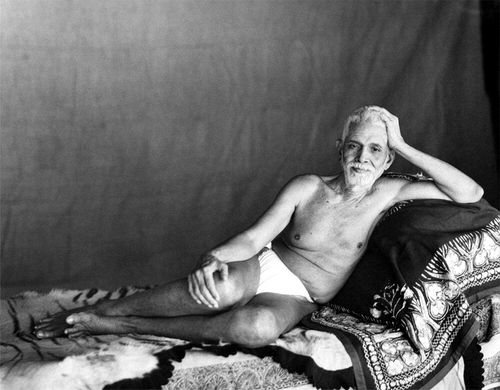
Talks with Sri Ramana Maharshi
Talk 174
Tom’s comments:
Time after time, again and again, Ramana says the only thing needed to do is remove the ego. Reality does not need to be realised, for it is already and always being realised.
Remove the ego, and reality shines by itself, as it always has done.
What is the ego? The ego is the notion of doership.
How to remove the ego? See that the sense of doership is an illusion. It doesn’t exist. There is no doer, there never was a doer, it was all imagined!
Regarding this Zen Doctrine of ours, since it was first transmitted, it has never been taught that men should seek for learning or form concepts. ‘Studying the Way’ is just a figure of speech. It is a method of arousing people’s interest in the early stages of their development
In fact, the Way is not something which can be studied. Study leads to the retention of concepts and so the Way is entirely misunderstood. Moreover, the Way is not something specially existing; it is something called Mahayana Mind – Mind which is not to be found inside, outside, or in the middle. Truly it is not located anywhere.
‘Studying the Way’ is just a figure of speech…In fact, the Way is not something which can be studied.
The first step is to refrain from knowledge-based concepts. This implies that if you were to follow the empirical method to the utmost limit, on reaching that limit you would still be unable to locate Mind.
The way is spiritual Truth and was originally without name or title. It was only because people ignorantly sought for it empirically that the Buddhas appeared and taught them to eradicate this method of approach.
The first step is to refrain from knowledge-based concepts.
Fearing that no one would understand, they selected the name ‘Way.’ You must not allow this name to lead you into a mental concept of a road. So it is said, ‘When the fish is caught we pay no more attention to the trap.’
When body and mind achieve spontaneity, the Way is reached and Mind is understood.
A shramana [seeker, monk] is so called because he has penetrated to the original source of all things. The fruit of attaining the shramana stage is gained by putting an end to all anxiety; it does not come from book-learning.
Taken from The Zen Teaching of Huang Po (Chun Chou record no. 29)
 Tom Das