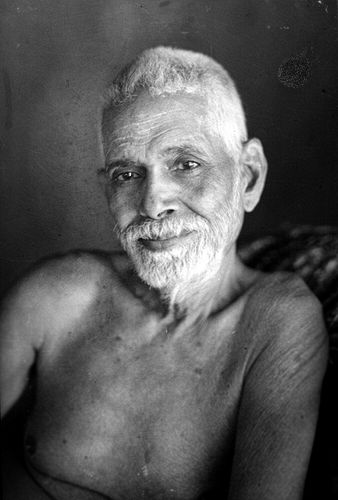
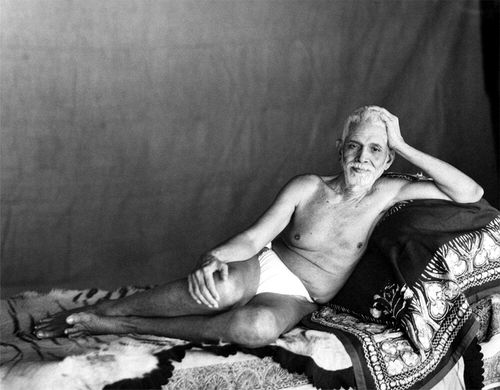
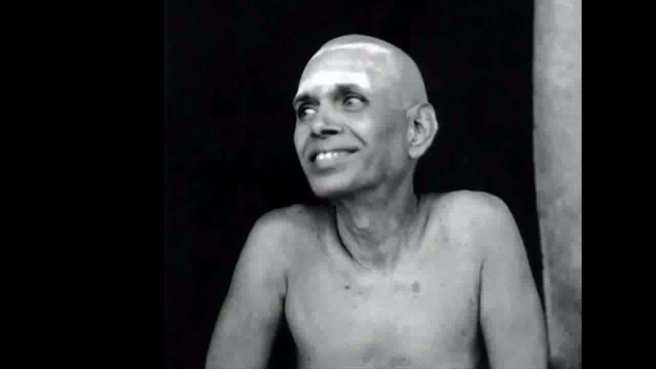
‘Once you realise the Self, it becomes your direct and immediate experience. It is never lost.’
Ramana Maharshi
Time and time again I hear from spiritual seekers that they glimpsed the Self, they experienced that ecstasy, but it slipped through their fingers and fell away. Their question to me is how to get it back again. This is the wrong question, this is the wrong way, as it is based on a fundamental misunderstanding of the path.
Everything that comes can also go. Everything that comes, all experiences that have been attained, are not the Self.
The Self is no particular experience. It is always here, fully manifest, fully evident. Everything that is perceived is It. It is not different from whatever is being perceived to be happening.
Realising that ‘this is It’ is Self-realisation. It is simply seeing what already is the case. When it is seen, there is no desire to reach a new experience, and a seeing that everything happens spontaneously without the presence of a separate doer-entity. Here suffering falls away as the simple truth of no-doer is seen.
Actions, thoughts and desires continue to manifest themselves, spontaneously, but there is nobody doing it, just like the wind blowing or digestion happening. Things happen, no doer.
As long are you are alive, you always are, you always exist. No matter what happens, you are. This knowledge of (your) being is Self-knowledge. It is not something to attain, just something to be ‘acknowledged’. It is not separate from whatever is perceived to be happening. How can this ‘knowledge’ be lost?
To remain as you are, without question or doubt, is your natural state
Ramana Maharshi
This is still an instruction for the spiritual seeker: ‘to remain as you are’.
With liberation, questions and doubts are irrelevant, as the natural state is simply whatever is. Nothing can obstruct it. It is always here and manifests as whatever is arising. It can never be obstructed and is always in plain sight.
However for the seeker, ie. the person that takes themselves to be the author of their thoughts and actions, the instruction to remain as you are and not worry about or get entangled with thoughts, questions and doubts, is one of the highest and most refined spiritual teachings available.
Be still, forget all concept of who you are, notice things as they happen. Regardless of what is happening, you know that you are, never what you are, only that you are.
When the mind and its concepts are no longer being believed, what use is there to talk of separation or no separation, self or no-self?
In my recent interview on Buddha at the Gas Pump, Rick asked me about Turiya, the 4th state of consciousness.
According to Vedanta, Turiya is that state of consciousness which lies beyond the 3 states of consciousness that we all ordinarily experience, namely the waking state, the dream state and the deep sleep state. In experiencing Turiya directly there is the possibility of liberation.
You can listen to our exchange on the video below. After the interview I decided to see what Ramana Maharshi had said about Turiya and was relieved to find that he agreed with me 🙂 😛 (at least on this occasion – he probably agrees with Rick on other occasions!)
Here is what Ramana had to say about Turiya:
From Talks with Sri Ramana Maharshi, Talk 353:
Questioner: What is turiya?
Ramana Maharshi: There are three states only, the waking, dream and sleep. Turiya is not a fourth one; it is what underlies these three. But people do not readily understand it. Therefore it is said that this is the fourth state and the only Reality. In fact it is not apart from anything, for it forms the substratum of all happenings; it is the only Truth; it is your very Being. The three states appear as fleeting phenomena on it and then sink into it alone. Therefore they are unreal.
This view is also the traditional view of Turiya in vendanta as expounded by Gaupada in his Mandukya Karika.
So does this mean that Rick’s view is wrong? I don’t think so. His view is also a useful view, but in a slightly different way. Thinking of Turiya as a 4th state distinct from the others can also be a beneficial teaching when used in the teachings of a skilled teacher with a genuine realisation. Rick’s notion of entering a (nirvikalpa) samadhi and this having a purifying effect on the waking state is also a valid way of approaching this realisation/freedom.
It’s important to note that these teachings are ways of describing our experience. They are concepts, and form conceptual ways of carving up our experience with the intended effect of leading the seeker to liberation. They are not intended to be based in physiology or ‘science’ in my view.
The point of these specific teachings/concepts is to point out the awareness-consciousness that does not come and go, regardless of what is happening. Whether or not they are successful in achieving that end is the test of how good the teaching is, not how well it is based in human physiology or scientific observations. It is therefore impossible to say one teaching is better than the other – the teaching that works is the ‘best’ teaching for that situation (this is the notion of expedient means in Buddhism)
Eventually, when you realise that consciousness is the essence of you, and remain as that, unidentified as body or mind, the illusory sense of doership is eventually destroyed. With it, the dualistic notion of a consciousness that is in some way distinct, underlying and permanent is also destroyed. What you are left with is what is already here: this, nameless, beyond words (and inclusive of words).
For a more detailed discussion of Turiya please see here:
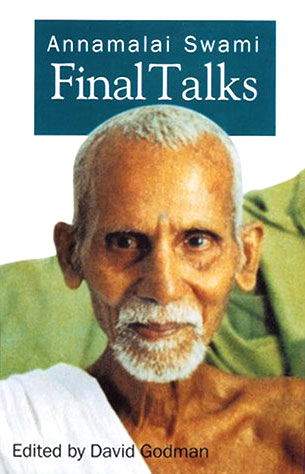
The following excerpt is from Chapter 7 of the above book:
Annamalai Swami: Enquire ‘Who am I?’ or ‘What is my real nature?’ The nature of the Self is nothing but peace. If you are not aware of that peace, it means that you are identifying with something that is not the Self. As long as you hear, taste and smell things, you identify with the body. When the perceptions and the perceiver of them vanish, you become aware of the peace that is there all the time.
If you are not aware of that peace, it means that you are identifying with something that is not the Self.
Q: I hear the sound. Then I ask myself who is hearing the sound, and the answer is ‘I’. What happens next depends on where I am. If I am in Swami’s presence or in the meditation hall at Sri Ramanasramam, I feel the presence of the Self and the bliss of peace, but when I am away from Swami, it is not easy.
AS: You need not hold on to That because you are That all the time. That is enough. You are That. How can you hold on to That, or feel separate from it, or try to get it back, or lose it? If That is your real nature, how can you pretend that you are nearer to it in two places and separate from it when you are somewhere else?
How can you hold on to That, or feel separate from it, or try to get it back, or lose it?
Q: I have the experience of That with Swami, but I don’t have the same experience when I am away from him. This is definitely my experience, so I don’t really understand what you are telling me.
AS: Your understanding or your lack of it does not affect the truth of what I am saying. You are That. See who you are and there will be nothing obstructing the experience of this fact.
Q: I still say I see who I am when I am near Swami. When I am away from him, I can remember it as a fact, but it is not my direct experience.
AS: This is because you identify with your body and your mind. Your mind is making you believe that a certain experience can only happen when you are in a particular place. Give up this identification and you will find that the Self is everywhere. You will see it, know it and be it wherever you go. Everything is Swami including you yourself.
Question: How do I give up identification with the body, particularly when I am not in front of Swami? I keep practicing, but I don’t have that experience.
AS: Meditate ‘I am the Self’. If you do this, the idea that you are the body will go. ‘I am the Self’ is still an idea, and as such, it belongs in maya, along with all other ideas. But you can begin to conquer maya by giving up utterly wrong ideas that bind you and cause you trouble. How to do this? Replace them with ideas that are a better reflection of the truth, and which are helpful in leading you towards that truth. If you want to cut iron, you use another piece of iron.
But you can begin to conquer maya by giving up utterly wrong ideas that bind you and cause you trouble. How to do this? Replace them with ideas that are a better reflection of the truth…
In battle, if someone shoots an arrow at you, you shoot one back. In maya, if the arrow of a bad idea comes speeding towards you, dodge it. Don’t let it stick to you of you will end up in pain. Then, in retaliation, fire back the arrow of ‘I am the Self’ at the place where the wrong idea came from.
Sadhana is a battlefield. You have to be vigilant. Don’t take delivery of wrong beliefs and don’t identify with the incoming thoughts that will give you pain and suffering. But if these things start happening to you, fight back by affirming, ‘I am the Self; I am the Self; I am the Self’. These affirmations will lessen the power of the ‘I am the body’ arrows and eventually they will armour-plate you so successfully, the ‘I am the body’ thoughts that come your way will no longer have the power to touch you, affect you or make you suffer.
Don’t take delivery of wrong beliefs and don’t identify with the incoming thoughts that will give you pain and suffering…fight back by affirming, ‘I am the Self; I am the Self; I am the Self’.
This fight all takes place within maya because in reality you are peace and peace alone. But while you are suffering in maya you can use these thoughts as a means of ultimately conquering it.
(The following is an excerpt from the above book and comprises most of Chapter 3):
A devotee who came to Annamalai Swami had so much pain in one of his legs, he found it very difficult to sit comfortably on the floor. Observing his difficulties, Annamalai Swami (AS) made the following remarks:
AS: Though the body is needed for Sadhana, one should not identify with it. We should make good use of it and look after it well,but we should not pay too much attention to it.
There are so many thoughts in the mind. Thought after thought after thought. They never stop. But there is one thought that is continuous, though it is mostly subconscious. ‘I am the body’ – this is one string on which all other thoughts are threaded. Once we identify ourselves with the body by thinking this thought, Maya follows. It also follows that if we cease to identify ourselves with the body, Maya will not affect us anymore.
‘I am the body’ – this is one string on which all other thoughts are threaded. Once we identify ourselves with the body by thinking this thought, Maya follows.
Maya is fundamentally non existent. Bhagavan said that Maya literally means ‘that which is not.’ It is unreal because everything that Maya produces is an outgrowth of a wrong idea. It is a consequence of taking something to be true that is not really true. How can something that is not real produce something that is real? If a barren woman says that she has beaten by her son, or that she has been injured by the horns of a hare, we would rightly take her to be deluded. Something that does not exist cannot be the cause of suffering or of anything else.
Maya is fundamentally non existent.
How to get rid of this ‘I am the body’ feeling and of the Maya that is produced by it? It goes when there is ‘saman bhava’ the equanimity or equality of outlook that leaves one unaffected by the extreme opposites such has happiness and unhappiness, pleasure and pain. When ‘saman bhava’ is attained, the idea ‘I am the body’ is no longer present and Maya is transcended.
Question: Is the body to be regarded as unreal, as ‘not me’? What attitude should I have towards this body and all the sensory information it provides me with?
AS: By itself, this body is jada, inert and lifeless. Without the mind, the body cannot function. And how does the mind function? Through the five senses that the body provides.
Mind and body are like the tongue and teeth in the mouth. They have to work in harmony with each other. The teeth do not fight with tongue and bite it. Mind and body should combine in the same harmonious way.
However, if we want to go beyond the body, beyond the mind, we have to understand and fully accept that all the information the senses provide is not real. Like the mirage that produces an illusory oasis in the desert, the senses create information that there is a real world in front of us that is being perceived by the mind. The apparent reality of the world is an illusion. It is merely a misperception. When the mind perceives a snake where in reality there is only a rope, this is clearly a case of the senses projecting an imaginary image onto a real substratum. This, on a large scale, is how the unreal appearance of the world is projected by the mind and the senses onto the underlying reality of the Self….
…Self Inquiry is the process by which attention is put on the substratum instead of on names and forms that are habitually imposed on it. Self is the substratum out of which all things appear to manifest, and the Jnani is the one who is continually aware of the real substratum. He is never deluded into believing that the names and forms that are perceived by the senses have any real existence.
Self Inquiry is the process by which attention is put on the substratum instead of on names and forms that are habitually imposed on it.
Whatever we see in this room, for example, that picture of Bhagavan over there, is unreal. It has no more reality than objects we perceive in our dreams. We think we live in a real, materially substantial world, and that our minds and bodies are real entities that move around in it. When the Self is seen and known, all these ideas fade away and one is left with the knowledge: Self alone exists.
Question: If I regard all the people that I see and meet as unreal projections, what do I base my moral sense on? I can go around killing then or robbing them without feeling guilty because i would know that they are just characters in my dream.
AS: Everything that we perceive is maya, an unreal dream, but one should not then think, “Since everything is unreal, I can do what I like”. There are dream consequences for the bad acts committed in the dream, and while you still take the dream to be the reality, you will suffer the consequences of your bad behaviour. Do no evil and have no hate. Have equanimity towards everything.